
To remove tweets from Google search, treat it as two tasks: remove or restrict the source on X, then submit the exact tweet URL to Google’s outdated content process once the page no longer shows what Google indexed. Preserve the tweet page and the search snippet first. For posts by others, a rights-based complaint replaces the standard request.
Key facts
- Google works at the URL level; there is no option to remove all of X from search results.
- Requests filed before the source change is visible are rejected as unchanged.
- Protecting an X account is not retroactive; earlier public tweets can stay indexed.
- Submit the canonical tweet URL Google indexed, not the profile link or a mobile variant.
Where ContentRemoval.com comes in. ContentRemoval.com handles X content that keeps surfacing in Google after deletion or that belongs to a hostile poster: mapping every indexed URL, preserving proof, coordinating source removal with de-indexing, choosing between outdated-content requests and rights-based complaints, and tracking reposts and quote tweets afterward. Executives and public figures usually reach us through a chief of staff or counsel during diligence or a media cycle. A free 15-minute Exposure Scan maps what is removable, and the report is yours to keep. Get a Free, Confidential Exposure Scan or read how our X (Twitter) content removal work is done.
A problematic tweet usually reaches Google at the worst possible moment. An investor is doing diligence. A journalist is assembling a profile. Opposing counsel is building a narrative. You delete the post, refresh the search results, and find that Google still shows the old URL, snippet, or cached trace.
That’s where efforts often falter, and time is lost. This is frequently treated as a deletion issue. It isn’t. It’s a visibility control issue involving source removal, search de-indexing, evidence preservation, and, in some cases, legal escalation. If you need to remove tweets from Google search, speed matters, but sequence matters more.
The Two-Front War On X and On Google
A damaging tweet surfaces in search during a financing call or a media background check. You remove it from X, but Google still serves the URL, headline text, or snippet. At that point, you are dealing with two separate systems with two separate timelines.
That distinction decides whether the problem fades or stays visible long enough to be copied, circulated, and cited.
Why deletion alone fails
X controls the source page. Google controls the search result. If you remove the post on X, you have handled only the source. Google may still show the result until it crawls the change or receives a valid request to refresh outdated content.
Treat those as parallel workstreams, not a single task. Deletion cuts off the original publication point. De-indexing cuts off search visibility.
Public figures, founders, and executives often lose time here because they assume platform removal and search removal happen together. They do not. A deleted tweet can remain searchable long enough to create fresh screenshots, hostile commentary, and secondary coverage.
The exposure problem also tends to be wider than one post. In practice, the issue may include an old profile URL, a renamed handle, a stale snippet, or reposted copies on third-party sites. CNET’s discussion of removing social media from Google search points to the same operational problem. You have to address the source, the search result, and the residual traces.
What experienced operators do differently
Experienced operators do not treat this as a form-filling exercise. They treat it as a control problem. The goal is to identify every exposed URL, preserve proof before pages change, decide which removals can be forced, and build an escalation record if standard requests fail.
That matters because public X content spreads fast. Posts can be previewed, scraped, archived, and republished through monitoring systems and collection tools. If you want a technical view of how public data can be gathered at scale, Scrapeway on Twitter web scraping shows the collection risk clearly.
Assume public means portable.
That is why high-stakes response plans focus on evidence, URL precision, sequencing, and scope. If the problem extends beyond a single tweet, a broader Twitter content removal strategy is usually the right frame.
Immediate Actions for Content Control
A damaging tweet is live. Reporters are reading it, critics are screenshotting it, and Google may already be storing the version you want gone. Your first move is not panic deletion. Your first move is control.
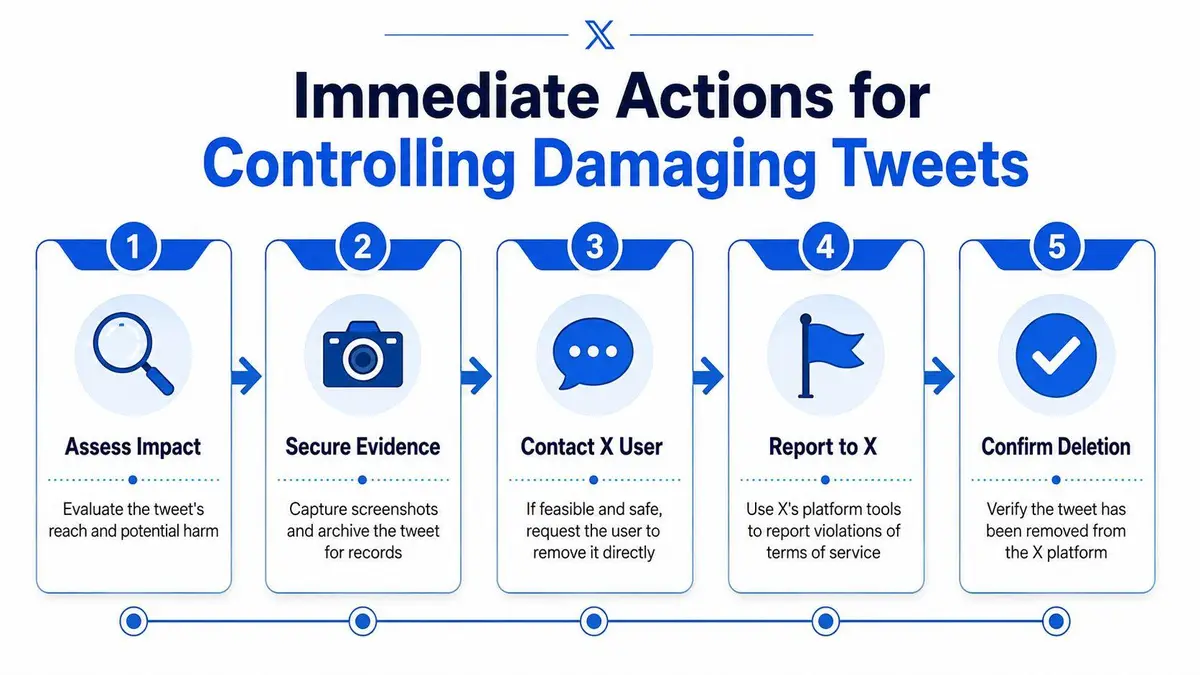
Secure evidence before anyone touches the post
Preserve the record before the post changes, disappears, or gets edited by someone else. High-stakes removal work depends on proof. If you cannot show the exact URL, the visible text, the account identity, and the search snippet, you weaken every later step, including platform complaints, legal review, and de-indexing requests.
Capture more than the tweet itself. Save the full tweet page with the browser bar visible. Record the handle, display name, date, time, replies, quoted reposts, images, and any linked article. If the tweet appears in Google results, preserve that search result too. The snippet and cached wording can matter as much as the post.
Use this sequence:
- Capture the exact tweet URL. Search screenshots are not enough. Save the direct address Google indexed.
- Take full-page screenshots. Include the address bar, account details, timestamp, and surrounding context.
- Save the search result view. Capture the title, snippet, and visible URL exactly as Google displays them.
- Preserve related copies. Document embeds, quoted reposts, article references, and third-party screenshots.
- Choose your first contact carefully. A polite takedown request can work in a routine dispute. In harassment, extortion, or coordinated attacks, it can trigger wider distribution.
- Then change access. Delete the post if you control it, or restrict visibility after the evidence file is complete.
This is case building, not clerical work.
Deletion and privacy changes do different jobs
Delete a tweet to remove the source. Change privacy settings to limit what can be seen next. Those are separate controls, and they produce different results.
A deleted post may still appear in Google until the index refreshes. A private account may block future access, but it does not erase what Google or third parties already captured. Treat source control and search control as two distinct tracks. That is the discipline weaker guides skip, and it is why rushed cleanup often fails.
Delete the tweet only after you have captured what was public, how it appeared in search, and which URL is causing the problem.
For executives, the operational mistake is acting too fast. The strategic mistake is acting without a record. Once evidence is gone, your ability to prove harm, show inaccuracy, or force updates drops sharply.
When the post belongs to someone else
You have less control, but you still have options. Start by classifying the post. Is it defamation, impersonation, doxxing, copyright misuse, non-consensual imagery, or a clear platform-policy violation? That classification determines whether you should contact the poster, report through X, prepare a legal notice, or build a search-removal file for later use.
Do not send a generic complaint and hope for cooperation. Write a short demand tied to a specific rule, right, or false statement. Preserve every communication. If the post is likely to spread before the user responds, work in parallel. Document the source, prepare the platform report, and map every indexed or indexable URL connected to the incident.
If you need a tighter playbook for source-platform action, see this strategic guide for removing a Twitter post.
Forcing the Index to Update with Google’s Tools
Once the source content is down or materially changed, the priority shifts to Google. At this point, discipline is key. Google’s outdated-content process is not a general complaint box. It’s a verification system that checks whether the source page has changed.
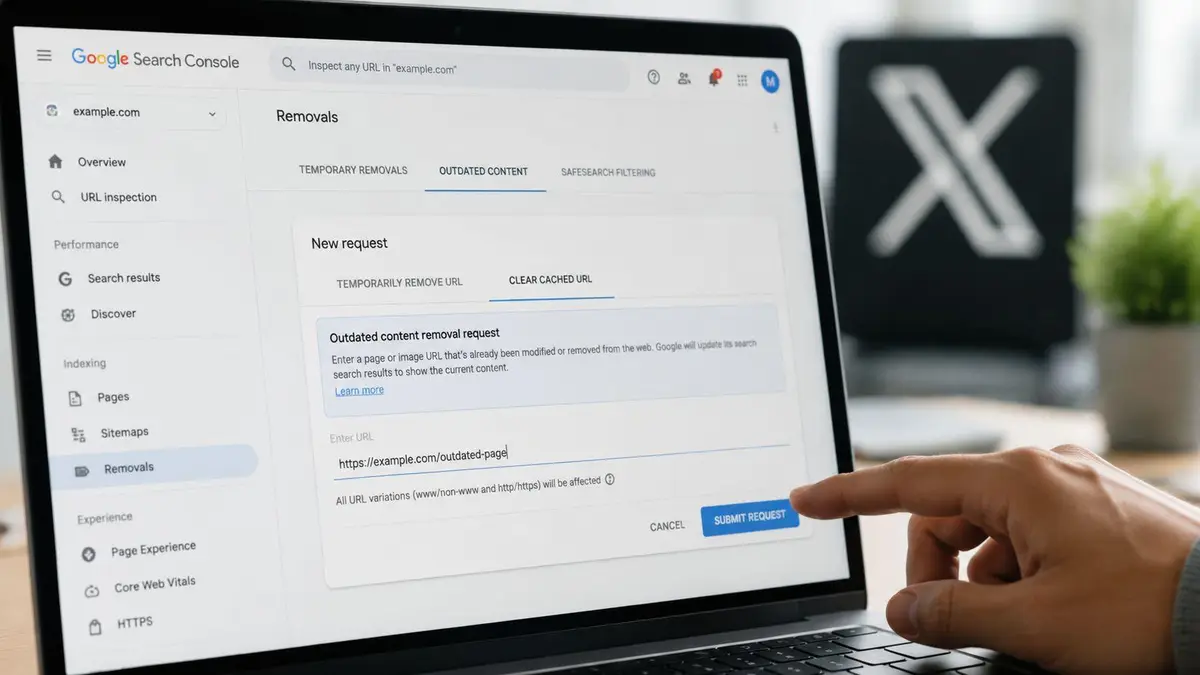
Google works at the URL level
Google’s own support position is blunt. Its removal process is URL-dependent, and there is no general option to remove an entire site like X from regular search results. Success depends on submitting the specific URL after the source content has become inaccessible or no longer matches what Google indexed, as discussed in Google support guidance on removing or blocking X from search.
That means you need precision. Not the profile URL if the indexed result is the tweet URL. Not a mobile variant if Google indexed the canonical page. Not a search result screenshot instead of the address itself.
A simple working standard helps:
| What you submit | What happens |
|---|---|
| Exact tweet URL that no longer resolves or no longer shows the indexed content | Best chance of de-indexing |
| Wrong page variant or broad profile link | Request is likely to fail or stall |
| Request filed before source changes are visible | Google may reject it as unchanged |
What Google needs to see
Think of the request as a proof exercise. Google has to confirm that the page changed or disappeared. If the tweet still loads publicly, your request is weak. If the page is gone, protected, or materially altered, your position improves.
The practical sequence is:
- Remove or restrict the source first. Google’s process works best when the page has already changed on X.
- Check the exact URL manually. Confirm what a logged-out browser sees.
- Submit the removal request with the precise address. One URL at a time.
- Track status and re-check search results. Don’t assume one submission clears every variation.
A more detailed operational breakdown is available in this guide to the Refresh Outdated Content tool.
Common failure points
Most failed requests come from avoidable errors:
- Submitting too early. The tweet was deleted, but Google still sees an accessible version during recheck.
- Using the wrong URL. The indexed result points to one tweet, but the request names the profile or another post.
- Ignoring snippets. The visible harm may sit in the search snippet even after the page changed.
- Assuming site-wide control exists. It doesn’t. This is page-level work.
The following walkthrough is useful if you want to see how the process looks in practice.
> Google responds best when the request is boringly precise. Exact URL. Verifiable source change. No ambiguity.Escalation Paths When Standard Removal Fails
Standard de-indexing is built for outdated material. It is not built for malicious campaigns, fabricated allegations, stolen content, or severe privacy abuse. When the tweet falls into one of those categories, you need to change the lever you’re pulling.
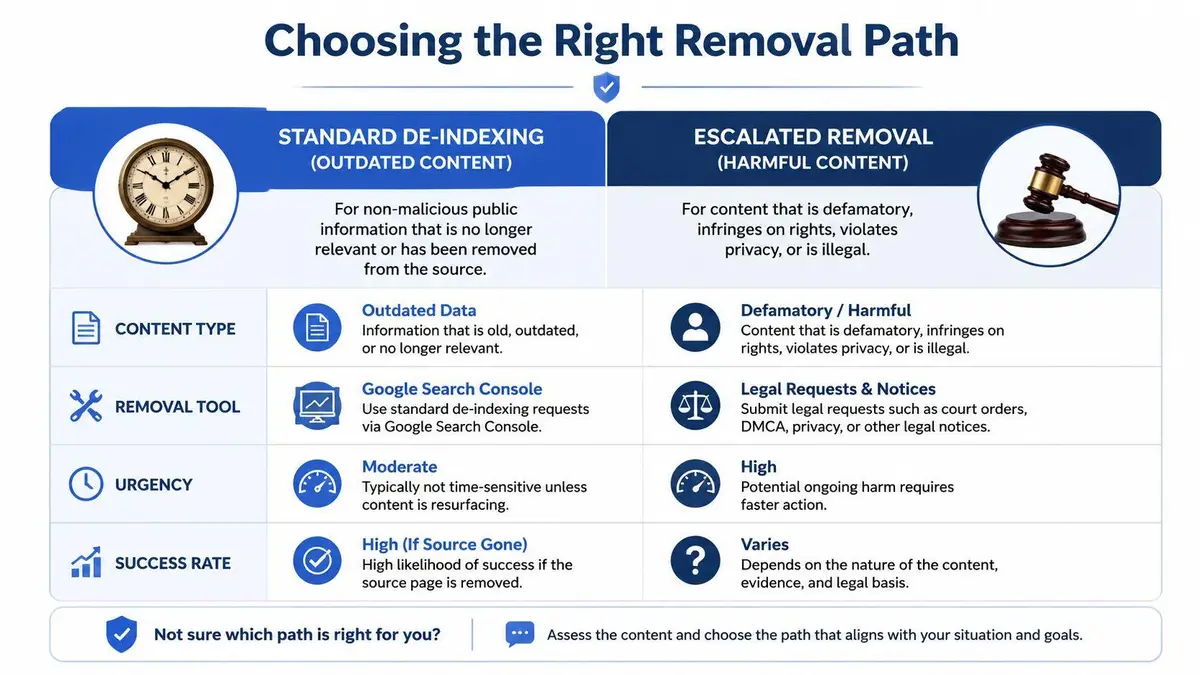
Standard de-indexing versus rights-based removal
There are two broad lanes. One handles old or removed content. The other addresses content that violates rights, law, or platform policy.
| Path | Best use case | Core requirement | Likely objective |
|---|---|---|---|
| Standard outdated-content removal | The tweet is gone or changed at source | Verifiable source change | Remove stale Google result |
| Copyright claim | The tweet uses protected original content without authorization | Proof of ownership and infringement | Source removal and search impact reduction |
| Defamation route | False factual allegations causing harm | Evidence of falsity and, often, legal process | Source challenge, search suppression, or both |
| Privacy or doxxing complaint | Sensitive personal data or dangerous exposure | Clear identification of the private information | Rapid reduction of access |
| NCII reporting | Intimate content shared without consent | Proof of non-consent and identification | Emergency removal priority |
Copyright is often the cleanest escalator
If the tweet republishes your copyrighted photo, video, written material, or other original work without authorization, copyright can be a sharper tool than argument. It is rule-based, document-driven, and often easier to adjudicate than a reputational dispute framed as opinion.
What matters is ownership and clear copying. Preserve the original file or publication history. Keep records showing that your work predated the tweet. If the tweet contains only commentary about you, copyright usually won’t help. If it reproduces your protected content, it may.
Defamation requires discipline, not outrage
Defamation claims fail when people confuse insult with false statement of fact. A tweet calling an executive “corrupt” may be inflammatory, but your legal team will ask a narrower question. Is there a provably false factual assertion? Can you document falsity? Can you show harm?
If yes, escalation may involve counsel, formal demand letters, court process, and coordinated notices to platforms and search engines. If not, a legal threat with weak facts can backfire by attracting more attention.
Counsel’s view: The strongest defamation files are built like evidence binders, not emotional timelines.
Privacy and safety cases move differently
Doxxing, exposure of personal addresses, account numbers, government identifiers, private contact details, or intimate material calls for a faster and more focused response. In these cases, the objective is not merely reputational repair. It is immediate risk reduction.
Work from a simple triage model:
- Physical safety first. If the tweet exposes home addresses, family details, or movement patterns, prioritize urgent reporting and protective steps.
- Identity exposure next. If it reveals personal identifiers, preserve the evidence and prepare both platform and search-related actions.
- Re-upload risk always. Harmful content often reappears. Track mirrors, quote tweets, and reposts, not just the original URL.
When the attacker is organized
Anonymous or coordinated actors create a different class of problem. One tweet disappears, another goes up. A search result falls, a screenshot thread appears. This isn’t a technical cleanup exercise. It’s an adversarial campaign.
In those matters, you need a live response system that combines preservation, repeat reporting, legal review, and search monitoring. One option in that category is ContentRemoval.com, which handles source removal and de-indexing work across search and social properties for cases where repeated escalation is required.
Proactive Defense and Continuous Monitoring
The most effective way to remove tweets from Google search is to stop creating indexable exposure you’ll later have to clean up under pressure. That starts with a blunt fact many people learn too late. Protecting your X account is not retroactive.
Only tweets published after the account is protected are shielded from public indexing. Earlier public tweets may already be in search and require specific removal requests, as explained in X’s video guidance on protected posts and Google indexing.

Privacy settings are a forward control
That means privacy changes should be treated as future risk management, not historical cleanup. If your account spent years in public mode, assume older posts may already exist inside search systems and derivative channels. You still have to audit them.
A disciplined defense program usually includes:
- Quarterly post reviews. Executives should review legacy posts, especially those touching politics, litigation, layoffs, compensation, or personal conduct.
- Handle and profile audits. Old usernames can persist in search memory longer than expected.
- Search surface monitoring. Standard web search isn’t the only exposure point.
Google’s ecosystem is fragmented. Even if you reduce standard web visibility, X content can still surface through other Google products. Google support guidance indicates users can control some Discover behavior at the account level, but there is no universal switch to block the whole X domain across those surfaces, as reflected in Google support discussion about removing X posts from Discover.
Monitoring is not optional for exposed individuals
If you’re a CEO, founder, public official, investor, or family office principal, monitoring should be treated like executive security. You need alerts for:
- Impersonation and parody drift
- Archived or resurfaced posts
- Quote tweets that repackage old material
- Search results tied to old aliases or prior roles
Private mode helps with tomorrow. Monitoring protects you from what was already public yesterday.
Reactive cleanup is expensive in time, influence, and stress. Continuous monitoring catches issues while they’re still small enough to contain.
Engaging Professionals A Strategic Decision
There is a clear point where handling this yourself stops being efficient and starts becoming risky. If one deleted tweet still appears for a routine vanity search, you can often manage the mechanics alone. If the issue touches litigation, media scrutiny, investor diligence, family privacy, or coordinated abuse, DIY work usually breaks down.
The inflection points are predictable. Multiple URLs appear at once. The source post is gone, but screenshots and snippets remain. The attacker is anonymous. The claim is false but legally sensitive. Different jurisdictions are involved. Or the timeline is compressed because a board process, financing event, or article is imminent.
At that stage, the job is no longer “remove a tweet.” It becomes evidence management, platform escalation, legal positioning, and search remediation under time pressure. That’s specialist work. It requires people who know how to preserve proof without poisoning the removal path, how to choose between outdated-content requests and rights-based complaints, and how to keep tracking reposts after the original item falls.
For executives building a broader policy around personal and company exposure, this guide to managing online reputation is a useful companion read. The larger lesson is that reputation protection is an operational discipline, not a one-off cleanup task.
Professional engagement is a risk decision. You bring in specialists when speed, discretion, and evidentiary precision matter more than the cost of trial and error.
If harmful X content is still surfacing in Google, ContentRemoval.com can assess the URLs, preserve the necessary evidence, coordinate source removal and de-indexing, and advise on escalation when standard requests won’t solve the problem. For high-stakes matters, start with a confidential review before the issue spreads further.
Frequently asked questions
I deleted a tweet but it still shows in Google. What do I do?
Confirm in a logged-out browser that the exact tweet URL no longer loads or no longer shows the indexed text, then submit that precise URL to Google’s outdated content process, one URL at a time. Filing before the change is visible, or naming the profile instead of the tweet, is why most requests fail.
Will making my X account private remove old tweets from Google?
No. Protection only shields tweets published after the account is protected. Older public tweets may already be in Google and require specific removal requests, so treat privacy settings as forward risk management and audit legacy posts separately.
Can I get someone else’s tweet about me removed from Google?
It depends on classification. If the tweet reproduces your copyrighted photo or video, a copyright claim is often the cleanest route. Doxxing and intimate imagery have dedicated fast channels. Defamation needs a provably false statement of fact, evidence and often legal process, and a weak legal threat can draw more attention.