
To remove defamatory Trustpilot reviews, preserve the review first, then flag it through Manage Reviews under Harmful or illegal or Not a genuine experience, quoting the exact false statements with records showing no transaction or contradicting the claims. If Trustpilot treats the review as a genuine experience, escalate with a solicitor’s letter, a GDPR notice or a disclosure order.
Key facts
- Trustpilot moderation asks whether some interaction occurred, not whether every factual assertion is true.
- Flag through Manage Reviews under Harmful or illegal or Not a genuine experience, not both at once.
- Break the review into individual claims and pair each with the record that disproves it.
- Anonymous reviewers can be identified through a UK Non-Party Disclosure Order or US subpoena practice.
Where ContentRemoval.com comes in. ContentRemoval.com handles Trustpilot matters where the first flag has failed: assembling the evidentiary dossier, filing policy-matched reports, coordinating solicitor letters, GDPR notices and disclosure applications with counsel across jurisdictions, and monitoring for copycat reviews afterward. Founders, regulated firms and family office principals usually reach us through their general counsel or operations lead. A free 15-minute Exposure Scan maps which reviews are removable, and the report is yours to keep. Get a Free, Confidential Exposure Scan or read how our review removal work is done.
A Trustpilot review turns into a crisis when it stops being criticism and starts making factual accusations. For an executive, founder, physician, adviser, or family office principal, that shift is immediate. Prospects read the allegation before they ever speak to you. Counterparties start asking indirect questions. Internal teams panic and want to respond fast, often in exactly the wrong way.
The phrase many clients use is simple: “How do we remove Trustpilot reviews defamatory?” The answer is also simple in outline and demanding in practice. You need to treat the review as evidence, not irritation. Then you need to separate protected opinion from actionable falsehood, run the platform process correctly, and be ready to escalate beyond Trustpilot when moderation fails.
Most generic advice stops at “flag the review.” That’s not enough for a serious attack. Trustpilot is structured to protect genuine customer feedback, and its moderation logic often focuses on whether some interaction occurred, not whether every factual assertion is true. If the review accuses you or your business of fraud, criminality, professional misconduct, extortion, or other factual wrongdoing, the proper response is a disciplined takedown campaign with legal grounding.
Anatomy of an Attack Defamation on Trustpilot
The usual pattern is easy to recognize once you’ve handled enough of these cases. A review appears from an account you don’t recognize. It uses a compressed, damaging allegation. It’s written to rank in search, influence buyers, and put you on the defensive. Sometimes it names a specific executive. Sometimes it targets the business and leaves readers to connect the dots.
A negative opinion isn’t automatically defamatory. “I didn’t like the service” is generally opinion. “This company committed fraud,” “the CEO stole money,” or “they forged documents” is different. Those are factual assertions. If false, they can move from unpleasant to actionable.
What actually makes the review dangerous
The damage rarely comes from one star alone. It comes from the factual sting inside the text.
A review becomes materially more serious when it contains claims such as:
- Criminal or dishonest conduct: allegations of scams, theft, fraud, or deception.
- Professional misconduct: claims that a lawyer, doctor, adviser, or executive acted unlawfully or unethically.
- Invented events: statements describing meetings, transactions, or communications that never happened.
- Pressure tactics: language that suggests the review was posted to coerce payment, influence a dispute, or punish refusal.
Those categories matter because they help frame the case later. Trustpilot won’t remove content solely because it’s harsh. You need to show either that it wasn’t based on a genuine experience, or that it crossed into a policy violation such as defamation, harmful content, privacy abuse, or fraudulent posting behavior.
Why panic creates bad decisions
Under pressure, businesses often make the same mistakes. They post an angry public reply. They contact the reviewer directly and threaten suit before preserving evidence. They ask staff to flag the review repeatedly. Or they assume falsity alone will force removal.
Practical rule: A defamatory Trustpilot review is handled like a dispute file, not a customer service issue.
That mindset shift changes everything. Your objective isn’t to “win the argument” in public. It’s to create a record that survives moderation scrutiny and, if necessary, legal scrutiny. Once you do that, the review stops being a vague reputational threat and becomes a removable piece of harmful content or evidence for court-backed action.
Immediate Triage and Evidence Preservation
The first hour matters more than is commonly understood. Before you flag, reply, or contact anyone, preserve the review exactly as it appears. If it changes later, you’ll need the original version. If the reviewer deletes it and reposts a variation, you’ll need a clean record of the first publication.
The legal backdrop also affects how you document. The rules vary by jurisdiction. The UK is implementing a new regime from April 2025 making it unlawful to publish or commission fake or misleading consumer reviews, while in the United States the Consumer Review Fairness Act protects genuine customer feedback while prohibiting fraudulent or defamatory content, as summarized in Jonathan Lea’s analysis of legal options when Trustpilot won’t remove a false review. That means your evidence file should be built with both platform and legal escalation in mind from the start.
Preserve the review in its native form
Start with a disciplined capture process.
- Capture the full page: Include the visible URL, date, browser bar, star rating, business name, reviewer name, and all visible text.
- Save the page source or HTML: A screenshot is useful. The underlying page record is better.
- Record the reviewer profile: Save the profile page, review history if visible, account age indicators, and any unusual naming or activity patterns.
- Preserve linked context: If the review references photos, attachments, or related comments, capture those too.
- Log discovery details: Note when your team first saw the review, who found it, and whether anyone responded.
If you manage multiple brands or high-profile principals, centralize those captures immediately. A fragmented response is how evidence gets lost.
What not to do in the first 24 hours
Some actions make later removal harder.
- Don’t contact the reviewer impulsively: You may alert them before you’ve secured the evidence.
- Don’t post a detailed rebuttal: Public replies can repeat the defamatory content and can lock you into facts before counsel reviews the record.
- Don’t mass-flag through multiple accounts: That can look abusive and undermine credibility.
- Don’t alter internal records: Even harmless cleanup creates avoidable questions later.
Preserve first. Speak later.
This is also the point where proactive monitoring starts earning its keep. If your team doesn’t already track review platforms and branded mentions systematically, set that up now. Ongoing reputation monitoring helps catch edits, copycat reviews, and spread to other domains before the attack hardens into search visibility.
Build a chain of custody
For high-stakes matters, create a simple evidence log.
| Item | What to preserve | Why it matters |
|---|---|---|
| Review page | Full-page capture and saved page file | Shows original publication |
| Reviewer account | Username, profile, related activity | Supports authenticity analysis |
| Internal records | CRM, invoices, email logs, call notes | Tests whether any real relationship existed |
| Timeline | Discovery, actions taken, moderation responses | Supports escalation chronology |
A clean chain of custody doesn’t need courtroom theatrics. It needs consistency. If Trustpilot’s legal or integrity team asks for supporting material, you should be able to produce it in minutes, not reconstruct it from memory.
Executing the Initial Platform Report
The first report to Trustpilot is procedural, but it still matters. Done well, it creates a record of reasoned, policy-based objection. Done poorly, it looks like a business trying to suppress criticism.
Trustpilot’s own framework is narrower than most clients expect. The platform distinguishes between a review that reflects a genuine experience and one that violates specific rules. That distinction is why plainly false reviews often stay up after the first report. Moderators may conclude that some interaction occurred, which for platform purposes can be enough to preserve the review unless you show a separate breach.
Choose the right flagging ground
The practical pathway begins in the business dashboard. You flag through “Manage Reviews,” choose the category, and then escalate through support if needed. The categories that usually matter in a defamation case are “Harmful or illegal” and “Not a genuine experience.”
Those aren’t interchangeable.
If the review contains direct accusations that damage reputation, “Harmful or illegal” may be the stronger opening. If the person appears never to have dealt with you at all, “Not a genuine experience” may be the cleaner route. In many cases, both issues are present, but your first filing should reflect the strongest, clearest violation.
A concise tactical breakdown is in this executive-focused guide on how to remove a review from Trustpilot.
How to write the report so it survives review
The report should read like a moderation memo, not a rant. Keep it short. Anchor every point to the review text and your evidence.
Use this structure:
- Identify the statement: Quote the exact sentence or phrase.
- Classify the breach: State whether it’s defamatory, privacy-invasive, fabricated, or unrelated to any genuine experience.
- Tie it to proof: Refer to records showing no transaction, no account, no engagement, or a clear factual impossibility.
- Request the action: Removal under the cited guideline category.
Bad reports sound emotional. Effective reports sound inevitable.
The strongest Trustpilot report doesn’t argue fairness. It demonstrates a rule breach with documentary support.
Why valid complaints still get rejected
Trustpilot’s moderation process places heavy weight on whether the reviewer had some interaction with the business. According to analysis of the platform’s removal process, Trustpilot uses a multi-factor verification algorithm and distinguishes between “genuine experience” reviews and guideline violations, which means proving a review is false isn’t enough by itself. Successful cases require transaction records, communication logs, and direct quotes showing either no customer relationship or a clear policy breach, as described in World Delete’s review of how negative Trustpilot reviews are removed.
That distinction explains many frustrating outcomes. A reviewer may have sent an email, made a call, or interacted with a receptionist. Trustpilot may treat that as enough “experience” to keep the review online, even if the core accusation inside the review is false or malicious.
So the purpose of the initial report isn’t blind optimism. It’s disciplined positioning. You are building the file that justifies manual review, legal escalation, and, if necessary, disclosure applications to identify the reviewer.
Building the Evidentiary Dossier for Takedown
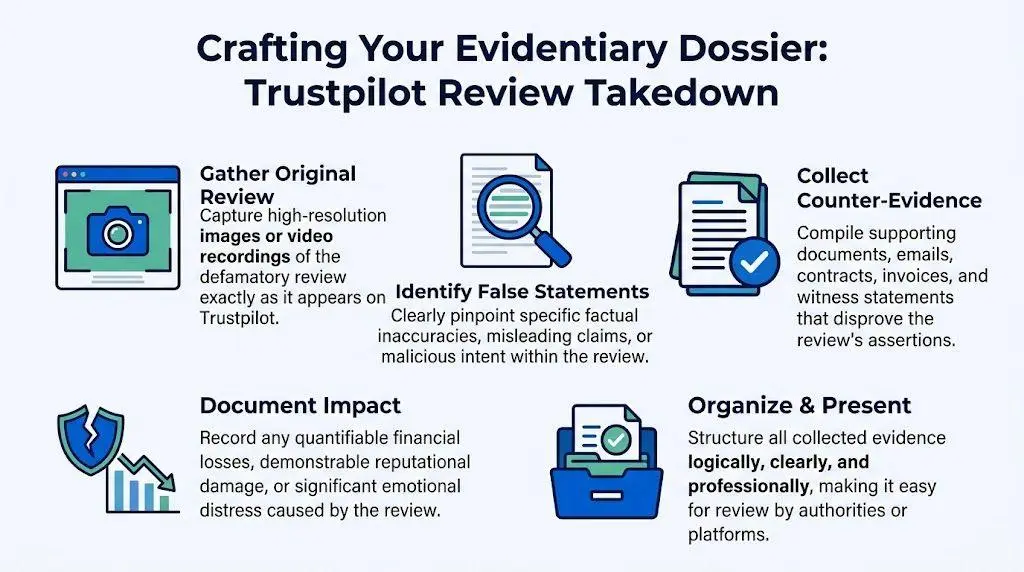
Once the first report stalls, the case turns on evidence quality. At this stage, you are no longer “reporting a bad review.” You are assembling a dossier that removes ambiguity and narrows Trustpilot’s room to defer.
Prove the relationship, or prove there wasn’t one
Start with the most binary question. Did this person ever deal with you?
Search all systems that would normally capture a legitimate interaction. That includes CRM records, invoices, payment logs, support tickets, intake records, delivery history, and relevant email accounts. If you operate through affiliates, multiple domains, concierge teams, or assistants, search those too.
When there is no trace, say that clearly and back it with records. When there was limited contact, don’t hide it. Define it narrowly. “The reviewer emailed once requesting information and never became a client” is often more credible than pretending no contact ever occurred.
Break the review into individual propositions
Most businesses lose because they challenge the review as a whole. That’s too broad. Break it into discrete statements.
For example:
| Review claim | Evidence to gather | Strategic use |
|---|---|---|
| “I paid for service and received nothing” | Invoices, refund records, delivery records | Tests transaction truth |
| “The director threatened me” | Call logs, emails, meeting notes | Refutes conduct allegation |
| “They leaked my data” | Privacy procedures, correspondence, access logs | Frames privacy and defamation issues |
| “This is a scam operation” | Corporate records, engagement file, service completion records | Challenges defamatory factual assertion |
That granular approach matters because Trustpilot’s moderators and legal reviewers respond better to direct quote-plus-proof pairs than to general complaints about unfairness.
Use the platform’s own logic against the review
Trustpilot prohibits fake or misleading reviews and harmful content, including defamation and privacy violations. It also evaluates authenticity through multiple signals rather than one single proof point. That means your dossier should not rely on one dramatic exhibit. It should show a pattern of impossibility or misconduct.
Include material such as:
- Transaction records: absence of purchase, account, retainer, booking, or engagement.
- Communication logs: emails, support correspondence, or call history showing what happened.
- Direct review quotations: highlight the exact defamatory statements rather than paraphrasing them.
- Contradictory documents: signed agreements, delivery confirmations, timestamps, or policy acknowledgments.
- Pattern analysis: clustered negative reviews, similar phrasing, fresh accounts, or synchronized posting behavior.
Pattern evidence often breaks deadlock
One isolated review can look like a dispute. Several reviews with similar wording, posted close together, can look like coordination. Trustpilot’s policy environment allows you to point to suspicious patterns, especially where multiple submissions appear linked by timing or account behavior. Used carefully, that can shift the case from “customer disagreement” to fraudulent activity.
Don’t just say the review is false. Show why the account, timing, language, and records make the post unreliable.
Draft the dossier like a legal brief
The presentation matters almost as much as the substance. A persuasive dossier usually contains:
- A one-page chronology.
- A table listing each offending statement and the evidence disproving it.
- Copies of the underlying records.
- A short legal note identifying why the content is defamatory, harmful, privacy-invasive, or not based on a genuine experience.
- A clear removal request addressed to the correct Trustpilot channel.
Weak files bury the strongest point on page eight. Strong files surface it immediately.
For executives and HNW clients, discretion matters too. Redact what isn’t necessary. Preserve the original in full, but provide Trustpilot only what is proportionate and relevant. That keeps the case focused and avoids unnecessary data exposure while still proving the breach.
Legal Escalation Beyond Platform Reporting
When moderation rejects a strong dossier, the next move isn’t more frustration. It’s legal escalation with a narrow objective: compel reassessment, identify the reviewer, or secure an order that makes continued publication untenable.
Start with a targeted legal notice
A solicitor’s letter or formal cease-and-desist should do more than repeat the moderation complaint. It should identify the defamatory statements, specify the governing jurisdiction, explain why the review crosses from opinion into false factual allegation, and attach the core evidence.
This letter may be directed to the reviewer if identifiable, to Trustpilot’s legal team, or to both. The objective differs in each case. Against the reviewer, you’re seeking deletion, preservation of data, and sometimes undertakings. Against the platform, you’re seeking legal review of content already shown to violate policy or law.
A rushed threat letter can backfire. A precise one often changes the level of attention on the file.
Cross-border cases are where most DIY efforts collapse
The hardest files involve a reviewer in one country, a business in another, and platform operations touching multiple jurisdictions. That’s where generic advice becomes unreliable.
Minc Law notes that cross-jurisdictional defamation is an underserved problem. Its discussion of false Trustpilot reviews says EU GDPR requests or international subpoenas succeed in only 20-30% of cases due to jurisdictional conflicts, and cites a recent Propelld study claiming 40% higher success rates with hybrid legal-tech approaches in reputation matters, as summarized in its article on removing false Trustpilot reviews. Those figures should reset expectations. Cross-border takedowns can work, but they require forum strategy, not just persistence.
That means asking the right questions early:
- Where is the reviewer likely located?
- Where was the content accessed and where did harm occur?
- Which jurisdiction gives you the best procedural route?
- Is the right move defamation, privacy, disclosure, or a combined strategy?
For some cases, GDPR-based requests help where the review discloses personal data or unnecessary identifying detail. In others, privacy arguments are weak and disclosure relief is stronger.
Anonymous reviewers and disclosure orders
If the reviewer hid behind a pseudonym, you may need a disclosure mechanism. In the UK context, that can involve a Non-Party Disclosure Order. In US matters, the route may involve subpoena practice. The point is the same. You seek identifying information from a platform or intermediary so the claim can move from abstract grievance to enforceable dispute.
Trustpilot won’t hand over identity details just because you ask. Courts require a basis. That’s why the earlier evidence file matters. You need to show the review is serious enough, false enough, and harmful enough to justify compelling third-party disclosure.
A practical overview of the broader response sequence appears in this guide on what to do if you are a victim of online defamation.
After the initial legal notice, many clients benefit from seeing how the process unfolds in practice:
When court-backed relief becomes the answer
Sometimes you don’t need a full defamation trial. You need an order or determination strong enough to force platform compliance. In documented UK matters involving fake, defamatory Trustpilot reviews, solicitor letters led to most removals, with remaining content taken down after GDPR notices and Non-Party Disclosure Orders revealed non-UK origins, as described in Reputation America’s write-up on Trustpilot review removal and negative review strategy.
That matters because it shows the actual sequence. Platform reporting first. Evidence file second. Legal pressure third. Disclosure if needed. Court-backed influence where necessary.
The legal question isn’t “Can this review be challenged?” It’s “Which pressure point will force action fastest with the least collateral exposure?”
For executives, that final clause matters. Litigation can amplify what you’re trying to bury if it’s handled badly. The right escalation path is the one that removes or neutralizes the content without creating a larger public record than necessary.
Engaging Professional Takedown Services
Some Trustpilot matters are manageable in-house. Many aren’t. The dividing line isn’t annoyance. It’s complexity, exposure, and speed.
If the review is a one-off complaint from an identifiable former client, your lawyer and internal team may be enough. If the matter involves anonymity, coordinated attacks, copycat postings, cross-border enforcement, or accusations that threaten licensing, fundraising, investor confidence, or personal standing, specialist takedown support becomes a practical decision.
Cases that usually justify outside intervention
Bring in a specialist when the file looks like this:
- The reviewer can’t be matched: no customer record, no obvious identity, no straightforward platform resolution.
- The review alleges criminality or fraud: factual accusations create higher stakes and narrower room for error.
- The attack is coordinated: similar reviews, mirrored language, or spread across multiple platforms.
- The business is highly visible: founder-led brands, regulated firms, public figures, and family office interests absorb reputational damage differently.
- Internal reporting already failed: once the platform has declined removal, the next move needs more precision.
The point isn’t mystique. It’s specialization. A strong takedown team understands how platform moderation, evidence presentation, privacy law, and defamation strategy fit together.
What specialist firms actually add
According to the verified material, Trustpilot removed approximately 4.5 million fake reviews in 2024, representing 7.4% of all submissions globally, and documented UK cases show that when internal flagging failed because content was treated as a “genuine experience,” solicitor letters, GDPR notices, and Non-Party Disclosure Orders could compel removal, as reported in Reputation America’s article on Trustpilot review removal strategy. That tells you two things. First, Trustpilot does remove abusive content at scale. Second, cases that survive the first pass often need better evidence and legal escalation.
A specialist service typically adds:
| Need | In-house limitation | Specialist value |
|---|---|---|
| Platform process | Teams report emotionally | Structured, policy-matched submissions |
| Evidence handling | Records are scattered | Dossier assembly and narrative control |
| Legal escalation | General counsel may not focus on platform tactics | Jurisdiction-specific removal strategy |
| Ongoing risk | Review may reappear or spread | Monitoring and follow-on action |
ContentRemoval.com is one option in that category. Its work includes defamation and false review takedowns, de-indexing, source removal coordination, and monitoring. For the right case, that kind of specialist support sits between ordinary customer service reporting and full-scale litigation.
What doesn’t work, even with money involved
High-net-worth clients often assume speed can be bought. Sometimes it can. Certainty usually can’t.
Avoid anyone who promises guaranteed removal without reviewing the record, suggests unauthorized access, proposes harassment of the reviewer, or treats platform rules as optional. Those approaches create new liabilities and can poison future requests.
The competent path is slower than panic and faster than litigation theater. It’s evidence-first, platform-literate, and legally credible.
Long-Term Reputation Fortification
Removing one defamatory review solves the immediate problem. It doesn’t solve the structural one. If your online reputation is thin, a single hostile review can dominate branded search and due diligence. If your reputation is broad, current, and well-managed, the same review has less force even before removal.
Build a stronger review profile lawfully
Trustpilot allows businesses to invite reviews, but the invitations must be fair, neutral, and unbiased. That means no incentives, no selective outreach only to happy customers, and no manipulative language. The right program is routine, consistent, and operationalized across the customer lifecycle.
A resilient review profile usually comes from process, not campaigns. Ask consistently. Ask neutrally. Ask after genuine interactions. That produces a body of authentic feedback that gives readers context and reduces the impact of outlier attacks.
Monitor like a risk function, not a marketing task
Brand protection teams catch attacks earlier than PR teams because they look for anomalies, not just sentiment. You want alerts for new reviews, edits to old reviews, executive name mentions, and republication on other domains. The earlier you detect a defamatory post, the better your evidence and the more removal options you preserve.
A robust reputation isn’t built by one successful takedown. It’s built by making future attacks less credible and less visible.
Decide what belongs with counsel and what belongs with operations
Not every review needs lawyers. Some need customer service. Some need silence. Some need immediate legal containment. The mature organization defines those lanes before the next incident.
Use a simple escalation model:
- Operational complaint: answerable through support or a concise public reply.
- Platform violation: handled through structured reporting and evidence submission.
- Defamation or privacy threat: routed to legal and reputational response immediately.
That discipline prevents overreaction to ordinary criticism and underreaction to serious harm. It also protects senior principals from becoming personally entangled in public arguments they should never be having online.
A strong digital reputation is an asset class. It affects trust, deal flow, hiring, counterparties, and personal influence. Treat it that way.
If a defamatory Trustpilot review is putting your business, name, or deal flow under pressure, ContentRemoval.com can assess the file confidentially and map the right removal strategy, whether that means platform escalation, evidentiary preparation, legal coordination, or multi-jurisdiction response.
Frequently asked questions
Why won’t Trustpilot remove a review that is clearly false?
Because its moderation weighs whether the reviewer had some interaction with your business, and an email or a call can be enough to count as a genuine experience even if the accusation inside the review is false. You need to show either no relationship at all or a separate policy breach such as harmful or illegal content.
Should I reply publicly to a defamatory Trustpilot review?
Not in the first 24 hours and not in detail. A public rebuttal can repeat the defamatory statement, lock you into facts before counsel reviews the record and alert the reviewer before evidence is preserved. Capture the review, build the file, then decide with counsel whether any reply is needed.
Can I find out who posted an anonymous Trustpilot review?
Trustpilot will not hand over identity details on request. In the UK a Non-Party Disclosure Order and in the US subpoena practice can compel identifying information, but a court needs to see that the review is serious, false and harmful enough to justify it, which is why the evidence file matters.