
To remove a post on Facebook, delete your own content through the Activity Log, untag yourself from others’ posts and turn on Tag Review, then report posts you do not control under the Community Standards category that fits: harassment, privacy violation, impersonation or NCII. For defamation, coordinated attacks or NCII, a formal takedown demand replaces the public report button.
Key facts
- Deleted Facebook posts can take up to 90 days to be purged; archiving hides them while preserving a record.
- Tag Review sits under Settings, Profile and Tagging, and requires your approval before tagged posts appear.
- Reporting defamation as harassment routes it to the wrong review team and usually fails.
- Facebook says most reports are reviewed within 24 to 48 hours; nuanced cases can take weeks.
Where ContentRemoval.com comes in. ContentRemoval.com does not use the public report button: we build the case, draft a formal takedown demand framed as a policy and legal risk, submit it through the channels reserved for legal and trusted partners, and de-index cached copies from Google and Bing once the source is gone. Executives, public figures and their counsel usually make contact after a report has been denied. A free 15-minute Exposure Scan maps what is removable, and the report is yours to keep. Get a Free, Confidential Exposure Scan or read how our Facebook content removal work is done.
You can, of course, remove a post on Facebook yourself. Deleting your own content is simple. Untagging yourself is straightforward. Reporting a post that violates platform rules is an available option. For a high-stakes reputational threat such as defamation, a severe privacy breach, or a coordinated attack, these basic actions are insufficient.
In situations where your career, safety, or legal standing is at risk, a professional strategy is required to ensure the offending content is removed expeditiously and permanently.
The Critical First Hours After a Damaging Post Appears
When a harmful post about you or your organization appears on Facebook, you are in a race against the algorithm. The initial hours are determinative; this is the window where content achieves virality and inflicts the most significant reputational damage.
Every minute a defamatory or private post remains accessible, its reach multiplies exponentially. Facebook’s own systems interpret initial engagement (likes, shares, and comments) as a signal of relevance, rewarding the post with increased visibility. This creates a feedback loop that accelerates the spread of damaging information.
The Problem with Passive Waiting
Waiting for Facebook’s standard content review process to resolve a critical issue is a strategic error, particularly for high-profile individuals. This system is designed to manage volume, not to provide the urgent, targeted response necessary to protect an executive’s career or a family’s privacy.
The review process can extend for days. By the time a moderator assesses the report, the reputational harm is already inflicted.
This timeline illustrates the problem precisely. The post achieves maximum reach long before Facebook’s moderators intervene.
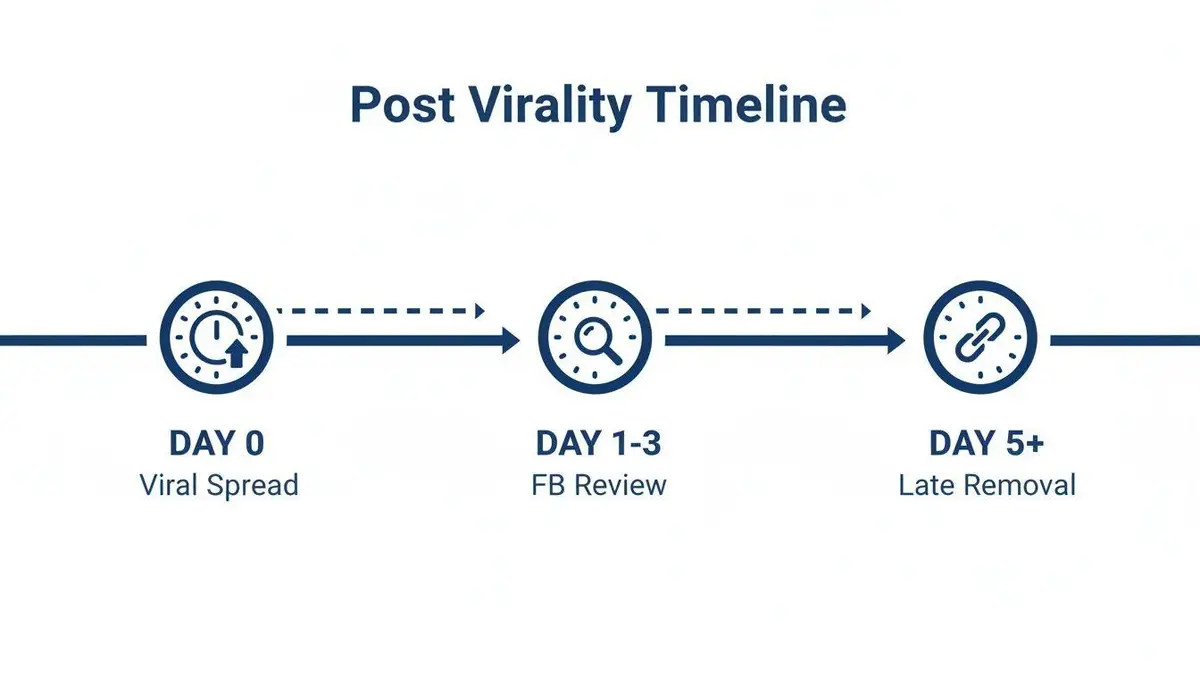
As this demonstrates, the vast majority of the post’s exposure occurs before any official takedown. Your response must therefore be immediate and decisive.
Why Standard Moderation Fails
Empirical data confirms the inadequacy of standard moderation for urgent threats. A major study analyzing over 2.6 million posts revealed that by the time Facebook removes violating content, it has already reached at least 75% of its total potential audience.
The takedown only prevents the final 24% to 30% of views. For a high-profile client, this means the financial loss or reputational damage has already occurred. The digital footprint is established.
The delay is the critical vulnerability. A defamatory post that accumulates 10,000 views in its first 24 hours is not “fixed” by a belated removal. The damage is done, the narrative is established, and screenshots almost certainly exist.
Your strategy cannot be reactive. It must be aggressive and focused on neutralizing the post’s momentum before it becomes uncontrollable. While you work to undo the damage of a regrettable online post, your primary objective must be containment.
Threat Scenarios and Recommended Immediate Actions
For public figures, executives, and other high-profile individuals, the nature of the post dictates the required response. The following table outlines common threat scenarios and the necessary initial actions.
| Scenario | Risk Level | Primary Threat | Recommended First Action |
|---|---|---|---|
| Defamatory Accusations | High | Reputational damage, legal liability | Document everything (screenshots, URLs) and engage a professional removal service immediately. |
| Doxxing / Privacy Invasion | Critical | Personal safety, identity theft | Do not engage the poster. Report to the platform and immediately contact an expert for rapid takedown. |
| Impersonation Account | High | Misrepresentation, fraud | Report the account for impersonation and gather evidence to escalate through specialized channels. |
| Non-Consensual Imagery (NCII) | Critical | Severe personal harm, exploitation | Immediately use platform-specific NCII reporting tools and contact a crisis management firm. |
This analysis underscores that a uniform approach is ineffective. The response must be tailored to the specific threat to achieve a successful outcome.
While your priority is content removal, the personal toll of an online attack can be significant. Seeking support from resources like professional counselling services can be a necessary step in managing the emotional distress.
Ultimately, for the content itself, proactive and professional intervention is the only reliable method to manage severe fallout and protect your reputation. You require a response that moves faster than the algorithm.
Securing Your Own Digital Footprint on Facebook
Before addressing content posted by others, you must secure your own digital assets. For any executive, public figure, or high-profile individual, auditing your Facebook history is not a discretionary task. It is a critical defensive maneuver. An ill-considered post from a decade ago, a poorly worded comment, or a past opinion can be weaponized without warning.

The objective is to strategically curate your digital past to align with your current professional standing. This involves identifying and neutralizing potential liabilities before a motivated adversary, a journalist, or opposing counsel discovers them.
Deletion vs. Archiving: A Strategic Decision
Facebook provides two primary mechanisms for managing old content: deletion and archiving. Understanding the distinction is vital, as each serves a different reputation management function. An incorrect choice can create more problems than it resolves.
Deletion is permanent. Once a post is deleted, it is scheduled for permanent removal from Facebook’s servers, a process that can take up to 90 days. The content is irrecoverable.
Archiving functions as a secure private vault. The post is removed from public view but saved in a personal archive accessible only to you. This tactic conceals the content without destroying it, which is often the superior strategic choice.
During litigation, career transitions, or periods of intense media scrutiny, archiving is almost always the prudent action. It removes the content from public access while preserving a record that may be crucial for legal discovery, thereby preventing accusations of spoliation of evidence.
How to Conduct a Thorough Self-Audit
A proper self-audit requires a forensic approach. You must systematically investigate your history to identify content that could be distorted or used against you.
Facebook’s Activity Log is the essential tool for this task. It provides a complete, searchable history of your platform activity, including every post, like, comment, and photo.
Access the Activity Log via:
- Settings & Privacy > Activity Log
- From there, utilize filters such as “Your posts” or a specific date range to isolate content from particular periods.
The Activity Log is designed for bulk actions. It allows you to select multiple items from a specific month or year and either Archive or Move to Trash (delete) them simultaneously, which is far more efficient than addressing posts individually. For a strategy extending beyond Facebook, our guide on conducting a complete digital footprint cleanup provides a more comprehensive framework.
A Framework for Content Triage
As you review your history, you must have a clear methodology for deciding what to retain and what to remove. Not all old content poses a risk, but certain categories are undeniable liabilities.
Be prepared to remove posts containing strong political or social views, as opinions that were once acceptable can become professional liabilities. In one notable case, a judge was removed from the bench after a blog post with far-right rhetoric resurfaced; the Illinois Supreme Court ruled his words violated judicial conduct rules.
Also remove old posts that may inadvertently disclose past addresses, phone numbers, or other personal information that could facilitate doxxing. Finally, remove any photos or comments reflecting unprofessional behavior or associations, as such content can easily be taken out of context to damage your professional image.
This process is not about erasing your online personality; it is a matter of intelligent risk mitigation. By systematically securing your own digital footprint, you take the most important first step to remove a post on Facebook that could cause future harm. You are reclaiming control and hardening your profile against attack.
Managing Unwanted Tags and Mentions
Controlling your own posts is one matter; managing what others post about you is another. The most enduring damage to an individual’s online reputation often originates from content they did not create.
A tag in an old photograph, a mention in a frustrated client’s post, or a shared private moment from a past relationship can suddenly associate your name with content beyond your control, creating an unforeseen reputational crisis.
Untagging yourself is the immediate and obvious action, but it is rarely a complete solution. The post remains online, your name may still appear in the text, and it is visible to the original poster’s network. The objective is not merely to sever a link but to secure removal of the content at its source.

Proactive Defense Through Tag Review
Your most effective strategy is a robust defense. Facebook offers a powerful setting called Tag Review, which every professional and public-facing individual should enable immediately. This feature functions as a gatekeeper, requiring your manual approval before any post you are tagged in can appear on your timeline.
This simple step can preemptively neutralize a problem. To enable Tag Review:
- Navigate to Settings & Privacy, then Settings.
- Locate Profile and Tagging under the Audience and Visibility section.
- Under “Reviewing,” enable both “Review posts you’re tagged in…” and “Review tags people add to your posts…”.
This creates a crucial buffer, allowing you to evaluate a tag before it becomes a public issue on your profile. This action does not remove the original post from the poster’s timeline or their network’s feeds, but it contains the immediate damage by keeping it off your page.
Communicating a Removal Request
When a problematic post appears, the first step after untagging yourself should be to contact the individual who posted it. This communication requires tact. An angry or accusatory approach will almost certainly be counterproductive.
A calm, professional message is most effective. Keep the communication concise and direct. Briefly explain your connection, state that the post is causing a professional or personal issue, and politely request its removal. This approach frequently yields the fastest results while preserving relationships.
Always document your conversation with screenshots. If the individual refuses to cooperate or becomes hostile, this documentation becomes crucial evidence for escalation to Facebook or for potential legal action.
Escalating to Platform Reporting
If a direct request fails, you must utilize Facebook’s official reporting tools. To successfully remove a post on Facebook that you do not own, you must be strategic. Your report must clearly demonstrate how the post violates Meta’s Community Standards.
The most common violations applicable in these scenarios are Harassment or Bullying, where the post is intended to shame or degrade you; Privacy Violation, where it shares your private contact information without consent; Hate Speech, where it attacks you based on a protected characteristic; or Impersonation, where someone is posting under your identity.
Selecting the correct violation category is critical. A miscategorized report is almost certain to be rejected by Facebook’s automated review systems. Your report must adhere strictly to the facts, avoid emotional language, and directly link the post to a specific policy violation. This establishes the necessary foundation for more advanced tactics should your initial reports be unsuccessful.
Removing Posts From Other People’s Pages
When damaging content resides on another user’s profile, you cannot simply delete it. This is where standard procedures become inadequate. Merely reporting the post and hoping for a favorable outcome is a strategy destined for failure.
Securing the removal of a post from another person’s page requires building an evidentiary case that compels Facebook to act in accordance with its own policies. You are entering a system that processes millions of reports daily; if your complaint is not perfectly framed, an automated system will likely reject it before a human reviewer ever sees it.
Choose Your Battle: Picking the Right Violation
Your first action is the most critical: selecting the correct violation category. This is not a matter of semantics. Reporting a post for “harassment” versus “defamation” directs it to entirely different review teams at Facebook, each with distinct evaluation criteria. This initial error is the leading cause of failed reports.
For example, reporting a defamatory statement as simple “harassment” is a common mistake. While the post may feel harassing, the team reviewing harassment claims is not trained to adjudicate legal defamation. They will assess the content against their checklist for bullying, find it does not precisely match, and deny the report.
Consider these common scenarios. If someone creates a fake profile pretending to be you, the violation is impersonation, which triggers a specific identity verification protocol. If they attack you from their legitimate account, the violation is harassment. If a competitor uses your copyrighted photograph, it is an intellectual property claim. If they pair that photo with false claims about your business, it becomes a defamation issue, which is far more difficult to prove through standard channels. If someone posts your private phone number, it is a privacy violation. If they post an intimate image of you without consent, it is Non-Consensual Intimate Imagery (NCII), a severe violation with its own dedicated, fast-tracked reporting channel.
Failing to correctly categorize the violation guarantees your report will be rejected. You must get it right the first time.
How to Write a Report That Actually Works
Once you have identified the correct violation, the report itself must be concise, factual, and persuasive. This is not the forum for emotional appeals. Adhere strictly to the facts and state precisely how the post violates a specific Facebook policy.
Your objective is to make the reviewer’s decision as simple as possible. Provide a clear violation, point to the evidence, and leave no ambiguity that would justify denying the takedown. A vague or rambling complaint will be rejected.
Certain situations, such as police departments engaging in photo shaming via Facebook, create complex issues that blur the lines between public information and personal harassment. These cases often require a sophisticated understanding of how law intersects with platform policy. To appreciate the scale of this challenge, note that Facebook took action on 1.5 million pieces of bullying and harassment content in the second quarter of 2023 alone. Your report must be flawless to be seen. You can review their official content action metrics to understand the volume they manage.
Mastering this initial reporting strategy is your best chance to achieve removal on your own. It demonstrates to the platform that you understand their rules and are presenting a valid complaint. Our guide on how to remove a Facebook post that is not yours offers a more detailed walkthrough of this process.
If you have followed these steps and the content remains online, it is an indication that the problem has exceeded the scope of self-help solutions. It is time to engage a professional to protect your reputation.
You have reported the post, appealed the decision, and followed all of Facebook’s rules, yet the damaging content remains visible. This is the point at which a frustrating problem escalates into a crisis that requires professional intervention.
Knowing when to cease DIY efforts and engage a specialist is critical. For our clients (executives, public figures, and legal professionals) a lingering defamatory post is not a mere annoyance. It is a direct threat to their reputation, livelihood, and financial stability. Leaving its removal to chance is an unacceptable risk.
Hiring a specialist is not an admission of defeat. It is a strategic decision to protect what you have built.
When Facebook’s Moderators Say No
The most common impetus for seeking professional help is a rejected report. Clients report content that clearly violates Facebook’s policies, only to have moderators deny the request. This is a maddeningly frequent outcome, especially when dealing with nuanced harassment or complex defamation that automated systems and first-tier reviewers are not equipped to handle.
You can appeal the decision, but the success rate is dismal. The same overwhelmed system that initially rejected your report often handles the appeal. When you receive a notification stating that a genuinely harmful post “does not violate our Community Standards,” that is your signal. It is time to exit the standard reporting queue and engage a firm that can compel a meaningful review.
Scenarios That Require an Expert from Day One
While a denied report is a clear trigger for escalation, certain situations are so sensitive that any attempt to remove a post on Facebook yourself is a strategic error. These cases demand immediate, expert intervention.
If a post accuses you of criminal acts, financial fraud, or professional malpractice, you are dealing with libel, not merely an offensive comment. These are legal matters. A professional service frames the issue as a legal demand, citing relevant laws and precedents that create liability for the platform if it fails to act.
If multiple accounts are suddenly disseminating false information about you, this is a coordinated attack, not the action of a single individual. We address this by mapping the entire network, documenting the scale of the campaign, and presenting it to Facebook as a systemic threat requiring a more robust response than a single-post takedown.
For Non-Consensual Intimate Imagery (NCII), there is zero margin for error. While Facebook provides an NCII reporting portal, a specialist firm can often accelerate removal through direct, back-channel contacts. We also work to have the content added to industry hash databases, which helps prevent it from being re-uploaded on other platforms.
If a fake profile is damaging your reputation or a page is impersonating your business, it must be shut down immediately. This requires a multi-pronged strategy involving takedown demands, trademark infringement claims, and ongoing monitoring to prevent copycat accounts from emerging.
This widespread user frustration is well-documented. A 2023 survey found that 42% of users had taken a break from Facebook, with 65.8% of those who deleted their accounts citing data privacy concerns. This dissatisfaction arises directly from the platform’s inability to effectively manage harmful content. It is in this gap, between user needs and platform capabilities, that a firm like ContentRemoval.com demonstrates its value, frequently resolving cases in 24-48 hours. The rising volume of removed social media content illustrates why this expertise is so critical.
How a Professional Removal Service Works
Engaging a professional service fundamentally alters the dynamic. You are no longer a user filing a complaint; you are a client represented by a firm with established processes and direct lines of communication to the platform.
We do not use the public “report” button. Our process begins with a thorough case analysis and the drafting of a formal takedown demand. We submit this demand through privileged, back-end portals reserved for law firms and trusted partners, ensuring it is reviewed by a senior policy or legal team member, not a first-tier moderator.
This approach bypasses the algorithms and biases of the public reporting system. It reframes your issue from a subjective complaint into an objective legal and financial risk for the platform, a language they understand and are motivated to address. For anyone facing a high-stakes reputational threat, this is the only reliable path to a swift, discreet, and permanent resolution.
Frequently Asked Questions About Facebook Post Removal
When faced with a damaging post on Facebook, you have urgent questions that demand clear answers. As experts who manage these situations daily, we have compiled the most critical questions from our clients to provide the straightforward guidance needed to regain control.
Can I Permanently Delete a Post Someone Else Made About Me?
No, you cannot directly delete content from another person’s account. However, this does not leave you without recourse. You can secure the post’s removal.
The initial step is to untag yourself, which contains some exposure but does not solve the problem. The post remains live and discoverable. The next action is to report the post to Facebook for a policy violation such as harassment or a privacy breach. This initiates their review process, but it is often just the start.
For serious matters (defamation, impersonation, or non-consensual intimate imagery (NCII)) standard reporting is rarely sufficient. A professional service becomes your most valuable asset. We escalate the issue through established legal channels and direct contacts, making it clear to Facebook that the content represents a liability they must address immediately.
This strategy shifts the dynamic from a simple user complaint to a formal legal demand, compelling a permanent takedown at the source.
How Long Does It Take for Facebook to Review a Reported Post?
The timeline is unpredictable. Facebook’s official guidance suggests most reports are reviewed within 24 to 48 hours, but this is often optimistic. Simple, flagrant violations may be resolved quickly, but any case requiring nuanced judgment can languish in a review queue for days or weeks.
For an executive or brand in crisis, such a delay is devastating. The majority of a post’s viral damage occurs within the first 24 hours. By the time moderators review your report, the harm is already done. If a post poses an immediate threat, waiting is not a viable strategy. You need a method to force a resolution in hours, not days.
What if Facebook Rejects My Request to Remove a Defamatory Post?
It is common for removal requests to be rejected. Facebook’s first-line moderators are trained to identify obvious policy violations, not to adjudicate complex legal issues like libel. If a post is artfully worded to evade simple classification, they will often default to leaving it online.
At this point, you can appeal, but the success rate for appeals is notoriously low. This is the moment to change your strategy.
A firm like ours does not use the same front-door reporting tools. We reframe the issue entirely. We bypass the standard moderation queue, present the content as a legal problem citing specific laws in the relevant jurisdiction, and submit our takedown demands through back-end portals reserved for legal partners. This transforms your request from a complaint they can dismiss into a legal notice they cannot ignore, ensuring the case is reviewed by a senior team qualified to assess legal risk.
Can a Deleted Facebook Post Still Be Found Online?
Yes. The removal of a post from Facebook does not mean it has vanished from the internet. Its digital footprint can persist in search engine caches, on data-scraping websites, or in archives like the Wayback Machine.
A complete and permanent removal is a two-step process:
- Source Removal: First, we ensure the post is permanently scrubbed from Facebook’s servers.
- De-Indexing: Next, we actively remove any cached versions or links from Google, Bing, and other search engines so no trace of the content remains discoverable.
A professional service manages both aspects. We also provide ongoing monitoring to ensure the same misinformation is not re-uploaded, delivering a comprehensive solution that protects your reputation long-term.
When standard methods fail, you need an expert with the processes and access to secure results. At ContentRemoval.com, we specialize in the rapid and discreet removal of damaging online content. If your reputation is on the line, contact us for a confidential assessment at ContentRemoval.com.