
To remove an Amazon review, you must prove a violation of Amazon’s Community Guidelines rather than argue it is unfair. Removable categories include defamatory false statements of fact, promotional content, obscene language, seller feedback posted as a product review, and conflicts of interest. Report through Brand Registry or Report abuse, then escalate to DMCA notices or a court order.
Key facts
- Subjective opinions like the product felt cheap cannot be removed; provably false factual claims can.
- Brand Registry owners use the Report a Violation tool; others use the Report abuse link on the review.
- A DMCA notice applies only when a reviewer uses your copyrighted photos or marketing copy.
- Amazon blocked or removed over 275 million inauthentic reviews in 2024; standard requests reportedly succeed only 3 to 6%.
Where ContentRemoval.com comes in. ContentRemoval.com takes on Amazon review matters when the review is defamatory, part of a coordinated attack or aimed at a named executive, and when Seller Support has already rejected a well-built report. Brand owners, their agencies and their counsel usually make contact, often across more than one Amazon marketplace. A free, confidential 15-minute Exposure Scan maps which reviews fit a removable category and which need legal escalation, and the report is yours to keep. Get a Free, Confidential Exposure Scan or read how our review removal work is done.
The feeling is unmistakable. You have poured years into building your brand, and then one morning, you see it: a strategically placed, malicious review. This is not just frustrating; it is a direct threat to your hard-earned reputation and, more importantly, your sales.
This is not about feedback. When a review is false or defamatory, it becomes a business crisis demanding a swift, calculated response. We do not “manage” the problem. We are here to remove the Amazon review and reclaim your brand’s narrative.
Why a Single Bad Review Is a Financial Emergency
When a false review appears, the anxiety you feel is not an overreaction. It is a rational response to a real financial threat. Every minute that content remains live, it actively works against your bottom line.
A well-written negative review can poison the well at the precise moment a customer is prepared to buy. It plants a seed of doubt that can be nearly impossible to overcome.
Direct Hit to Your Conversion Rates
The most immediate damage is to your conversion rate. A potential customer might be seconds from clicking “Add to Cart,” but a single, credible-sounding one-star review, especially one alleging a safety issue or a critical product failure, can stop the sale cold.
This is not a slow leak; it is an abrupt halt to your revenue stream. The impact is direct and immediate.
For high-value products or premium brands, a single prominent negative review has been observed to reduce conversion rates by up to 70%. Discerning buyers perceive that review as a red flag and will almost always choose a competitor with a cleaner reputation rather than assume the risk.
The Slow Burn of Brand Erosion
Beyond the instant loss of sales, a lingering false review causes a much deeper, more insidious problem. It systematically erodes the trust and authority you have worked so hard to establish.
Each customer who reads that review and navigates away is a lost opportunity for brand loyalty. This reputational decay has a compounding effect over time. Malicious reviews are a direct assault on a brand’s health, making effective brand protection on Amazon a non-negotiable component of operations.
The damage rarely remains confined to one product page. In a connected marketplace, a negative narrative on one listing can easily bleed over into other channels, tainting your brand’s image across the board. Passivity is not an option.
Constant monitoring of your online presence is crucial. A stronger defense can be built by following our guide on professional reputation monitoring. The ultimate objective is not just to react, but to create a brand resilient enough to withstand these attacks.
Understanding Amazon’s Review Removal Policies
Let us be clear about removing an Amazon review: success has nothing to do with fairness and everything to do with policy. Amazon operates on a strict, and often frustrating, set of Community Guidelines. If your removal request is not built upon a rock-solid violation of their rules, it is dead on arrival.
A common mistake sellers make is confusing a negative opinion with a policy breach. A customer stating your product “felt cheap” or “was a disappointment” is sharing a subjective opinion. That cannot be removed. But when a review crosses into specific, prohibited territory, you have a viable path to removal.
The Anatomy of a Removable Review
To build a winning case, you must pinpoint exactly how a review breaks Amazon’s terms. Amazon is not concerned with protecting your brand’s reputation; they are focused on protecting the integrity of their platform. Your task is to demonstrate how a specific review threatens their ecosystem.
Successful removals are most frequently achieved by focusing on these clear-cut violations:
- Defamatory or Harassing Content: This extends beyond a mere bad opinion. It includes provably false statements of fact, such as “this product contains lead” when it has passed all safety certifications. Direct personal attacks on you or your staff also fall into this category.
- Promotional Content: This is typically easy to identify. A review stating, “Don’t buy this, Brand X’s version is way better,” or including a link to another website is a blatant advertisement and a clear violation.
- Hate Speech or Obscene Language: Any review containing profanity, threats, or discriminatory language is a high priority for Amazon’s removal queue. Their moderators act quickly on these.
- Conflicts of Interest: Reviews from competitors are a classic black-hat tactic. This category also includes reviews from disgruntled former employees or even your own family members attempting to “help.” Amazon views all such actions as manipulation.
Your goal is to match the review’s content to the exact language in Amazon’s policy. Leave no room for interpretation.
Sellers often inquire which violation is most likely to result in a successful removal. While success always depends on the evidence, some breaches are more clear-cut than others. The following table breaks down removal likelihood based on our experience.
Amazon Review Violation and Removal Likelihood
| Violation Type | Description | Example | Removal Likelihood |
|---|---|---|---|
| Obscene/Hate Speech | Contains profane language, threats, or discriminatory comments. | “This seller is a [profanity]! Do not buy from them!” | Very High |
| Promotional Content | Acts as an advertisement for another product or includes external links. | “This is junk. Go to my-awesome-store.com for a better one.” | High |
| Product vs. Seller Feedback | The entire review is about shipping, packaging, or customer service (FBA only). | “The box was crushed and it arrived 3 days late.” | High |
| Defamation | Makes a provably false and damaging statement of fact. | “This supplement gave me a heart attack.” (requires evidence) | Medium |
| Conflict of Interest | Written by a competitor, former employee, or someone with a clear bias. | A known competitor leaving a 1-star review. (requires evidence) | Medium |
| One-Word Review | A 1-star review with a single, unhelpful word like “Terrible.” | “Bad” | Low |
| Subjective Opinion | The customer simply didn’t like the product for personal reasons. | “The color wasn’t what I expected and it feels cheap.” | Very Low |
The more objective and provable the violation, the better your chances. Stick to reporting clear breaches, as this builds credibility with Amazon’s support teams for future cases.
Navigating Amazon’s Algorithmic Enforcement
Do not assume a human is reading your first report. Amazon’s systems are constantly scanning for patterns, driven by aggressive algorithms designed to police the entire review ecosystem. These bots are a major reason why generic reports are instantly rejected.
It is a grave error to believe Amazon only hunts for fake negative reviews. The company is equally focused on rooting out inauthentic positive reviews, as both destroy shopper trust in the platform. An attack on your business could even involve a competitor receiving fake positive reviews to set them up for a later takedown.
This algorithmic policing intensified in early 2026, when sellers witnessed a massive wave of review deletions during a platform-wide integrity initiative. This was not random. For example, any review left after a customer used a seller-provided discount code now faces a staggering 98% removal rate because the algorithm flags the “material connection.” Simple, repetitive phrases like “works great!” carry an 83% deletion risk when they appear across too many reviews, as the system suspects bot activity. You can read more about the findings on why Amazon reviews get deleted.
This means your removal request must be surgically precise. It needs to be structured like a legal argument, citing the specific rule broken and presenting proof. Only then do you have a real chance of bypassing the bots and having a human agent remove the review damaging your business.
How to Build an Ironclad Case for Amazon Review Removal
Simply clicking the “Report abuse” button and hoping for the best is a losing strategy. You must approach it less like a complaint and more like building a legal case. Your one shot is to present such a clear, policy-based argument that Amazon’s internal team has no choice but to act.
A lazy, emotional report is automatically dismissed in the vast majority of cases. That only leaves the damaging review up longer, hurting your sales and reputation.
First, preserve the evidence. Before you do anything else, capture a perfect record of the offending review. Take full-page, timestamped screenshots showing the entire review, the reviewer’s name, the date, and the product page. Using a service like the Wayback Machine at Archive.org to save a permanent copy of the live URL is also advisable.
This documentation is not just for your report. It is key evidence if the situation escalates to legal counsel. If the reviewer edits or deletes their post and you lack documentation, your case can fall apart instantly.
Choose Your Battlefield: Selecting the Right Reporting Channel
Amazon offers several reporting channels, and selecting the correct one is critical. Using the wrong channel will likely result in your report being lost or sent to a department that cannot help. The optimal path depends on your status and the type of violation.
- For Brand Owners: If you are in the Brand Registry, your most powerful weapon is the Report a Violation (RAV) tool. This is a dedicated channel for brand owners, and Amazon takes these reports more seriously because they are tied to intellectual property.
- For Third-Party Sellers: If you are not in the Brand Registry, your only option is the public-facing “Report abuse” link on the review itself. You are in the general queue, so making your case concise and directly tied to a policy violation is absolutely vital.
- For Non-Sellers: If a review targets you or your company but you do not sell the product (for example, a defamatory comment about an executive), you will also use the “Report abuse” link. Here, you must frame your argument around personal harassment, defamation, or safety concerns.
If you are serious about protecting your brand, investigate the Amazon Brand Registry requirements. Enrollment provides access to the RAV tool and significantly more control.
Crafting a Report That Gets Results
Your report must be all facts, no emotion. Complaining about how unfair the review is or how it hurts your business is a waste of time. The moderator’s only job is to determine if the review breaks a rule. Make it easy for them.
The most effective reports ever filed were bone-dry and to the point. They presented facts as follows: “The review at [Archived URL] violates the Community Guideline against promotional content. The text, ‘[Quote from review],’ is a clear example of this violation. This is verifiably false, as proven by the attached [Certification/Documentation].” This approach removes all guesswork and forces the moderator to make a decision based on their own rulebook.
This flowchart illustrates the exact violations Amazon’s teams are trained to identify and act upon.
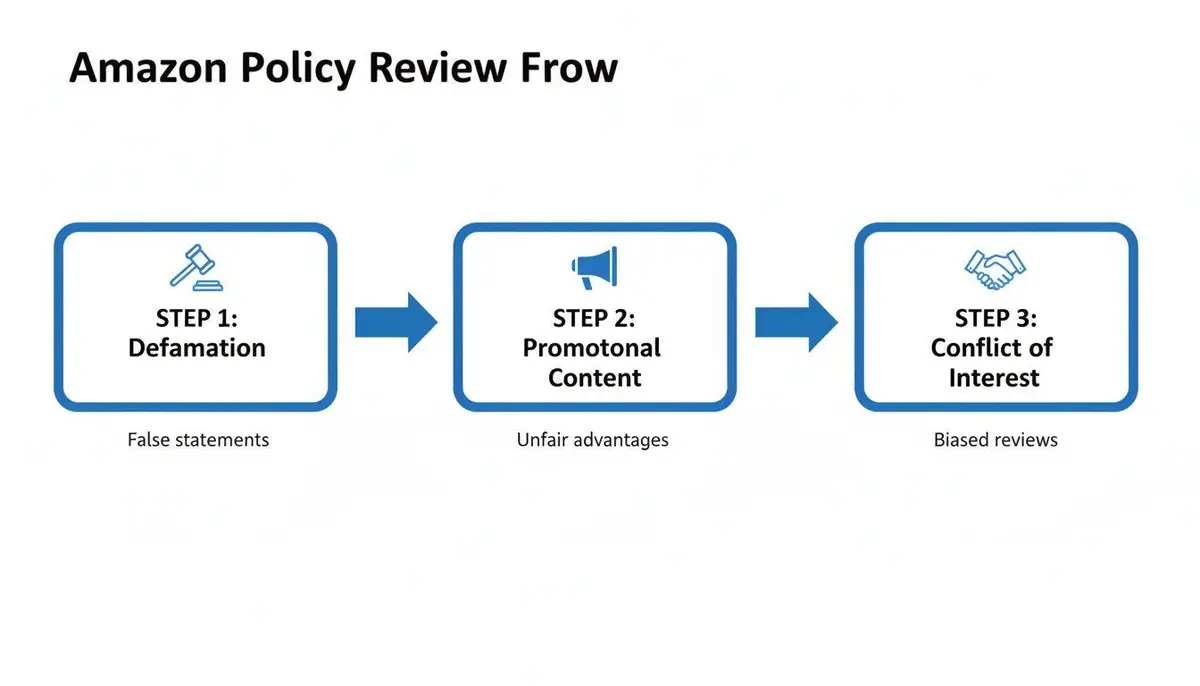
As shown, while Amazon has channels for various issues, your best chance for removal lies with clear-cut violations like defamation, promotional content (such as mentioning a competitor), or an obvious conflict of interest.
When you write your report, ensure it includes these three elements:
- Name the Violation: State the specific policy being broken. For instance, “This review violates the policy against seller feedback.”
- Quote the Evidence: Pull the exact phrase or sentence from the review that breaks the rule. Do not paraphrase.
- Provide Objective Proof: This is the decisive element. If the review makes a false claim, attach documentation to disprove it. If you suspect it’s a competitor, show evidence of their identity.
Omit the backstory. The moderator does not care about your company’s history or financial losses. Stick to the facts of the violation. This disciplined approach dramatically improves your chances of success. If your well-built case is still denied, it provides a clean record for escalation.
For a deeper dive into content takedown strategies beyond Amazon, see our guide on how to remove online content.
Advanced Escalation Paths When Reporting Fails
So, you have submitted your carefully prepared report to Amazon, and it was rejected. This is not the end of the road; it is the point where the standard, automated process has failed. For our firm, this is where the real work often begins.
An initial rejection does not mean your claim is invalid. It means the first-tier reviewers, who are often overwhelmed or ill-equipped for legal nuance, could not or would not help. Now, it is time to escalate your argument to a department with the authority to act: Amazon’s legal team.
The DMCA Takedown: A Powerful Niche Strategy
One of the most potent tools available is a DMCA takedown, but it applies to a very specific use case. The Digital Millennium Copyright Act (DMCA) addresses copyright infringement, not bad opinions or general defamation. This strategy is relevant when a reviewer has literally stolen your intellectual property.
This occurs most often when someone uses your professional product photos or proprietary marketing copy in their negative review. Imagine a competitor leaving a one-star review and attaching your copyrighted lifestyle image to lend legitimacy to their fake review. This is no longer just a bad review; it is a clear-cut case of copyright infringement.
Filing a DMCA takedown is a formal legal process, not a simple report. It involves sending a specific notice to Amazon’s designated copyright agent, which must include:
- Your physical or electronic signature.
- Clear identification of your copyrighted work.
- The exact location of the infringing material on Amazon.
- Your contact information.
- A statement of good faith belief that the use is not authorized.
- A declaration, under penalty of perjury, that you are telling the truth.
When executed correctly, a DMCA notice legally compels Amazon to act. They must remove the infringing content quickly or face potential liability.
Pursuing Defamation Through a Formal Legal Complaint
What if the review is simply false and damaging to your reputation? If it contains a provably false statement of fact, libel in legal terms, you may have a case for defamation. This is not another report to Seller Support. This is a formal legal complaint, typically drafted by a law firm or a specialist service like ours, and sent directly to Amazon’s legal department.
The bar for defamation is high. It cannot be a subjective opinion. It must be a provably false assertion of fact.
- Opinion (Not Actionable): “This product feels flimsy and cheap.”
- Potential Defamation (Actionable): “This skincare product contains mercury and caused a chemical burn.”
The second statement is a factual claim that can be disproven with lab reports, safety certifications, and other hard evidence. A strong legal complaint packages that evidence and argues to Amazon’s counsel that by hosting this defamatory content, they are exposing themselves to legal risk.
While Amazon is shielded by Section 230 of the Communications Decency Act, it is not completely immune to legal pressure. A well-written complaint from a known legal entity signals that you are serious and that this could escalate into a costly court battle. This is often what finally motivates their legal team to step in where customer service failed.
The Ultimate Recourse: Obtaining a Court Order
The most surefire way to remove an Amazon review is to obtain a court order. Once a judge issues an injunction declaring a review to be defamatory and explicitly orders its removal, Amazon has no choice but to comply. This bypasses their internal policies and discretion entirely.
Getting a court order is a serious legal maneuver. It means filing a lawsuit (often against an anonymous “John Doe” reviewer), presenting your evidence in court, and convincing a judge that the review meets the legal standard for defamation. The resulting order must be crystal clear, identifying the exact statements and the specific URL on Amazon for removal.
Once you have that order, it is sent straight to Amazon’s legal department. At this point, compliance is not up for debate. It is a matter of law.
In 2024 alone, Amazon blocked or removed over 275 million inauthentic reviews, a staggering figure demonstrating the scale of their fraud problem. With that volume, legitimate requests are lost. Seller experts estimate that standard removal requests succeed only 3-6% of the time. Given those odds, escalating with legal precision is not just advisable; it is the only viable path for complex cases. We help clients bypass this frustrating system by using direct legal channels to achieve results. You can explore the full research on fake review statistics to better understand the challenge.
When Is It Time to Call in a Specialist?
You will eventually face a choice: handle a damaging review yourself or engage a professional. For most sellers, a single bad review is an annoyance. For high-net-worth individuals, executives, and established brands, it is an entirely different calculation. It becomes an unacceptable risk where the time, uncertainty, and potential for escalation carry a much heavier cost.
Attempting to remove an Amazon review on your own through standard channels is a long shot. It consumes valuable time with no guarantee of success. Hiring a specialist is not an admission of defeat; it is a strategic business decision to regain control of a volatile situation with speed and certainty.
Is It Just a Bad Review or a Coordinated Attack?
First, you must obtain a clear-eyed view of the threat level. A standard negative review is usually an isolated incident focusing on a customer’s perceived issue with your product. A coordinated reputational attack, however, has a different signature, one that signals malicious intent.
These attacks often involve:
- A sudden flood of negative reviews over a short period, often using similar language or fixating on the same supposed flaw.
- Reviews containing sophisticated falsehoods or personal attacks targeting company leaders or employees by name.
- The same negative content appearing across multiple platforms simultaneously, a clear sign of an organized campaign to inflict maximum damage.
When you spot these patterns, you are no longer dealing with a disgruntled customer. You are facing a calculated assault on your brand. This is the point where the cost of professional help ceases to be an expense and becomes a critical investment in reputational defense.
The Strategic Edge of Professional Intervention
A specialist firm does not just “report abuse.” We operate on a different level. Our process is built on years of experience, direct platform contacts, and the ability to deploy complex legal arguments with surgical precision.
Engaging our firm provides immediate access to:
- Established Platform Relationships: We do not simply submit a ticket and wait. We have direct lines of communication with the legal and escalation departments at major platforms, allowing us to bypass the ineffective front-line support that hinders most sellers.
- Proprietary Removal Methods: Our strategies are derived from successfully handling thousands of cases and are not public knowledge. We know exactly which arguments and evidence compel platforms to take action.
- Speed and Discretion: We typically commence work within 24-48 hours to contain the damage before it spreads. All communications and actions are handled with complete confidentiality to protect our clients’ privacy.
The real advantage is that we change the dynamic entirely. Instead of a seller pleading with a massive platform, we present a legally solid, evidence-backed case that makes removing the content the most logical and least risky option for the platform.
This expert approach is more critical than ever as platforms adapt their rules. For example, Amazon’s review sharing guidelines are being updated, with changes phasing in through May 31, 2026. This will stop review sharing between significantly different product variations. While intended to curb misleading feedback, it also introduces new risks. Public figures and brands could find new products unfairly damaged by old, negative reviews from a now-unrelated product variation. Standard PR cannot fix this; it requires targeted removal. You can read more on how these Amazon guidelines are changing the game.
How the Engagement Process Works
For clients who require a guaranteed outcome, the path forward is straightforward. It begins with a confidential assessment. We analyze the defamatory content, trace its origin if possible, and identify the most effective removal strategy. From there, we present a clear action plan with defined goals and timelines.
This process is not about hoping for the best. It is a calculated execution based on a proven playbook, the only logical choice for clients who cannot afford the financial and reputational bleeding from a long, public, and uncertain fight. You can explore our whitepaper on the strategic approach to online review removal services for executives to understand more. By delegating the conflict, you regain your time and your narrative.
Frequently Asked Questions About Amazon Review Removal
The questions we receive about hostile Amazon reviews are almost always the same. The situation creates significant confusion and stress. Here, we address the most common inquiries.
Can I Legally Force Amazon to Remove a Negative Review?
The short answer is no, not typically. You cannot force Amazon to remove a review simply because it is negative or you believe it is unfair. Platforms like Amazon are protected by Section 230 of the Communications Decency Act, which shields them from liability for user-generated content. An opinion, even a harsh one, is typically protected speech.
However, that protection is not absolute. The dynamic changes when a review crosses a clear legal line. We can compel removal when the content involves:
- Defamation: A statement presented as fact, which is provably false and damages your reputation.
- Copyright Infringement: Someone stealing your photos or product descriptions for use in their review.
- Court Order: A direct injunction from a judge ordering Amazon to remove specific content.
Achieving a removal for defamation is challenging, but presenting a well-prepared claim to Amazon’s legal department is a serious escalation they must address.
How Long Does It Take to Remove an Amazon Review?
The timeline to remove an Amazon review depends entirely on the approach. Using the standard “Report abuse” button for a simple policy violation can lead to weeks of waiting with a very low success rate.
Filing a formal legal claim, such as a DMCA takedown notice for copyright infringement, can accelerate the process, but you are still likely looking at several weeks to a month. The single greatest factor in shortening this timeline is engaging a specialist. By using established backchannels and a proven process, we can often initiate action within 24-48 hours and achieve a much faster resolution, stopping the damage in its tracks.
A significant mistake sellers make is repeatedly reporting the same review through the public form. Not only is this rarely effective, but it can sometimes flag your product, making it even harder to have a legitimate claim reviewed later. Your first attempt is your most critical one.
Will Amazon Notify the Reviewer if Their Review Is Removed?
Amazon’s process is opaque. For a minor infraction resolved through the “Report abuse” button, the review often vanishes without any notification to the author.
For more serious issues or legal claims, Amazon is more likely to inform the user that their content was removed for a policy or legal violation. In cases involving a court order, they are almost always notified. We handle these communications carefully to maintain our client’s privacy and avoid provoking retaliation from the reviewer.
Is It Possible to Remove Reviews on International Amazon Sites?
Yes, it is possible, but this is where the complexity increases. Each marketplace, whether it’s Amazon.de in Germany or Amazon.co.uk in the UK, operates under its own rules and local laws.
A review that is clearly defamatory under U.S. law might be viewed differently in the UK. To remove it, you need a strategy tailored to that specific country’s legal landscape. Managing takedowns across different jurisdictions is a core part of our practice, ensuring a brand’s reputation is protected wherever they sell.
When you are dealing with a sophisticated or relentless attack on your brand’s reputation, speed and expertise are paramount. At ContentRemoval.com, we specialize in executing these complex removal strategies quickly and discreetly. If you require a guaranteed result, reach out for a confidential assessment.