
A ransomware removal service is a containment-to-recovery operation, not malware cleanup with a premium invoice. It isolates infected endpoints, preserves forensic evidence before eradication, identifies the strain, resets compromised credentials and restores from validated backups into clean targets, with counsel shaping every attacker contact and payment decision. Paying the ransom often fails to return usable data.
Key facts
- The correct order is containment, forensics, eradication, then recovery; a rushed reboot destroys the attack trail.
- Sophos reported average ransom payments of about $1.0 million in 2025 and average recovery costs of $1.53 million.
- Analysis cited by Sherlock Forensics found only 56% of paying organizations reported full data recovery.
- Walk away from vendors who promise recovery by a fixed date or push direct cryptocurrency payment.
Where ContentRemoval.com comes in. ContentRemoval.com handles the exposure that follows a ransomware event once the technical team has containment: stolen files posted on leak sites and forums, executive names pushed into search alongside the breach, and extortion material circulating on social platforms. General counsel and the incident lead usually make contact while recovery is still in progress. A free, confidential 15-minute Exposure Scan maps what has surfaced and what is removable, and the report is yours to keep. Get a Free, Confidential Exposure Scan or read how our content removal work is done.
317 million ransomware attempts hit worldwide in 2023, and roughly 7 in 10 reported cyberattacks were ransomware that year. If you’re dealing with an active incident, a serious ransomware removal service is the fastest way to contain spread, preserve evidence, and get back to clean systems without gambling on the attacker’s promises.
The core problem at that moment is rarely the malware alone. It’s the pressure in the room, the board call looming, the general counsel asking what’s been touched, and the fact that every wrong move can destroy forensic value or turn a recoverable incident into a legal mess.
The First Hour of a Ransomware Incident
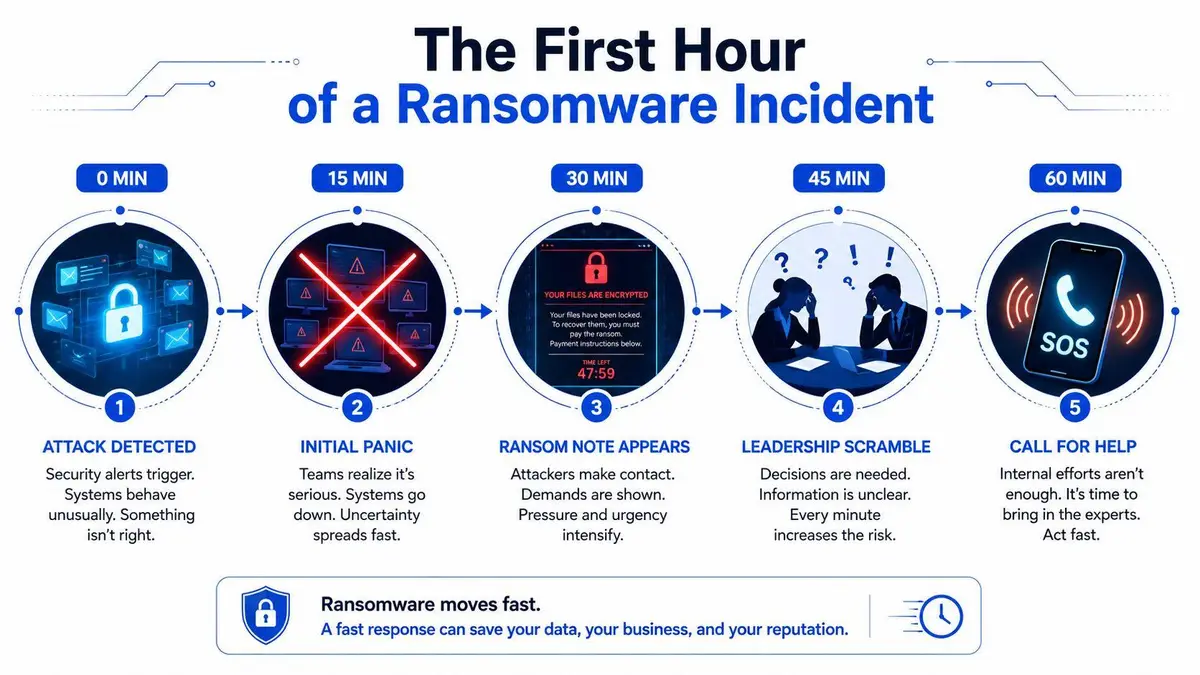
At minute zero, someone on your team says the finance dashboard won’t load, shared drives are locked, and half the inboxes are suddenly useless. By minute fifteen, you’re not looking at an IT issue anymore, you’re staring at an executive event with legal, operational, and reputational consequences attached to it.
The CEO feels the panic first because the room goes quiet in a very specific way. People start talking over each other, screenshots appear in group chats, and somebody wants to restart servers, while somebody else wants to pull plugs, and both instincts can make the incident harder to investigate.
What matters before anyone touches a keyboard
The first call should go to people who can make containment decisions fast, not to the loudest vendor in your inbox. A competent response starts by isolating infected endpoints, disabling remote and cloud sessions, and preserving forensic evidence before anyone starts eradicating anything, because the original attack chain matters for scoping and legal review (incident response workflow guidance).
Practical rule: if the first responder can’t explain how they’ll isolate systems without destroying evidence, they’re not ready for your incident.
That’s why a generic managed service provider is usually the wrong first move. They may know your environment, but that doesn’t mean they know how to preserve custody, scope compromise, or support counsel under pressure.
The better question in hour one is simple. Who can stop spread, protect evidence, and keep the company from making the incident worse while the clock is already running?
What a Ransomware Removal Service Actually Does
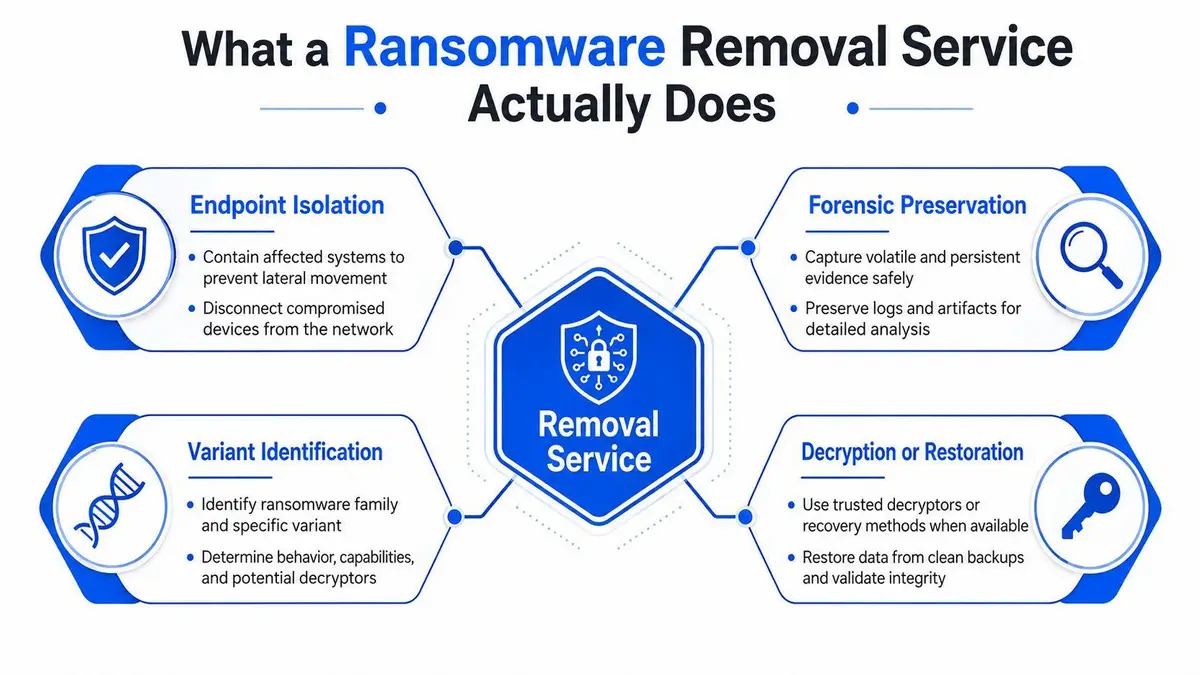
A real ransomware removal service is not “malware cleanup” with a premium invoice. It’s a disciplined containment-to-recovery operation that combines isolation, evidence handling, variant identification, restoration, and post-incident validation, all while keeping the legal and operational record intact.
The service is bigger than decryption
CISA’s guidance makes the gap clear. The response is not just “remove malware and restore files.” It includes isolation, evidence capture, password resets, vulnerability remediation, and rebuilding systems from trusted images before anything reconnects to the business (CISA ransomware guidance).
That distinction matters because a vendor can be technically clever and still be the wrong vendor. If they can’t talk fluently about chain of custody, rebuild-from-trusted-image, and whether they validate clean backups, they’re selling comfort, not recovery.
Why buyers get misled
Most executives assume the service begins and ends with restoring files. In practice, the vendor has to handle several separate jobs. It has to contain the breach, preserve artifacts for outside counsel, identify the strain, attempt decryption if available, and restore into clean targets so compromised infrastructure doesn’t poison the recovery.
Modern vendors also validate more than file counts. They use hash verification, sample-open testing, and controlled restoration into isolated environments because backup assumptions can fail when attackers have already touched backup infrastructure (recovery vendor validation practices).
A vendor that talks only about “getting you back online” is usually talking around the hardest part of the work.
A useful way to think about it is this. You’re not buying a cleanup crew. You’re buying a team that can manage evidence, decision rights, and restoration integrity under pressure.
The Containment, Forensics, and Recovery Workflow
A ransomware incident is usually won or lost in the first minutes. The right response is disciplined, and it starts with containment, not with panic-driven cleanup. Take affected devices offline at once, then keep them powered on after isolation so investigators can preserve volatile evidence and active session data.
That order matters because a rushed reboot or blind wipe can destroy the trail that shows how attackers entered, what they touched, and whether they still have access elsewhere in the environment.
The order that protects the case
A competent team follows a strict sequence.
- Containment first. Isolate hosts, disable remote sessions, segment access paths, and stop lateral movement.
- Forensics second. Capture images, logs, and relevant memory before anyone changes the environment.
- Eradication third. Remove persistence, reset compromised credentials, and patch the entry point.
- Recovery last. Restore from validated backups into an isolated environment, then confirm the systems are clean before reconnecting them.
That sequence is the difference between recovery and repeat compromise. Ransomware often goes after backup infrastructure before encryption, so a simple claim that backups exist means nothing until someone checks their integrity and restores them into a clean target.
What a real team checks before declaring victory
- Endpoint isolation: infected machines are cut off, but the evidence remains intact.
- Credential hygiene: remote access tokens, cloud sessions, and reused passwords get reset.
- Backup trust: the recovery team verifies backups before using them.
- Re-entry monitoring: the job is not done when the files come back, because attackers often try again through stale access.
The FBI tells victims to isolate affected systems, identify the strain, report the incident through the IC3 channel, and recover from clean backups or decryption tools where available. If the attack includes extortion through stolen data, follow the guidance for online blackmail help and treat that as a separate legal and communications problem, not just a file-restoration issue.
The firms that handle this well do not improvise. They preserve evidence, control access, and restore into clean systems in an order that gives counsel, insurers, and executives something solid to act on.
Recovery Economics and the Payment Question
The wrong question is “Should we pay?” The right question is “What does recovery cost either way, and what do we get if we spend the money?”
Sophos reported in 2024 that organizations that paid ransoms paid an average of $2 million, while the average cost of recovery excluding ransom reached $2.73 million. In 2025, Sophos said the average ransom payment fell to about $1.0 million, and the average recovery cost dropped to $1.53 million. Sophos also found that 53% of ransomware victims fully recovered within one week in 2025, and 97% of organizations whose data was encrypted were able to recover it through backups, decryption tools, or payments (Sophos ransomware data).
Payment is not a recovery strategy
The market still sells a comforting lie, payment equals restoration. Public reporting on recovery firms showed that some of the industry’s “recovery” model was really attacker payment wrapped in a service layer, then billed back to the victim as expertise (ProPublica reporting on recovery firms).
That’s not a technical solution. It’s a financial workaround with a premium attached.
A published analysis cited by Sherlock Forensics says roughly one in three organizations that pay never recover their data at all, only 56% of paying organizations reported full recovery, and the remaining 44% got no decryptor, a broken decryptor, or only partial files (Sherlock Forensics analysis).
What executives should take from that
The decision is not moral theater. It’s a risk calculation. Paying may look faster in the moment, but it doesn’t guarantee usable data, and it doesn’t replace the need for containment, evidence handling, and clean restoration.
For organizations trying to avoid the hidden payment trap, this is the time to coordinate with the right specialists, not freelance the negotiation. If the incident is tied to online blackmail or extortion pressure, a separate escalation path like online blackmail help can matter for reputation and coercive messaging, but it doesn’t change the recovery math.
The hard truth is that recovery economics now favor fast, verified remediation over wishful thinking. If a vendor pushes payment as the default, they’re not solving your problem, they’re moving it into a darker room.
Legal, Regulatory, and Ransom-Payment Considerations
The moment the incident is confirmed, general counsel belongs on the first call. That is not bureaucracy, it is exposure management, because notification duties, contract obligations, and sanctions risk can turn a technical event into a liability problem for executives.
The attacker is only one legal problem. Public companies can face disclosure pressure, cross-border operations can trigger GDPR and other international obligations, and any payment discussion can raise OFAC and sanctions concerns if a listed threat actor is involved. No IT lead should carry that alone.
Why communication needs counsel
Any contact with the attacker should run through counsel. That keeps the messaging disciplined, creates a better record, and separates technical negotiation from legal admissions. The FBI’s IC3 channel is for reporting and intelligence, not a substitute for private legal advice or privileged coordination.
Legal rule of thumb: if the message could later be read in a courtroom, counsel should shape it before it leaves the building.
Restoring only from backups that have been scanned and confirmed free of malware matters for compliance as much as it does for uptime. It is the cleanest path when the board, auditors, or regulators ask how recovery was handled.
The executive mistake to avoid
Do not let urgency collapse the legal process. A fast payment with no sanctions review, no outside counsel, and no documented chain of custody is a controllable risk turning into an avoidable mess.
When the board asks who approved what, the answer needs to be clean, documented, and defensible. That starts with counsel in the room before anyone promises a decryption path.
How to Evaluate and Select a Ransomware Removal Vendor
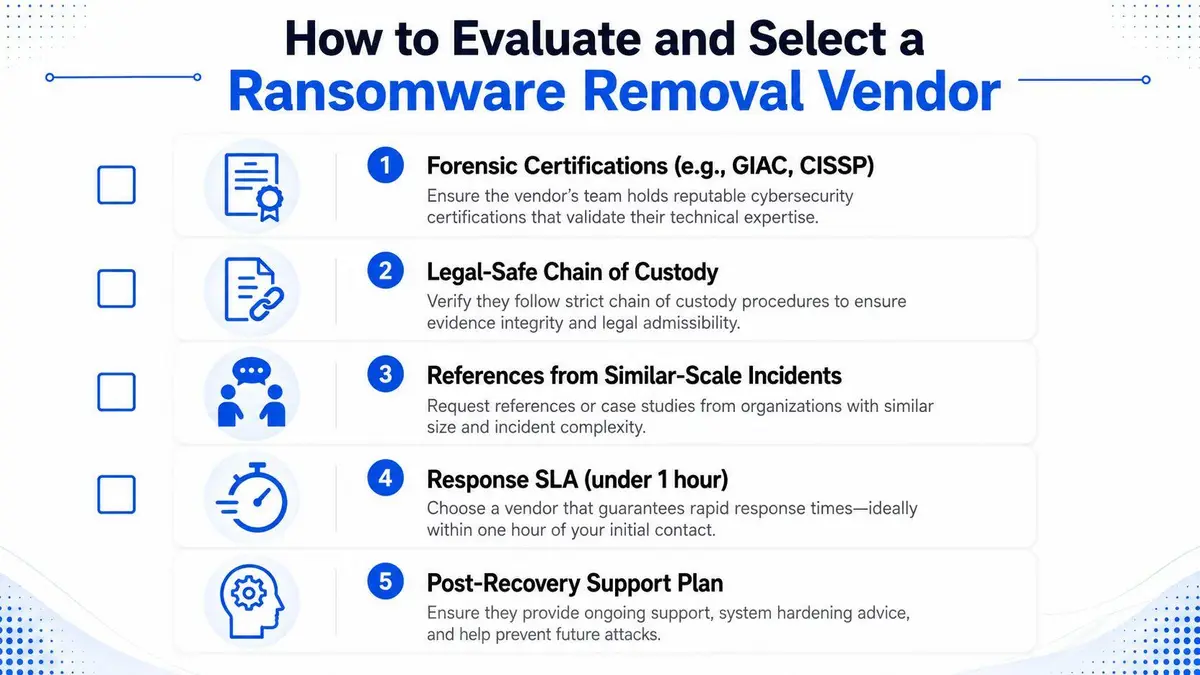
The vendor search should be run like a forensic due diligence exercise, not a beauty contest. Brand recognition means little if the team can’t prove chain of custody, coordinate with counsel, and restore from trusted images without contaminating the environment.
Compare the vendors on the work that matters
| Criterion | Why It Matters | Question to Ask the Vendor |
|---|---|---|
| Forensic certifications | You need people who understand evidence handling, not just endpoint tools. | Which team members will handle evidence, and what forensic certifications or equivalent experience do they have? |
| Legal-safe chain of custody | If the artifacts are sloppy, counsel may not trust the record. | How do you document, store, and transfer forensic materials? |
| References from similar-scale incidents | High-pressure incidents are not the place to train on your company. | Can you provide references from comparable engagements under NDA? |
| Response SLA | Time lost in the first hours makes containment harder. | What does your SLA promise for containment and clean restore? |
| Post-recovery support | Recovery isn’t finished when the server comes back. | What monitoring and validation do you provide after restoration? |
The questions that expose weak firms
Ask who owns the forensic artifacts. Ask whether they rebuild from trusted images or just “clean up” infected boxes. Ask how they validate backups, whether they coordinate with outside counsel, and what happens when the decryptor fails.
If the answer sounds vague, you already have your answer. A vendor that can’t describe the operational path in plain language probably doesn’t have one.
The vendor should also be able to explain how they’ll work with the legal team without freelancing around it. That matters more for executives and family offices than a polished slide deck ever will.
A good engagement feels controlled. A bad one feels like a sales call with malware attached.
Red Flags, Timelines, and What Recovery Should Cost
Some vendors should be walked out of the room immediately. If they refuse to name the decryption method, guarantee recovery in a fixed number of days, demand direct cryptocurrency payment from the client, won’t describe chain of custody, or push to talk to the attacker without counsel, they’re telling you how they operate.
Those are not quirks. They’re indicators that the firm values speed of sale over integrity of recovery.
What a realistic engagement looks like
Containment should happen in hours, not after a long procurement cycle. Forensics and scope usually take longer, because the team has to understand where the attack started, what persistence remains, and which systems need rebuilds. In complex cases, full restoration is usually a multi-day effort, not an instant reset.
That means the right purchase decision is not just about price. It’s about whether the vendor can deliver clean recovery, preserve evidence, and coordinate the legal side without improvisation.
For executives dealing with both public fallout and technical cleanup, reputation management often becomes part of the response stack. If breach visibility is already spreading, the follow-through may also need reputation management after a data breach so the incident doesn’t keep compounding after the systems are restored.
Walk away from firms that sell “recovery” as a disguise
- Direct payment pressure: if they want you to pay attackers without legal review, they’re serving their own margin.
- Fixed-time promises: if they guarantee recovery by a date, they’re guessing or lying.
- No custody trail: if they can’t document evidence handling, they’re weak on process.
- Decryptor certainty: if they promise the decryptor works before testing, they’re overselling.
- Attacker contact without counsel: if they want to negotiate in a vacuum, they’re creating liability.
The cost of recovery is not just the invoice. It’s the difference between a controlled restoration and a second crisis caused by bad vendor judgment.
Prevention and Long-Term Resilience for Executives
The best ransomware removal service is the one you never have to use in anger, and that starts with executive governance, not more software. Privileged identity segregation, tested immutable backups validated by hash, and network segmentation between personal, executive, and corporate estates reduce the blast radius when something slips through.
A separate family-office or executive protection posture helps here too, especially when personal devices, travel, assistants, and corporate access all overlap. If your environment crosses those lines, a digital executive protection program belongs in the conversation alongside incident response.
Keep the playbook with the leadership team
Dark-web monitoring for leaked credentials gives you earlier warning, but rehearsed incident playbooks matter more. The playbook should be owned by the executive team, not buried in IT documentation no one can find during a crisis.
That’s also why the same vendors you consider for recovery should be able to audit the environment that prevented the incident. The firms that understand clean restoration usually understand exposure reduction, credential hygiene, and backup validation too.
For executives with digital asset exposure, a strong comprehensive crypto security plan is a useful model for disciplined recovery thinking, because the same habits apply, clean access control, tested backups, and rehearsed escalation paths.
The most valuable resilience control is a practiced decision tree that still works when the board call starts early and the screens go dark.
The next move is simple. Schedule a confidential assessment, assign legal, IT, and executive owners now, and rehearse the escalation path before the first panic hour arrives. If you want a discreet team that can deal with exposure, takedown, and reputation fallout as part of a broader recovery posture, visit ContentRemoval.com and start the conversation before the incident decides the timetable for you.
Frequently asked questions
Should a company pay a ransomware demand?
The article frames it as a risk calculation rather than a moral question. Payment does not reliably return data, roughly one in three paying organizations never recover it, and any payment discussion raises OFAC and sanctions concerns that require counsel. Fast, verified remediation from clean backups is usually the stronger path.
What should I ask a ransomware removal vendor before hiring them?
Who handles evidence and with what forensic credentials, how chain of custody is documented, whether they rebuild from trusted images or just clean infected machines, how they validate backups, what their containment SLA is, and what monitoring follows restoration. Vague answers are the answer.
How long does ransomware recovery take?
Containment should happen in hours. Forensics and scoping take longer because responders must find the entry point and remaining persistence. Full restoration in complex cases is a multi-day effort, and Sophos found 53% of victims fully recovered within one week in 2025.