
Online reputation repair services are a form of high-stakes risk management, not public relations. The objective is permanent removal or neutralization at the source, using defamation takedowns for false statements of fact, DMCA notices for content you own, and expedited NCII channels for intimate imagery, with search engine de-indexing as the next-best outcome when source removal is not possible.
Key facts
- Defamation needs a false assertion of fact, not opinion; an embezzlement claim is actionable, a competence opinion is not
- DMCA needs proof of ownership, not falsity; compliant hosts often act within 24 to 72 hours
- NCII reports are high-priority on major platforms and turn on lack of consent rather than defamation or copyright
- Lifecycle: confidential assessment, strategic formulation, active removal operations, post-removal monitoring
Where ContentRemoval.com comes in. ContentRemoval.com runs the removal operations described here: building the defamation, copyright, or NCII case file, working directly with publishers, hosts, and search engines, and keeping watch for reappearance after the takedown. The executive’s counsel, a family office, or the person themselves usually makes the first contact, and the assessment is handled under confidentiality from the outset. A free 15-minute Exposure Scan maps what is removable, and the report is yours to keep. Get a Free, Confidential Exposure Scan or read how our reputation management work is done.
For an executive, a high-profile individual, or a family office, a damaged online reputation is not a marketing problem. It is a direct, material threat to personal and corporate assets. Professional online reputation repair services should be understood not as public relations, but as a critical form of high-stakes risk management designed to disarm these threats with surgical precision.
Why Executives Need Digital Reputation Control

A passive approach to your digital footprint is no longer a viable option. Negative content (whether a defamatory article, a leaked private document, or a string of fraudulent reviews) creates real liabilities and immediate business costs. We have seen such content derail M&A deals, sink investor confidence, and directly impact share prices.
Standard public relations tactics, effective for generating positive press, are not equipped to handle targeted, malicious online attacks. True control over your reputation comes from precise, expert intervention that blends legal, technical, and strategic capabilities.
The Financial and Strategic Costs of a Digital Crisis
Leaving your digital flank exposed creates a constant source of risk. The fallout can affect several critical areas, impacting both professional and personal life.
A single damaging search result can unravel decades of trust built with clients, partners, and the public. Harmful online content can jeopardize financing rounds, put executive appointments on hold, and terminate strategic partnerships before they begin. Online attacks often escalate; what starts as a negative article can lead to exposed personal information, creating tangible security risks for you and your family.
This is a matter of asset protection. A hostile search profile acts as a permanent, public dossier that actively works against your interests. For executives seeking to preempt this, understanding the role of a best personal SEO consultant is a vital first step in regaining control.
The Imperative for a Surgical Approach
Restoring your digital narrative requires a focused, surgical approach that goes far beyond the scope of typical PR firms. It involves dismantling negative online assets piece by piece, using a sophisticated toolkit built for complex digital threats.
The goal is not to “bury” or “suppress” negative information. It is to achieve its permanent removal or neutralization at the source. This is the fundamental difference between public relations and professional online reputation repair.
The process is a synthesis of legal challenges, technical takedowns, and strategic content placement. The most effective firms do not simply react to problems as they appear. They deploy a framework to dismantle existing threats while building a resilient defense against future attacks. Our guide on protecting your online identity provides a strategic framework for executives examines this proactive mindset in greater detail.
The following sections will deconstruct the specific legal and technical methods we use to execute this strategy, from initial assessment to final resolution.
Understanding Professional Reputation Repair
The term “online reputation repair” is often mistakenly associated with public relations firms or SEO agencies. The common belief is that the strategy is to simply create a flood of positive content to “bury” the negative material.
That is not what we do. Professional-level reputation repair is a different discipline. It is not about concealing a problem; it is about permanently removing it.
The distinction is best illustrated with an analogy: Imagine discovering a major crack in your home’s foundation. You could hire a contractor to install new drywall and apply a fresh coat of paint to hide it. Alternatively, you could bring in a structural engineer to surgically remove the faulty section and make the foundation whole again. One is a cosmetic patch; the other is a permanent solution. Our work is structural engineering, not painting.
For the executives and high-net-worth individuals we represent, this distinction is paramount. Your reputation is not merely a marketing asset. It is a critical component of your personal and financial security. It must be actively defended.
Source Removal vs. Search Engine De-Indexing
Defending that reputation involves two primary objectives: source removal and search engine de-indexing. Understanding the difference is crucial.
Source removal is the gold standard. It means the damaging content (a libelous news article, a false review, a leaked private document) is completely and permanently erased from the original website. It is gone for good. Search engine de-indexing is the next-best outcome when source removal is not possible. The content technically remains on the host website, but it is removed from search results. If it cannot be found on Google, it effectively ceases to exist for public purposes.
An expert will always pursue source removal first because it completely neutralizes the threat. De-indexing is an incredibly effective secondary strategy, rendering the problem invisible to the outside world.
The Strategic Use of Legal Instruments
Achieving these outcomes requires more than a polite takedown request. It demands a sophisticated approach, using a specific set of legal and technical tools to compel action from publishers, hosting companies, and search engines.
The entire process is an exercise in leverage. It is about identifying the correct pressure point for each specific problem (be it a Terms of Service violation, a copyright infringement, or a court order) and applying it with surgical precision. This is a strategy game, not a numbers game.
For example, a DMCA (Digital Millennium Copyright Act) notice may be used to force the removal of stolen photos or intellectual property. In other cases, a well-documented defamation claim, sometimes backed by a court order, is the necessary tool to dismantle a false and harmful narrative.
Each negative item in your digital footprint requires its own unique diagnosis and strategic plan. The growing demand for this specialized work is reflected in market data. The global Online Reputation Management Services Market grew from USD 427.96 million in 2025 to USD 499.43 million in 2026, with projections to reach USD 1.305 billion by 2032. You can explore the research behind this market expansion on 360iresearch.com.
The Toolkit for Taking Down Negative Content
When dealing with a reputation attack, an indiscriminate approach is ineffective. Real online reputation repair services are about precision. The process is more akin to surgery than demolition, where every tool in the kit has a specific function. Success depends on matching the right strategy to the right problem, often involving a combination of deep technical knowledge and sharp legal action.
Consider it a hierarchy of solutions. While suppressing negative content can be effective in some scenarios, the most permanent solution is always the complete removal of the damaging material. This chart illustrates the basic decision-making process we follow.
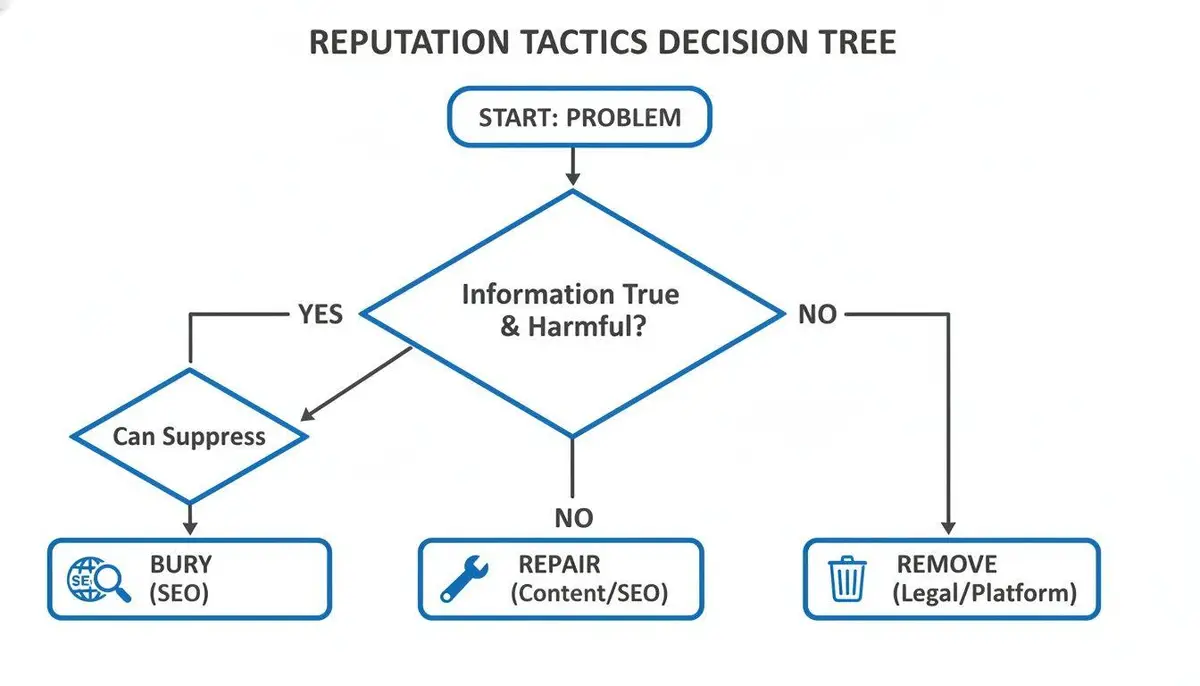
As shown, the path to removal is rarely linear. It demands a clear-eyed assessment of the situation before selecting the appropriate tool. Let’s analyze the most powerful options.
Defamation and Libel Takedowns
When someone is disseminating verifiably false information about you or your business, a defamation claim is your strongest weapon. This is a direct legal challenge, but it is not as simple as identifying content you dislike. You must prove the statement is a false assertion of fact, not merely a negative opinion.
This distinction is critical. “I think the CEO is incompetent” is an opinion and generally protected speech. However, “The CEO embezzled company funds” is a factual claim. If you can prove that claim is false, you have grounds for a defamation action.
The process begins with the meticulous collection of all relevant evidence. With a strong case assembled, we approach the website host or publisher. Many platforms have clear policies against libel, and a well-documented claim often leads to a prompt takedown. If they refuse to cooperate, the next step is to secure a court order that legally compels them to remove it.
Copyright Claims Under the DMCA
One of the most effective and versatile tools available is the Digital Millennium Copyright Act (DMCA). Designed to combat intellectual property theft, it is incredibly useful for reputation repair. If someone has posted your original content (such as a photograph, a private document, or even an email you wrote) without your permission, the DMCA can be used to have it taken down.
The advantage of a DMCA takedown is its speed and simplicity. You do not need to prove the content is false or malicious. You only need to prove you own the copyright to the material and that it was published without your consent.
The law provides a straightforward, powerful process for removal. When a service provider receives a valid DMCA notice, they are legally required to “expeditiously remove, or disable access to, the material.”
This makes the DMCA a decisive tool for removing items like leaked personal photos, stolen business plans, or any authored content being used against you. For compliant hosts in jurisdictions like the U.S., content is often removed within 24-72 hours.
Non-Consensual Intimate Imagery (NCII) Removal
The distribution of Non-Consensual Intimate Imagery (NCII), often termed “revenge porn,” is a deeply violating and urgent crisis. Both legal statutes and platform policies have evolved to treat this issue with the gravity it warrants, creating expedited channels for removal.
All major search engines and social media platforms have dedicated reporting systems for NCII. These reports are flagged as high-priority and are handled differently from standard complaints. The focus is not on proving defamation or copyright; it is on protecting the victim by establishing a lack of consent.
Our role is to navigate these specialized systems quickly and effectively, providing all the necessary documentation to trigger an immediate takedown. This is not just about removing an image from one website. It is a full-scale operation to scrub it from the web and de-index it from search results to prevent its rediscovery. In these situations, speed is critical.
Understanding these removal strategies is key to appreciating the complexity of reputation repair. The following table contrasts the primary methods, showing how each is suited for a different type of problem.
A Comparative Analysis of Content Removal Strategies
This table contrasts the primary methods used in online reputation repair, outlining the ideal use case, legal basis, typical speed, and primary challenges for each approach, giving readers a clear framework for understanding the available tools.
| Removal Strategy | Primary Application | Legal/Technical Basis | Typical Timeline | Key Challenge |
|---|---|---|---|---|
| Defamation Takedown | False statements of fact causing harm (libel/slander). | Tort law (defamation), requiring proof of falsity and damages. | Weeks to months; longer if court order is needed. | Proving a statement is fact, not opinion; navigating different legal standards by jurisdiction. |
| DMCA Copyright Claim | Unauthorized use of your original content (photos, text, videos). | Digital Millennium Copyright Act (DMCA) and similar international laws. | 24 hours to a few days for compliant hosts. | Proving original ownership of the content; ineffective if the content isn’t yours. |
| NCII Removal | Distribution of private, intimate images without consent. | Platform-specific policies and laws like the Violence Against Women Act (VAWA). | Very fast (often hours to days), as it’s a high-priority issue. | Ensuring all copies are found and removed across the web; dealing with uncooperative offshore hosts. |
Each strategy is a specialized instrument. Knowing exactly when and how to deploy them is the core skill of an experienced reputation management team, ensuring the most direct and effective path to restoring your good name.
Executing a Strategy with Realistic Timelines
A successful campaign for online reputation repair services is not a matter of luck, but a carefully planned operation. It does not begin by firing off takedown requests. Instead, it starts with quiet intelligence gathering, a confidential assessment to map every piece of damaging content online. This initial step is absolutely critical for building a strategy that applies the right tool to each specific threat.
Once a clear map of the problem is established, we move into the active phase. This is where a firm’s real-world experience and capabilities are tested. It is not an automated process. It is an active, hands-on campaign run by specialists who know how to navigate the complex, and often frustrating, policies of web hosts, publishers, and search engines.
One of the first questions we always receive is, “How long will this take?” The answer depends on the specific circumstances. There is no one-size-fits-all timeline. Success, and the speed at which it is achieved, hinges on key factors like the type of content, its legal jurisdiction, and the responsiveness of the hosting platform. Setting realistic expectations from the outset is essential.
The Lifecycle of a Removal Project
While every case is unique, the underlying process we follow is structured and methodical. This approach distinguishes professional, targeted intervention from generic tactics.
- Confidential Assessment: We conduct a complete audit of your digital presence to identify every negative item, whether a defamatory article, a fraudulent review, or data leaked onto the dark web. We investigate the origin, content, and proliferation of each threat.
- Strategic Formulation: Based on our findings, we develop a precise plan of attack. This plan outlines the exact removal strategies for each piece of content, whether a legal challenge, a technical takedown, or direct negotiation.
- Active Removal Operations: We execute the plan. Our teams work directly with publishers, hosting companies, and search engines to get the content removed or de-indexed. We provide regular progress reports to keep you informed.
- Post-Removal Monitoring: Removal is a major victory, but the work is not complete. We establish ongoing monitoring to ensure the content does not reappear, a common issue. If it does, we are prepared to act immediately.
This process acknowledges that different problems require different timelines. For a deeper analysis, our guide on professional timelines for search result removal offers a more detailed perspective.
Contrasting Timelines: Anonymized Case Studies
To illustrate the variability of timelines, consider two real-world (but anonymized) examples from our firm. They demonstrate how the nature of the content dictates the operational pace.
A disgruntled former employee posted a defamatory, one-star review on a major business directory. We were able to prove the review was a clear violation of the platform’s Terms of Service against conflicts of interest. The result? We had it permanently removed in under 48 hours.
Such speed is possible when there is a clear policy violation on a cooperative platform. A hostile news article, however, presents a different challenge.
A client was targeted in a misleading news article from an international media organization. Because journalism is heavily protected by free speech laws, a simple takedown request was never going to work. Our multi-stage strategy started with legal negotiations to correct factual errors in the story. Then, we launched a technical campaign to get the article de-indexed from search results in specific countries. The entire process took four months to fully resolve.
The reputation management industry is shifting from reactive problem-solving to a predictive and preventative system that prioritizes real-time monitoring to avert crises. As you can discover more insights about how the reputation industry is changing for 2026 on financialcontent.com, this evolution highlights the need for a flexible strategy capable of handling everything from swift, 48-hour takedowns to sustained, months-long campaigns.
How to Vet an Online Reputation Repair Firm
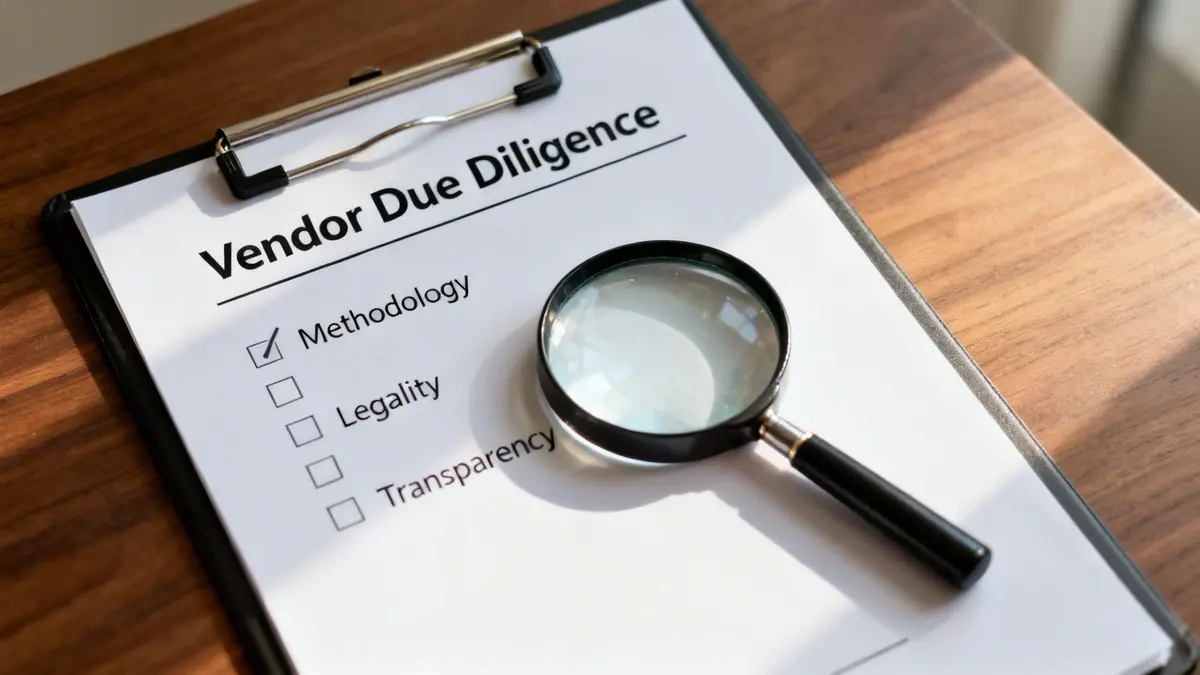
Choosing a firm for online reputation repair services is not like hiring a marketing agency. It is a decision with serious financial and personal implications. The field is crowded, with providers ranging from highly specialized legal and technical teams to glorified SEO shops. Your task is to distinguish the surgeon from the snake oil salesman before engaging their services.
You are not looking for someone to paint over a problem. You are retaining a specialist to perform a discreet, high-stakes operation on your digital footprint. The quality of your questions will directly determine the quality of the partner you find.
Probing for Process and Methodology
Disregard the sales pitch and focus on their process. Vague talk of “suppression” or “creating positive content” is an immediate red flag. A true specialist will discuss removal and neutralization at the source, and they should be able to explain their methods with the precision of a law firm.
The single most important question you can ask is: “Walk me through your specific legal and technical process for removing content, not just burying it.” An expert will immediately discuss legal tools like DMCA takedowns and defamation claims, platform-specific Terms of Service violations, and technical de-indexing strategies. An amateur will evade the question and pivot back to SEO.
Demand to know how they handle different types of threats. Their strategy for a defamatory news article should be entirely different from their approach to fraudulent reviews or a leaked internal document. Their ability to articulate these nuances reveals their actual experience.
Your due diligence should not stop there. A competent firm knows that damaging content can reappear. Ask them directly: “What happens if removed content is re-uploaded or appears on a new website?” Their answer will indicate whether they offer a permanent solution or a temporary fix. For a more detailed framework, you can review our guide on evaluating professional content removal services.
Identifying Critical Red Flags
Knowing what to look for is only half the battle; you also need to recognize the warning signs of an ineffective or unscrupulous operator. Certain promises are impossible to keep, and any firm that makes them should be immediately disqualified.
A 100% success guarantee is a major red flag. No one can honestly guarantee 100% removal for all content. Success often depends on third parties like hosting companies, courts, and search engine administrators. A credible firm guarantees their process and effort, not an outcome they do not fully control.
Reliance on SEO suppression alone is another warning sign. If a firm’s primary strategy is to “bury” negative results with new articles and profiles, they are not a true repair specialist. Suppression is a complementary tactic, not the primary solution for serious reputational damage.
Vague or opaque pricing is also a cause for concern. You should receive a clear, itemized proposal detailing the exact scope of work and the associated costs. Avoid any company offering ambiguous hourly rates without a project cap or that will not provide a concrete fee structure upfront.
The market for these services is expanding rapidly. The Enterprise Internet Reputation Management Market was valued at USD 6.1 billion in 2026 and is projected to reach USD 25.5 billion by 2036. This growth attracts both seasoned experts and opportunistic imitators, making your due diligence more crucial than ever. A thorough vetting process is your best defense against wasting time and money on a strategy that is doomed from the start.
Taking the First Step: Your Confidential Strategic Defense
This guide has covered significant ground, from identifying reputational threats to outlining the specific tools used to combat them. One point should now be clear: your online reputation is not an abstract concept. It is a real, valuable asset that requires professional management and a robust defense. The existence of online reputation repair services demonstrates that you do not have to be a passive victim.
Knowing this is just the beginning. The critical moment is when you transition from understanding the problem to solving it. For any executive, public figure, or company facing a digital crisis, inaction is not a neutral choice. It is a decision that allows the damage to proliferate.
The Next Logical Step Is a Confidential Assessment
Your first move should not be a public statement or a flurry of legal letters. The correct starting point is a quiet, completely confidential assessment of your specific situation. This is where you shift from reacting to attacks to building a proactive strategy, guided by experts who understand the necessity of absolute discretion.
A proper assessment is not a sales pitch. It is a fact-finding mission. We map the full extent of the threat, investigate its source, identify weaknesses in the negative content, and develop a precise, goal-oriented action plan. Everything is handled under a strict cloak of confidentiality, ensuring your situation is contained while we implement the solution.
Your story is too important to be written by anonymous critics or bad actors. Choosing to bring in a professional is about taking back the pen and securing the narrative you’ve worked hard to build.
Consider us your strategic partners in this endeavor. We are here to provide a rapid, targeted defense to neutralize online threats and restore your good name. Your reputation is under pressure, but the means to protect it are at hand.
When you are ready to take definitive action, we are ready to assist. Contact ContentRemoval.com today to begin your confidential assessment and start the process of securing your reputation.
Your Questions About Reputation Repair, Answered
When facing a reputation crisis, you have serious, practical questions. You need to know what is possible, what the cost will be, and how long it will take. Below are straightforward answers to the questions we hear most often from executives, families, and their legal counsel.
Can Negative Content Actually Be Removed for Good?
In many cases, the answer is an emphatic yes. Success is not about luck; it is about strategy. The process is less like waving a magic wand and more like a precise tactical operation. The right approach depends entirely on the type of content, its hosting location, and the applicable laws. We may use direct negotiation, a copyright claim, or a court order for defamation. Each tool is chosen for its effectiveness in a specific scenario. Suppressing content in search results is a backup plan; our primary objective is always complete, permanent removal at the source.
What Does Reputation Repair Cost?
There is no single price tag because no two situations are identical. The investment is tied directly to the complexity of the problem. For instance, removing a single negative item from a compliant website might cost a few thousand dollars. Conversely, dismantling a coordinated attack across multiple hostile sites, especially one requiring international legal work, is a more involved campaign with a correspondingly higher investment. A true specialist will not quote a vague hourly rate. You should expect a thorough analysis followed by a fixed-fee proposal, ensuring alignment on goals and costs from the outset.
A major red flag is any firm offering a “one-size-fits-all” price. Your situation is unique, and the strategy to fix it must be, too. Professional service is always customized.
How Long Does the Process Take?
The timeline is dictated by the strategy employed. For a clear-cut violation of a major platform’s rules, like a copyright infringement on YouTube, a resolution can often be achieved in just 24 to 72 hours. These are swift, decisive actions where the platform’s own policies are on our side. However, more complex cases naturally take longer. Securing a court order to remove a defamatory article or navigating uncooperative foreign hosts requires patience and persistence. These campaigns can span several weeks or even months. Our initial analysis will provide you with a realistic, experience-based timeline.
What Kind of Guarantee Is Realistic?
Be extremely cautious of any firm that promises a 100% success guarantee on all removals. The final decision to remove content rests with third parties like web hosts, site administrators, or search engines. No one can directly control them. A credible specialist guarantees their process and their expertise. They guarantee they will execute the agreed-upon strategy with precision. Success is measured by confirmed, permanent takedowns, and a professional firm will always have a clear plan for what happens if removed content ever reappears.
Taking control of your digital story begins with a single, decisive step: a discreet, confidential review of the facts. At ContentRemoval.com, we provide a clear, actionable path forward so you know exactly where you stand.
Begin your confidential assessment with us today.
Frequently asked questions
What is the difference between removing content and de-indexing it?
Source removal erases the content from the original website; it is gone. De-indexing leaves it on the host but removes it from search results so the public cannot find it. Specialists pursue source removal first because it fully neutralizes the threat, with de-indexing as the next-best outcome.
Can I use a DMCA notice to remove a leaked document or photo about me?
Yes, if you own the copyright, for example a photograph you took, a document you wrote, or an email you authored. You do not need to prove the content is false or malicious, only ownership and lack of consent. Compliant hosts in jurisdictions like the US often remove within 24 to 72 hours.
How long does online reputation repair take?
A clear-cut platform violation can resolve in days, while a defamatory article requiring a court order or an uncooperative foreign host can take weeks or months. The article contrasts a policy-violating review removed quickly with a misleading international news article that needed legal negotiation and country-specific de-indexing over several months.