
Removing a mugshot from the internet takes two parallel efforts: getting the image deleted from the host site and getting the URL de-indexed from Google. The route depends on the publisher: .gov portals need an expungement or sealing order, news sites rarely delete accurate reporting, and for-profit aggregators respond to formal notices citing state law and Google’s exploitative removal policy.
Key facts
- Several states make it illegal for a website to charge a fee to remove a booking photo.
- Google’s policy against exploitative removal practices covers mugshot sites that demand payment to take images down.
- An expungement seals the official record but does not automatically remove copies from private websites.
- Paying one mugshot site can lead to the image appearing on affiliated sites demanding more money.
Where ContentRemoval.com comes in. ContentRemoval.com handles mugshot removal for professionals who cannot afford to have an old arrest photo sitting on page one, usually after the person, their attorney or their chief of staff has already found it. We contact the host sites and Google on your behalf so you never have to reveal your identity or urgency to an extortion-style operator. A free 15-minute Exposure Scan maps every copy that is removable, and the report is yours to keep. Get a Free, Confidential Exposure Scan or read how our mugshot removal work is done.
Discovering your mugshot online is a significant and personal crisis that requires a decisive, strategic response. Effective removal necessitates a two-pronged approach: eliminating the image from the source website and purging it from Google’s search index. This is a complex legal and technical challenge where a single misstep can amplify the damage.
The High Stakes of an Unwanted Digital Footprint

An online mugshot is not merely an inconvenience; it is a direct threat to your livelihood and credibility. For executives, professionals, and individuals whose careers depend on trust, an old arrest record, even for a dismissed charge, can instantly jeopardize high-stakes transactions, investor confidence, and critical business relationships.
This is not a matter of embarrassment. We have seen a single search result derail multi-million-dollar deals and poison professional partnerships. Search engine algorithms are indifferent to legal outcomes; they prioritize sensational content that generates user engagement, often elevating a damaging post to the top of your search results.
The Predatory Ecosystem of Arrest Data
The problem is compounded by an industry built on profiting from this data. Numerous mugshot websites systematically scrape public arrest records from government databases and republish them, converting your personal legal matter into their advertising revenue. These operators function in a legal gray area, wholly ignoring the context of the arrest or the resolution of the case.
A dismissed charge, a case of mistaken identity, or a minor infraction from years ago is stripped of all context. It is presented as a permanent mark against your character, shaping public and professional perception long after the legal matter has concluded.
This system is fueled by a high volume of arrests, a significant portion of which do not result in criminal convictions. For example, as of February 7, 2026, Immigration and Customs Enforcement (ICE) held 68,289 individuals in detention. A staggering 73.6% of them (50,259 people) had no criminal conviction. Many were detained for minor infractions, yet their booking photos feed this massive, commercially driven online database.
Assessing the Initial Damage
This is not a public relations issue to be managed with spin. It is a complex digital problem demanding a precise, expert-led response. The objective is not merely to suppress the negative result but to achieve its complete removal from the source website. A thorough assessment of the damage is the first step in formulating a counter-strategy. You must document where the mugshot appears, its visibility, and its impact on your professional and personal standing.
Initial Damage Assessment Framework
Utilize this framework to methodically evaluate the visibility and potential impact of the online mugshot.
| Risk Area | Assessment Question | Severity Level (Low/Medium/High) |
|---|---|---|
| Search Visibility | Does the mugshot appear on the first page of Google for your name? | High |
| Site Authority | Is the mugshot on a well-known, high-traffic website? | High |
| Social Media | Has the image been shared on platforms like Facebook or X? | Medium |
| Professional Impact | Is it visible to clients, employers, or investors? | High |
| Personal Impact | Have family, friends, or community members seen it? | Medium |
| Image Duplication | Does the same mugshot appear on multiple websites? | High |
Answering these questions provides an objective measure of the threat. This disciplined analysis is the first step in moving from a state of crisis to a position of control, enabling you to methodically dismantle the reputational risk.
Your First 48 Hours: A Damage Control Protocol

The discovery of a personal mugshot online invariably triggers an acute sense of distress. The actions taken in the subsequent 48 hours are critical. Hasty, emotional responses can be counterproductive, complicating future removal efforts. The immediate objective is not removal but containment. The priority is to shift from a reactive posture to a controlled, strategic position by gathering intelligence without alerting the website operators.
First, Maintain Strategic Silence
The immediate instinct to demand removal via an angry email is a tactical error. Many mugshot websites are sophisticated extortion operations, and a panicked communication is the signal they await. Contacting them confirms the information’s value and your desperation, which often results in exorbitant “processing fee” demands. Worse, some operators will interpret your distress as leverage, syndicating your mugshot across affiliated websites to increase pressure to pay.
The single most powerful initial action is to do nothing that alerts the publisher. Strategic silence denies them the desired reaction. It ensures you retain control over the timeline and the terms of any potential future negotiation.
This initial period is an observation phase. Your silence is a strategic asset. Do not comment on the post, do not use their contact forms, and under no circumstances send an email. Gather intelligence discreetly.
Initiate a Controlled Search
While maintaining silence, you must ascertain the full extent of the information’s proliferation. Repetitively searching your own name can signal to search engines that the page is relevant, potentially increasing its rank. This process must be conducted with precision.
Always use a private browsing window, such as Incognito Mode in Google Chrome, to prevent your search history from influencing the results. Be methodical.
Search these key variations and maintain a secure record:
- Your full name: “Johnathan Smith”
- Your name + location: “Johnathan Smith Atlanta”
- Your name + “arrest” or “mugshot”: “Johnathan Smith arrest”
As you conduct these searches, create a spreadsheet to log every URL where your mugshot appears. This document is the foundation of your removal campaign, converting a broad, overwhelming problem into a concrete list of targets, each requiring a specific strategic approach.
Document Everything Securely
Your documentation must be meticulous, as it will serve as the primary reference for you, your legal counsel, or a professional removal service. Bookmarks are insufficient.
For every URL on your list, you must preserve three pieces of evidence:
- The Full URL: Copy and paste the exact web address.
- A Full-Page Screenshot: Capture the entire webpage, including the site’s branding, advertisements, and all text accompanying your mugshot. If possible, ensure the system date and time are visible in the screenshot.
- All Associated Data: Transcribe every detail published: arrest date, specific charges, booking number, and any other listed information.
This rigorous record-keeping serves two critical functions. First, it creates a complete and undeniable snapshot of the problem. Second, it prepares you for the next phase: analyzing each site to determine the optimal removal strategy, whether through a legal process, direct request, or search engine de-indexing. A composed, methodical approach now is essential for a successful outcome.
Executing Removal: Direct Takedowns and Google De-Indexing
With comprehensive documentation prepared, the removal campaign can commence. This is a two-front battle targeting both the websites hosting the mugshot and the search engines that provide visibility.
Source removal, getting the image taken down from the host website, is the final objective, as it eradicates the content. However, de-indexing the URL from Google is a powerful interim measure that renders the image effectively invisible to the public. These two efforts must be pursued concurrently for maximum effect.
Identify Your Adversary
Your strategy is contingent upon the type of website publishing the content. A request submitted to a county sheriff’s office differs fundamentally from one sent to a predatory mugshot aggregator. An incorrect approach will be ignored or, worse, could lead to extortion.
These websites fall into three primary categories:
- Official Law Enforcement Portals: These are .gov websites operated by police departments or courts. They publish information in accordance with public records laws, not for profit. Removal from these sources is not a negotiation; it requires official legal documentation, such as a court-ordered expungement.
- Legitimate News Media: Established newspaper and television station websites that reported the arrest as news operate under strong First Amendment protections. They will rarely remove factually accurate reporting. The most viable strategy here is to request an update or addendum noting if the charges were dismissed or the record expunged.
- Predatory Data Brokers: This is the most prevalent category. These are for-profit websites that scrape and republish mugshots. Their business model is predicated on profiting from your situation, either through ad revenue or by charging for removal. They will be your most common and challenging adversaries.
Strategy for Engaging Data Brokers
Dealing with predatory sites requires careful navigation. They are structured to exploit fear and urgency. The moment they detect panic, you lose leverage. Therefore, your initial contact must be formal, impersonal, and professional.
Draft a formal takedown notice. Do not plead or offer emotional explanations. Instead, cite their own Terms of Service or privacy policy. More effectively, research and cite relevant state laws. A number of states have enacted statutes making it illegal for a business to charge a fee for removing a booking photo. Referencing a specific statute demonstrates legal awareness and signals that you are not an easy target.
Your communication must never betray desperation. Frame your request as a procedural matter of compliance, not a personal appeal. This approach shifts the power dynamic and significantly reduces the likelihood of an extortion attempt. The objective is to position removal as a matter of their own policy or legal compliance.
If they respond with a demand for payment, you have entered a hazardous negotiation. We have seen countless instances where paying one site results in the mugshot appearing on several “affiliate” sites in a classic extortion scheme. Before ever considering payment, demand a written guarantee of permanent removal with a defined timeline. This is a point where engaging a professional service is invaluable, as they are equipped to navigate these negotiations without succumbing to such tactics.
The Google De-Indexing Process
Concurrently with your efforts to secure source removal, you must petition Google to de-index the content. De-indexing removes the page from search results for your name. While the image may persist on the obscure source website, it will be undiscoverable by the public.
Google maintains specific policies regarding this content. While it generally will not remove mugshots from government websites, it has a clear policy against “exploitative removal practices.” This is your primary angle of attack. Mugshots published on predatory sites that demand payment for removal squarely fit this definition. For detailed guidance on structuring this argument, see our analysis on how to submit a Google legal request for maximum effectiveness.
A successful de-indexing request requires:
- The exact URLs of the pages containing the image.
- The search queries that surface the image (e.g., your full name).
- A concise, clear explanation of how the site violates Google’s policies.
Proactively, consider how to defend against future data scraping. As technology advances, exploring strategies to block AI crawlers from indexing your information on personal websites or blogs you control is a prudent long-term measure. A successful campaign requires a disciplined plan and a dispassionate approach, transforming a personal crisis into a manageable project.
Using Legal Instruments for Permanent Removal
While takedown requests and Google de-indexing are effective initial steps, achieving permanent protection of your reputation requires leveraging legal authority. A technical request is, by its nature, optional for a website owner to fulfill. A court order is not.
When you introduce legal instruments, you are no longer requesting a courtesy; you are making a demand backed by the force of law. This is particularly potent if your case was dismissed, you were acquitted, or the matter was otherwise resolved in your favor. In these circumstances, the law is unequivocally on your side.
The Power of Expungement and Record Sealing
The single most effective weapon for permanent removal is a court-ordered expungement or record seal. This legal instrument declares that the arrest record is no longer public, providing ultimate leverage against any website still publishing the associated mugshot.
Once a record is expunged, any site continuing to display the image is no longer reporting a public fact; they are disseminating outdated, misleading, and legally sealed information. This fundamentally alters the legal dynamic from a debate over freedom of publication to a matter of their obligation to remove information that a court has ordered private. A formal removal demand accompanied by an expungement order is nearly impossible for any legitimate publisher to deny.
This decision tree illustrates the distinct pathways for addressing mugshots, depending on whether they are on the source website or merely indexed in search results.
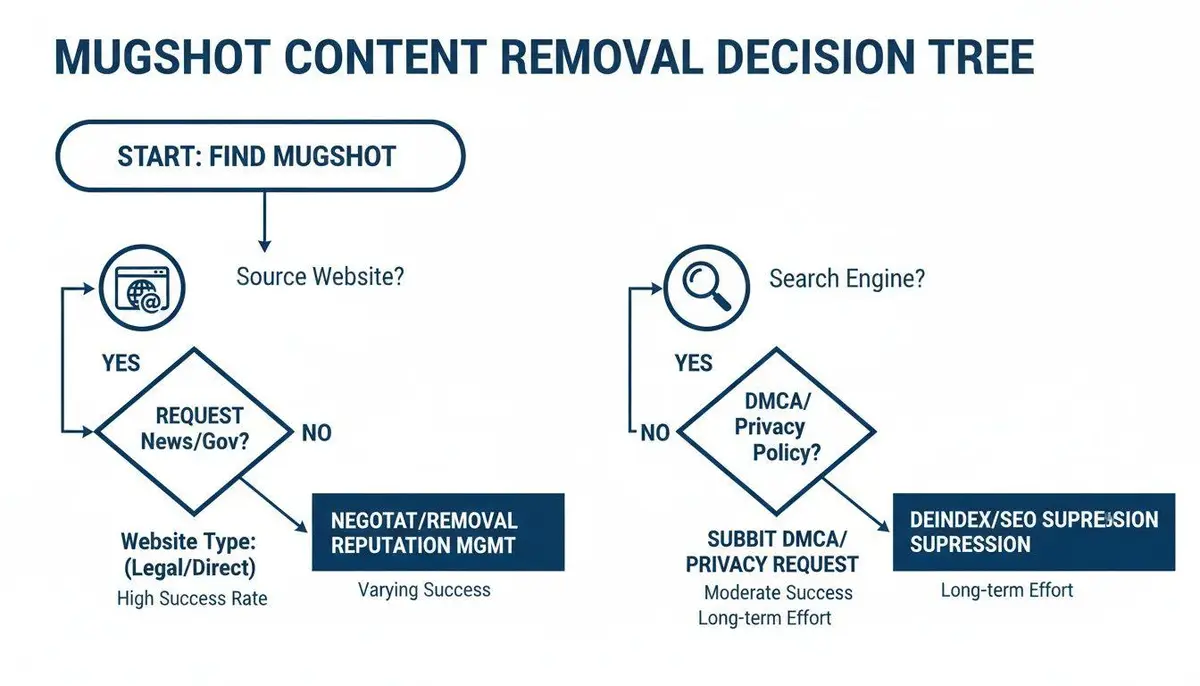
As the diagram shows, your strategy must adapt based on where the content resides. The approach involves either direct negotiation with the website or a concentrated effort to de-index the content from search engines.
Strategic Deployment of Cease and Desist Letters
If an expungement is not an option or the process is protracted, a Cease and Desist letter from qualified legal counsel is a powerful initial action. This is not merely an email; it is a formal legal notice that puts the website operator on notice of potential litigation.
A professionally drafted letter from a law firm signals that you are prepared to escalate the matter. It compels the site operators to conduct a cost-benefit analysis: is the marginal ad revenue from your mugshot worth the significant risk and expense of a lawsuit? For most smaller operators, the answer is no. It communicates that continued non-compliance will have material financial consequences.
A Cease and Desist letter functions as a formal line in the sand. It documents your removal demand and starts a clock on the publisher’s liability, making any continued publication of the content an act of willful negligence.
These letters are not a panacea. Hardened extortion-style mugshot sites may dismiss them, anticipating that the sender will not follow through with litigation. A Cease and Desist is therefore most effective when deployed as part of a broader strategy, often as a prelude to more forceful legal action. Understanding the full spectrum of options for legal content removal is essential for developing a successful strategy.
Defamation Claims for Inaccurate or Misleading Content
In some cases, the harm stems not from the mugshot itself but from the inaccurate context surrounding it. If a website falsely claims a conviction for a mere arrest or publishes exaggerated details, you may have grounds for a defamation claim. Defamation is the publication of a false statement that damages a person’s reputation. A successful defamation lawsuit can result in a judicial order compelling the site to remove the content and potentially pay damages.
This legal avenue has grown in importance. For instance, during the first nine months of a recent presidential administration, interior deportations increased by a factor of 4.6. This surge created a flood of online arrest records for minor immigration holds, many of which were quickly resolved but left a damaging online footprint. These records often lack critical context, creating a false narrative that can cause long-term harm.
In such situations, legal action is often the only means to correct the record. It is also relevant that many of these sites acquire data via automated processes. A foundational understanding of web scraping legality and compliance can sometimes reveal procedural weaknesses in how your data was obtained. Ultimately, employing legal tools transforms the conflict from a frustrating exchange with a website operator to a formal legal matter where facts and evidence prevail.
When to Engage Professional Removal Services

While the desire to resolve a mugshot issue independently is understandable, self-directed efforts are fraught with risk. In our experience, well-intentioned DIY attempts frequently backfire, leading to prolonged frustration and, in some cases, increased visibility of the damaging content.
The moment you contact a predatory mugshot site, you transition from an anonymous name on a list to a confirmed, actionable lead. At this juncture, engaging a professional firm is not an admission of defeat but a decisive strategic maneuver. This is not a simple “delete photo” request; it is a specialized operation that requires experience, established relationships, and absolute discretion.
The Value of Speed, Certainty, and Discretion
The core value that a professional service like ContentRemoval.com provides is a synthesis of speed, certainty, and discretion. An individual could spend weeks or months sending requests with no response. In contrast, our firm often initiates action and achieves significant results within 24 to 72 hours.
This efficiency is not arbitrary. It is the result of years spent developing proprietary removal systems and cultivating direct lines of communication with web administrators, hosting providers, and search engine support teams. We do not simply submit a request; we activate a proven workflow designed to bypass bureaucratic delays and achieve resolution.
The question isn’t if a mugshot can be removed. It is a matter of how quickly, cleanly, and discreetly the removal can be executed. A professional service converts a stressful, high-stakes gamble into a predictable, managed process with a guaranteed outcome.
Certainty is the other critical component. When you attempt removal yourself, the outcome is unknown. A reputable firm provides a clear, upfront assessment and often backs its work with a results-based guarantee. This transfers the risk from you to the service provider.
Understanding the Cost and Timeline
We believe in complete transparency regarding costs and timelines. Professional mugshot removal should be viewed as an investment in your most critical asset: your reputation. The cost is not arbitrary but is based on the specific parameters of your case, including the number of websites, their level of cooperation, and the overall complexity of the situation.
Our process is methodical:
- Confidential Assessment: We conduct an exhaustive digital audit to identify every instance of the damaging content.
- Strategic Plan: We develop a bespoke action plan detailing the precise strategy for each website and search engine.
- Execution and Monitoring: We execute the removal campaign and implement continuous monitoring to ensure the content does not reappear.
Timelines are variable. A straightforward Google de-indexing may take several days. A complex case involving uncooperative offshore websites could take several weeks. However, by leveraging our established protocols, we condense a process that could take an individual months into a matter of days.
The following table provides a direct comparison between a self-directed approach and engaging an expert firm.
Comparison of Removal Approaches DIY vs Professional Service
This breakdown clarifies the risks, timelines, and success rates when comparing a DIY approach to engaging an expert firm.
| Factor | DIY Approach | Professional Service (ContentRemoval.com) |
|---|---|---|
| Timeline | Weeks to months, often with no resolution. | Initial actions within 24-48 hours; full removal typically in days. |
| Success Rate | Highly variable and often low, especially with extortionist sites. | Extremely high, often backed by a success-based guarantee. |
| Risk of Escalation | High; can trigger wider distribution of the mugshot. | Minimal; all communications are handled discreetly by experts. |
| Confidentiality | Compromised; you directly expose your identity and desperation. | Absolute; client identity is shielded throughout the process. |
| Resources Required | Significant personal time, emotional energy, and legal research. | A single point of contact manages the entire complex process. |
Ultimately, engaging a professional firm is about securing a definitive solution. It allows you to regain control of your narrative with the assurance that specialists are managing the problem completely and permanently.
Frequently Asked Questions About Mugshot Removal
Finding your mugshot online prompts an immediate flood of urgent questions. Having guided numerous clients through this exact situation, we provide clear, authoritative answers to the most pressing concerns.
Is It Legal for Websites to Post My Mugshot?
In most jurisdictions, yes. Arrest photographs are typically created as part of an official government process, classifying them as public records. This legal status often grants third parties the right to republish them.
The legal landscape shifts, however, when commercial websites exploit these images for profit. Several states have enacted laws specifically targeting sites that demand a fee for removal. If a website is conditioning removal of your mugshot upon payment, they may be in violation of state law, which provides a strong legal basis for a removal demand.
Will an Expungement Automatically Remove My Mugshot?
No. This is a common and critical misunderstanding. An expungement is a legal process that seals or destroys the official government record of an arrest. It directs the courthouse and law enforcement agencies to make the record non-public. It does not, however, automatically notify the thousands of private websites that have already scraped and published your photograph.
An expungement isn’t a magic wand for the internet. It is, however, your single most powerful piece of leverage. You or your representative must proactively present the expungement order to each website and search engine to demand removal.
Once you possess a court order, your request is no longer a polite inquiry but a legal demand. A website that ignores an expungement order is knowingly publishing information that has been legally designated as private, placing them in a legally precarious position.
How Long Does Mugshot Removal Take?
The timeline varies significantly. In an ideal scenario involving a cooperative local news site or a simple Google de-indexing request, resolution might occur within a few days to a few weeks.
This, however, is not the typical experience. Many mugshot websites are designed to be uncooperative, ignoring communications for months or refusing to act without payment. This is where professional intervention is transformative. Leveraging established contacts and proven methodologies, a dedicated service can secure removals from the most recalcitrant sites and clear search engine results in as little as 24 to 72 hours.
Can I Remove a Mugshot Myself?
While you can attempt removal yourself, extreme caution is necessary. The most significant error is making direct contact with a predatory mugshot site. This action confirms your identity and signals your desperation, often triggering extortion demands or, worse, syndication of your photo across their network, thereby escalating the problem.
Every action you take online can either advance or undermine your objective. A single misstep can inadvertently increase the mugshot’s search engine visibility, a phenomenon known as the Streisand effect. Engaging a professional ensures that every step is executed strategically and discreetly, mitigating these risks and resolving the issue without unintended consequences.
When your reputation is at stake, you require a definitive solution, not a high-risk DIY endeavor. The team at ContentRemoval.com specializes in the fast, discreet, and permanent removal of damaging online content. We manage the entire complex process, allowing you to focus on your personal and professional obligations. Begin your confidential assessment with ContentRemoval.com today.