
A celebrity reputation management service is a coordinated legal, technical and operational response to harmful online material about a public figure. It identifies where the content originated and spread, classifies each item as removable, de-indexable or suppressible, then acts through platform enforcement, legal notices, search removal requests and monitoring for re-uploads, all under strict confidentiality.
Key facts
- Three pillars: real-time monitoring, surgical removal where possible, and digital fortification with authoritative assets.
- The first 24 to 48 hours cover evidence capture, host-level notices, search-focused requests and message discipline.
- Section 230 limits direct action against US platforms; European privacy frameworks open routes US litigation lacks.
- Around 30 days in, work shifts to search reshaping, asset deployment and repeat takedown cycles.
Where ContentRemoval.com comes in. ContentRemoval.com handles this kind of matter for public figures, usually approached by a manager, publicist, family office or counsel rather than the person themselves. The team maps the source, the copies and the search results, then works through the removal, de-indexing and monitoring routes item by item. A free, confidential 15-minute Exposure Scan shows what is removable, and the report is yours to keep. Get a Free, Confidential Exposure Scan or read how our reputation management work is done.
At the point most clients call us, the facts are not the only problem. The primary problem is velocity.
A leaked clip is being reposted. A hostile article is ranking for your name. A private dispute has become searchable. Your manager is fielding messages from partners, counsel, and family office staff at the same time. Everyone asks the same question in different language: how bad is this, and how fast can it be contained?
A celebrity reputation management service exists for that exact moment. Not for vanity. Not for routine publicity. For control.
The work is technical, legal, and operational. It deals with source removal, de-indexing, impersonation, re-upload prevention, search result restructuring, and secure coordination across counsel, management, and platform contacts. If you hire a generalist PR shop for this kind of problem, you are asking a speechwriter to do the work of a crisis unit.
The Anatomy of a Digital Crisis
A digital crisis rarely starts where the public sees it. It starts with a trigger. A disgruntled former associate uploads private material. A blogger republishes an allegation without verification. A forum thread gains traction, then a larger account screenshots it, then a search engine indexes the commentary before your team has even agreed on a statement.
Within hours, your name can become attached to an unflattering narrative that is incomplete, false, invasive, or all three.
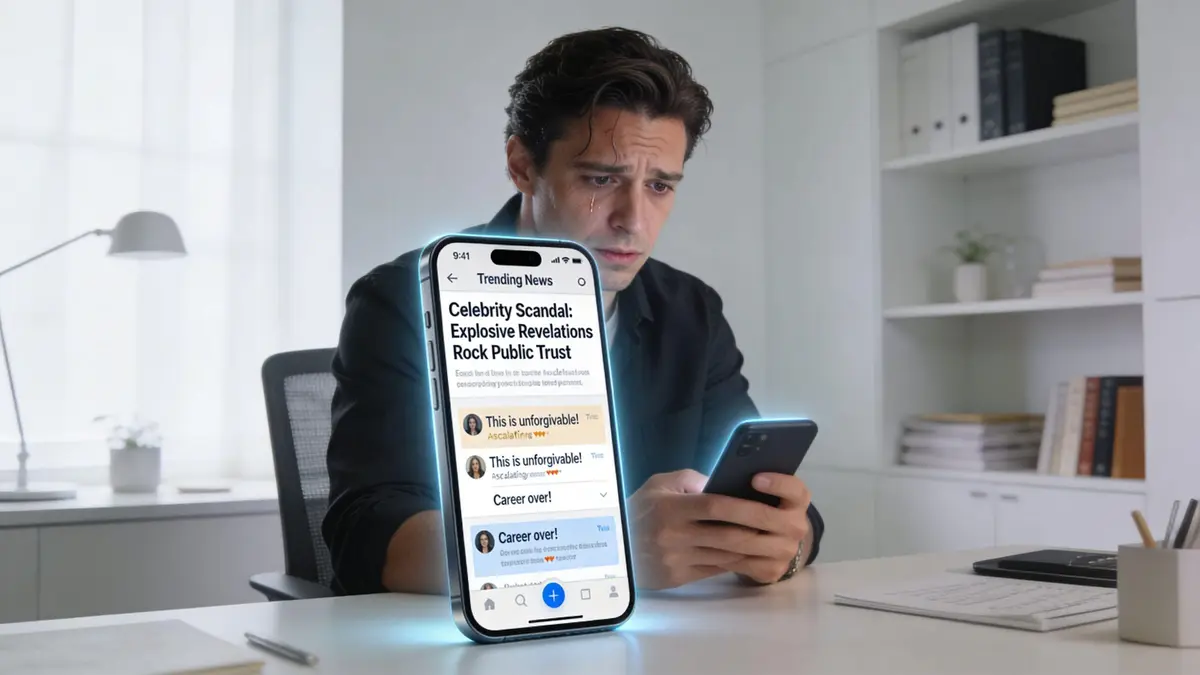
The public tends to call this “bad press.” That is inaccurate. Bad press is an image problem. A true digital crisis is an infrastructure problem. Harmful material lives on websites, search indexes, social platforms, image repositories, mirror sites, and anonymous forums. It is copied, quoted, clipped, and reframed. If you only address the headline, the copies continue working against you.
What the crisis threatens
The threat is not abstract reputation. It is commercial and strategic advantage.
A partner considering an endorsement, investor access, a board appointment, a film attachment, or a licensing deal does not conduct a philosophical review of your character. They search your name. They assess risk. They ask whether controversy will distract from the asset they are paying for.
That is why the broader market is expanding so aggressively. The online reputation management services market is projected to reach $22.18 billion by 2032, growing at a 11.2% CAGR starting from 2026, according to WiserReview’s reputation management statistics. The point is clear. Informed clients no longer treat reputation defense as optional overhead.
What a professional intervention looks like
A proper service does three things at once:
- It identifies the primary attack surface: original publishers, syndicators, search results, high-risk social accounts, and replicating hosts.
- It classifies the material correctly: defamation, privacy breach, copyright misuse, impersonation, non-consensual intimate imagery, platform policy violation, or lawful but damaging coverage that must be suppressed rather than removed.
- It executes through the right channels: legal notices, platform escalation, search de-indexing requests, technical suppression, and evidence preservation.
The first mistake high-profile clients make is treating a searchable crisis as a communications issue. It is a removal, indexing, and containment problem first.
If you want a public example of how allegations and public narrative can rapidly overtake legal process, the background in The Lizzo Scandal is useful. Not because every case is comparable. Most are not. But because it shows how quickly a dispute becomes a permanent search issue once the story hardens online.
A celebrity reputation management service, done properly, is closer to coordinated legal and technical enforcement than classic media relations. PR may support the effort. It should not be mistaken for the effort.
The Mechanics of Digital Reputation Control
Think of your digital presence the way you would think about a private estate. You do not protect it with one lock. You use surveillance, perimeter control, and structural hardening.
A serious celebrity reputation management service follows the same logic.
Monitoring before narrative drift
The first pillar is real-time monitoring. Not passive alerts that arrive after a story has spread, but active tracking across search, social, video, image boards, forums, and copycat domains.
Industry benchmarks cited by Reputation Rhino state that real-time monitoring allows response within the critical first hour and can limit reputational damage by up to 70% through rapid intervention. Their discussion of celebrity ORM strategies is here: effective celebrity online reputation management strategies.
Monitoring is where many teams underinvest because it looks invisible. That is a mistake. If your name, likeness, family members, or business entities are being targeted, early detection determines whether counsel can stop a problem at source or whether you are forced into a slower suppression campaign later.
For clients who need standing surveillance rather than sporadic alerts, a dedicated reputation monitoring system is part of the defensive baseline.
Removal where removal is possible
The second pillar is surgical removal. This is the part most outsiders misunderstand.
Not every harmful result can be deleted. Some can. Some should be. Some must be pushed down because the host has legal protection or refuses cooperation. The skill lies in categorizing each item correctly and acting through the highest-influence route.
A competent team reviews questions like these:
| Threat type | Primary response path | Why it matters |
|---|---|---|
| Defamatory article | Source challenge, legal review, de-indexing analysis | Wrong route wastes time and preserves visibility |
| Leaked private media | Platform policy enforcement, privacy claims, re-upload watch | Speed matters more than messaging |
| Fake account or impersonation | Account reporting, identity verification, escalation | Delay invites screenshots and secondary spread |
| Search result built on old or misleading content | Suppression and authoritative content replacement | Search architecture can outlast the underlying event |
This work is not glamorous. It is procedural, repetitive, and exacting. That is why it works.
Fortification so one hit does not define you
The third pillar is digital fortification.
If your online footprint is thin, one scandal-themed result can dominate perception. If your footprint is deep, authoritative, and well-structured, a hostile item faces resistance from official assets, verified bios, interviews, controlled domains, professional profiles, and publisher relationships.
That fortification includes:
- Authoritative assets: official sites, controlled profiles, verified biographies, and high-trust media pages.
- Search architecture: schema, entity alignment, profile consistency, and content that clearly signals legitimacy.
- Persistence controls: monitoring for re-uploads, aliases, clipped reposts, and mirrored pages.
The strongest defense is not a statement. It is a digital environment in which false or invasive material struggles to dominate search and social discovery.
Most underperforming providers do one of these pillars and pretend it is a full system. It is not. Monitoring without removal leaves the threat alive. Removal without fortification invites recurrence. Fortification without monitoring means you discover the next problem too late.
From Crisis to Control The Service Lifecycle
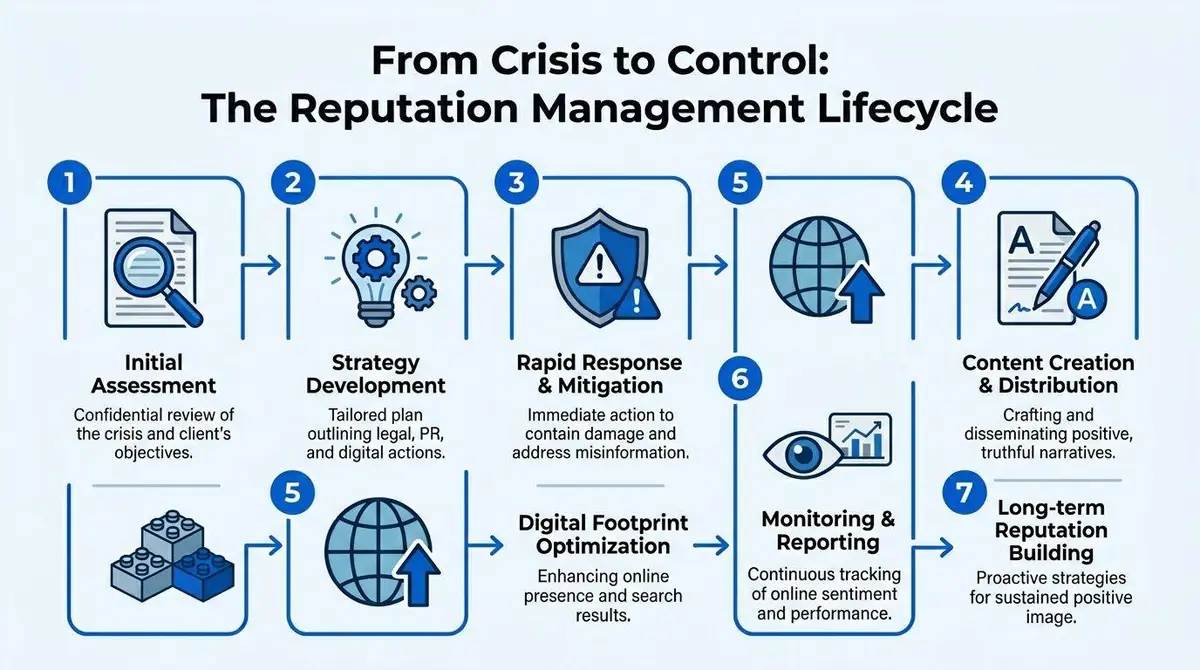
When a high-profile client engages a specialist firm, the process should move fast but not blindly. Disorder is expensive. A disciplined sequence produces better outcomes and fewer secondary mistakes.
Intake and containment
The first phase is confidential assessment. We identify what exists, where it originated, what has been indexed, what has been copied, and which counterparties matter most. Public interest and legal posture are evaluated immediately because they determine whether the lead tactic should be source removal, search de-indexing, platform enforcement, or parallel suppression.
This phase also answers a question clients often avoid asking directly: what can be fixed quickly, and what will require a campaign?
Some matters are suitable for immediate platform action. Others involve entrenched press coverage and need a longer program that changes what appears when your name is searched.
What can happen in the first 24 to 48 hours
The short window is used for actions where speed has the highest payoff.
According to The Best Reputation’s discussion of celebrity ORM, SEO-driven content suppression can push authorized content to 90% of first-page real estate, and within 24 to 48 hours, de-indexing requests under GDPR or CCPA, or direct source removals, can suppress 65% of defamation content in suitable cases. That source is here: celebrity reputation management service tactics.
In practice, this early period usually includes a combination of the following:
- Evidence capture: preserving URLs, timestamps, account details, cached copies, and distribution pathways before a poster edits or deletes.
- Host-level action: notices to publishers, social platforms, and intermediaries where policies or rights have been violated.
- Search-focused intervention: requests aimed at reducing visibility while source disputes proceed.
- Message discipline: instructing representatives and associates not to amplify the issue through uncontrolled reactions.
A sloppy response in this period creates long-term damage. The wrong legal threat can provoke publication. The wrong public denial can refresh the story. The wrong intermediary can notify the poster before evidence is secured.
The first month
By this point, the emergency phase should be over. The case becomes a managed operation.
We now know which items can be removed, which can be de-indexed, which must be outranked, and which are likely to persist because they sit inside lawful reporting or hostile jurisdictions. Search result engineering becomes more deliberate. Controlled assets are published or strengthened. Platform trust and verification issues are cleaned up. Impersonation variants are mapped.
A client should expect regular reporting on movement, not theatrical language. The questions that matter are practical:
| Time horizon | What should be happening |
|---|---|
| First days | Triage, evidence capture, urgent notices, immediate platform actions |
| Around 30 days | Search reshaping, asset deployment, suppression work, repeat takedown cycles |
| Longer horizon | Re-upload prevention, persistent monitoring, resilience building, legacy cleanup |
A strong service does not promise universal deletion. It tells you which assets are removable, which are suppressible, and which require long-term containment.
The longer campaign
At the later stage, reputation work becomes less visible and more valuable. The objective is no longer just reducing harm. It is restoring strategic freedom.
That means your official profiles rank properly. Old, low-quality pages lose prominence. High-authority material about your legitimate work occupies more of the digital field. The next journalist, investor, casting director, or counterparty encounters a curated but truthful footprint rather than a crisis snapshot.
Many clients finally understand the distinction between panic response and control at this stage. Panic seeks deletion. Control builds a search and media environment that is harder to hijack the next time.
The Indispensable Role of Legal and Confidentiality
The legal side of reputation management is where most amateur operators fail. They know the language of image repair but not the mechanics of enforceable removal.
That gap is costly. If the content is illegal, invasive, stolen, or defamatory, your strategy should begin with legal classification, jurisdiction analysis, and evidence integrity.
The law is not uniform across platforms and borders
A single incident can involve a US-hosted forum, a European search request, an offshore mirror site, and social reposts from anonymous accounts. That is why jurisdiction matters.
Brandefenders notes that a 2025 study found 65% of high-profile scandals involve cross-border content persistence, and it also points to the complexity of navigating GDPR requests, with a 45% approval rate for de-indexing in that context. Their discussion is here: why celebrities need online reputation management.
The practical implication is clear. You do not send one generic takedown notice and wait. You build a jurisdiction-specific roadmap.
A serious legal review considers:
- Defamation standards: what is provably false, what is opinion, and what evidence can support challenge.
- Privacy rights: whether publication exposes private personal information, intimate material, or family details.
- Copyright influence: whether images, videos, or text were copied without authorization.
- Platform rules: terms of service often provide faster influence than litigation.
- Search remedies: whether de-indexing is more realistic than source deletion.
What experienced teams use
The toolkit usually includes DMCA-style copyright claims where rights exist, privacy complaints, non-consensual intimate imagery reporting, impersonation enforcement, and jurisdiction-specific search removal requests. In the United States, Section 230 complicates direct attacks on many platforms. In Europe, privacy frameworks can create openings that do not exist in US litigation. That is why legal strategy must be adapted, not copied.
For clients dealing with reputational spillover from old records or sealed matters, the broader idea of reclaiming one’s reputation through Nondisclosure Orders is worth understanding. It is not the same as online takedown work, but it illustrates a point experienced clients grasp quickly. Record access, visibility, and public narrative are related but distinct issues.
Confidentiality is part of the service, not an afterthought
A reputation intervention that creates new exposure is operational malpractice.
Secure handling matters because crises often involve private correspondence, family information, contracts, draft statements, settlement discussions, or intimate materials. If too many people touch the file, the file leaks. If unsecured channels are used, screenshots spread. If vendors are loosely managed, the cleanup effort becomes its own story.
Clients should insist on:
- Need-to-know access controls: not every account manager should see the full matter.
- Secure communications: controlled channels for legal documents, evidence, and approvals.
- Tight vendor discipline: no outsourcing to anonymous freelancers for takedown work.
- Written confidentiality terms: explicit restrictions on publicity, portfolio use, and internal sharing.
A useful overview of the broader stakes appears below.
If your exposure involves doxxing, family details, addresses, contact pathways, or persistent identity abuse, protecting the individual behind the public brand becomes urgent. That is where services focused on protecting celebrities’ personal information fit into the legal strategy rather than sitting beside it.
Confidentiality is not courtesy. It is risk control. High-profile matters collapse when too many intermediaries know too much.
Selecting Your Reputation Management Partner
Most firms in this space sell confidence first and competence second. For a high-profile client, that is backwards.
You do not need charisma. You need a provider that can explain what happens when a defamatory article sits on a hostile foreign domain, when intimate material is mirrored after initial removal, or when a “news” item is legally protected but commercially devastating.
The questions that expose weak operators
Ask direct questions. The answers will tell you whether the firm is built for serious matters or for local review management dressed up in luxury language.
Start with process.
- Describe your removal path for a hostile publisher. If they answer with generic outreach and “brand storytelling,” move on.
- Explain how you handle re-uploads. If they have no repeat-monitoring or hash-based detection workflow, they are not equipped for leaks.
- Show how you separate removable content from suppressible content. This is basic triage. If they cannot articulate it, they will waste time.
- What is your escalation path when platforms refuse first-level requests? Serious cases often require persistence and layered argument.
- How do you protect confidentiality inside your own operation? You want specifics, not reassurance.
Then test legal understanding. Ask how they adapt strategy where local law is unfavorable. Ask whether they coordinate with outside counsel or just “recommend a lawyer.” Ask what they do when a demand letter would inflame the publisher.
Red flags worth acting on
A weak firm usually reveals itself quickly.
| Warning sign | What it usually means |
|---|---|
| They guarantee complete deletion | They do not understand platform limits or lawful publication protections |
| They speak only about PR | They lack removal, de-indexing, and enforcement capability |
| They avoid specifics on confidentiality | They have no disciplined operational security |
| They report vanity metrics only | They cannot tie work to actual risk reduction |
| They treat every case the same | They do not understand jurisdiction and content type differences |
Price can also mislead. A cheap provider can burn valuable time, alert adverse parties, and leave you with a larger indexing footprint than you started with. An overpriced provider can hide behind jargon and monthly reports that never alter search reality.
What a serious answer sounds like
Competent firms speak in pathways, not slogans. They explain likely routes by content category. They describe limits without sounding helpless. They define how success is measured. They account for what happens if source removal fails. They can discuss platform rules, search behavior, legal escalation, and reputation architecture in one conversation.
The right partner is not the one who sounds optimistic. It is the one who sounds prepared.
An informed client should also ask for sample reporting formats, anonymized if necessary. Not because metrics tell the whole story, but because disciplined reporting reveals disciplined execution.
The correct selection standard is clear: choose the team you would trust with your hardest matter, your family name, and the probability that the issue resurfaces months later. Anything less is procurement theater.
Evaluating the Investment and Return
Most clients ask the wrong opening question. They ask, “What does this cost?” The sharper question is, “What does unmanaged visibility cost if this remains searchable, shareable, and discoverable by counterparties?”
That is how experienced buyers evaluate a celebrity reputation management service. As risk transfer and value preservation.

The asset you are protecting
Reputation is not soft value. It affects pricing power, trust, and conversion.
ElectroIQ reports that 68% of customers are willing to pay up to 15% more for the same product or service if it has a better reputation, and 86% of people are hesitant to buy from a business with negative online reviews. The underlying data is here: reputation management statistics on buyer behavior.
For public figures, the commercial translation is obvious. Damaged search results can affect endorsements, licensing, speaking opportunities, investor confidence, casting, partnerships, and even internal influence during negotiations. A compromised digital profile changes what other people think they are buying when they buy access to your name.
How to think about pricing
Two billing models are common.
One is project-based. That fits a defined event such as leaked media, an impersonation cluster, or a small number of hostile URLs. The other is retainer-based. That fits ongoing monitoring, recurring takedown work, persistent suppression, and reputation fortification.
The mistake is choosing solely by fee structure. A fixed project can easily sprawl if copies proliferate. A retainer can become wasteful if the provider has no clear execution discipline.
When comparing proposals, ask whether the scope includes:
- Initial forensic review
- Platform and publisher outreach
- Search de-indexing work where applicable
- Suppression strategy and asset creation
- Monitoring for recurrence
- Reporting tied to risk outcomes
For executives and public figures comparing providers, this practical guide on evaluating professional content removal services for executives is a useful benchmark for what a serious scope should cover.
What counts as return
The return is rarely captured by one dashboard. It appears in preserved opportunities and avoided losses.
A sensible ROI review asks:
| Category | What to assess |
|---|---|
| Visibility risk | Are harmful results being removed, reduced, or displaced? |
| Revenue exposure | Did the intervention help preserve active deals or future opportunities? |
| Legal exposure | Was damaging material contained before wider republication? |
| Time cost | How much executive, legal, and management attention was saved? |
| Recurrence risk | Is the environment now harder to exploit again? |
The best clients understand this quickly. They do not buy ORM to feel reassured. They buy it to preserve earning power, negotiating strength, and long-term optionality.
Frequently Asked Questions on Advanced Reputation Defense
High-profile clients usually ask better questions after the first call. They stop asking whether content can “come down” and start asking what happens if it does not, where it moves next, and how to prevent the second wave. Those are the right questions.
Advanced Reputation Defense Inquiries
| Question | Answer |
|---|---|
| Can you remove a lawful but damaging news article? | Sometimes no at source. That does not end the matter. If the publisher is protected and the article is lawful, the strategy shifts to search de-indexing where available, factual challenge where justified, and suppression through stronger authorized assets. |
| What if the content has already been copied to multiple sites? | The original post is only one node. The main task is mapping the replication chain, prioritizing the highest-visibility copies, and setting recurrence monitoring so mirrors are caught early. |
| Should my team issue a public denial immediately? | Not automatically. A premature response can harden the story, create inconsistencies, or supply fresh keywords that strengthen search association. Response should follow legal and search analysis, not panic. |
| How do you deal with anonymous posters? | First, preserve evidence. Then determine whether platform rules, technical identifiers, publication patterns, or legal process can narrow the source. Unmasking is sometimes possible, but it is not always the first or best move. |
| Can negative autocomplete or related searches be fixed? | Often they can be influenced indirectly through broader reputation restructuring, authoritative content deployment, and reducing the prominence of harmful associations. They should be treated as symptoms, not the entire disease. |
| What if my family is being pulled into the story? | Then privacy protection escalates immediately. Family names, addresses, schools, contact data, and tagged accounts require separate containment. Public-profile strategy and personal safety strategy should not be conflated. |
| Is aggressive suppression risky? | Yes, if done clumsily. Overreaction can trigger more interest, especially when a publisher wants a fight. Good operators know when to remove discreetly, when to de-index, when to outrank, and when not to touch a marginal item at all. |
| How do I know whether a provider is doing the work? | Ask for action logs, URL-level status tracking, and rationale by item category. You are not looking for vague sentiment talk. You are looking for evidence of notices sent, platform responses, ranking movement, and recurrence handling. |
The practical answer to most edge cases
Complex cases usually require mixed tactics. Legal pressure alone is too slow. SEO alone is too blunt. PR alone is too superficial.
The effective approach combines legal analysis, platform knowledge, search engineering, evidence management, and operational security. That is why informed clients use specialists rather than stitching together a litigator, a publicist, and a freelance SEO consultant after the fact.
If the matter affects your name, your family, or active revenue, treat it like a live risk file. Not a branding exercise.
The final practical point is this. Delay narrows your options. Harmful content becomes harder to challenge after it spreads, gets quoted, and accumulates search history. Early action gives your advisors more routes and better influence.
If you are dealing with a live issue or want to harden your digital footprint before one develops, ContentRemoval.com handles confidential assessments for high-profile individuals, executives, family offices, and legal teams. The work is focused on source removal, de-indexing, suppression strategy, privacy protection, and recurrence control. If the matter is serious, start with facts, URLs, and timeline. That is enough to build the first action plan.