
A discreet reputation management service is a controlled intervention for high-risk online exposure: it preserves evidence, maps the chain of hosts, mirrors and search entries, pursues source removal on a specific legal or platform basis, de-indexes what cannot be removed and monitors for reposts, all under confidential handling with minimal public footprint. It is crisis containment, not publicity management.
Key facts
- Matters fall into four types: false factual claims, privacy breaches, platform abuse and search prominence problems.
- Source removal and search de-indexing are separate tracks with different objectives and legal bases.
- Non-consensual intimate imagery needs a faster tempo because every hour of delay creates duplication and indexing.
- Serious providers refuse blanket removal promises and explain that outcomes depend on rights, evidence and jurisdiction.
Where ContentRemoval.com comes in. ContentRemoval.com runs exactly this kind of engagement: restricted intake, compartmentalized case handling, rights-based removal at source, de-indexing where publishers refuse, and monitoring for mirrors and reuploads, with outreach handled so the response never becomes its own story. Founders in due diligence, family office principals and their general counsel usually make contact. A free 15-minute Exposure Scan maps what is removable, and the report is yours to keep. Get a Free, Confidential Exposure Scan or read how our reputation management work is done.
You open your phone before a board meeting and see it. A fabricated allegation in a search result. A review written to look like a customer complaint but timed perfectly to hit a financing event. A leaked image, contract, or court filing mirrored across obscure sites that were invisible yesterday and suddenly prominent today. Your first instinct is usually the wrong one. You want to respond, threaten, argue, or call a general PR firm.
Don’t.
When harmful material appears online, the issue stops being a communications problem and becomes an evidence, platform, legal, and search architecture problem. You need someone who can identify what can be removed at source, what can be de-indexed, what requires rights enforcement, what needs urgent monitoring, and what must never be publicly acknowledged. That isn’t standard publicity management. It’s crisis containment.
The stakes are commercial as well as personal. The global online reputation management market was valued at USD 6.88 billion in 2025 and is projected to reach USD 7.75 billion in 2026, with demand driven by content removal and AI-amplified reputational risk. The urgency is obvious when 93% of consumers say online reviews directly influence purchasing decisions, according to Mordor Intelligence’s online reputation management market analysis.
A discreet reputation management service exists for exactly this moment. Not to make you look popular. To stop damage, preserve optionality, and regain control without turning the response itself into another liability.
The Moment of Digital Crisis
At 6:40 a.m., your general counsel forwards a link that was not ranking yesterday and is now on page one for your name. By 8:15, an investor has asked for context. By noon, staff have started passing screenshots internally. That is how a digital crisis usually arrives. Initially unnoticed, then swiftly escalating.
The first bad decision often follows within hours. A principal calls a marketing agency and asks them to bury the result with fresh content. Or someone contacts the publisher directly, signals alarm, and confirms that the material has pressure value. Both mistakes widen the problem. They create attention, preserve evidence for the other side, and waste time you need for takedown analysis.
Speed matters because online narratives spread faster than normal corporate response cycles. Meltwater reports that negative stories on social platforms can spread rapidly in minutes, not days. Revenue risk is just as immediate. Harvard Business School found that a one-star increase in a restaurant’s Yelp rating led to a 5 to 9 percent increase in revenue. The reverse logic is obvious. Visibility changes behavior, and behavior changes revenue.
What the client is actually facing
The issue typically falls into one of four categories:
- A false factual claim with a potential defamation, falsity, or intermediary-liability route.
- A privacy breach involving personal data, intimate material, medical information, leaked records, or doxxing.
- A platform abuse event such as impersonation, fabricated reviews, account compromise, or coordinated harassment.
- A search problem where old or low-credibility material becomes newly prominent because of indexing, query demand, syndication, or a news trigger.
These categories look similar from a distance. Operationally, they are different matters with different proof standards, escalation paths, and time horizons.
A false article may call for publisher notice, preservation of defamatory statements, jurisdiction analysis, and search de-indexing where local law allows it. A privacy breach starts elsewhere. You identify the host, registrar, CDN, ad partners, and search surfaces, then move on the strongest rights basis available, often with parallel notices rather than a single complaint. Platform abuse requires account-level evidence, policy mapping, and a clean chain of screenshots, URLs, timestamps, and archived copies before the content shifts or disappears.
The first hours determine whether you keep control of the evidence, the narrative, and the available remedies.
Why generalists make things worse
Generic agencies default to suppression. That is too blunt for a live crisis. Publishing new content can strengthen the search query, create discovery material, and leave the harmful source untouched.
Litigators miss another part of the job when they treat every matter as a filing exercise. Many outcomes are decided before any claim is issued. The essential work is source mapping, policy selection, notice drafting, cross-border rights analysis, de-indexing eligibility, and disciplined sequencing so one action does not undercut another. Premium discreet service is defined by that operational control.
Start with triage. What exactly was published. Where is the original host. Which copies are indexed. Which entities control hosting, caching, syndication, and search display. Which legal right applies to each layer. Which step removes the content, which step limits visibility, and which step should wait to avoid alerting the wrong party.
If you are under pressure now, do not chase the attacker. Secure evidence, contain discoverability, and act on the infrastructure around the content.
Defining the Discreet Reputation Management Service
A discreet reputation management service operates as a controlled intervention for high-risk digital exposure. The job is to reduce visibility, remove unlawful or policy-violating material, limit further spread, and protect your identity while that work happens. Public messaging may play a role later. At the definition stage, the service is judged by execution discipline, legal accuracy, and containment.
That difference matters the moment your name carries transactional value. A founder in due diligence, a principal in a family office, a listed executive, or counsel handling a sensitive dispute cannot afford extra attention from a noisy vendor. The wrong outreach can alert the publisher, trigger reposts, and create records you did not need.

What separates discreet from generic
Generic ORM usually centers on review generation, profile management, and search suppression through new content. Those tools are limited. They do not resolve false allegations, leaked documents, impersonation, extortion pages, intimate imagery, or exposed personal records.
A discreet service is built around three operating standards:
- Confidential handling
Client identity, instructions, evidence files, and outbound communications are restricted on a need-to-know basis from the first intake call. - Rights-based execution
Every action is tied to an actual route. Defamation analysis, privacy claims, copyright ownership, impersonation rules, platform enforcement criteria, and search delisting standards each lead to different procedures. A serious provider should be able to explain the legal content removal options that fit the facts, including rights-based content removal and de-indexing routes, without resorting to vague promises. - Minimal public footprint
The first objective is resolution with the least possible exposure. Public rebuttal is reserved for cases where silence creates more risk than response.
The premium distinction is operational. A discreet team maps the full chain of exposure before acting. That includes the original host, mirrors, social reposts, search result entries, data broker references, cached versions, and any syndication path that can keep the material alive after one takedown succeeds. If a provider cannot explain that chain clearly, they are selling activity, not control.
How a premium service actually works
Premium matters because these cases turn on sequencing. A templated notice sent too early can destroy evidence, warn the wrong person, or push the content into new channels. A skilled team decides whether to preserve first, whether to approach the host or a platform intermediary, whether to hold a legal notice until account attribution is complete, and whether de-indexing should run in parallel or wait.
That judgment is what clients are paying for.
Cheap providers often outsource drafting, recycle notice language, and promise guaranteed removals they do not control. High-stakes matters need tighter handling. You need a firm that can assess jurisdiction, choose the correct right, prepare a clean evidentiary record, coordinate with local counsel when required, and keep the matter contained while protecting commercial relationships and future claims.
Reputation strength affects pricing, trust, and access. As noted earlier, deterioration carries direct commercial consequences. For clients whose names influence investment decisions, board confidence, counterparties, or private negotiations, discreet reputation management is a risk-control function with legal and operational depth.
The Core Tactics and Legal Instruments
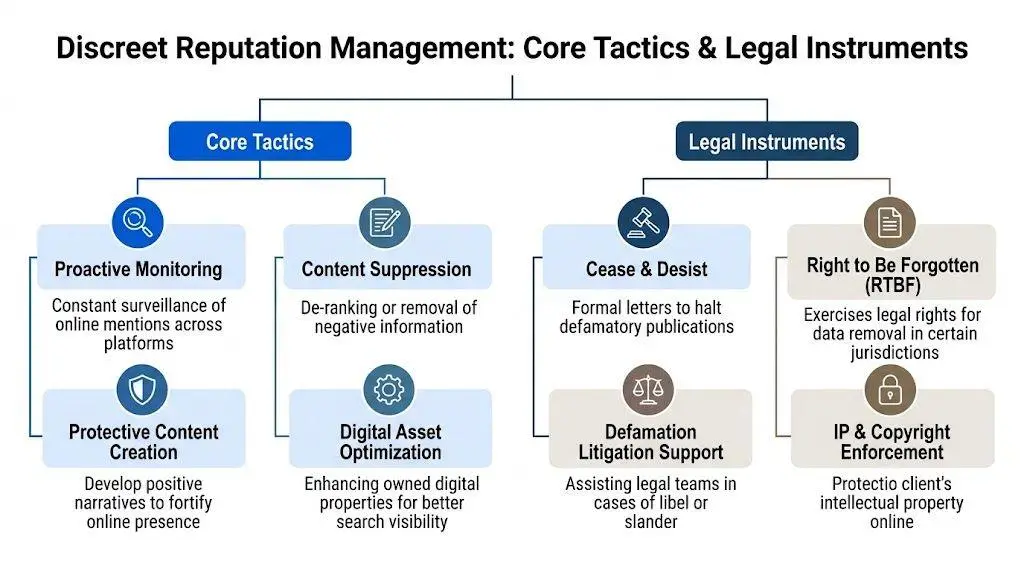
If a provider can’t explain the mechanism, they probably can’t execute it. In high-stakes matters, “we do takedowns” means nothing. The key question is which takedown route, based on what right, with what evidence, through which platform or intermediary, and with what fallback if the first path fails.
Source removal first
The strongest outcome is removal from the originating source. That means the page, post, image, profile, thread, or file is taken down where it was published.
This usually turns on one of several rights frameworks:
- Defamation and false statement claims when the content presents false assertions as fact.
- Copyright enforcement when photos, videos, written material, or proprietary documents were reposted without authorization.
- Privacy and data protection rights where personal data, identifying records, or intimate material are exposed without lawful basis.
- Platform policy violations involving impersonation, harassment, manipulated reviews, doxxing, or non-consensual imagery.
The procedure should be evidence-led. Archive the content. Capture URLs, timestamps, search result positions, metadata, and repost chains. Then classify the violation. A complaint drafted under the wrong theory often gets rejected even when the content is plainly harmful.
For matters that require a rights-based assessment before outreach, legal content removal work should be grounded in a documented process, not a generic email blast. A useful reference point is this overview of legal content removal pathways.
De-indexing when source removal won’t happen
Some publishers won’t remove content quickly, and some never will. That doesn’t mean the matter is stuck. It means the objective changes from source deletion to search invisibility.
De-indexing asks a search engine to stop presenting a result for name-based or other relevant queries. The exact basis depends on jurisdiction and facts. In some cases, privacy rights support delisting. In others, court orders, clear policy violations, or demonstrably unlawful content create the path. The practical effect is powerful. The page may still exist at source, but it stops surfacing when counterparties search for you.
That distinction is where many providers show their limits. They talk loosely about “Google removal” as if search engines own third-party content. They don’t. Source removal and search delisting are separate tracks. A competent discreet service runs both where appropriate.
NCII, leaked imagery, and rapid escalation
Non-consensual intimate imagery requires a different tempo. The legal basis is often clearer than in editorial disputes, but the repost velocity is worse. Delay creates duplication. Duplication creates indexing. Indexing creates discoverability. Every hour matters.
The workflow should include immediate evidence capture, platform submissions under the relevant intimate-image or abuse policy, search engine reporting where available, host-level notices, and continuous watch for mirrors and reuploads. If the imagery is tied to extortion, impersonation, or account compromise, identity and security remediation have to run in parallel.
This is one of the clearest examples of why a discreet service is not just “reputation repair.” It is incident response.
Preserve proof before requesting removal. Once a page disappears, you may lose the record needed for later legal action, insurance reporting, employment proceedings, or criminal referral.
Dark web monitoring and pre-surface interception
Surface web content is only half the problem. Sensitive records, credentials, private photos, and internal documents often circulate in closed channels before they appear in search results or social feeds. For high-stakes threats, firms use dark web scrapers and related intelligence methods to identify impersonation or leaks 2 to 3 days before they surface on the web, and a 150% surge in deepfake extortion targeting CEOs has made this capability more urgent, according to SMG’s analysis of online reputation management priorities.
That lead time changes outcomes. It gives your team a chance to rotate credentials, notify platforms, prepare legal notices, brief counsel, and lock down vulnerable accounts before the content spreads.
Suppression is a tool, not the strategy
Suppression still matters. But only after the case has been mapped correctly.
Protective content can help occupy branded search results, reinforce verified profiles, and displace low-authority pages. Digital asset optimization can ensure your controlled properties outrank junk domains. Those are useful layers. They are not substitutes for removal rights. When firms jump straight to suppression, they usually do it because they don’t know how to pursue the harder routes.
A good operator can tell you, asset by asset, which content should be removed, which should be delisted, which should be outranked, and which should be monitored for escalation.
Operational Security and Client Confidentiality
Clients at this level don’t just ask whether the issue can be fixed. They ask who will know, how information moves, and whether the response itself creates exposure. That concern is justified. Sloppy handling ruins otherwise strong cases.

How a secure engagement should run
At intake, the matter should be narrowed immediately. Not everyone on the provider side needs your full identity, family details, cap table, litigation history, or medical context. They need the minimum required to assess rights and act.
That means a sound workflow looks like this:
- Restricted intake with only essential facts captured at the outset.
- Secure communications through encrypted channels and controlled document exchange, not casual forwarding and unmanaged inboxes.
- Compartmentalized case handling so platform specialists, legal analysts, and monitoring teams only see what they need to execute.
- Anonymized reporting where possible, especially when family office staff, executive assistants, outside counsel, and principals all require updates at different levels.
Privacy-sensitive sectors already understand this logic. If you want a parallel outside reputation management, the question explored in Are luxury rehabs more private is useful because it shows how service design, environment, and process can either preserve confidentiality or subtly undermine it.
Monitoring without overexposure
Modern services use AI-driven sentiment analysis and real-time monitoring across over 100 platforms, with 95% accuracy in detecting negative mentions. Those systems can trigger alerts within minutes, and monitored brands have reduced crisis escalation by 70% through proactive suppression and de-indexing requests, according to RingCentral’s discussion of reputation management monitoring capabilities.
The technology matters, but the operating model matters more. Monitoring should not become surveillance theater. A useful system flags what is actionable, suppresses noise, and routes urgent issues to the smallest appropriate group. That is how you keep your internal circle tight while still seeing the threat environment early.
For ongoing oversight, reputation monitoring workflows are most effective when alert thresholds, escalation paths, and reporting audiences are defined before the next event occurs.
Confidentiality isn’t only about secrecy. It’s about limiting data spread inside the response team so a routine vendor record never becomes a future disclosure risk.
What you should insist on
Ask how files are stored. Ask who sees raw evidence. Ask whether personal names are used in internal tickets. Ask whether the provider contacts publishers in your name, through counsel, or through an intermediary identity built for the matter. Ask how they handle screenshots of intimate material or stolen documents. If the answers are vague, leave.
Discreet work requires disciplined handling because many clients are exposed on multiple fronts at once. A leaked item may involve security compromise, extortion pressure, family risk, and transaction sensitivity. You cannot solve that with a cheerful account manager and a shared spreadsheet.
Vetting a Provider What You Must Demand
Most providers in this sector sell confidence first and competence second. That is backwards. If you’re choosing a firm to handle a personal or corporate exposure event, your due diligence should feel closer to hiring specialist counsel than buying a marketing service.
The test is simple. Can the provider explain what they will do, what they won’t do, what right they’ll rely on, how they’ll report, and where the limits are. If they can’t, they’re not qualified for discreet work.
Ask questions that force specificity
Start with jurisdiction and content type. A firm that handles fake Google reviews may not understand intimate-image takedowns, and a team that knows DMCA notices may be weak on privacy delisting or impersonation protocols. You want precise experience with the exact category of harm in front of you.
Then move to workflow. Who drafts notices. Who reviews evidence. Whether they support outside counsel. Whether they can split the matter into source removal, search delisting, platform action, and monitoring. Whether they preserve admissible records.
For executives comparing providers, this guide to evaluating professional content removal services is a useful framework because it keeps the discussion focused on process rather than marketing claims.
Provider vetting checklist
| Area of Inquiry | Essential Question to Ask | Optimal Answer / Green Flag |
|---|---|---|
| Matter type | Have you handled this exact content category before? | They distinguish between defamation, privacy, NCII, impersonation, review fraud, leaked records, and search de-indexing rather than treating them as one problem. |
| Jurisdiction | Which legal or platform routes apply in the relevant country or region? | They identify likely rights and limits by jurisdiction and don’t pretend every route works everywhere. |
| Evidence handling | How do you preserve proof before action? | They document URLs, timestamps, copies, and repost patterns before sending notices. |
| Search strategy | Can you explain the difference between source removal and de-indexing? | They answer clearly and treat the two as separate tracks with different objectives. |
| Confidentiality | Who on your team will see my information? | They use restricted access, compartmentalized handling, and controlled reporting. |
| Escalation | What happens if the publisher refuses removal? | They can map fallback options such as host complaints, search delisting, policy escalation, counsel coordination, and suppression where appropriate. |
| Guarantees | Do you guarantee removal? | They refuse blanket guarantees and explain that outcomes depend on rights, evidence, platform rules, and jurisdiction. |
| Reporting | What will I actually receive during the engagement? | They offer clear action logs, status updates, and decision points rather than vague “campaign summaries.” |
| Monitoring | How do you prevent reappearance or reposting? | They describe continuous monitoring, alerting, and reupload response procedures. |
| Ethics | Do you buy reviews, use fake profiles, or publish deceptive assets? | They reject manipulative tactics that create future legal and platform risk. |
The answer you don’t want to hear
Be wary of firms that answer every question with certainty and speed. Serious operators know that some matters are straightforward and some are ugly. They can tell you where they have influence and where they don’t.
A credible provider will also separate immediate actions from longer-cycle work. They won’t pretend a harmful article, copied onto multiple domains and indexed in several jurisdictions, can be “gone tomorrow” unless there is a clear rights basis and a platform channel known to move quickly.
The right provider gives you a decision tree, not a slogan.
Red Flags and Industry Misdirection
This industry has a credibility problem. Too many providers market fear, sell certainty, and hide the fact that they’re running commodity SEO with legal-sounding language wrapped around it.

The common false promises
The first red flag is the flat-fee guarantee. No serious provider can guarantee source removal across unknown publishers, platforms, and jurisdictions without first assessing rights and evidence. What they usually mean is that they’ll send a standard notice and hope someone complies.
The second is “guaranteed Google removal.” Search engines don’t control third-party truth, and they don’t erase lawful content because a vendor says it is unfair. Sometimes delisting is available. Sometimes it isn’t. Anyone collapsing that distinction is either careless or dishonest.
The third is fake suppression. That means low-grade microsites, spun articles, junk profiles, or purchased assets pushed into branded search results. These can create their own credibility issues, leave discoverable fingerprints, and fail the moment the search environment changes.
Anonymous attacks expose weak providers
One persistent challenge is anonymous bad-mouthing. The problem is wider than most clients realize. 46% of companies report only basic or non-existent online reputation strategies, leaving them more vulnerable to unverified attacks that bypass standard takedown methods, as discussed in the PMC analysis of anonymous reputation threats.
That matters because anonymous review campaigns, burner accounts, and forum-style accusations often require patience and infrastructure analysis, not just takedown requests. You may need pattern detection, account linkage review, timing analysis, identity clues from repost behavior, and coordinated platform escalation. A cheap vendor won’t do that work. They’ll file the same complaint repeatedly and call the matter “difficult.”
If a provider won’t explain risk, they’re probably the risk.
Pricing opacity is usually a warning
Opaque retainers are another problem. You don’t need every internal detail, but you do need to know what you’re buying. Is the scope evidence capture, notice drafting, platform escalation, de-indexing work, monitoring, content strategy, or all of the above? Are there decision points if the matter expands? What happens if a second domain appears? Who approves legal escalation?
A discreet reputation management service should be precise about scope because precision is the whole value. Vague services create vague outcomes.
Examples in Practice Anonymized Case Studies
One principal came to us after a legacy article containing false factual assertions started ranking during an acquisition process. The publisher ignored direct complaints. Public rebuttal would have amplified the issue, and litigation timing didn’t match the deal calendar.
The response was split into tracks. Evidence was preserved, factual inaccuracies were mapped, and a rights-based removal demand was prepared. At the same time, search delisting routes were evaluated, and controlled digital assets were strengthened so counterparties conducting name searches encountered authoritative, current material instead of recycled allegations. The key was not volume. It was sequencing.
Another matter involved a public-facing client dealing with intimate content posted without consent and then mirrored across secondary sites. The first task wasn’t messaging. It was containment. The team documented the originating posts, secured account compromise evidence, initiated platform reporting under the relevant abuse policies, pursued host-level notices where appropriate, and set up watch protocols for reuploads. The client needed speed, but they also needed the handling to remain private enough that the response didn’t become a story of its own.
A third case involved a family office after leaked data surfaced in closed online channels and early signs of impersonation followed. Search results were not yet the main issue. Exposure was. The work centered on threat monitoring, identity-risk mapping, and remediation steps tied to the leaked material. Parallel outreach prepared for any later surface-web appearance, while internal communications were restricted to a very small group.
These examples matter because they show what clients under pressure often miss. There is no single “ORM fix.” A discreet reputation management service is effective only when it classifies the problem correctly, chooses the right legal and technical tools, and protects confidentiality throughout the operation.
Your Strategic Action Plan
At 6:40 a.m., a board member forwards a search result, a journalist has already called, and the harmful page is still live. That is the point where disciplined procedure matters more than instinct. The first 24 hours decide whether this stays contained or becomes a wider reputational and legal problem.
Start with a four-part triage.
Secure evidence in a form your lawyer can use. Capture full-page screenshots, live URLs, timestamps, search queries, cached copies, account identifiers, and any signs of reposting or syndication. Preserve headers, source links, and platform complaint records if they exist. Store everything in a restricted folder with a clear chain of custody. If later action involves counsel, insurers, regulators, or platform appeals, sloppy evidence slows removal and weakens your position.
Freeze contact. Do not message the poster, threaten action from a personal account, or ask colleagues to report content in a panic. Each careless contact can trigger more publication, tip off the operator, or create discoverable material that complicates legal strategy.
Classify the matter by remedy, not by emotion. Ask one practical question. What mechanism can effectively remove or suppress this item? Defamation may call for counsel-led notice and publisher review. Privacy violations, impersonation, and non-consensual intimate imagery often move through platform policy channels, host notices, and identity verification protocols. Search harm from lawful but outdated content may require de-indexing requests, re-optimization of controlled assets, or direct negotiation with the publisher. If you misclassify the content, you waste the short window where fast action works.
Then set priorities by exposure path. A leaked document in a closed channel creates a different risk from a ranking page on branded search, a review attack on a maps listing, or a profile impersonation aimed at clients. Identify who is likely to encounter the material first, investors, media, customers, licensing bodies, schools, counterparties, family office contacts, and sequence your response around that audience.
Bring in a specialist early, but ask for an operational plan, not a generic audit. You should receive a written view on what can be removed, what can be de-indexed, what must be monitored for replication, which jurisdiction and platform rules apply, and who will handle outreach under privilege where appropriate. That is the difference between a discreet reputation management service and a vendor that merely sends templated complaints.
If you need that assessment, ContentRemoval.com handles confidential evaluations for executives, public figures, family offices, and legal teams facing online defamation, leaks, impersonation, NCII exposure, review fraud, and search-result harm. The right next step is a private review of the content, the applicable rights, and the fastest defensible path to removal or containment.
Frequently asked questions
What is the difference between discreet reputation management and regular ORM?
Generic ORM centers on review generation, profile management and burying results with new content. A discreet service works on the harmful item itself: identifying the host, mirrors and search entries, choosing the defamation, privacy, copyright or platform policy route that fits, pursuing removal and de-indexing, and keeping client identity and evidence restricted throughout.
What should I do in the first 24 hours after damaging content appears about me?
Secure full-page screenshots, URLs, timestamps, search queries and cached copies in a restricted folder. Freeze contact with the poster and do not threaten from a personal account. Classify the matter by the mechanism that can remove or suppress it rather than by emotion, then bring in a specialist and ask for a written operational plan.
What are the warning signs of a bad reputation management provider?
The article flags flat-fee removal promises, claims of certain Google removal, fake suppression built from junk microsites and purchased profiles, opaque retainers with undefined scope, and vague answers about who sees your data. Credible providers give you a decision tree, explain their limits and preserve evidence before sending any notice.