

Machine learning detection in reputation protection is a decision-support layer, not a verdict. Classification, anomaly detection, natural language processing and computer vision can surface fake reviews, impersonation accounts, deepfakes and leaked images at scale, but a score is triage evidence that a qualified reviewer must verify for context, identity, source and legal basis before any platform notice or removal action.
Key facts
- Independent testing showed detector accuracy fell sharply after AI text was edited or paraphrased.
- A 2025 SANS survey found false positives were the leading detection challenge for 73 percent of respondents.
- Anomaly detection flags behavior outside a baseline; classification only recognizes threat types it was trained on.
- Under EU Digital Services Act Article 16, a notice must let a host identify illegality without detailed legal analysis.
Where ContentRemoval.com comes in. ContentRemoval.com pairs AI-driven monitoring with human-led verification and takedown for deepfakes, impersonation, leaked media, defamation and harmful search results, so an alert becomes an evidence package a platform can act on. Corporate counsel, family office security leads and executives’ chiefs of staff usually get in touch once a detection tool has flagged something nobody can action. A free 15-minute Exposure Scan maps the live threats that are removable, and the report is yours to keep. Get a Free, Confidential Exposure Scan or read how our content removal work is done.
The most popular advice about machine learning detection is also the most dangerous: deploy the model, trust the score, and let automation handle the rest. That approach confuses statistical pattern recognition with a legal conclusion, a reputational judgment, or a removal decision.
For executives, family offices, public figures, and corporate counsel, the question isn’t whether a detector can identify suspicious material in controlled conditions. It’s whether the system can distinguish a genuine threat from legitimate criticism, survive paraphrasing and manipulation, produce evidence a platform can act on, and route ambiguous cases to a person with authority to decide.
Machine learning detection has a legitimate role in reputation protection. It can process more signals than a human team, identify behavior that doesn’t fit an established pattern, and prioritize incidents before they become difficult to contain. But it remains an imperfect component of a wider process that includes verification, legal analysis, platform engagement, source removal, search remediation, and continuous monitoring.
Why Machine Learning Detection Is Not a Silver Bullet
A detection score is evidence for review, not proof of wrongdoing. It shows that a model recognized features associated with a content or behavior category. It does not establish who created the material, whether it is false, or what action a legal or communications team should take.
Vendor benchmarks rarely show how performance changes after publication. Editing, translation, reposting, and deliberate evasion can all alter the signals a model relies on. Independent testing found accuracy falling from 74% on raw AI text to 42% after manual edits and 26% after paraphrasing in the tested conditions (the independent study on edited and paraphrased AI text).
That creates a record-keeping problem for a legal team handling a defamatory article. A detector may flag the original, miss a rewritten copy, and generate inconsistent results across versions. The monitoring dashboard can then understate the number of harmful items requiring investigation.
Accuracy isn’t the same as usefulness
A model can perform well on familiar examples and fail against new attack patterns. Research on network-traffic anomaly detection shows the trade-off. In one cited experiment, a CNN achieved 0.9110 precision but only 0.1954 recall on unknown attacks, while LOF reached 0.8370 recall with 0.5746 precision (the adversarial-example detection review).
The operational choice is clear. The first approach produced more precise alerts but missed many unfamiliar threats. The second found more unknown activity while creating more investigative work. Neither result justifies calling a model “accurate” without specifying the risk the organization accepts, the threats it prioritizes, and the workload its analysts can handle.
Practical rule: Treat every automated result as triage evidence until a qualified reviewer verifies the content, context, identity, source, and legal basis for action.
False positives create a separate operational risk. The SANS 2025 survey identified false positives as the leading challenge for 73% of respondents, up from 64% the previous year (the SANS 2025 Detection and Response Survey). In reputation work, an incorrect alert can consume analyst time, prompt an unjustified complaint, or cause a client to treat lawful criticism as malicious conduct.
Deploy machine learning detection as a controlled decision-support layer. It should surface risk, preserve evidence, rank urgency, and route uncertain cases to an authorized reviewer. It should not decide whether a statement is defamatory, an image is authentic, or a platform must remove material. Those decisions require context, documented reasoning, and accountable human judgment.
Core Detection Techniques and How They Work
Reputation threats don’t arrive in one format. A fake review, an impersonation account, an AI-generated voice recording, and a manipulated photograph require different signals. Procurement teams should therefore ask vendors which detection techniques they use, what each technique can observe, and where the model’s output stops being reliable.
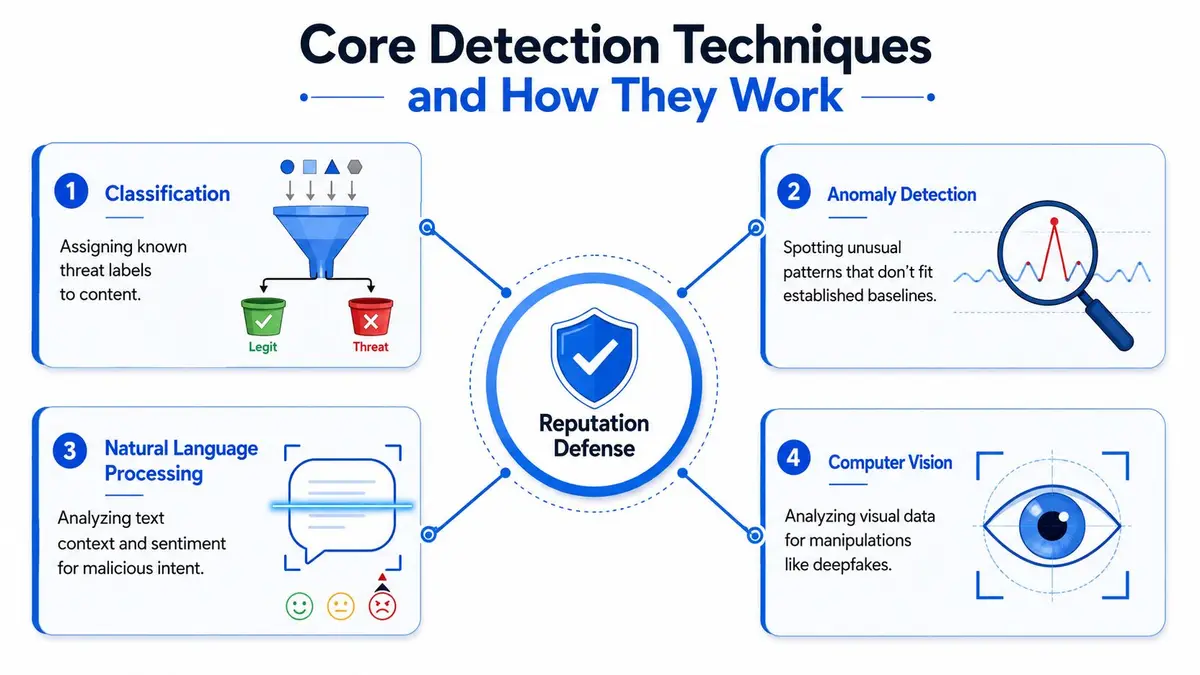
Classification identifies familiar threat categories
Classification models assign content or behavior to known labels. In a reputation setting, the labels might distinguish legitimate customer feedback from coordinated fake reviews, or an authentic account from a likely impersonator.
The strength is consistency. If the model has seen credible examples of review manipulation, it can examine language, timing, account history, repetition, and relationships between accounts. The weakness is dependence on representative training data. A model trained on one platform, language, or fraud pattern may not recognize a different campaign that uses more subtle wording or a new distribution channel.
Classification is useful when the organization knows what it’s looking for. It’s less reliable when the threat changes faster than the model’s labels.
Anomaly detection looks for behavior that doesn’t fit
Anomaly detection establishes a baseline and flags deviations from it. It doesn’t need a complete catalogue of every possible attack, which makes it valuable for unusual account behavior, coordinated posting, sudden distribution of private material, or an executive’s name appearing across an unfamiliar network of profiles.
A 2026 systematic review found 274 related research articles and reported that 27% of selected papers used unsupervised anomaly detection, compared with 18% using supervised methods, 7% combining both, and 5% using semi-supervised learning (the 2026 systematic review of machine learning for anomaly detection). That distribution reflects a practical reality. Reputation teams often have limited confirmed labels for rare or newly emerging events.
Anomaly detection is good at saying, “This pattern deserves examination.” It isn’t good at explaining intent without supporting evidence.
NLP examines language, context, and manipulation
Natural language processing, or NLP, evaluates text for linguistic patterns, sentiment, relationships, and potentially malicious context. It can help identify AI-generated defamation, repeated allegations, coordinated narratives, or text that imitates a known individual’s style.
NLP cannot reliably determine truth from language alone. Sarcasm, quotation, translation, legal commentary, and genuine criticism can resemble hostile content. A responsible workflow pairs NLP scoring with source review, publication history, factual verification, and a clear legal theory.
Computer vision tests visual and audiovisual signals
Computer vision systems analyze images, video frames, facial movement, visual inconsistencies, and other features associated with manipulation. They are relevant to deepfakes, altered documents, fake endorsements, and unauthorized use of private imagery.
The model’s output should be treated as one part of an authenticity assessment. Original files, metadata where available, publication sequence, matching copies, and expert examination may be necessary before counsel makes an allegation or sends a formal notice.
For procurement, ask for performance by threat type, not one blended accuracy figure. A vendor should explain how the system handles unknown attacks, modified content, multilingual material, and human review.
Real-World Applications for Reputation Protection
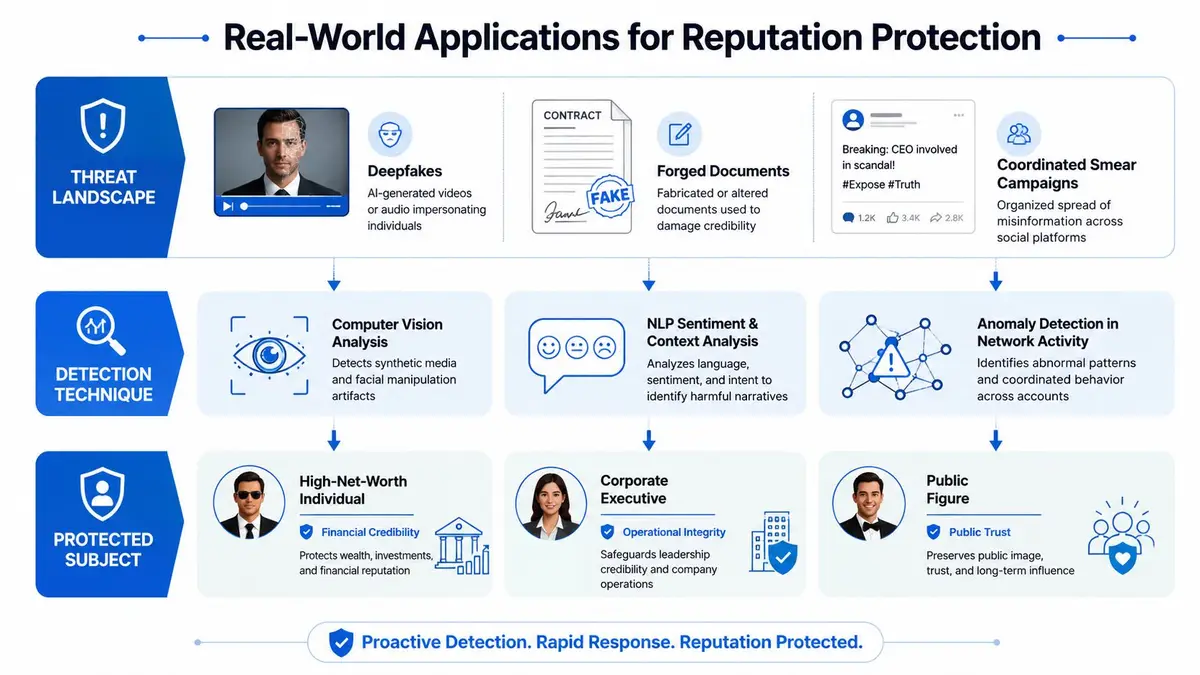
A chief executive discovers a video appearing to show them endorsing a financial product they’ve never used. A family office finds a private image circulating through accounts that copy the principal’s name and photograph. A business sees a sudden cluster of reviews that repeat the same accusation across unrelated profiles.
These incidents look different to a human observer, but each can produce machine-readable signals. The value of detection depends on matching the right technique to the threat and connecting the alert to a response that can reduce exposure.
Deepfakes and fake endorsements
Computer vision and audiovisual analysis can identify signs of manipulated video, synthetic imagery, or voice cloning. Detection is most useful before distribution accelerates, when a response team can preserve the original URL, capture evidence, notify the platform, and identify copies.
It won’t catch every technically convincing alteration, especially after compression, cropping, re-encoding, or reposting. Human verification remains necessary, particularly where the material could affect a transaction, public statement, regulatory inquiry, or employment decision.
Leaked images and video
Image matching and visual fingerprinting can help locate unauthorized copies across social platforms, websites, and harder-to-index channels. The system can identify similarities that a manual search would miss, then support a takedown record showing the affected material, source location, and relationship between copies.
Detection alone doesn’t establish ownership, consent, or the correct legal basis for removal. The response may require privacy analysis, copyright documentation, platform-specific forms, and escalation through counsel. For organizations managing public-facing properties, broader guidance on how to protect your venue’s reputation can complement specialist content-removal work.
Fake reviews and coordinated campaigns
Classification and NLP can identify repeated phrasing, unusual account relationships, synchronized activity, and review patterns that differ from normal customer behavior. These signals can help a company separate an isolated complaint from a coordinated campaign.
The model still shouldn’t label every negative review fraudulent. A legitimate customer may use common language, post at the same time as others, or criticize the same event. Analysts need order records, account history, platform rules, and evidence of coordination before recommending a complaint.
Impersonation and account abuse
Anomaly detection can compare profile behavior, posting patterns, location signals where lawfully available, linked content, and changes in account activity. It can surface accounts that mimic a public figure or executive, particularly when several profiles emerge with related behavior.
The strongest response combines detection with identity documentation, verified account information, platform reporting, and monitoring for reuploads. Organizations can review reputation monitoring services when they need one process covering search, social, leaks, and impersonation surfaces.
Piracy and unauthorized distribution
Computer vision, content fingerprinting, and automated discovery can locate copies of branded media, training materials, photographs, or private footage. Detection works best when the protected content has a clear reference version and the team has authority to request removal.
The objective isn’t merely to find a URL. It’s to map the distribution chain, prioritize the sources with the greatest reach, preserve evidence, and pursue source removal before search suppression.
Where Detection Systems Fail and Adversaries Exploit Gaps
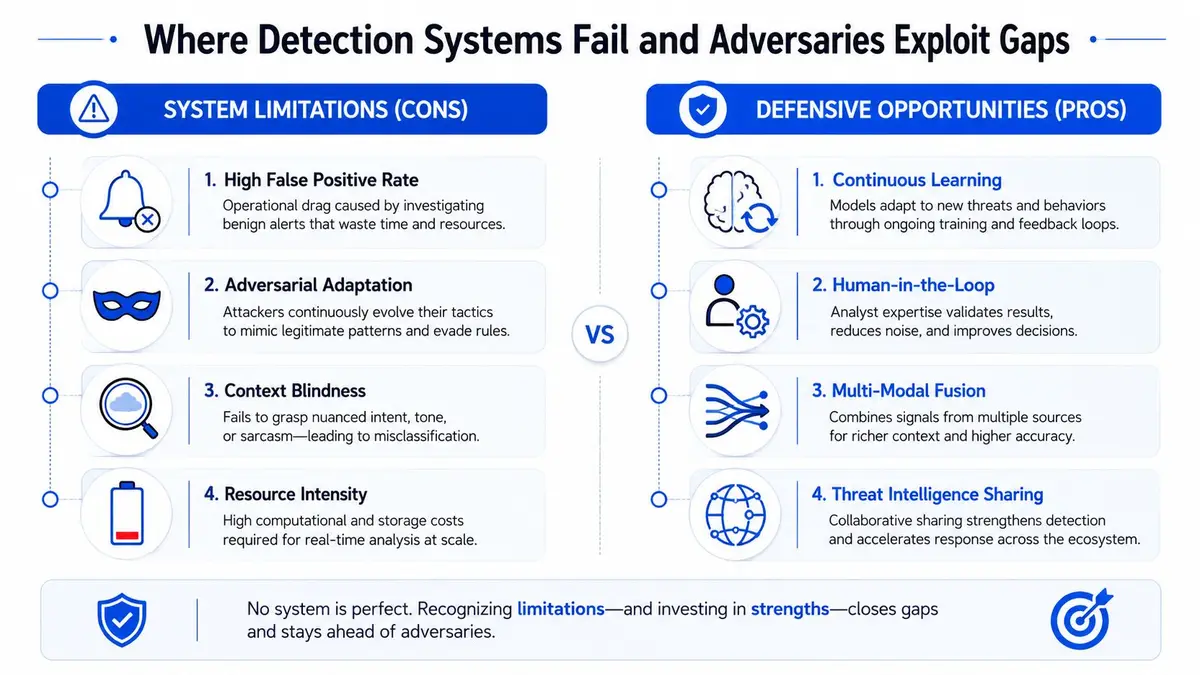
Machine learning detection fails most dangerously when attackers can observe its thresholds and adjust their behavior. A campaign operator can change wording, divide distribution across accounts, crop or recompress an image, or shift activity to a less visible host. The model may then assign a lower risk score precisely while the reputational threat grows.
False positives consume the response capacity
False positives compete with genuine incidents for analyst attention, legal review, and executive time. As noted earlier, industry survey findings identify false positives as a leading detection challenge. Treat alert volume as a governance problem, not a model-engineering detail.
Set an escalation threshold that reflects the consequence of delay. A high-risk allegation involving an executive may justify review at a lower confidence level than a routine duplicate image. Each alert should state why it was scored, identify the affected subject and source, record the first observed time, connect related copies, and recommend the next action. A probability without investigative context is not an actionable finding.
Adversarial edits undermine confident outputs
Edited or paraphrased material can defeat a detector that performed well on its reference examples. As noted earlier, independent research showed a sharp drop in tested accuracy after manual editing and paraphrasing (the study of edited and paraphrased content). Legal teams should therefore treat authorship scores as one signal within an evidence record, never as the sole basis for accusing a person of synthetic authorship or proving origin.
Operational controls matter more than a single score. Group versions by source, timestamp, wording, and distribution path. Preserve the original capture before content changes, record every transformation, and compare clusters rather than judging each edited item in isolation. The same exposure affects images, audio, and video after platform compression or deliberate manipulation.
Unknown threats expose training limits
Choose the balance according to the harm of missing an incident and the cost of reviewing a false alarm. Test against altered content, new attack patterns, and environments outside the training data before relying on the output in a legal or executive decision. Require a human review path for high-impact conclusions.
Digital monitoring also has a boundary. For suspected physical surveillance or offline compromise, teams may need bug detection services in London. Online anomaly detection cannot identify every source of risk.
Building an Operational Detection Pipeline
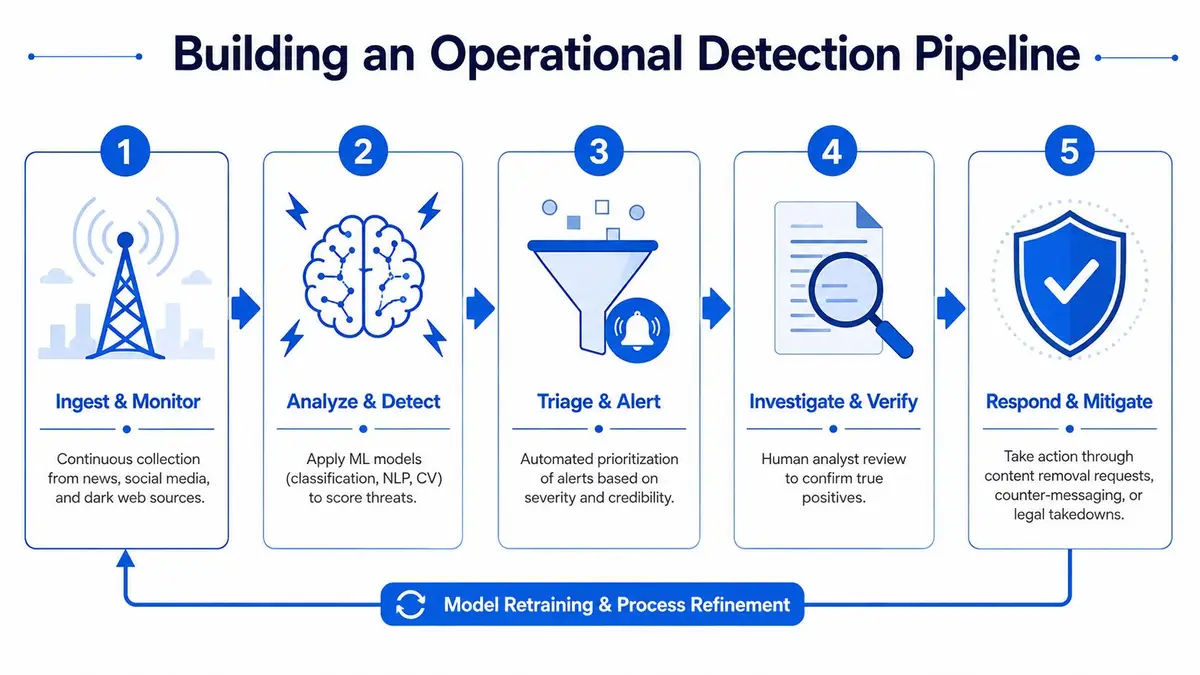
A detection system should be designed around decisions, not dashboards. Before selecting a model, define what happens when an alert is raised, who owns verification, what evidence must be preserved, and which events justify immediate escalation.
Start with the evidence layer
Collect only the sources relevant to the threat profile. That may include search results, social platforms, news coverage, review sites, image repositories, leak locations, and AI-assistant outputs. Define retention rules before collection begins, especially when monitoring involves personal information, private communications, or sensitive material.
The system should preserve the original URL, timestamp, screenshots or files where lawful, account identifiers, related copies, model version, and analyst decisions. Without that chain of evidence, a technically advanced detector may still leave counsel unable to explain what happened.
Score for action, not vanity metrics
Accuracy can conceal the trade-off that matters. Require vendors to report precision, recall, false-positive behavior, performance on unseen threats, and results after editing or transformation. The benchmark results discussed earlier show why a high recall score can coexist with a difficult operational burden.
Use risk bands:
- Immediate escalation: A high-confidence threat involving impersonation, private material, fraud, or a fast-moving publication goes directly to a senior analyst and counsel.
- Analyst review: Ambiguous content receives contextual investigation before anyone contacts a platform or accuses a publisher.
- Watch status: Low-confidence anomalies remain under monitoring, with related accounts and copies grouped into one incident rather than generating separate alerts.
Keep a person in the decision loop
Analysts should verify identity, context, source, duplication, legality, and business impact. Counsel should decide whether the response is a platform complaint, a privacy request, a copyright notice, a defamation escalation, a search-removal request, or no action.
A feedback loop is equally important. Record whether each alert was a true positive, false positive, duplicate, lawful criticism, or unresolved case. That record improves thresholds and helps the team identify recurring blind spots.
Build compliance into the workflow
The European Union’s Digital Services Act provides a useful standard for notice quality. Under Article 16, a notice creates actual knowledge or awareness for the specific item only when it allows a diligent hosting provider to identify the illegality without a detailed legal examination (Article 16 of the EU Digital Services Act).
That means a model score isn’t enough. A notice needs the specific item, the relevant facts, the legal basis, and evidence presented in a way the provider can assess. Teams evaluating AI protection software should ask whether the product supports that evidentiary workflow, not merely whether it detects content.
Connecting Detection to Takedown and Remediation
An alert has no protective value if nobody can convert it into a defensible action. The response begins by classifying the incident, identifying the decision-maker, and matching the evidence to the available remedy.
The first distinction is between deindexing and source removal. Deindexing removes a URL from search results while the page can remain online. Source removal deletes or disables the material at the host, after which Google can drop the page from its index when it recrawls it (the explanation of Google’s removal tools).
These remedies solve different problems. Deindexing can reduce discoverability, but it doesn’t stop direct access, reposting, screenshots, or circulation through other search engines. Source removal is usually the stronger outcome, but it depends on jurisdiction, ownership, platform rules, applicable law, and the host’s willingness to act.
Turn the model output into a notice
A useful evidence package should identify the exact content, preserve its location, describe the harm, explain the legal basis, and connect any duplicate URLs or accounts. The model can supply discovery signals and similarity analysis. A human should establish the facts and select the remedy.
The DSA also gives priority to notices submitted by trusted flaggers within their area of expertise, while requiring every notice to be processed in a timely, diligent, and non-arbitrary manner (the DSA preamble on trusted flaggers). Trusted flagger status isn’t automatic removal. It improves handling priority, but the notice still needs to identify the specific violation.
Monitor after the first success
Removal is not the end of the incident. Adversaries can upload a revised image, create a new account, change the headline, or move the content to another host. Continuous monitoring should search for substantially similar copies, altered versions, and new distribution routes.
For family offices and corporate legal teams, the practical objective is a closed loop: detect, preserve, verify, notify, escalate, confirm the outcome, and continue watching. That process is more valuable than a dashboard that produces a confident score but leaves the harmful material accessible.
Deciding Between In-House Detection and Specialist Partners
In-house detection makes sense when an enterprise already has data science, security operations, legal review, and infrastructure capable of maintaining models and evidence workflows. It gives the organization control, but it also creates a continuing obligation to retrain, test, document, and monitor performance as threats and platforms change.
Most individuals, family offices, and mid-sized organizations should use a specialist partner when the issue involves high personal sensitivity, multiple jurisdictions, leaked material, impersonation, deepfakes, or urgent takedowns. Evaluate response times, confidentiality controls, jurisdictional coverage, evidence handling, source-removal capability, reupload monitoring, and the quality of human review. The criteria in this guide to choosing a content removal company should form part of that diligence.
The right partner doesn’t sell detection as certainty. It explains what the system can identify, where it fails, how analysts verify alerts, and how the team turns evidence into removal or remediation.
ContentRemoval.com combines AI-driven monitoring with human-led verification and takedown workflows for deepfakes, impersonation, leaked media, defamation, and harmful search results. If a machine learning alert has identified a live reputation threat, visit ContentRemoval.com for a confidential assessment and a specific action plan.
Frequently asked questions
Can AI detection tools prove that a review or article is fake?
No. A detection score shows that a model recognized features associated with a category. It does not establish who created the material, whether it is false or what a legal team should do. Analysts still need order records, account history, platform rules and evidence of coordination before recommending a complaint.
Why do deepfake and AI text detectors miss reposted or edited content?
Editing, translation, cropping, compression and reposting change the signals a model relies on. Cited independent testing showed accuracy dropping substantially after manual edits and again after paraphrasing, so a detector can flag the original and miss a rewritten copy, understating how many harmful items exist.
What should a detection system record so counsel can act on an alert?
The original URL, timestamp, screenshots or files where lawful, account identifiers, related copies, model version and analyst decisions. Each alert should state why it was scored, identify the subject and source, connect duplicates and recommend a next action, because a probability without investigative context is not an actionable finding.