
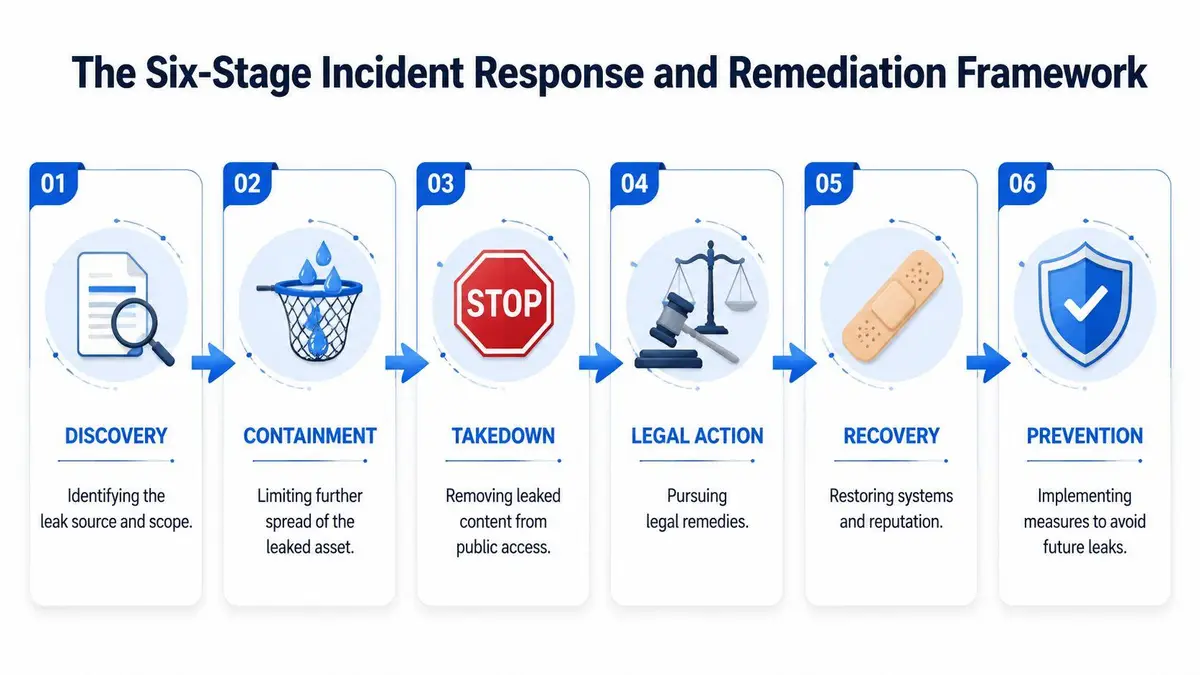
Leak remediation for executives and high-net-worth individuals is the controlled response to any uncontrolled release of sensitive assets: credentials, financial records, private media, intellectual property or communications. It runs in six stages, discovery, containment, takedown, legal action, recovery and prevention, with the first 24 to 48 hours deciding whether the incident stays containable or becomes a reupload problem.
Key facts
- Leaks are classified by asset: data, media, intellectual property, communications, and non-consensual intimate imagery as an urgent subset.
- Containment means isolating devices, revoking access, securing backups, locking cloud sessions and controlling the physical scene.
- Takedown must cover source pages, mirrors, social uploads, cached results, fake profiles and secondary references.
- Cited research found 62 percent of leak victims saw content reuploaded within three months.
Where ContentRemoval.com comes in. ContentRemoval.com handles the recovery and prevention stages of a leak for executives, public figures, family offices and their legal teams: de-indexing, source removal, impersonation takedowns, leaked media removal and monitoring across search, websites and social platforms while counsel runs the legal track. A family office principal, general counsel or IT lead usually makes contact once the material has appeared online. A free 15-minute Exposure Scan maps what is removable, and the report is yours to keep. Get a Free, Confidential Exposure Scan or read how our leaked content removal work is done.
At 6:10 a.m., your property manager reports a burst pipe in the residence. By 7:00, the home office is offline, a backup drive is missing from the network, and a private family video appears in a text thread that should never have existed. Before lunch, legal is asking whether this is a facilities issue, an IT breach, or a reputational event. The correct answer is all three.
That’s why serious leak remediation can’t be treated as a plumbing problem with a cleanup crew attached. For executives, public figures, family offices, and founders, a leak is often the first domino in a wider exposure chain. Water reaches hardware. Hardware stores credentials. Credentials grant access to cloud accounts, messaging archives, deal documents, and private media. Then the public layer begins: search results, social reposts, impersonation, extortion, and copied files that keep resurfacing after the initial incident looks contained.
A disciplined response exists. It starts by classifying what was exposed, isolating the source, preserving evidence, and stopping distribution before the incident hardens into a long-term reputation problem.
Defining Leak Remediation in a Hostile Environment
The old definition of leak remediation is too narrow. It assumes a visible failure, a physical source, and a contained repair. That model is obsolete.
For the clients I advise, a leak is any uncontrolled release of sensitive assets. That includes private correspondence, investor updates, medical records, family office documents, internal strategy decks, source files, location data, and intimate media. In practice, the leak itself is only the opening event. The true crisis begins when those assets become searchable, shareable, and persistent.
The executive scenario that changes the analysis
Consider the pattern that shows up repeatedly in high-pressure incidents. A senior executive experiences a water event at a primary residence or home office. Devices are moved quickly. Security systems go offline. A laptop is powered down and then restarted on an unsecured temporary setup. Cloud sessions remain active. An assistant forwards files to keep operations moving. Somewhere in that scramble, control is lost.
That’s no longer just a facilities matter. It’s a cross-domain breach touching privacy, legal exposure, and reputation.
Practical rule: The moment a physical leak intersects with devices, backups, credentials, or private media, you’re in crisis management territory, not routine maintenance.
A common mistake at this stage is separating the physical response from the digital one. Facilities handles drying and repairs. IT checks hardware. Outside counsel reviews liability. Nobody owns the integrated exposure picture. That gap is where the worst damage happens.
Why the environment is hostile
A hostile environment isn’t defined only by a malicious actor. It includes opportunistic reposting, search engine indexing, screenshot culture, platform delays, and people close to the incident making poor decisions under pressure. Once sensitive material escapes into that environment, simple deletion rarely solves it.
For affluent households and executives, the stakes are higher because the assets are richer. There may be trust documents, wire instructions, passports, litigation files, or family images on connected systems. There may also be domestic staff, contractors, insurers, restoration vendors, and IT personnel cycling through the scene. Every additional actor increases exposure.
A more durable privacy posture starts before the crisis, but it matters just as much after one. The right benchmark is a structured high-net-worth privacy architecture, not ad hoc cleanup. That’s the logic behind this digital privacy framework for high-net-worth households, which treats physical disruption and digital exposure as part of the same risk surface.
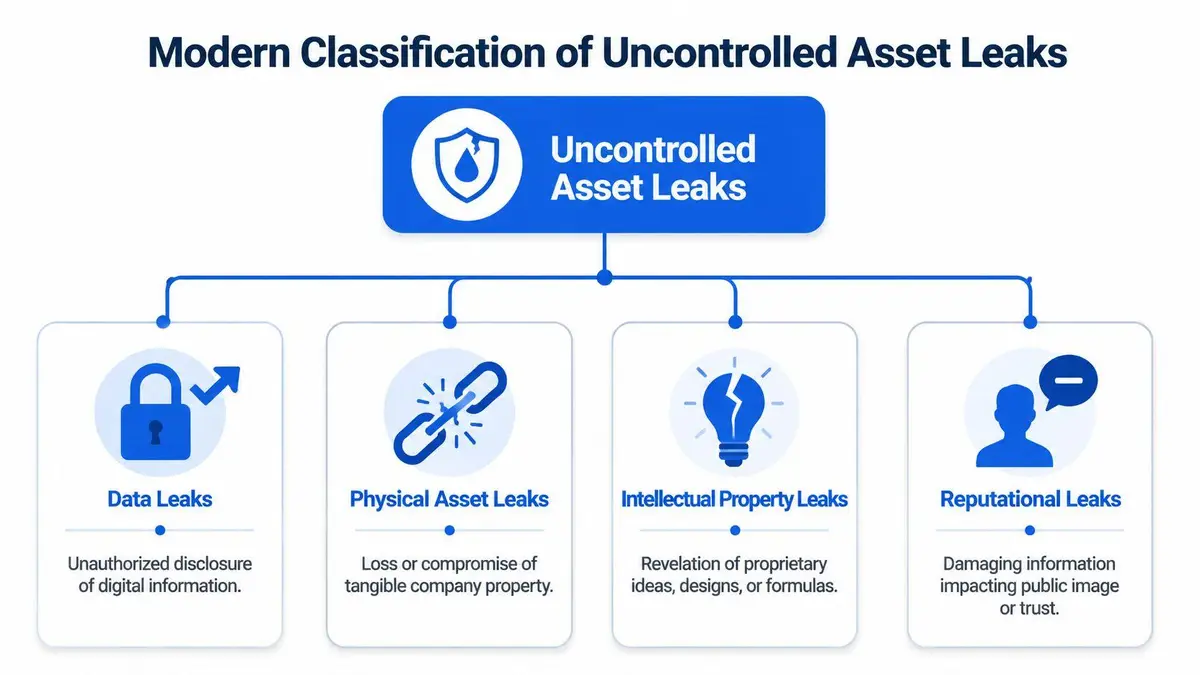
A Modern Classification of Uncontrolled Asset Leaks
Leaders under pressure need a framework that cuts through noise. I use a simple classification system based on the asset that escaped control, because the asset determines the damage pattern, the urgency, and the remedy.
Data leaks
A data leak is the compromised vault. Think credentials, banking information, tax records, identity documents, account access, or internal files with client and employee information. If private data escapes, the harm isn’t limited to privacy. It becomes an operational problem because bad actors can use that data to authenticate themselves, reset accounts, or impersonate trusted parties.
A water-damaged home office creates this exact risk. A soaked laptop, a hastily reconnected backup, or an exposed paper file can turn a domestic incident into a credential and document exposure event.
Media leaks
A media leak is the forced publication of your private diary. Photos, videos, audio clips, and recordings carry a different kind of force because they spread faster, trigger stronger emotional reactions, and are harder to contain once mirrored across platforms.
This category matters because media tends to escape formal channels. People forward it in private chats, upload edited versions, and repost fragments stripped of context. Legal rights still matter, but speed matters more.
Intellectual property leaks
An intellectual property leak strikes the company’s future earnings, not just its current position. Product roadmaps, prototypes, legal strategy, pricing models, source code, investor materials, and customer lists all fit here. A founder often underestimates this category because the initial focus stays on the visible event, such as flood cleanup or office downtime.
The market won’t make that mistake. Competitors, counterparties, and litigants can all exploit leaked IP long before a building is dry again.
Communications and NCII leaks
Private communications deserve their own practical treatment even when they overlap with data or media. Email threads, direct messages, negotiation notes, and internal chats can alter board dynamics, trigger claims, or distort public narratives when released selectively.
A severe subset of media leaks is non-consensual intimate image abuse, often called NCII. That category requires immediate escalation because every hour of delay increases duplication, search visibility, and advantage against the victim.
A fast triage model helps:
| Leak type | Typical asset | Primary risk |
|---|---|---|
| Data | IDs, credentials, financial records | Fraud, impersonation, account takeover |
| Media | Photos, videos, recordings | Viral spread, humiliation, extortion |
| IP | Roadmaps, code, plans, client lists | Competitive loss, contractual fallout |
| Communications | Emails, chats, internal memos | Narrative distortion, legal exposure |
The smart first question isn’t “What leaked?” It’s “Which asset class escaped control, and who can weaponize it first?”
Assessing the Escalating Business and Legal Risks
The financial and legal consequences of a leak rarely arrive in a neat sequence. They stack.

The physical trigger is often underestimated
Executives still dismiss domestic and facility failures as minor operational events. That’s careless. The U.S. Environmental Protection Agency estimates that physical household leaks contribute to 2 million insurance claims and an annual cost of $8 billion to U.S. businesses and insurers according to EPA-backed leak and insurance loss reporting. The strategic lesson is obvious. Small physical failures can trigger large financial consequences long before anyone uses the word “breach.”
The direct costs are only the beginning. You’ll face incident review, outside counsel, forensic work, hardware replacement, restoration vendor coordination, and executive time diversion. For companies, the bigger damage often comes from delay. Teams argue over jurisdiction, privilege, and vendor ownership while leaked materials continue to circulate.
The legal exposure expands fast
The legal risk depends on what escaped and who was affected. A personal leak can become a corporate issue if it involves client material, insider communications, regulated records, or employee information. A corporate leak can become personal if it includes executive devices, family office systems, or intimate media stored in the wrong environment.
That overlap is where conventional responses fail. Traditional litigation is often too slow to stop active spread. Standard PR is too superficial to remove indexed content, fake profiles, or pirate copies. If leaked business documents have already surfaced online, the practical playbook is targeted removal, de-indexing, and evidentiary preservation, not hand-wringing. A useful reference is this executive guide to removing leaked business documents from the internet.
The reputation damage often outlasts the event
Reputation is where unmanaged leaks become expensive in a way balance sheets initially hide. Search results fossilize incidents. Journalists and counterparties discover the story out of sequence. Impersonation accounts appear. Stolen materials are reframed as scandal, negligence, or hypocrisy.
Three patterns usually drive long-term damage:
- Narrative vacuum: If you don’t control the facts early, others will define the event for investors, media, employees, and family.
- Persistent indexing: Even removed material can leave traces in search, screenshots, forum posts, and aggregator pages.
- Reupload culture: Once a file becomes shareable, bad actors treat every takedown as a temporary inconvenience.
A board should view leak remediation as a business continuity issue with legal consequences, not a cleanup expense. The first leak is the incident. The uncontrolled public afterlife is the ultimate liability.
The Six-Stage Incident Response and Remediation Framework
A leak crisis needs command and control. Not improvisation. Not committee drift.
The protocol below is the model I recommend when private assets, business data, or sensitive media have escaped control.
Stage one and stage two
Discovery comes first. You need a defensible picture of what was exposed, where it appeared, who had access, and whether the source was physical, digital, or both. In a slab or structural water event, disciplined investigation matters just as much on the physical side. Concrete moisture diagnostics and relative humidity testing are the right way to locate hidden sub-slab problems, because surface impressions alone miss internal moisture and lead to false confidence.
Containment is the next move. This means isolating affected devices, revoking compromised access, securing backups, locking down cloud sessions, and halting further distribution on known channels. It also means controlling the physical scene. Restoration crews, assistants, vendors, and domestic staff shouldn’t have broad, unsupervised access to devices or records during active response.
A visual summary helps frame the sequence.
Stage three and stage four
Takedown is where many providers underperform. Removing a single URL or filing a complaint isn’t enough. Effective takedown work targets source pages, mirrors, social uploads, cached search results, fake profiles, and secondary references. It also prioritizes the platforms and pages most likely to amplify the leak first.
Legal action supports the takedown strategy. It doesn’t replace it. Counsel may need to issue preservation notices, pursue injunctions, assert copyright or privacy rights, coordinate with law enforcement, or pressure platforms and site operators. But legal process must be synchronized with digital response. If not, you’ll win procedural arguments while the material keeps spreading.
Board-level test: If your response plan can’t explain how the leak will be removed from search, platforms, mirrors, and impersonation channels, you don’t have a remediation plan. You have paperwork.
Stage five and stage six
Recovery is broader than restoring a building or replacing a device. It includes repairing search visibility, correcting false narratives, monitoring for reposts, restoring account integrity, and addressing secondary abuse such as impersonation or extortion attempts. This is the point where specialized vendors may matter. ContentRemoval.com, for example, handles de-indexing, source removal, impersonation takedowns, leaked media removal, and monitoring across search engines, websites, and social platforms.
Prevention is the final stage, and many underinvest in it because the acute panic has passed. That’s a mistake. A 2025 study by the Global Digital Reputation Institute found that 62% of individuals who experienced a leak had their content reuploaded within 3 months, while only 15% of remediation guides offer proactive continuous monitoring according to the Global Digital Reputation Institute’s 2025 leak reupload findings. Reuploads aren’t an exception. They’re the predictable next phase.
A strong prevention layer usually includes:
- Monitoring architecture: Search, social, forums, dark web references, impersonation, and mirrored files need continuous watching.
- Access redesign: Credentials, backups, shared folders, and household or executive office permissions need to be restructured.
- Environment hardening: Sensitive media and critical documents shouldn’t live in the same weakly controlled ecosystem that just failed.
- Response rehearsal: Executives should know who owns legal, digital, physical, and communications decisions before the next incident.
Timelines Documentation and Professional Engagement
The first 24 to 48 hours decide whether a leak becomes containable or chronic. That isn’t theory. A 2025 report by the National Cybersecurity Forum found that 34% of business owners who experienced water damage in their home office reported subsequent digital breaches within 6 months, and it emphasized the importance of intervention within 24 to 48 hours as described in the National Cybersecurity Forum’s 2025 home-office breach report. Delay gives attackers, mirrors, search engines, and gossip networks time to do what they do.
What to document immediately
Start with evidence, not statements. Preserve screenshots, URLs, timestamps, file names, account alerts, platform notices, chat messages, device locations, and chain-of-custody details for any hardware or storage media. If a physical leak is involved, document the scene, who entered it, what was moved, and when systems went offline.
Then document access changes. Who revoked credentials, who touched backups, who contacted platforms, who engaged vendors, and what was said. Clean documentation does two things. It supports legal options later, and it stops your own team from rewriting the story in real time.
A concise record should capture:
- Exposure map: What assets were affected and where they appeared
- Actor log: Which employees, vendors, counsel, and third parties were involved
- Action trail: Every takedown request, account lockout, and preservation step
- Public footprint: Search results, reposts, impersonation, and references across platforms
What not to do under pressure
Don’t issue a public statement before you understand the asset class, the audience, and the distribution pattern. Don’t let a generalist PR team improvise language that creates liability or confirms facts you may later need to contest. Don’t ask staff to “clean things up” informally by deleting messages, wiping devices, or contacting site operators from personal accounts.
When leaders move too slowly, the leak becomes evidence against them. When they move recklessly, their own response creates the next problem.
Traditional legal channels matter, but they often move on litigation time. Leak remediation requires incident time. That’s why specialist engagement is usually the most valuable decision in the first day. You need operators who understand search, takedowns, evidence, platform escalation, privacy rights, impersonation, and the mechanics of reupload suppression.
For executives asking how long removal takes, the honest answer is that asset type, platform, and jurisdiction determine the pace. This practical guide on how long it takes to remove a search result is useful because it separates wishful thinking from operational reality.
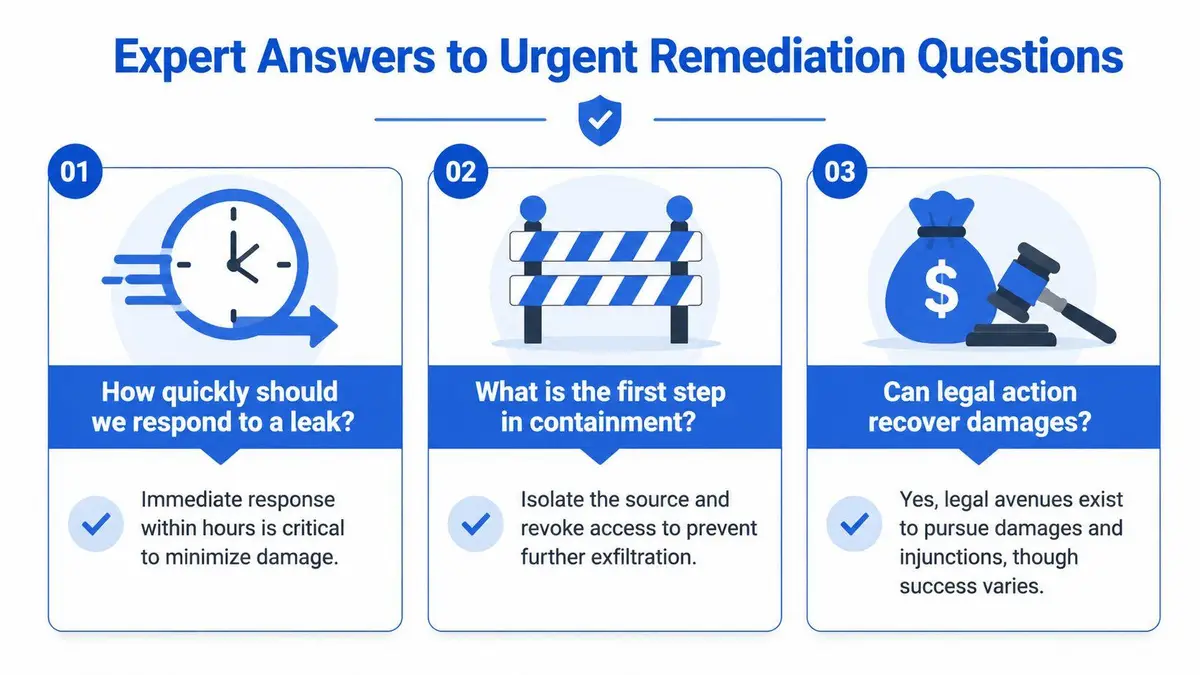
Expert Answers to Urgent Remediation Questions
The questions below usually arrive after the first shock wears off. By then, the client has learned that removal is harder than deletion and that silence isn’t the same as control.
Can’t our internal teams handle this themselves
Sometimes they can handle the first hour. They usually can’t handle the full life cycle.
Internal IT can isolate systems. Outside counsel can preserve claims. A communications team can shape language. None of that guarantees source removal, de-indexing, mirror suppression, impersonation takedowns, or reupload monitoring across the public web. DIY responses fail because they treat the incident as a single event. Real leak remediation treats it as an evolving distribution problem.
If content is removed once, isn’t the crisis over
No. That assumption causes repeat victimization.
A leak that has already circulated develops a shadow life through copied files, forum reposts, search snippets, and private channels that later go public again. Removal without monitoring is temporary relief. If your plan ends at takedown, it is incomplete by design.
Does insurance solve the real exposure
Insurance can help with part of the financial impact, but it doesn’t neutralize search visibility, public humiliation, or persistent digital copies. For affluent households and executives, a strong risk posture often includes specialized coverage and coordinated response expectations. That’s one reason many advisers review insurance for affluent individuals alongside privacy, security, and incident-retainer planning. Financial recovery and reputational recovery aren’t the same thing.
What physical warning signs justify immediate escalation
Any sign of hidden water intrusion near devices, archives, or communications infrastructure should trigger immediate review. Common slab leak warnings include unexpected bill increases, damp flooring, warm spots on floors, low water pressure, and the sound of running water when fixtures are off, as outlined by SERVPRO’s slab leak repair guidance. Ignoring foundation moisture also raises mold and structural concerns that can disrupt occupancy and force hurried device moves, according to this slab leak consequences overview.
When should we bring in specialist remediation support
At the start. Not after press coverage, not after the second repost, and not after a fake account appears.
The right time is when you know sensitive assets may have escaped control, or when a physical incident plausibly exposed systems that hold them. Specialists help preserve options. Delay removes them.
Fast intervention protects more than files. It protects leverage.
If sensitive data, private media, leaked documents, or impersonation content are already circulating, waiting won’t improve your position. ContentRemoval.com works with executives, public figures, family offices, and legal teams on discreet assessments, coordinated takedown strategy, de-indexing, monitoring, and cross-jurisdiction response when a leak has become both a physical and digital crisis.
Frequently asked questions
What should I do first when private documents or images have leaked online?
Preserve evidence before making any statement: screenshots, URLs, timestamps, file names, platform notices and chain-of-custody details for any device. Then contain by isolating affected devices, revoking compromised credentials, securing backups and locking cloud sessions. Do not let staff delete messages, wipe devices or contact site operators from personal accounts.
If the leaked content has been removed once, is the problem over?
No. A leak that has circulated develops a shadow life through copied files, forum reposts, search snippets and private channels that later go public again. Cited research found most victims saw reuploads within three months, so a plan that ends at takedown is incomplete by design.
Can a burst pipe or water damage really lead to a data leak?
Yes. Devices get moved, security systems go offline, laptops are restarted on unsecured setups, cloud sessions stay active and assistants forward files to keep operating. A cited report found about a third of business owners with home-office water damage reported a digital breach within six months, so any water event near devices or archives should trigger immediate review.