
Reporting copyright infringement means preserving evidence first, then sending a notice that meets the six elements of 17 U.S.C. 512 to the party with operational control: the platform’s copyright form if it hosts the file, the web host if the site is independent, and search engines when visibility drives the harm. Offshore hosts often ignore DMCA notices, so de-index too.
Key facts
- A valid DMCA notice needs your signature, the work, each infringing URL, good-faith and perjury statements, and contact details.
- A counter-notice opens a 10 to 14 day window in which the platform may restore the content.
- Large-scale or commercial piracy can be referred to the DOJ CCIPS and the IPR Center.
- A U.S. copyright infringement claim must be filed within three years of the date it accrued.
Where ContentRemoval.com comes in. ContentRemoval.com runs copyright enforcement for founders, public figures and rights holders whose paid content, interviews or images are being mirrored and outranking their own assets. The matter usually arrives through a licensing manager, PR adviser or in-house counsel who has had a notice ignored. A free 15-minute Exposure Scan maps every infringing URL and the host, platform or search route that applies, and the report is yours to keep. Get a Free, Confidential Exposure Scan or read how our content removal work is done.
You find the infringement after the damage has already started. A licensing client forwards a pirate link. Your assistant spots your paid video course mirrored on a junk domain. A search result for your name now surfaces stolen interview clips, leaked images, or reposted proprietary content above your legitimate assets. At that point, speed matters, but precision matters more.
Many individuals mishandle copyright enforcement in the first hour. They fire off angry emails, use the wrong reporting form, or send a defective notice to a generic abuse inbox that nobody monitors. That wastes time, alerts the infringer, and weakens your position if the matter escalates.
If you want to know how to report copyright infringement correctly, start with a hard rule: treat every incident as both a removal problem and an evidence problem. If the infringer sits on a U.S. platform, a DMCA takedown is often the fastest path. If the infringer sits outside the U.S., the smarter move may be de-indexing and host-level pressure rather than chasing a takedown regime that won’t be honored.
Recognizing Copyright Infringement Scenarios
High-profile clients rarely discover infringement in a clean, obvious way. It usually appears sideways. A reputation team notices a suspicious result in Google. A PR advisor flags a copied article that stripped attribution. A brand monitor catches a clip of a keynote, interview, webinar, or promotional video republished on channels you never authorized.
The first job is to separate actionable infringement from noise. Some uses are commentary. Some are parody. Some are licensed through a distributor you forgot had syndication rights. Others are pure theft dressed up as “fan content” or “news reporting.”
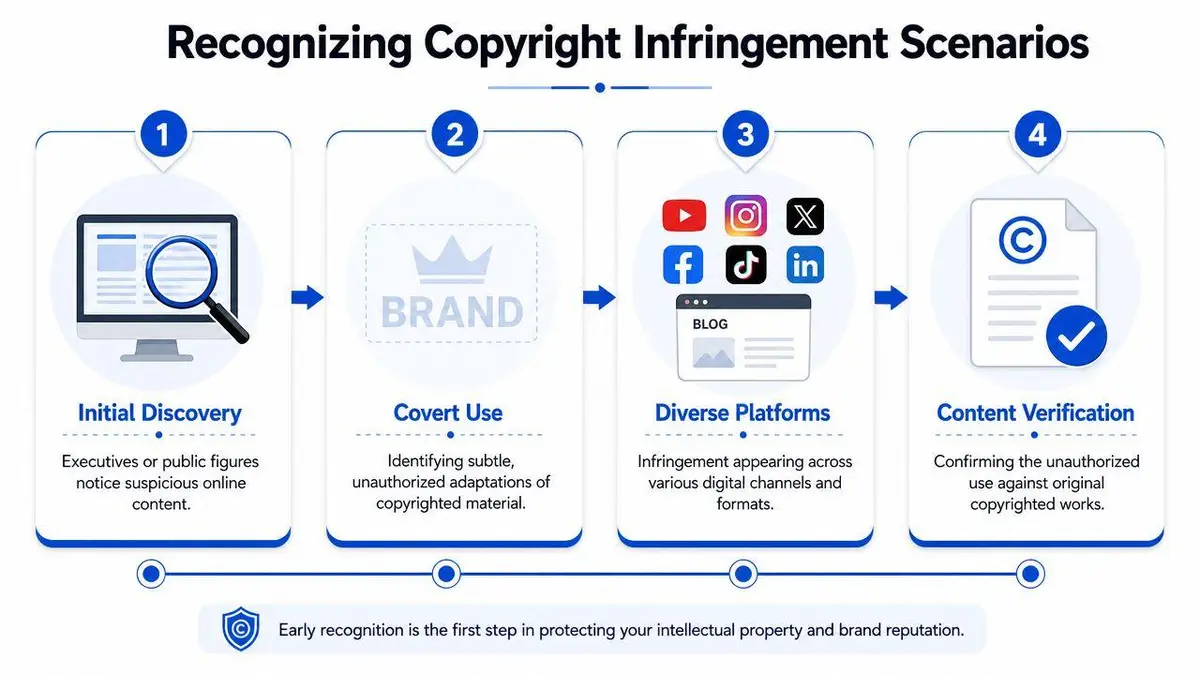
The patterns that usually matter
Outright piracy is the easy case. Someone uploads your film, training, photos, music, book excerpt, or paid member content without permission. Less obvious cases are more common with executives and public figures.
- Repackaged media that crops watermarks, trims intros, or overlays a new logo.
- Impersonation-adjacent reposts that use your creative assets to imply endorsement.
- Scraped editorial content copied onto low-quality blogs and monetized through ads.
- Unauthorized ad usage where a brand borrows the “feel” of your work too closely.
If you deal with commercial voice or likeness misuse, the line between infringement and adjacent rights can get messy fast. A useful cultural example is when sound-alikes aren’t good enough, which shows why “not an exact copy” doesn’t automatically make a use defensible.
A quick triage test
Ask three questions before you report anything.
- Do you control the copyrighted work? Ownership, exclusive license, or clear authority to enforce matters.
- Is the copied material substantial? A full repost is obvious, but even partial copying can be actionable if it captures the protected core of the work.
- Is there a legitimate defense in play? Commentary, criticism, news reporting, and parody need a cooler head before you send notices.
Practical rule: If the use competes with your original, substitutes for it, or exploits it commercially without permission, treat it as urgent until proven otherwise.
Why recognition has to happen fast
Delay gives infringers time to duplicate the asset across mirrors, social accounts, file lockers, and search indexes. For a founder, celebrity, or investor, that’s not just an IP problem. It becomes a visibility problem. Once copied material starts outranking or contaminating branded search results, cleanup gets more expensive and more public.
Recognizing the right scenario early prevents the worst mistake in this field. Misclassifying a fast-moving piracy issue as a simple one-off repost.
Preserving Evidence of Infringement
Before you send a notice, preserve the record. If the page disappears after you complain, you still need proof of what was there, where it was hosted, and when you found it. Sloppy evidence handling compromises your advantage.
Build a record that survives scrutiny
Capture the infringement in layers, not with a single screenshot. Take full-page screenshots that show the content, the page title, the URL bar, and the visible date if available. Save the page source or a local copy when lawful and practical. Download the infringing file if it’s publicly accessible and relevant to the claim.
Then document the surrounding context:
- Exact location data such as the page URL and any direct media URL visible from the platform
- Discovery details including the date, time, and who found it
- Ownership proof such as the original publication file, registration details if available, draft files, or distribution records
- Hosting information gathered through WHOIS or DNS lookup so you know who needs to receive the complaint
A screenshot proves appearance. It doesn’t prove chain. You need both.
Preserve metadata and custody
Store everything in a dedicated matter folder with restricted access. Name files consistently. Keep an index of what was captured, by whom, and on what date. If your team handles sensitive media, adopt the same disciplined retention mindset used in ITAD data compliance essentials. Different context, same principle: evidence loses value when storage and handling are casual.
Save the evidence before you touch the platform. Once a page changes, your cleanest proof may be gone.
What sophisticated teams document
A reliable infringement file usually includes:
- Visual proof from desktop and mobile views, because platforms often render different content by device
- Platform identifiers such as usernames, channel names, profile links, and account IDs when visible
- Server and registrar details to distinguish the website operator from the actual host
- Integrity controls like preserving original file names and maintaining a clear timeline of any downloads or exports
If litigation becomes necessary, your lawyer will want a coherent chain, not a pile of disconnected screenshots sent over text message.
Drafting a Legally Compliant Takedown Notice
A bad notice wastes the first 48 hours. In high-stakes matters, that delay gives mirror sites time to spread, foreign hosts time to reshuffle infrastructure, and search engines time to keep serving the infringing URL.
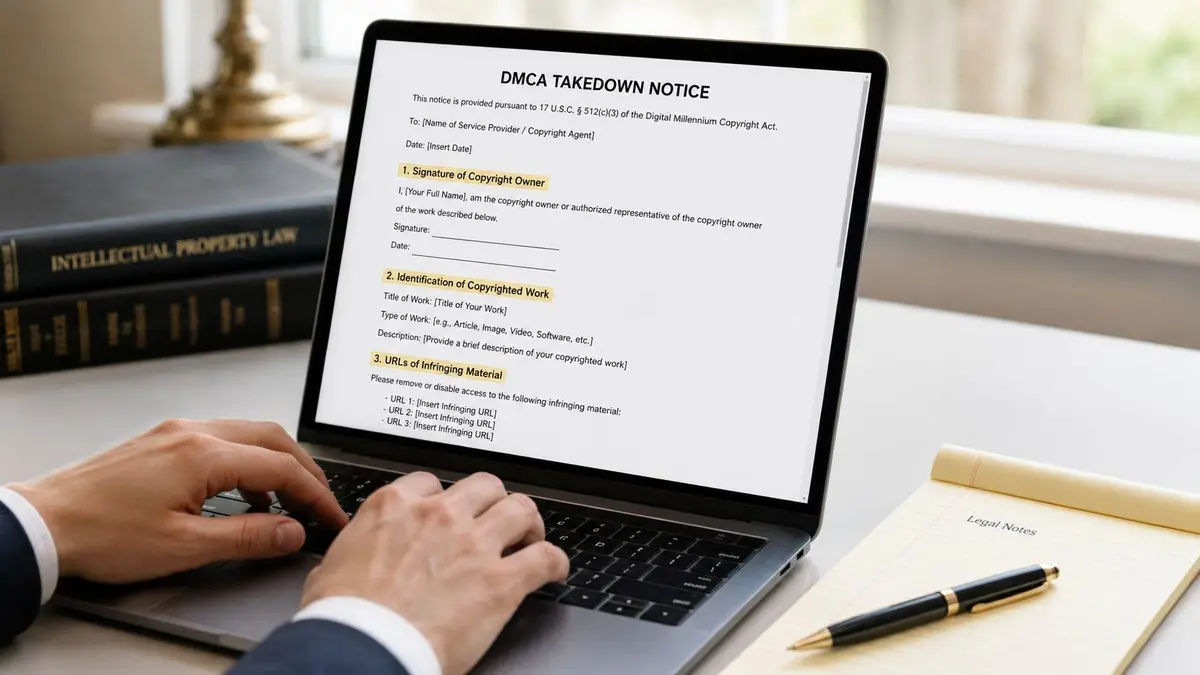
Your notice needs to do two jobs at once. It must satisfy the legal requirements for a valid DMCA claim, and it must be drafted for the messy reality that infringers often exploit jurisdictional gaps. If the operator sits offshore, hides behind a privacy shield, or cycles domains across weak-enforcement regions, a vague complaint will fail fast. A precise notice gives platforms, hosts, and search engines a clean record they can act on without debate.
Under 17 U.S.C. § 512, a compliant notice includes specific statutory elements. Miss one, and you hand the recipient a reason to reject, delay, or ignore the request.
What your notice must include
Include these points in clear, plain language:
- Your signature, physical or electronic.
- Identification of the copyrighted work, with title, publication link, and registration details if available.
- Identification of the infringing material, using exact URLs or other precise location data.
- A good-faith statement that the use is not authorized by you, your agent, or the law.
- A perjury statement confirming the notice is accurate and that you are authorized to act.
- Your contact information, including name, address, email, and phone if required by the platform.
That is the floor. Serious enforcement work requires better drafting than the statute’s minimum.
Draft for action, not for emotion
Write the notice so an overworked trust and safety reviewer can approve it in minutes.
State the original work with enough detail to confirm ownership. Then map each infringing asset to its own URL. If there are ten infringing links, list ten links. Do not bury them in a paragraph. Do not add accusations about theft, bad faith, or damages. Save that for counsel correspondence or litigation strategy.
Use direct language:
- Identify the protected work precisely with title, original URL, publication date, and ownership basis.
- List every infringing location separately so each URL can be removed or disabled without follow-up.
- Use the statutory statements exactly once and keep them clean.
- Sign in the capacity you hold, such as owner, authorized agent, or in-house counsel.
If you need a tighter operational model, this strategic guide to filing a DMCA takedown notice is worth reviewing.
The best takedown notices read like evidence-backed instructions.
Add details that close common enforcement gaps
This is the part generic guides miss.
If the infringing site sits outside the U.S. or routes traffic through multiple intermediaries, add identifiers that help third parties act even if the operator ignores you. Include page titles, account names, channel names, image file names, product listing IDs, and cached or archived references where relevant. If the content is likely to reappear, note that near-duplicate reposts, mirror URLs, cropped images, and renamed files are unauthorized versions of the same work.
That drafting choice matters because host removal is only one pressure point. Search de-indexing often becomes the faster way to cut discovery when direct host enforcement is slow, disputed, or blocked by foreign jurisdiction issues. A notice that clearly ties the original work to the infringing URL set puts you in a stronger position when you ask search engines to suppress visibility.
Use a disciplined structure
A practical order looks like this:
- Your identity and authority to act.
- The copyrighted work, with source location.
- The infringing material, listed URL by URL.
- The good-faith statement.
- The perjury statement.
- Your signature and contact details.
Keep it tight. Reviewers do not need your biography, your full legal theory, or a long narrative about brand harm.
A short explainer on how platforms process these reports can help if you’re coordinating with internal counsel or a communications team:
Cease and desist versus DMCA
A cease-and-desist letter serves a different purpose. It targets the infringer directly and helps build a record before litigation or settlement discussions. LawSikho’s discussion of copyright infringement legal notices explains the typical structure and timing.
Use a DMCA notice when you need an intermediary to remove, disable, or restrict access. Use a cease-and-desist when you want pressure on the operator, preserve litigation posture, or put willfulness on record. In high-value matters, you often need both, drafted in parallel and sent to different targets.
Submitting Reports to Hosts Platforms and Search Engines
Your notice is ready. The next mistake can cost you days.
A counterfeit clip hits a major platform at 9:00 a.m., gets mirrored to a stand-alone site by noon, and is ranking in search by late afternoon. If you send one generic complaint to everyone, you lose control of the timeline. High-stakes enforcement requires routing each report to the party that can cut off access, hosting, or visibility.
Where each reporting path fits
As noted earlier, the DMCA framework shapes how U.S. platforms and many global services process copyright complaints. That is why their reporting portals ask for the same core elements: the work at issue, the infringing URL, your contact details, and the required legal statements. YouTube, Meta platforms, marketplaces, and creator platforms all follow that logic, even when their forms look different.
What matters here is function, not form. File with the platform if it hosts the content. File with the web host if the site operates independently. File with search engines when search visibility is extending the harm or the operator is playing jurisdictional games.
| Channel | Target | Best Use | What You Actually Get |
|---|---|---|---|
| Platform copyright form | YouTube, Facebook, Instagram, marketplaces, creator platforms | The content sits directly on the platform | Removal or access restriction at the platform level |
| Host-level notice | Web host or infrastructure provider for the infringing site | No platform form exists, or the site is independently run | Source-level disruption if the host acts |
| Search engine removal or de-indexing request | Search results linking to the infringing page | Visibility is driving the damage, or source removal is delayed | Suppressed discoverability, even if the page remains live |
Use the right order
Start with the platform or host that controls the file.
Then file search engine removal requests for the same URLs if the content is being indexed, syndicated, or mirrored. That second step gets ignored in too many guides. It should not. In cross-border matters, de-indexing is often the fastest way to reduce commercial damage while you work through a slow or uncooperative foreign host.
This is the enforcement gap resourceful infringers use. They place content with offshore operators, weak-response hosts, or privacy-shielded site owners because they know direct removal may stall. Search suppression closes part of that gap. It does not delete the file, but it cuts traffic, lowers discovery, and reduces the chance that reposts keep spreading through search.
A direct filing rule
If the infringing material is on a major platform, use that platform’s copyright form first.
If the material sits on a stand-alone website, identify the actual host before sending anything. Do not waste time arguing with the site’s generic contact inbox if a hosting provider or CDN abuse channel has practical control.
If the site is evasive, offshore, or built to reappear under new domains, split your reporting plan immediately. Send the host notice. Send the search de-indexing request. Track mirrors as a visibility problem, not just a removal problem.
Send reports to the actor with operational control. In urgent matters, visibility suppression is often as important as source removal.
That is how to report copyright infringement efficiently under real-world pressure. Ask who can disable access, who can cut hosting, and who can bury the page from search. Then file in that order.
Handling Counter Notices and Repeat Infringements
Takedown success can be temporary. The more visible the client, the more likely the infringer disputes the notice, migrates the file, or reposts it through mirror accounts. If your enforcement plan ends at “content removed,” you’re underprepared.
What happens after the takedown
A counter-notice changes the posture. The platform may restore the material unless further legal action is taken within the applicable window. That means removal is no longer just an administrative process. It becomes a monitoring and escalation exercise.
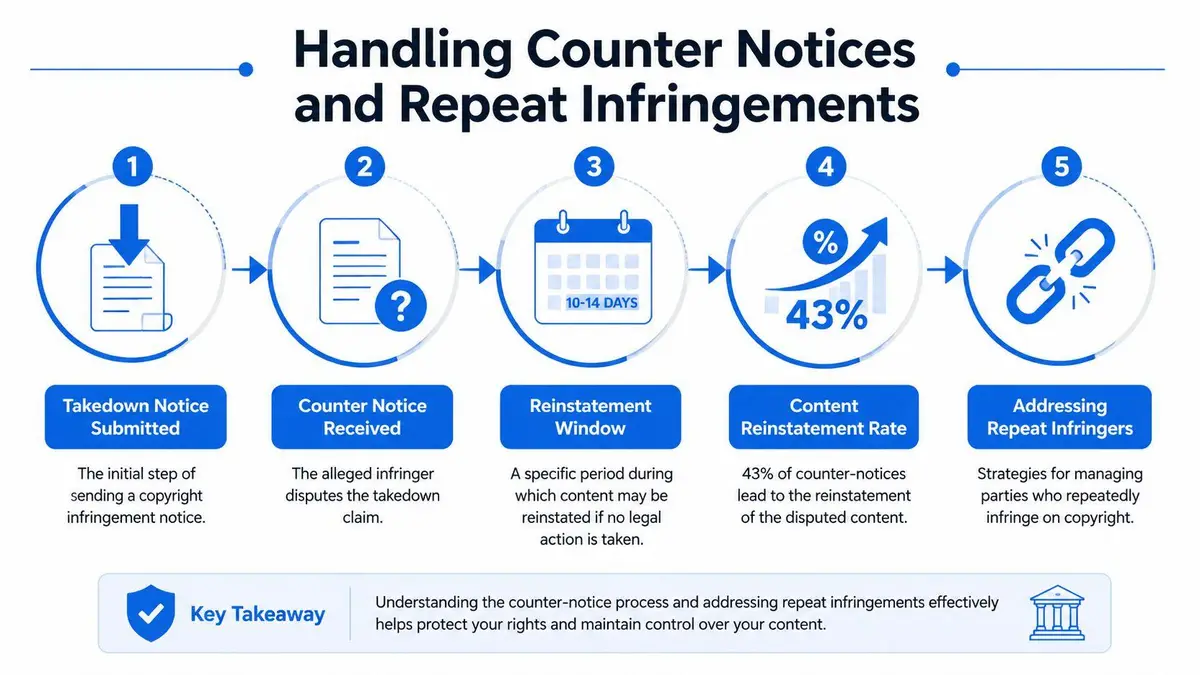
The gap most public guides ignore is the reinstatement period. As explained in Jaburg Wilk’s discussion of copyright enforcement, the counter-notice lifecycle triggers a 10 to 14 day reinstatement window where content can reappear. The same source states that 43% of counter-notices result in re-uploads within 72 hours because platforms often lack automated re-monitoring.
Why repeat infringement is a systems problem
A repeat infringer isn’t just one person uploading the same file twice. It’s often a network behavior.
You remove one URL. Another account posts the same video with a slight crop. A file locker mirrors the source. A gossip forum embeds the copied asset from a fresh host. Then search engines pick up the new location.
That’s why serious enforcement includes a monitoring loop:
- Watch for exact and near-match re-uploads across platforms, search results, and known mirrors
- Track recurring account identifiers such as aliases, channel names, and profile links
- Maintain notice history so repeated conduct is documented if you need stronger platform intervention
- Escalate faster on second and third appearances instead of treating every repost as a brand-new matter
When to litigate and when to contain
If the counter-notice appears credible, review it carefully. If it’s performative, abusive, or tied to obvious repeat piracy, shift into containment mode immediately. That means preserving the dispute record, watching the reinstatement clock, and preparing parallel action against newly surfaced URLs.
Removal without re-monitoring is temporary relief, not protection.
High-profile clients should assume copied material will try to come back. The issue isn’t whether the first takedown works. The issue is whether you have a process for the second and third wave.
Escalation Strategies for High Stakes Cases
The biggest mistake in cross-border infringement matters is acting as if every website fears a U.S. takedown notice. Many do not. They know the paperwork. They know the gaps. They know that most complainants stop after one ignored email.
The jurisdiction problem most guides duck
A DMCA notice is powerful, but it is U.S.-centric. That matters because 60% of global piracy occurs on servers in jurisdictions with weak IP enforcement, where DMCA notices are often ignored, according to Red Points on jurisdictional enforcement gaps. The same source says de-indexing yields 85% faster organic visibility loss than direct takedowns in non-DMCA countries.
That should change your strategy immediately. If the infringing host is in a jurisdiction that won’t honor your notice, stop acting as if source removal is the only meaningful outcome. For reputationally sensitive matters, reducing discoverability can be the more decisive move.
De-index first when visibility is the threat
For executives, celebrities, and founders, the public harm often comes from search exposure, not merely the existence of the source page. If a weak-enforcement host ignores your complaint, move on two tracks:
- Search engine de-indexing to strip the page from common discovery paths
- Host-level abuse reporting where a provider or intermediary may still act even if the publisher does not
- Proxy pressure points such as ad networks, embedded players, mirror hosts, and distribution endpoints
- Evidence preservation for later claims if the matter develops into a broader campaign
If a platform or search engine denies your request, this guide on what to do if Google denies your content removal request is a practical next step because denial rarely means the matter is over. It usually means your framing, jurisdictional angle, or target intermediary needs to change.
When the matter crosses into criminal territory
Some cases exceed civil takedown practice. Large-scale piracy, organized distribution, pre-release leaks, and operations with clear commercial scale may require criminal referral rather than another round of notices.
The reporting path shifts to the U.S. Department of Justice Computer Crime and Intellectual Property Section and the National Intellectual Property Rights Coordination Center. According to the DOJ guidance on reporting criminal intellectual property theft, reporters should document the estimated quantity of illegal distribution, the estimated value of illegal distribution, the time period of distribution, whether the operation is national or international, and internet details such as domain names and login credentials. The same DOJ material states that the IPR Center includes 22 federal, state, and local agencies and that the Department maintains 63 international legal attaches to support cross-border enforcement.
That is a different league from a DMCA form. Use it when the facts justify it.
Escalation is a sequencing issue
Strong cases don’t always fail because the law is weak. They fail because the response was linear when it needed to be layered. In high-stakes matters, the winning sequence is often evidence preservation, target-matched reporting, visibility suppression, and then civil or criminal escalation if the conduct persists.
Send one notice if the facts call for one notice. Don’t keep sending the same notice to the same uncooperative target and pretend you’re escalating.
Maintaining Ongoing Protection and Privacy
The matter isn’t closed when one URL disappears. It’s controlled only when you’ve built a system that catches recurrences, preserves confidentiality, and leaves your legal options intact.
Build a quiet protection loop
Set recurring sweeps for your key assets, names, signatures, media titles, and known infringer aliases. Keep a legal hold folder for evidence. Review hosting changes on recurring problem domains. Route takedown work through a limited-response team so your contact data and internal operations stay contained.
For public figures and family offices, privacy discipline matters as much as takedown speed. Use dedicated reporting identities where lawful and appropriate, maintain encrypted evidence storage, and avoid broadcasting ownership details unnecessarily across open support channels.
Don’t lose the litigation window
Civil enforcement has a hard deadline. The statute of limitations for a U.S. copyright infringement claim is exactly three years from the date the claim accrued, as noted by Robinson & Henry’s explanation of the filing deadline. If you may need damages or injunctive relief, calendar that date early.
For ongoing surveillance and discreet detection, structured reputation monitoring is often the difference between a contained infringement issue and a long public cleanup.
If you need fast, discreet help from specialists who handle takedowns, de-indexing, repeat infringement, and cross-border reputation threats for high-profile clients, contact ContentRemoval.com for a confidential assessment and a clear action plan.
Frequently asked questions
Who do I send a DMCA notice to if the infringing website is not on a major platform?
Identify the actual hosting provider or CDN through a WHOIS or DNS lookup and use its abuse channel rather than the site’s generic contact inbox. If the host is offshore or evasive, send the host notice and a search engine de-indexing request for the same URLs at the same time.
What happens if the infringer files a counter-notice?
The platform may restore the content after a 10 to 14 day window unless you take further legal action. Treat that period as a monitoring exercise: preserve the dispute record, watch the reinstatement clock and prepare action against any newly surfaced mirrors or re-uploads.
Is a cease and desist letter the same as a DMCA takedown?
No. A DMCA notice goes to an intermediary such as a platform, host or search engine to remove or disable access. A cease and desist goes to the infringer directly to apply pressure and put willfulness on record ahead of settlement or litigation. High-value matters often use both in parallel.