
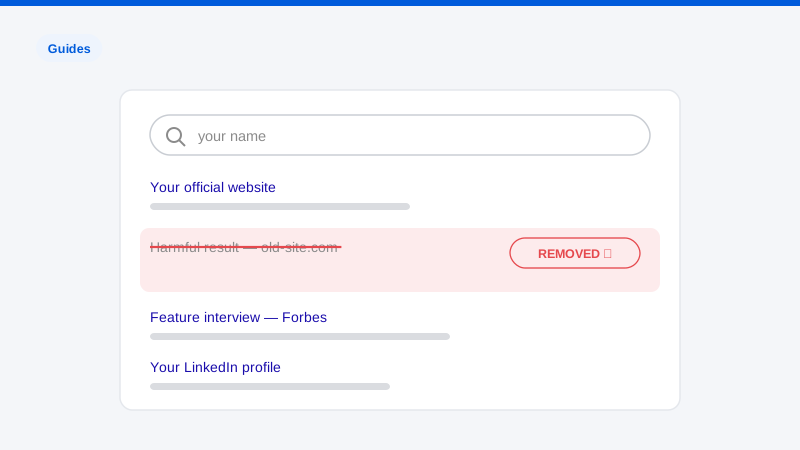
The email arrives with polite finality: Google has reviewed your request and decided the content “does not meet the requirements for removal.” If you’re staring at a Google denied content removal request right now, the first thing to understand is that this is the normal outcome of a first attempt, not a verdict on your case. We file removal requests every day, and the pattern is consistent: most denials are caused by fixable problems in how the request was framed and evidenced, not by the underlying content being unremovable.
The second thing to understand is that a denial costs you more than time. Refiling the same request with the same evidence trains Google’s reviewers to see you as a duplicate submitter, and repeated identical requests can get subsequent submissions dismissed with less scrutiny. So the worst move is the instinctive one, mashing the resubmit button. The right move is a post-mortem: figure out why the denial happened, fix that specific weakness, and refile a materially stronger request, or recognize that you filed under the wrong process entirely and switch tracks.
This guide covers both: how to diagnose and reverse a denial through Google’s own removal processes, and what to do when Google genuinely won’t act, which, as you’ll see, is very far from the end of the road.
Why Google denies removal requests: the real reasons
Google’s removal reviewers work from written policies with specific eligibility criteria, and they process enormous volumes. That combination produces denials for reasons that have little to do with the merits of your situation.
You filed under the wrong policy
This is the most common failure we see in requests people filed themselves. Google runs multiple distinct removal tracks: personal information (doxxing) removals, non-consensual explicit imagery, the outdated content tool, legal removals (defamation with a court order, copyright, trademark), results-about-you contact-info removals, and more. Each has different eligibility rules and different evidence requirements.
A request that describes a doxxing situation but was filed through the legal removals form gets evaluated against legal-removal criteria, and denied. A copyright claim filed through a personal-information form gets denied. The content might be removable three different ways, but the form you chose is the lens the reviewer must use.
Your evidence didn’t prove the specific elements the policy requires
Every Google removal policy has elements, discrete facts the reviewer must be able to verify. For a personal-information removal, for example, the reviewer typically needs to confirm that the information is actually yours, that it’s the type of information the policy covers, and that its presence creates the kind of risk the policy is designed to address. If your submission asserts these things but doesn’t show them, a high-volume reviewer will not go digging on your behalf. Denial.
The requests that succeed read like well-organized case files: the exact URLs, the exact location of the offending content on each page, screenshots with the relevant portions identified, and a plain-language explanation that maps your situation onto the policy’s own wording.
The content genuinely falls outside the policy
Some denials are correct. Google’s discretionary removal policies do not cover truthful negative news coverage, critical opinion, most business reviews, or public records lawfully republished. If your denied request falls in this category, refiling harder into the same wall won’t help, but it doesn’t mean the content is permanent. It means Google was the wrong target, and the source website is the right one. More on that below.
The technical details were wrong
Mundane, and surprisingly common: the submitted URL redirects, or points to the site’s homepage instead of the offending page, or the content moved after you filed, or you submitted a search-results URL instead of the target page. Reviewers verify what you submit, exactly as submitted. Any mismatch between your claim and what loads at the URL is a denial.
First, diagnose: read the denial like a practitioner
Before deciding anything, extract every signal from the denial notice itself.
Google’s denial emails are templated, but the template chosen tells you something. A response saying the content “does not violate” a named policy tells you which policy you were evaluated under. Check whether that’s the policy you meant to invoke. A response asking for more information is not a denial at all; it’s an invitation, and it usually names the missing element. A response pointing you to a different process (“you may wish to contact the site’s webmaster”) is Google telling you the request was aimed at the wrong party.
Then re-read your own submission with fresh eyes and ask three questions:
- Did I file under the policy that actually fits this content?
- Could a stranger, reading only my submission, verify every element the policy requires?
- Does the URL I submitted still show exactly what I described?
In our experience, one of those three questions exposes the problem in the large majority of denied first attempts.
Refiling with better evidence: how to do it properly
A refile should be a materially different submission, not a re-sent one. Here’s the step-by-step approach we use.
Step 1: Confirm the correct removal track
Map your content to the right process before anything else. Personal contact information (home address, phone number, email used to harass) belongs in the results-about-you / personal information track. Intimate or explicit imagery posted without consent has its own dedicated process. Content you own the copyright to (photos, articles, video, course materials) goes through the DMCA process, which is procedural rather than discretionary and is often the strongest tool available; see our copyright infringement removal practice for how those work. Pages that have changed or died but still show old information in results belong in the outdated content tool. If a court has ruled content defamatory, that order supports a legal removal request.
If your original filing used the wrong track, your “refile” is really a first filing under the correct one, which also means the previous denial carries little weight against it.
Step 2: Rebuild the evidence package from zero
Don’t patch the old submission; rebuild it.
- Capture the content as it exists today. Full-page screenshots with the URL and date visible. If the content is mixed into a long page, capture both the full page and a close-up of the offending portion.
- Prove the identity link. If the policy requires that the content be about you, include what’s needed to establish that: matching name, the connection between the username and you, whatever the policy’s verification step will ask for.
- Map evidence to policy elements explicitly. Structure your explanation as: here is the policy language, here is the content, here is why the content meets each element. Reviewers approve requests they can verify quickly.
- Verify every URL seconds before submitting. Load each one in an incognito window. Confirm it resolves, confirm the content is there, confirm it’s the canonical URL and not a redirect.
Step 3: Address the denial head-on
Where the form allows explanation, acknowledge the prior request and state plainly what’s different: “A previous request was submitted under [track]; this request is submitted under [correct track] with documentation of [the previously missing element].” This reframes you as a corrected filer rather than a duplicate one.
Step 4: Calendar the follow-through
Removal reviews take days to weeks. Log the submission date, the confirmation number, and check the URL weekly. If content is approved for removal but still appears in results, that’s sometimes a caching lag, and sometimes a partial action that needs a follow-up request for the remaining URLs. Removals are per-URL, and the same content frequently lives at several.
When Google says no twice: the alternative routes
Suppose you’ve refiled properly and been denied again, or your content genuinely sits outside every Google policy. You still have real options, and the strongest one is the route we recommend leading with in the first place.
Go to the source
Google indexes the web; it doesn’t host it. The website displaying the content can delete it regardless of what Google thinks, and when the source page dies, the search result follows automatically. Source removal is harder to execute than form-filing (it means identifying the right contact at the site, finding the lever that motivates them (their own terms of service, their advertisers’ policies, their host’s acceptable-use rules, a copyright claim, or a straightforwardly persuasive request), and negotiating) but it solves the problem everywhere: Google, Bing, AI chatbots, social shares, and the page itself. This is the core of our practice, and our removal process is built around it.
Use the other levers on the source side
- The platform above the page. Content on Reddit, Facebook, YouTube, or a forum is governed by that platform’s policies, which are often broader than Google’s. A post that Google won’t de-index may squarely violate the platform’s harassment or impersonation rules.
- The host below the site. Rogue sites that ignore all contact still depend on hosting companies, domain registrars, and CDN providers, businesses with abuse departments and acceptable-use policies. Escalating to infrastructure is slower but effective against sites built to be unreachable.
- Copyright, if you own anything on the page. Even when the text about you isn’t removable, your photo on the page might be your copyrighted image. A valid DMCA notice can remove it, and sometimes the page’s operator removes the whole post rather than edit it. If images are the core problem, see our guides to removing images from Google and image and video removal generally.
- Legal process. If the content is genuinely defamatory, a court determination changes everything, Google honors court orders that content is unlawful. We are not a law firm and this is not legal advice; what we can tell you as practitioners is that the legal route is slower and costlier than every other option, and worth evaluating with an actual attorney when the stakes justify it.
Reduce the damage while you work
If removal is going to take months, don’t let the content own your search results in the meantime. De-indexing individual URLs where possible, correcting inaccuracies with the publisher, and strengthening the legitimate content that ranks for your name all shrink the practical harm while the longer play runs. Our overview of removing search results covers how these tactics fit together, and our guide on removing yourself from Google covers the broader cleanup.
Frequently asked questions
How many times can I resubmit a removal request to Google?
There’s no published limit, but volume isn’t the constraint, novelty is. Each submission should be materially different: a new policy track, new evidence, or a changed circumstance (for example, the site altered the page, or you’ve since obtained a court order). Identical resubmissions accomplish nothing and can dilute the attention your future requests receive. One well-built refile beats five copies of a weak one.
How long should I wait after a denial before refiling?
There’s no mandatory cooling-off period. The real timeline is however long it takes you to fix what caused the denial, usually days if the problem was evidence or the wrong form, longer if you’re gathering documentation or pursuing a parallel route. Refile when the new submission is genuinely stronger, not when the calendar says so.
Google denied my request but the content violates their policy. What happened?
Almost always one of three things: the reviewer couldn’t verify the violation from what you submitted, the request was routed through a track whose criteria don’t match the violation, or the URL didn’t show what you described at review time. Occasionally reviews are simply wrong, reviewers are human and volumes are high, which is itself a reason a properly rebuilt resubmission can succeed where the first attempt failed.
If Google removes the result, is the content gone?
No: and this distinction matters more than any other in this field. A Google removal de-indexes the URL from Google search. The page remains live on the website, findable through other search engines, direct links, and social media, and it can resurface in Google under a new URL. That’s why we treat source removal as the primary objective and Google actions as one component of it.
A denial is information, not a defeat. It tells you what the reviewer couldn’t verify, and that’s a fixable problem far more often than not. If you’d like practitioners to diagnose your denial and map every removal route that applies to your situation, start with our free exposure scan. We’ll tell you honestly which paths are viable, including the ones that don’t involve paying us.