
Removing a fake Google review starts with flagging it through your Google Business Profile, citing a specific policy such as Spam and Fake Content, Conflict of Interest or Impersonation, with proof the reviewer was never a customer. If the report is denied, escalate with a documented pattern of coordinated activity. For defamatory reviews, a court order compels action.
Key facts
- Audit your CRM, invoicing and email records to prove the reviewer never had a transaction with you.
- Report through both the Google Business Profile dashboard and Google’s review reporting tool, and keep the case ID.
- Review bombing signs: a burst of one-star reviews within days, recycled wording and profiles with no history.
- A U.S. court order declaring a review defamatory bypasses Google’s internal moderation.
Where ContentRemoval.com comes in. ContentRemoval.com handles fake Google reviews once a documented report has been denied or a coordinated attack is under way, building the evidence file and escalation that reaches a decision-maker, and working with counsel where a court order is the only route. Practice managers, business owners and their marketing agencies usually make contact after the second denial. A free, confidential 15-minute Exposure Scan maps which reviews are removable and by which route, and the report is yours to keep. Get a Free, Confidential Exposure Scan or read how our review removal work is done.
Removing a fake Google review is not a simple administrative task; it is a strategic necessity. Your initial action is to flag the review through your Google Business Profile. When this standard procedure fails, as it often does, a more decisive approach is required.
Escalation is not optional. It involves building a robust case file with irrefutable evidence. In serious cases, it necessitates leveraging legal instruments to compel action from Google. A court order transforms a request into a legal directive that the platform cannot disregard.
The Escalating Threat of Fake Google Reviews
A fraudulent review is a direct assault on corporate integrity and revenue. These are not minor customer service issues; they are material business risks demanding a calculated, strategic response.
The damage from a single defamatory post can be swift and severe, impacting everything from search engine visibility to the fundamental trust established with clients and stakeholders. An offensive, not defensive, posture is required. We have detailed this approach in our briefing on 11 ways to protect your business’s online reputation.
For executives and high-net-worth individuals, the consequences transcend business metrics. A calculated smear campaign can target personal credibility, threatening to neutralize years of cultivated goodwill almost instantaneously.
Anatomy of a Coordinated Attack
An isolated negative review is one matter. A coordinated attack is another entirely. These campaigns are deliberate assaults, often orchestrated by competitors, disgruntled former employees, or commercial “review-for-hire” networks. Their sole objective is to degrade your star rating and inflict maximum reputational and financial damage in the shortest possible time frame.
Our experience shows these campaigns share common indicators. A sudden influx of one-star reviews within a concentrated period, often hours or days, suggests orchestration. The content of these reviews is typically vague, using inflammatory language but lacking verifiable details such as transaction dates or specific points of interaction. Furthermore, the reviewer profiles are frequently anonymous, featuring generic names, no images, and no legitimate review history, or a history that consists solely of one-star attacks on other businesses.
To quantify the immediate financial exposure, the following table summarizes the primary risks.
Immediate Impact of a Single Fake Negative Review
| Business Metric | Potential Impact |
|---|---|
| New Customer Acquisition | 94% of consumers avoid a business due to negative reviews. |
| Local Search Ranking | Negative reviews can lower your position in Google’s local map pack. |
| Conversion Rates | A drop from a 5-star to a 4-star rating can decrease clicks by 25%. |
| Brand Trust & Credibility | Accusations of fraud or incompetence immediately erode trust. |
| Revenue | A single negative review can cost an estimated 30 customers. |
These figures represent tangible losses in leads, sales, and market standing. The need for decisive action is unequivocal.
The Unseen Damage Beyond the Star Rating
The visible drop in your star rating is only the surface-level damage. The more corrosive harm occurs as a fraudulent review poisons consumer trust. When a prospective client encounters accusations of incompetence or dishonesty, they do not conduct due-diligence; they engage a competitor.
This directly undermines lead generation and conversion funnels, ultimately impacting revenue.
Compounding the problem, Google’s algorithm can penalize businesses with a pattern of low ratings, depressing their position in local search results and removing them from the valuable map pack. This cedes prime digital territory to competitors, creating a negative feedback loop that is difficult to reverse.
A fake review is a weaponized piece of content. Its purpose is not to inform but to inflict financial and reputational harm. Treating it as anything less is a strategic error.
The volatility of Google’s review ecosystem was demonstrated when the platform initiated a massive purge of reviews in early 2026, impacting over 60,000 Google Business Profiles globally.
This cleanup began in late 2025 and intensified between February 16th and 24th, with hundreds of millions of reviews removed. Medical practices and home services were disproportionately affected, with some experiencing removal rates of 15% or more, particularly for 5-star reviews Google’s AI identified as incentivized or purchased.
Building Your Case File for Removal
Reacting emotionally to a fraudulent review is a tactical mistake. Removal is not achieved through argument but through the construction of an evidentiary case that proves a clear policy violation.
Flagging a review as “inappropriate” without substantiation is a futile gesture. Such reports are typically relegated to Google’s automated moderation queue. To achieve removal, you must present a file so clear and compelling that it commands the attention of a human moderator. You must operate as a prosecutor, not a victim.
The objective is not to dispute the reviewer’s opinion. It is to methodically prove that the review itself contravenes Google’s terms of service. A carelessly prepared report is counterproductive, as it can exhaust your initial opportunity for a swift resolution.
This process is critical, as a single fake review can trigger a cascade of negative commercial consequences.
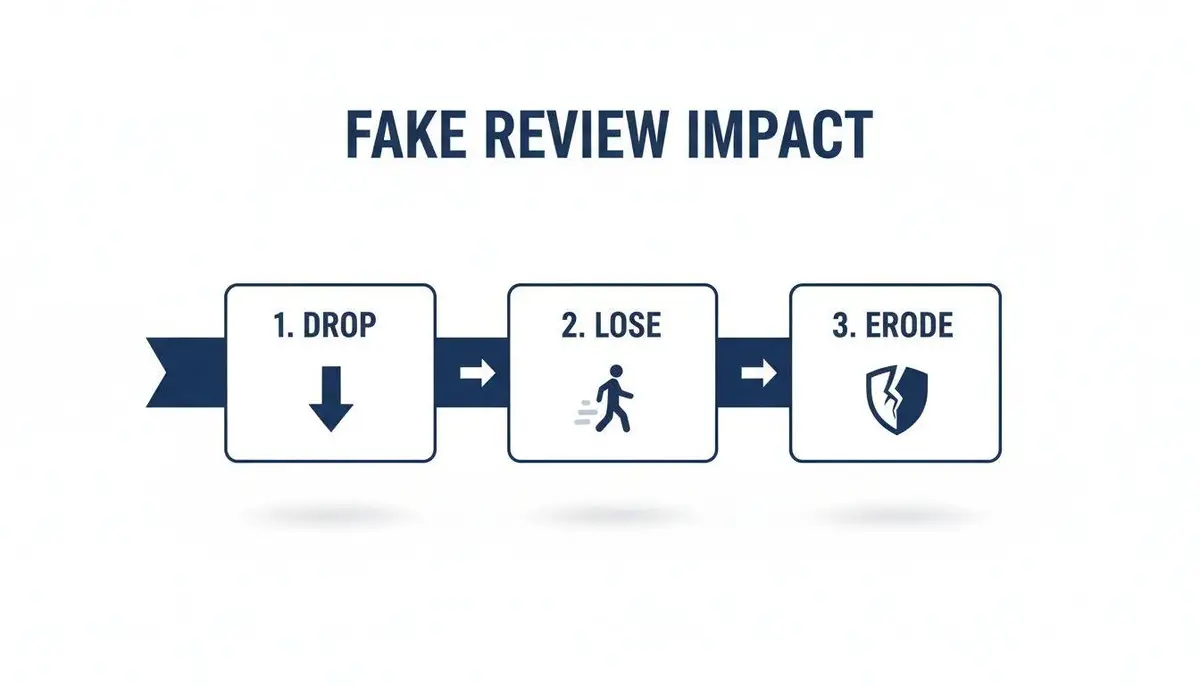
The sequence begins with a drop in your star rating, leading directly to lost clients and, over time, the erosion of brand equity. This is why rapid, precise action is essential.
Documenting the Evidence
Before initiating a report, you must compile your proof. The objective is to provide Google with a file that makes their decision to remove the content straightforward. A support agent must be able to assess your evidence and identify the violation within 30 seconds.
First, capture a full-screen, uncropped screenshot of the review, ensuring the date is visible. This creates a static record, preserving the content before the author can edit or delete it to obscure their actions.
Next, you must prove the reviewer was never a client. This is your most powerful piece of evidence. Conduct a forensic audit of your internal records, including your CRM system, payment and invoicing software, and email and contact form archives. Search for the reviewer’s name and any plausible variations. If this search yields no record of engagement (no invoice, no email, no client profile) you have the cornerstone of your claim that the review is fabricated.
Pinpointing Specific Policy Violations
Google does not remove a review because it is negative or because you dispute its claims. It must violate a specific rule within their Prohibited and Restricted Content policies. Your task is to identify and cite the precise infraction.
Common violations that warrant removal include:
- Conflict of Interest: The review originates from a competitor, a former employee, or a third-party marketing agency engaged by a rival. Proving this can be challenging but is a clear policy breach.
- Impersonation: The user is misrepresenting their identity or falsely claiming to represent an organization.
- Harassment: The review contains personal attacks, threats, or hate speech. Google acts on these violations with greater urgency.
- Spam and Fake Content: The review does not reflect a genuine experience and is posted solely to manipulate your rating. Your internal record audit is dispositive in proving this violation.
A successful removal request presents facts clinically: Here is the review, here is our proof of no commercial interaction, and here is the specific policy it violates. A vague complaint like “This is fake!” is ineffective.
Submitting Your Removal Request Correctly
You have two primary channels for submission, and both should be utilized to create parallel case files. The first is directly from your Google Business Profile (GBP) dashboard; the second is Google’s dedicated review reporting tool.
Your report must be concise and professional. Adhere strictly to the facts.
An effective submission states:
“This review by [Reviewer’s Name] on [Date] violates the ‘Spam and Fake Content’ policy. We have conducted a thorough search of our CRM, billing systems, and email archives and have no record of anyone by this name ever being a customer. This review is not based on a genuine experience.”
This statement is powerful because it is direct, references your due diligence, and cites a specific policy.
Upon submission, Google will issue an email containing a case ID. Preserve this email. The ID is your sole means of tracking the request and escalating the matter if your initial report is denied.
Advanced Evidence Gathering for Escalation
When your initial report to Google is denied, it is not a final judgment. It is an indication that you must escalate. The initial reporting channels function as filters for frivolous complaints. Overcoming this requires building a case so robust that a human analyst at Google is compelled to intervene.

This stage moves beyond standard reporting. The objective is to assemble a dossier that proves malicious intent. A single, isolated complaint is easily dismissed. A data-driven argument exposing a pattern of abuse is not.
Identifying Coordinated Attack Patterns
A single fraudulent review is an annoyance. A sudden cluster of them constitutes a “review bombing” campaign and is your most powerful piece of evidence. These are invariably deliberate attacks from a competitor, a disgruntled party, or a network selling negative reviews.
Analysis begins with timing. A sudden barrage of five one-star reviews in 48 hours following months of normal feedback is a clear indicator of inorganic activity. The velocity of posting itself suggests coordination.
Next, a forensic examination of the reviewer profiles is necessary to identify connections that indicate fabrication. Look for recycled language, as attackers often use scripts. Analyze the profiles themselves; many are empty shells with generic names, no profile pictures, and a history consisting solely of the negative review in question. Cross-reference the geographical locations of other reviews left by these profiles. A user who has ostensibly reviewed a barbershop in Miami, a car wash in Seattle, and your Chicago-based firm within the same week is not a legitimate consumer.
Document these findings in a spreadsheet with columns for the reviewer’s name, date, review text, and a notes section detailing all suspicious patterns.
Using Google’s Own Logic Against Abusers
Google’s algorithms are designed to detect manipulative behavior. Your objective is not to persuade a machine from a neutral position but to deliver the specific evidence its AI is trained to recognize. You are directing the algorithm to a violation it failed to detect on its initial pass.
Google’s AI uses natural language processing to identify repeated phrases and semantic anomalies, and it tracks reviewer “footprints” across the platform. It is programmed to know that a new account that suddenly reviews ten businesses in different states is likely fraudulent. As you learn how Google’s AI detects fraudulent reviews, you can frame your evidence in a way the system is designed to process.
When you submit your escalated report, do not merely state the review is fake. Present your case with authority: “We have identified a coordinated review bombing attack from multiple accounts between [Date] and [Date]. The attached spreadsheet details the overlapping language, improbable review histories, and concentrated posting timeline, which clearly indicate a violation of Google’s Spam and Fake Content policy.”
This reframes the interaction. You are no longer a complainant. You are an investigator presenting a documented case of systematic abuse that violates Google’s terms of service.
This approach is effective. In 2024 alone, Google removed over 240 million reviews that violated its policies. By building a clear, evidence-backed case, you dramatically increase the probability of the fraudulent reviews against your business being included in that total.
Taking Off the Gloves: Forcing Removal with Legal Action
You have executed the internal process correctly: you gathered evidence, submitted a detailed report, and were met with a generic denial stating the review does not violate policy.
When Google’s internal mechanisms fail, you must change the venue. The dispute moves from an appeal to a platform to a legal demand. For a truly damaging, defamatory review that Google refuses to address, legal action becomes your most potent, and often only, recourse.
This is a significant escalation. The conflict is no longer governed by a platform’s terms of service, but by law. The objective is to obtain a legal instrument that converts your request into a directive Google is legally bound to obey.
The Cease and Desist Letter: Your First Legal Shot
The initial legal maneuver is typically a cease and desist letter drafted by counsel. This formal legal document serves two critical functions.
First, it puts the reviewer on formal notice. If the individual can be identified, the letter clarifies that their actions constitute unlawful defamation and that failure to remove the content will result in litigation.
Second, it puts Google on notice. While a cease and desist letter does not legally compel Google to act, it creates an official record proving the company was formally notified of specific, illegal content on its platform. This becomes a crucial piece of evidence in subsequent legal proceedings, demonstrating Google was aware of the harm and failed to mitigate it.
The Court Order: The Ultimate Takedown Weapon
The single most effective tool for removing a fake review is a court order. A U.S. court order declaring a review defamatory ends the discussion with Google. Their internal review process becomes moot.
A court order isn’t an appeal; it’s a legal command. It bypasses Google’s entire internal review system. The platform must comply or face being held in contempt of court.
Obtaining such an order involves filing a lawsuit against the poster, who is often anonymous (a “John Doe” lawsuit). The primary objective is not a lengthy public trial but a judicial ruling that the statements in the review are false and defamatory. That ruling is the legal instrument that compels Google to act.
Building Your Legal Case to Remove a Fake Review
To secure a court order, a solid legal case is required. Your counsel will determine the optimal strategy, but it will likely be predicated on one of these claims:
- Defamation (Libel): This is the most direct legal theory. It requires proving the review contains a false statement of fact (not opinion), was “published” (posted on Google), and caused reputational damage.
- Tortious Interference with Business Relations: This claim argues the review was intentionally posted to disrupt your relationships with current or prospective clients, leading to financial loss.
- Commercial Disparagement: Similar to defamation, this claim focuses specifically on false statements about a company’s products, services, or financial health.
The evidentiary standard for these claims is high. It is imperative that all evidence was collected ethically and legally. Adhering to a framework like this 8-Point Lead Scraping Compliance Checklist helps ensure your evidence is admissible in court.
Suing an anonymous “John Doe” defendant may require issuing subpoenas to identify the poster. However, the result, a court-ordered takedown, is the most decisive and permanent solution available. This level of escalation is reserved for situations where your business and reputation face a direct, malicious attack and all other remedies have been exhausted.
Building a Proactive Defense for Your Reputation

Removing a fraudulent review is a reactive victory. A superior strategic posture involves building a reputation so resilient that such attacks have minimal impact. This shifts the focus from crisis management to continuous control of your brand narrative.
Consider it strategic inoculation rather than damage control. A single 1-star review is devastating when you have few reviews. That same review loses its power when it is one dissenting voice among hundreds of authentic, positive testimonials. The objective is to build this reputational buffer.
Drown Out the Noise with Authentic Reviews
Your most effective defense against a fraudulent review is a consistent stream of genuine, positive feedback. This is not achieved by purchasing 5-star ratings, a shortsighted tactic easily detected by Google’s algorithms. The correct strategy is to implement a system that encourages satisfied clients to share their experiences.
Integrate the request for feedback into your client workflow at the point of maximum satisfaction. Time the request to coincide with a successful project conclusion, a favorable case outcome, or the delivery of a significant result. Simplify the process by providing a direct link to the review section of your Google Business Profile, minimizing friction. A personal request from their primary point of contact referencing the specific success achieved is far more effective than a generic email blast.
This steady influx of positive sentiment does more than improve your aggregate rating. It builds a deep reservoir of credibility that frames any single negative comment as a clear outlier. This is how you learn how to remove fake google reviews by first rendering them irrelevant.
A great reputation isn’t built on the absence of criticism. It’s built on the overwhelming presence of authentic praise. Your objective is to dilute the poison of one fake review with a flood of genuine, positive sentiment.
Use AI Monitoring for Real-Time Alerts
You cannot counter a threat you do not see. Relying on manual discovery of negative reviews puts you at a disadvantage. Professional-grade reputation management employs AI-powered monitoring to provide instantaneous alerts.
These services scan Google and other platforms for any mention of your brand, delivering notifications the moment they appear. Speed is a decisive advantage, allowing you to flag a review and initiate your case file within minutes, not days or weeks.
This constant vigilance is also critical for identifying coordinated attacks. A monitoring system can instantly flag a sudden burst of negative reviews, giving you a head start on documenting the campaign before escalating the matter to Google. We know consumer trust is volatile; while 40% of consumers reported suspicion of reviews in 2025-2026, many still lack the ability to spot a fake. Professional tools address this vulnerability for your business. You can find out more about the shifting dynamics of Google review statistics and consumer trust.
Create Internal Feedback Channels First
Many public one-star reviews are the result of a customer’s private complaint being mishandled or ignored. Your first line of defense is a robust internal process for identifying and resolving issues before they escalate to a public forum.
Provide clients with clear, accessible channels to voice concerns directly to your team. A simple follow-up survey or a dedicated feedback email can function as a critical pressure-release valve. When a client feels their issue is heard and addressed promptly, the motivation to post a negative public review typically dissipates. This internal feedback loop is your most effective tool for converting potential detractors into loyal advocates.
When to Call in the Professionals for Takedown Services
For executives, prominent individuals, and premium brands, a damaging fake review is a direct threat where time, risk, and specialized expertise are critical variables. While the methods previously outlined are effective first-line responses, there is a point where self-managing a removal campaign becomes a significant liability.
Knowing when to transition from internal efforts to engaging a professional firm is a crucial strategic decision. This is not an admission of defeat; it is an escalation of force. If a review is dangerously defamatory, if you face a coordinated attack, or if your own best efforts have been rejected by Google, it is time to deploy specialists.
The Tipping Point for Professional Help
The line between a frustrating review and a business crisis is crossed when the content poses a direct and immediate threat to revenue, reputation, or personal safety. These situations demand a level of speed, discretion, and legal acumen that far exceeds standard reporting protocols.
Engage a specialist when you identify:
- Highly Defamatory Content: The review includes false accusations of criminal behavior, fraud, or other illegal acts causing severe and lasting harm.
- Coordinated “Review Bombing”: Your profile is targeted by a sudden wave of 1-star reviews from multiple suspicious accounts, indicating an organized attack.
- Failed Escalation Attempts: You have submitted detailed, evidence-backed reports to Google Support, only to be met with repeated denials.
- High-Stakes Scenarios: The review targets a high-net-worth individual, a C-suite executive, or a sensitive business unit where public trust is non-negotiable.
In these instances, continued internal efforts are often futile and may complicate future professional intervention.
The Specialist Advantage
Hiring a professional takedown service is not merely outsourcing a task; it is accessing a different class of tools and relationships. These firms operate at a level inaccessible to the public.
Their primary asset is established relationships with platform legal departments. Having managed thousands of complex cases, specialists develop direct lines of communication, allowing them to bypass the first-tier support channels where most requests stall. They understand precisely how to frame an escalation to ensure it reaches an individual with the authority to act.
These firms also employ proprietary removal strategies refined over years of practice. They understand the unwritten rules and nuanced interpretations of content policies, enabling them to identify violations that both automated systems and standard moderators consistently overlook.
A professional takedown isn’t a polite request. It is a clinical, evidence-based process that proves to the platform that leaving the content up exposes them to unacceptable legal and financial risk.
This approach transforms the dynamic from a user complaint into a serious business-to-business escalation.
Guaranteeing More Than Just Removal
The objective is not merely removal. A comprehensive strategy focuses on a guaranteed outcome that eradicates the damaging content from the public record.
A professional engagement typically involves these stages:
- Guaranteed Removal: The complete and permanent deletion of the fraudulent review from your Google Business Profile.
- De-Indexing from Search Results: Ensuring any cached versions of the review are scrubbed from Google’s search index, making it undiscoverable.
- Continuous Monitoring: Implementing systems to detect and block the same content from being reposted by the attacker under a new profile.
While many companies offer monitoring through reputation management software for defense, when a threat is live, guaranteed removal must be the priority.
For high-stakes individuals and enterprises, the decision comes down to a cost-benefit analysis. The fee for professional service must be weighed against the ongoing financial and reputational damage of a defamatory review. When a single piece of fake content threatens contracts, deters clients, and undermines executive credibility, the ROI on a guaranteed removal is both immediate and substantial. If you face such a challenge, exploring professional content removal services is the most powerful strategic move available.
Frequently asked questions
What evidence do I need to report a fake Google review?
An uncropped screenshot with the date visible, a record search across your CRM, billing and email showing no customer by that name, and the specific policy the review breaks. State it plainly: this review violates the Spam and Fake Content policy and we have no record of this person ever being a customer.
What do I do if Google refuses to remove a fake review?
Treat the denial as a signal to escalate rather than a final answer. Build a dossier showing patterns: timing clusters, repeated phrases, empty profiles, and reviewers who improbably reviewed businesses in several states in one week. Present it as a documented coordinated attack. If the content is defamatory, counsel can send a cease and desist and pursue a court order.
Can I sue over a fake Google review?
Yes, if the review contains a false statement of fact that has caused harm. Claims include defamation, tortious interference with business relations and commercial disparagement. Where the poster is anonymous, a John Doe lawsuit with subpoenas can identify them, and the resulting court order is what compels Google to remove the review.