
To remove negative reviews from Google, identify the policy category the review breaches, such as conflict of interest, fake engagement, harassment, off-topic content or impersonation, preserve the review, then report it from your Business Profile with a policy-based rationale and the factual mismatch. If rejected, escalate through Google Business support with a labeled evidence package, and suppress what stays live.
Key facts
- Google removes reviews for policy violations, not because they are unfair, rude or damaging.
- Saying no matching appointment, transaction or service record exists is stronger than saying the reviewer is fake.
- Manual flagging works best for obvious violations like obscenities; polished fake reviews usually survive the first pass.
- Refile only after the policy theory or evidence improves; repeating the same flag wastes time.
Where ContentRemoval.com comes in. ContentRemoval.com handles Google reviews that carry serious false allegations or form part of a coordinated attack, imposing discipline on the evidence, aligning the platform and legal tracks, escalating rejected takedowns with a clean case file and monitoring for reposts under new accounts. Founders, practice owners and family office staff usually make contact after the standard report has been denied. A free 15-minute Exposure Scan maps which reviews are removable, and the report is yours to keep. Get a Free, Confidential Exposure Scan or read how our review removal work is done.
You search your business name before a board call, a financing meeting, or a family office introduction. There it is. A one-star review sitting in prime real estate on Google. It accuses, implies, or distorts. Worse, it looks credible to strangers who have no context and no patience.
That is the part most articles miss. A damaging Google review is rarely just “feedback.” In high-stakes matters, it is often a live reputational threat attached to the most visible platform in local and branded search. If the review is false, malicious, or policy-violating, you do not manage it like a customer service ticket. You treat it like hostile content and move with discipline.
The Threat of a Single Negative Review
The first mistake is underreacting.
For a restaurant, clinic, law firm, investment office, medical practice, or founder-led brand, one well-placed review can change the tone of every first impression. Prospects do not read with legal precision. They scan for signals. A low-star review with a sharp allegation can frame the rest of the page before your team says a word.
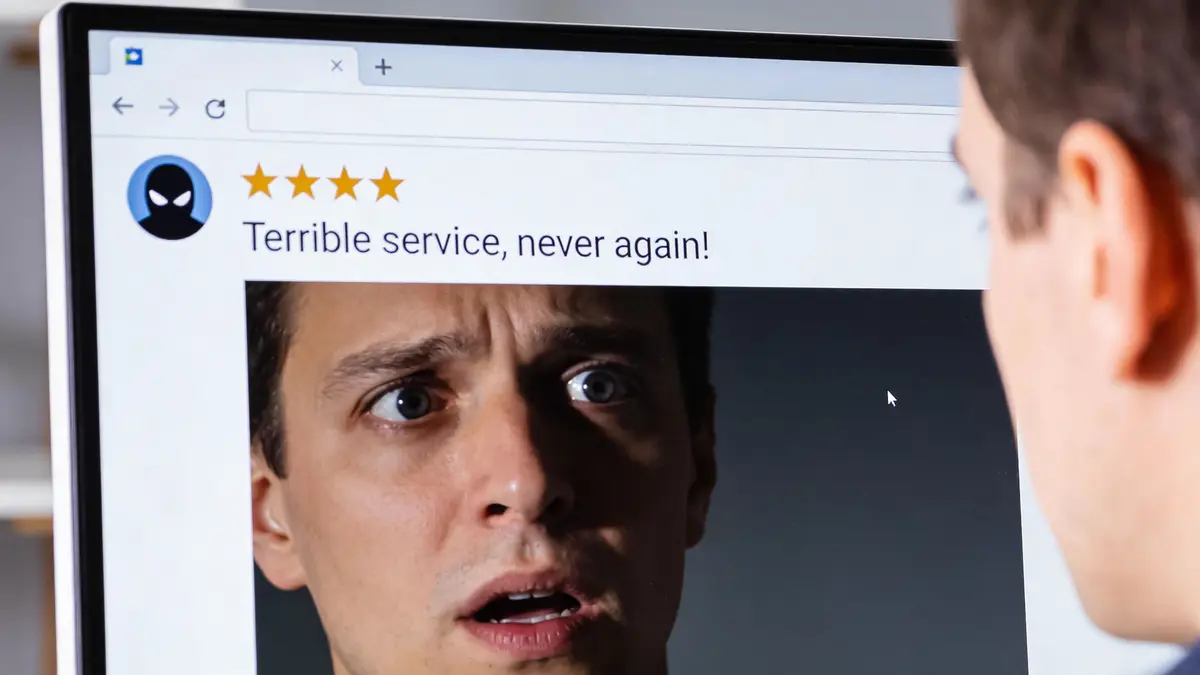
The review may come from a real customer. It may come from a competitor, a former employee, a disgruntled acquaintance, or a pseudonymous account with no genuine connection to your business. The source matters because it determines whether you are dealing with protected criticism, platform abuse, or something closer to defamation.
Google’s interface does not care about your urgency. It presents all reviews in the same visual format. To the public, a fabricated accusation and a legitimate complaint can look equally authoritative. That is why businesses with strong service records still lose ground when they respond slowly or choose the wrong removal path.
Why high-visibility profiles are more exposed
The more recognisable your name, the more attractive your profile becomes to bad-faith actors. Public-facing executives, professionals in regulated industries, and businesses tied to a founder’s personal reputation face a sharper version of this problem. The review does not stay confined to “reviews.” It bleeds into search perception, referral confidence, and deal friction.
A practical response starts with a strategic question. Is this review merely unpleasant, or is it an asset someone is using against you?
If you want a sense of how review presentation shapes buyer behavior, this piece on Google Reviews that convert is useful because it highlights how prospects read review profiles as trust signals, not isolated comments. That same dynamic explains why one malicious review can carry outsized weight.
Treat a harmful review as a visibility problem and an evidence problem at the same time. If you solve only one, you usually lose the other.
Neutralize, do not emote
Anger is understandable. It is also expensive.
Owners and executives often make the situation worse by replying too quickly, calling the reviewer a liar in public, or filing a vague complaint with Google that gets rejected because it cites outrage instead of policy. Once that happens, you are no longer just removing a review. You are correcting a failed first move.
The right posture is clinical. Capture evidence. Classify the violation. Use the platform correctly. Escalate if needed. Suppress the impact if removal is unavailable. That is how you remove negative reviews from google when the stakes are real.
Initial Triage and Violation Assessment
The review is already live. Your next move is diagnosis, not debate.
Google removes reviews for policy violations, not because they are unfair, rude, or commercially damaging. If you misclassify the problem, you waste time and signal weakness to a system that already rejects weak submissions. Many businesses fail here. They know the review is false, but they cannot prove the type of falsity in a way Google’s process recognizes.
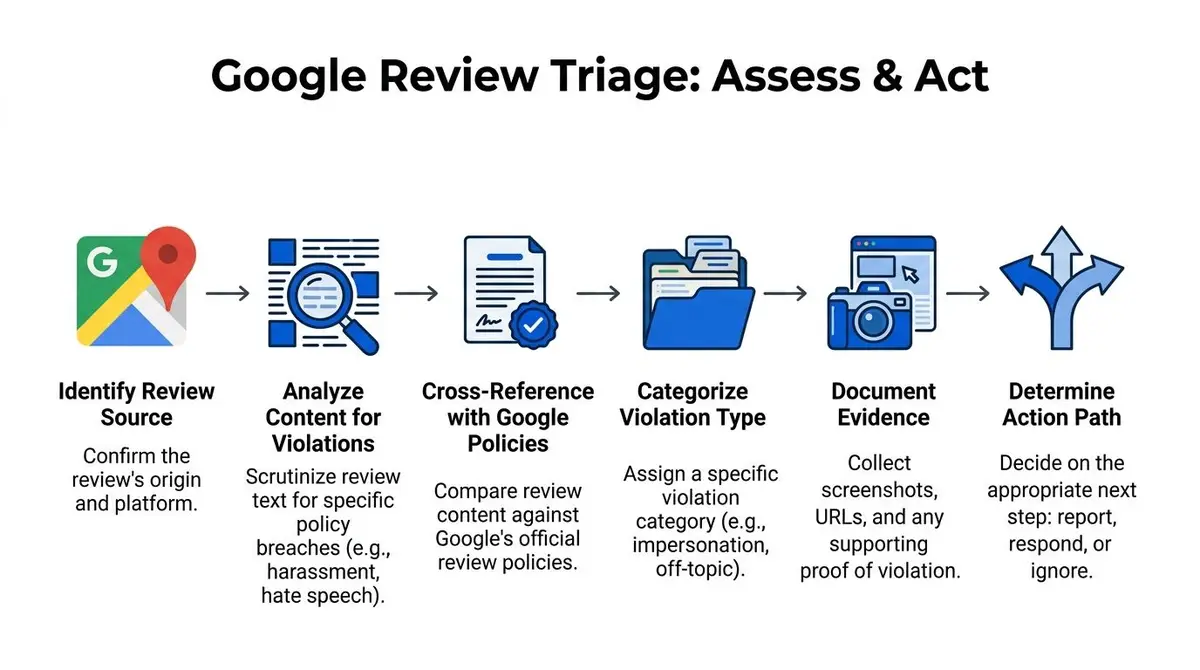
Start with the category, not your conclusion
Do not begin with “this is fake.” Begin with a narrower question: which policy bucket fits this review best?
A review can be vulnerable for several different reasons:
- Conflict of interest means the reviewer is a competitor, current staff member, former staff member, or someone with another disqualifying relationship.
- Spam or fake engagement applies where the account appears to mass-post, recycle language, or describe an experience that never happened.
- Harassment or offensive content is stronger when the review uses slurs, threats, or abusive personal attacks.
- Off-topic or irrelevant content applies when the review talks about politics, another business, or a grievance unrelated to the actual service experience.
- Impersonation or misrepresentation matters when the account presents itself as someone it is not, or claims a transaction that cannot be matched.
If you choose the wrong category in your initial report, you reduce your odds immediately. According to Consumer Fusion’s review removal guidance, manual flagging succeeds in approximately 20-30% of cases for obvious violations like obscenities, but this rate drops to less than 10% for nuanced issues like fake reviews without concrete proof. Many businesses report needing up to 28 attempts to achieve a removal, with wait times of 7-14 days per attempt.
Build a facts grid before you touch the report button
Do not rely on memory. Build a simple record.
| Question | What to check | Why it matters |
|---|---|---|
| Did this person transact with us | Booking records, invoices, CRM, intake logs | No matching record supports a fake-experience argument |
| Does the text mention specifics | Date, staff name, service, location, product | Vague allegations often signal fabrication |
| Does the account look authentic | Review history, naming pattern, other businesses reviewed | Pattern evidence supports spam or competitor concerns |
| Is there prohibited language | Threats, slurs, obscenities, targeted abuse | Clearer policy violations tend to move faster |
| Is this part of a cluster | Similar wording, same day timing, multiple suspicious reviews | Suggests coordinated activity |
This is also the point where ongoing monitoring matters. If your team is not tracking review activity systematically, you miss patterns that turn a weak complaint into a strong coordinated-abuse case. A proper reputation monitoring setup helps identify those links early, before screenshots disappear and account behavior changes.
Separate opinion from actionable violation
A customer can say your service was disappointing. They can say they waited too long. They can say they would not return. Google usually leaves that content alone.
Actionable content is different. It alleges events that did not occur, comes from someone with no legitimate customer relationship, includes prohibited abuse, or forms part of a manipulation pattern. Your job is to convert instinct into evidence.
The question is not whether the review feels false. The question is whether you can show Google why it falls outside legitimate user experience.
Preserve evidence before the reviewer edits or deletes
Capture the review in full. Screenshot the text, profile name, star rating, date, and surrounding review context. Save the review URL if available. Pull internal records that show whether the reviewer exists in your systems. If you suspect a competitor or former employee, preserve any contextual material that connects the account to that person.
Do this before anyone on your team responds publicly. A rushed reply can give away internal details, invite retaliation, or undermine your later argument that the review is fabricated.
Navigating the Standard Google Removal Process
A false review goes live on Friday afternoon. By Monday, your office has already fielded questions from clients, referrals, or board contacts who saw it first. That is the primary function of Google’s standard reporting tool. It is a fast first response, not a full investigation channel.
Use it promptly. Use it with discipline. Do not expect it to resolve a complex attack on its own.
What the standard process does
Report the review directly from your Google Business Profile or Google Maps. Open the three-dot menu, choose the reporting option, select the closest policy category, and submit a short explanation.
Google may review obvious violations quickly. The key word is obvious.
This system is built for clear policy breaches visible on the face of the review. It performs reasonably well when the content includes threats, explicit abuse, pure spam, or material unrelated to any real customer experience. It performs poorly when the review is polished, specific, and false in ways Google cannot verify from the text alone.
That distinction matters. A fabricated review written with restraint often survives the first pass unless your submission gives the reviewer a clean policy basis to act.
Why valid complaints still fail
The standard report fails for predictable reasons.
The first mistake is choosing a category that expresses frustration instead of a policy violation. Google does not remove content because a business says it is unfair. It removes content that fits a prohibited category such as fake engagement, conflict of interest, harassment, impersonation, or off-topic content.
The second mistake is filing a conclusion without a factual frame. Saying the reviewer was never a customer is weak. Saying there is no matching appointment, transaction, inquiry, or service record for the claimed event gives Google something concrete to assess.
The third mistake is tone. Angry submissions read like disputes. Effective submissions read like policy reports.
Write the report like a case summary
Your rationale should be brief, specific, and tied to policy. One tight paragraph beats a page of indignation.
Use this standard:
- Name the violation precisely. Pick the narrowest accurate category, such as fake engagement, conflict of interest, harassment, off-topic content, or impersonation.
- State the factual mismatch. Note the missing transaction record, the reference to a service you do not provide, or the inconsistency between the review and your business records.
- Keep the explanation restrained. Do not speculate about motives. Do not threaten litigation in the reporting field. Do not turn the submission into a rebuttal.
If you need a baseline for what Google does and does not remove inside the platform process, review Google’s removal policy before you file. That prevents a common error: arguing that a review is false when the stronger argument is that it is prohibited for a different reason.
Treat the standard report as a filter, not a strategy
High-stakes matters require a more disciplined view. The standard tool is useful because it creates an initial platform record and sometimes clears obvious violations without delay. It is limited because Google is not assigning an investigator to reconstruct your dispute from scratch.
That is why adept reviewers get through. A competitor, former employee, or coordinated abuse actor who understands tone and detail can draft around the obvious triggers. If your case depends on context, internal records, timing patterns, or identity conflicts, the first report is only the opening move.
File one clean, well-categorized report backed by facts. If Google rejects it, improve the theory and evidence. Repeating the same weak submission wastes time and signals nothing new.
A practical decision table
| Scenario | Standard report likely enough | Why |
|---|---|---|
| Review contains direct obscenities or threats | Often yes | The violation is apparent from the text itself |
| Review is clearly off-topic | Sometimes | Google can assess it without much outside evidence |
| Review appears fake but is polished and specific | Usually no | The issue depends on records and context Google cannot see immediately |
| Review likely posted by a competitor or former employee | Usually no | These cases need a tighter evidentiary package and stronger escalation |
| Review falsely accuses you of fraud or criminal conduct | Rarely by itself | Platform reporting may be only one part of the response |
If the first request is denied, read that result correctly. Google has not validated the review. Google has declined to remove it based on the material presented.
Advanced Escalation for Rejected Takedowns
A single false review can sit on your profile during a financing event, a licensing review, a recruiting push, or a sensitive client diligence process. Once the first takedown fails, speed matters, but discipline matters more.
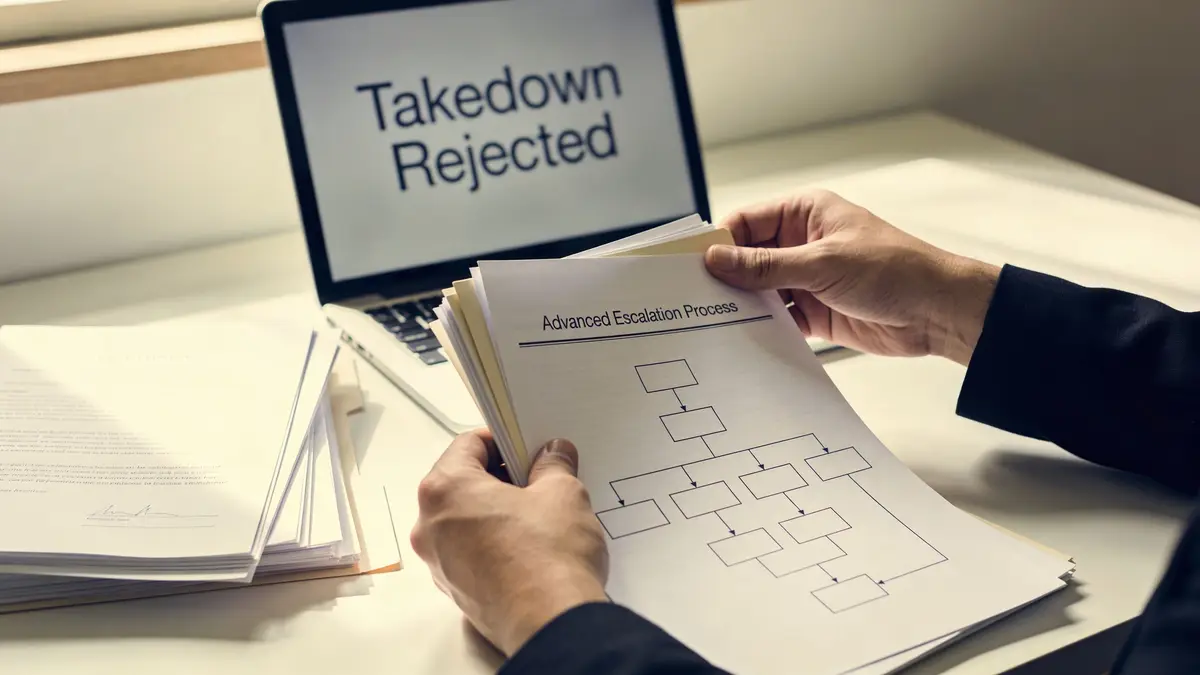
At this stage, the goal is not to complain louder. The goal is to present a cleaner theory, tighter proof, and a record that survives scrutiny inside Google’s support and legal channels.
Build a case file, not a protest
Rejected takedowns usually fail for one reason. The submission left too much interpretive work for Google.
Fix that. If the reviewer claims to be a customer, verify whether any transaction, appointment, inquiry, visit, or payment record exists. If the post describes an employee interaction, pull schedules, call logs, CRM notes, front desk records, and relevant messages. If you suspect a competitor, preserve business overlap, timing patterns, profile behavior, and any links between the reviewer identity and a rival operation. If the attack is coordinated, line up the reviews by date and compare wording, allegations, star patterns, and target pages.
Analysts and practitioners who track review disputes consistently report a simple pattern. Well-documented escalations perform better than unsupported claims of dishonesty. Keep the supporting material close to the argument it proves. A short video explanation can help your team understand the difference between routine flagging and evidence-led escalation: structured escalations with compelling evidence can outperform bare accusations.
What belongs in the escalation package
A useful file lets a reviewer understand the dispute quickly and reach a policy decision without guessing.
- Core exhibits: screenshots of the review, reviewer profile, timestamps, edits, and the listing context
- Transaction evidence: invoices, booking records, intake history, visitor logs, or records showing no customer relationship existed
- Pattern evidence: matching language, synchronized timing, clustered low-star activity, or related accounts targeting the same business
- Policy mapping: a short written explanation that ties each exhibit to a specific policy category such as spam, conflict of interest, impersonation, or off-topic content
- Submission history: prior flags, denials, support tickets, and the exact reason the first report likely failed
That last item matters. Google support often sees fragments of the history. You need one clean record.
Use support channels in a set order
After a denial, stop repeating the same flag. Refile only after the theory and evidence improve.
A disciplined sequence looks like this:
- Preserve the original review, reviewer profile, and denial notice.
- Reassess the policy category. Many failed reports were filed under the wrong violation.
- Assemble the evidence package and label each exhibit clearly.
- Submit through Google Business support or the applicable review management pathway with a concise policy-based summary.
- Track each response, then revise the argument if Google is reading the issue under the wrong rule.
- Escalate to the legal channel if the content alleges specific unlawful or professionally damaging conduct.
If the matter crosses into formal legal territory, use this procedural guide on how to submit a Google legal request.
Your public-facing assets still matter during this process. Clean listings, complete business details, and active profile management help support teams assess legitimacy faster. That is one practical reason optimizing your Google Business Profile belongs in the same playbook as takedown escalation.
Know when policy escalation is no longer enough
Some reviews are standard platform disputes. Others create legal exposure.
Bring in counsel quickly if the review accuses you or your company of fraud, criminal conduct, abuse, malpractice, licensing violations, or other concrete misconduct stated as fact. Those cases require more than a better support ticket. They require legal triage, jurisdiction analysis, and a decision about whether platform removal, direct legal demand, court order, or a combined approach gives you the best chance of removal without creating new risk.
Poor legal threats do damage. They can lock you into weak facts, alert the attacker, and create a paper trail that helps no one. Strong legal escalation does the opposite. It narrows the statement at issue, preserves evidence, identifies the correct defendant or anonymous poster strategy, and puts Google on notice with a properly framed request.
The quality of the second submission determines the outcome. Precision wins. Repetition burns time.
A short explainer can help if your team needs to see how escalation differs from routine flagging:
Common failure points in rejected cases
| Failure point | What businesses do | What professionals do instead |
|---|---|---|
| Wrong violation category | Label the review “fake” without matching the facts to policy | Choose the narrowest policy bucket the evidence can support |
| Thin evidence | Upload only a screenshot of the post | Add records, chronology, profile context, and supporting exhibits |
| Emotional framing | Argue about fairness or motive | Write to the policy standard and keep the tone clinical |
| No iteration | Resubmit the same complaint | Change the theory, evidence set, or channel before refiling |
| No legal triage | Threaten action on weak facts | Reserve legal escalation for specific false statements with real exposure |
If you need to remove negative reviews from Google in a high-pressure matter, outcomes split here. Administrative reporting handles obvious violations. Strategic escalation handles the cases that threaten enterprise value, licensing, investor confidence, or personal reputation.
Suppression and Mitigation When Removal Is Not an Option
Some reviews stay up. That does not mean you surrender the page.
If a review is protected opinion, too ambiguous for Google to remove, or resistant to takedown, the strategy shifts from deletion to suppression and dilution. This is not cosmetic. It is reputation defense by controlling what a prospect sees next and how much weight they give the attack.
The public response should calm the room
Your response is not for the reviewer. It is for everyone else reading.
Do not argue facts publicly line by line. Do not call the post defamatory in the response. Do not disclose private details to “set the record straight.” Those moves look unstable, and they often invite more abuse.
A strong response is short, composed, and procedural. It signals that the business takes concerns seriously, cannot verify the described interaction, and invites an offline resolution channel. That language protects you in two ways. It avoids admissions, and it tells future readers that the review may not reflect a verified customer event.
Positive review acquisition must be systematic
The second pillar is volume and recency from authentic customers. Not purchased reviews. Not staff-generated reviews. Not awkward blasts to every contact in your database.
You want a repeatable process tied to real moments of satisfaction: completed service, successful delivery, matter resolution, follow-up check-in, or milestone completion. Ask consistently. Make the path simple. Remove friction.
The expert background included in your brief notes that businesses often combine public responses with active collection of positive reviews to dilute the impact of negatives. That is exactly right. Suppression works when a harmful review is no longer the most salient item on the profile.
Build a profile that can absorb a hit
Review suppression is not just about more stars. It is also about stronger business signals across the listing itself.
That means keeping categories accurate, services complete, photos current, Q&A clean, and profile information professionally maintained. A well-built listing gives prospects more trust anchors than a thin one. For teams tightening the broader presentation layer, this guide to optimizing your Google Business Profile is a practical companion.
A single negative review matters most when your profile gives the reader nothing else to trust.
What suppression should look like in practice
- Respond once, not repeatedly. One measured public answer is enough unless the facts change.
- Ask for reviews from real clients at natural completion points. Timing matters more than volume theatrics.
- Keep language neutral and service-focused. Review requests should feel routine, not desperate.
- Monitor for reuploads or copycat reviews. A failed remover sometimes returns under a new account.
- Strengthen branded search results beyond the profile. A resilient reputation never depends on one Google panel.
A practical comparison
| Tactic | Good use | Bad use |
|---|---|---|
| Public response | Calm, brief, non-admissive | Defensive, emotional, over-detailed |
| Review generation | Ongoing and authentic | Sudden burst that looks manipulated |
| Profile optimization | Improves trust context | Cosmetic edits without review strategy |
| Monitoring | Catches repeat abuse early | Only checking after damage spreads |
Suppression is not an admission that you lost the takedown fight. It is a separate operating track. Smart operators run both tracks at once when necessary.
Engaging Specialists for High-Stakes Reputation Defense
There is a point where self-management becomes the expensive option.
If the review concerns rude service or a billing disagreement, a disciplined internal process may be enough. If the review accuses you of fraud, criminal conduct, professional misconduct, abuse, discrimination, regulatory breaches, or other serious falsehoods, this stops being a marketing problem. It becomes a risk problem.

The line you should not cross alone
Most executives wait too long to bring in specialists because the mechanics look simple. Click report. Fill in a form. Wait. That simplicity is deceptive.
The true challenge is not filing the request. It is choosing the right removal theory, preserving evidence correctly, escalating without procedural mistakes, coordinating with legal counsel where needed, and containing visibility damage while the case is pending. If your internal team gets any of that wrong, you do not just lose time. You create contradictory records and weaken your position.
Scenarios that justify immediate outside help
Some situations should trigger specialist involvement at once.
- Serious false accusations involving fraud, crime, abuse, malpractice, or regulatory misconduct.
- Coordinated attacks with multiple suspicious reviews, copycat language, or cross-platform spillover.
- Reviewer anonymity with real-world motive such as a competitor, former insider, estranged associate, or litigant.
- Cross-border complications where legal rights, privacy laws, and platform standards intersect.
- Urgency and discretion requirements for public figures, family offices, and transaction-sensitive businesses.
What specialists add
A competent specialist firm does three things that most businesses do badly in-house.
First, it imposes discipline on the evidence. That alone changes outcomes because most failed submissions are weakly documented.
Second, it aligns platform and legal strategy. Many businesses treat those as separate universes when they are often interdependent.
Third, it handles monitoring and recurrence. Removal without follow-up is incomplete if the same actor can repost, rephrase, or migrate the attack elsewhere.
Here is the practical distinction:
| DIY approach | Specialist approach |
|---|---|
| Reacts after the review appears | Builds a case and a containment plan simultaneously |
| Treats Google as the only path | Uses policy, escalation, and legal levers in parallel when justified |
| Responds from frustration | Responds from documentation |
| Stops after a denial | Iterates, appeals, and monitors for recurrence |
Cost should be measured against exposure, not effort
Clients often ask whether outside help is “worth it.” That is the wrong frame.
The right question is what the review is attached to. A local listing for a side project is one thing. A branded business tied to your surname, your principal investment vehicle, your clinic, your practice, or your executive profile is another. In those matters, reputational drag can affect introductions, diligence, referrals, recruitment, and trust long after the original post.
Once a review becomes a board-level discussion, a legal issue, or a family office concern, it no longer belongs in an an ad hoc inbox workflow.
If the problem is routine, handle it cleanly. If the problem is strategic, act like it.
If a false or malicious Google review is threatening your business, name, or deal flow, ContentRemoval.com can assess the case confidentially and map the fastest viable path, whether that means platform escalation, legal takedown support, suppression, or ongoing monitoring. The firm works with executives, founders, public figures, and high-net-worth clients who need speed, discretion, and a results-focused plan rather than generic advice.
Frequently asked questions
Why did Google reject my request to remove a fake review?
Usually because the submission left Google too much interpretive work: the wrong policy category, a bare screenshot, or an argument about fairness rather than a rule. Google has not validated the review; it has declined to act on the material presented. Refile only with a tighter category and an evidence package.
How should I reply publicly to a false Google review?
Once, briefly and procedurally. Say the business takes concerns seriously, cannot verify the described interaction and offers an offline channel. Do not argue line by line, call the review defamatory or disclose private details; the reply is for future readers, not the reviewer.
What proof do I need to show a Google review is fake?
Records showing no matching booking, invoice, CRM entry or intake log for the claimed event, screenshots of the review and reviewer profile with timestamps, the account’s review history and naming pattern, and any cluster evidence such as similar wording or same-day timing across several reviews. Tie each item to a specific policy category.