
Removing duplicate content runs on two tracks. Internal duplicates created by parameter URLs, printer pages and CMS quirks are consolidated with 301 redirects, canonical tags, noindex directives and cleaned-up internal links. External duplicates on scraper sites are handled as enforcement: preserve evidence, contact the operator with a deadline, then send a DMCA notice to the host, platform or search engine.
Key facts
- A 301 redirect is Google’s preferred way to consolidate duplicate URLs; robots.txt is a poor substitute.
- Canonical tags belong in the head with absolute URLs and act as signals, not enforcement.
- Google’s spam policies treat scraped content without added value as a search quality violation.
- DMCA notices go to whoever can disrupt the copy: the hosting provider, the platform or the search engine.
Where ContentRemoval.com comes in. ContentRemoval.com takes over when duplication has become hostile: a scraper outranking the original, a lookalike domain carrying an executive’s bio, or copied pages used in impersonation or scam funnels that ignore canonical signals and polite outreach. Marketing leads, in-house counsel and the company’s SEO agency usually make contact once technical fixes are done and the copies remain. A free, confidential 15-minute Exposure Scan maps each copy and which are removable, and the report is yours to keep. Get a Free, Confidential Exposure Scan or read how our content removal work is done.
You discover it the wrong way. A board member forwards a search result showing your article on a junk domain. Your own site also has three versions of the same page live because of parameter URLs, printer pages, and a CMS quirk no one fixed. Search visibility slips, attribution blurs, and a third party starts collecting traffic from work your team paid to create.
That isn’t a routine SEO tidy-up. It’s a control failure.
Duplicate content weakens authority, splits signals, and gives scrapers room to outrank or impersonate the original source. In high-stakes environments, the issue is bigger than rankings. It affects brand integrity, investor confidence, lead quality, and your ability to control what appears when someone searches your name, your company, or a flagship product. If the wrong version of your content becomes the one Google trusts, you’ve handed narrative control to either your own technical debt or someone else’s theft.
The right response has two tracks. First, contain internal duplication with precise technical fixes so search engines can identify one authoritative version. Second, escalate against external infringers when they ignore those signals. If you only do the first, scrapers keep benefiting. If you only do the second, your own infrastructure may still be sabotaging you.
Executives who need search results cleaned up quickly should also understand the broader removal pathway. A strong overview of strategic page removal from Google helps clarify when duplicate content is a technical indexing problem and when it has become a reputational risk event.
A Strategic Framework for Duplicate Content
Treat duplicate content as a governance problem, not a content problem. The page text is often the least interesting part of the issue. The core question is who controls the authoritative version, who is siphoning value from it, and what mechanism will force consolidation.

Know the three threat categories
Most duplicate content situations fall into three buckets.
| Category | What it looks like | Primary risk |
|---|---|---|
| Internal duplication | Parameter URLs, session IDs, category filters, printer pages, inconsistent canonicals | You dilute your own authority |
| Managed duplication | Syndication, localized variants, reused product copy, archived versions | Search engines may choose the wrong version |
| Hostile duplication | Scrapers, plagiarists, fake publishers, impersonation pages | You lose attribution and control |
Internal duplication is usually solvable fast if your technical team has clear instructions. Managed duplication needs policy, not just code. Hostile duplication demands a willingness to move beyond polite SEO signals.
Practical rule: If the duplicate exists because of your own stack, fix architecture first. If the duplicate exists because someone copied you, preserve evidence and prepare for enforcement.
Decide what success means
A weak brief says, “remove duplicate content.” A strong brief says, “consolidate search signals to one URL, suppress low-value variants, and force third-party removal where infringement is clear.”
That distinction matters because different tools solve different problems. A canonical tag is a signal. A 301 redirect is a directive. A takedown notice is enforcement. Confusing them leads to delay, and delay is expensive when an unwanted version starts gaining visibility.
Don’t let teams work from different assumptions
Your legal team may think this is copyright infringement. Your SEO lead may think it’s canonicalization. Your reputation advisor may see a search control issue. They can all be right.
The strategic framework is simple. Identify the source, classify the duplicate, assign the remedy, and set an escalation trigger in advance. That’s how to remove duplicate content without wasting weeks debating whether the problem is “technical” or “legal.”
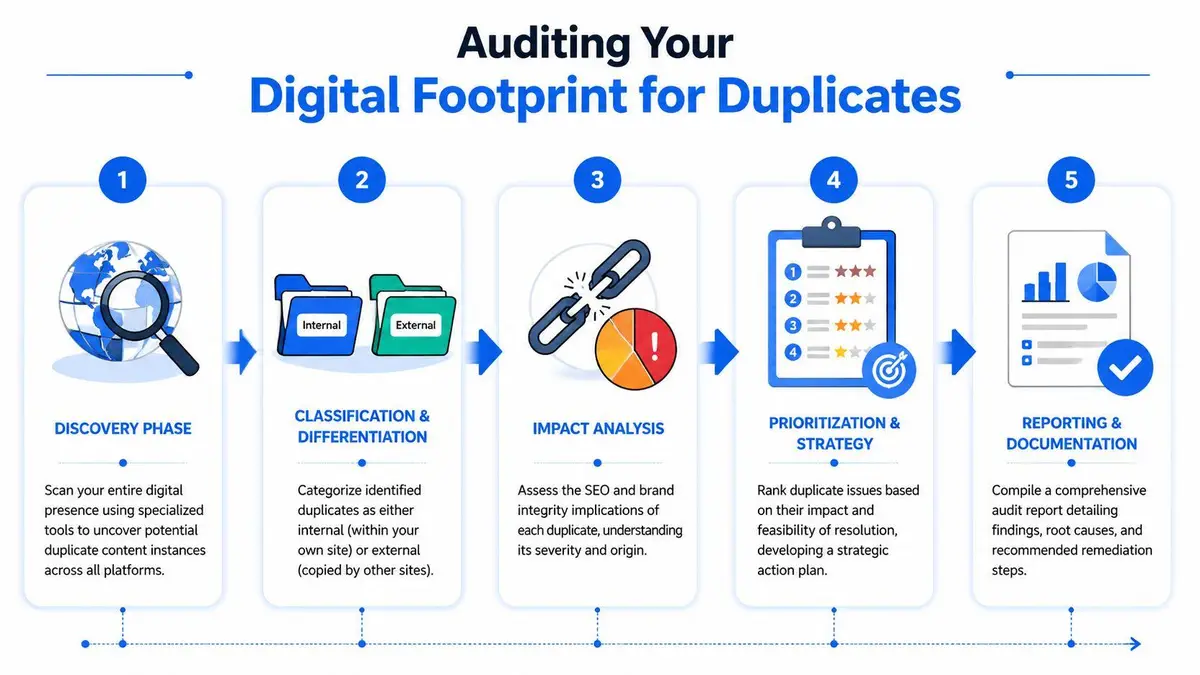
Auditing Your Digital Footprint for Duplicates
At 8:30 a.m., your CEO forwards a search result showing three versions of the same page. One sits on your domain. One sits on a partner site. One sits on a scraper built to outrank attribution. If your team treats all three as a standard SEO clean-up, you lose time, evidence, and control.
An audit has one job. Produce a decision-ready record of every duplicate that affects indexation, authority, attribution, or legal exposure. That means mapping what exists, who controls it, how it is harming you, and when the issue shifts from technical remediation to enforcement.
Audit internal duplication first
Start with pages and URL variants you control. Use Screaming Frog, Sitebulb, server logs, your XML sitemaps, and CMS export data. Cross-check crawl findings against Transformy.io resources if you need a clean reference for sitemap structure and discovery paths.
Look for duplicate URLs created by parameters, session IDs, mixed trailing-slash rules, HTTP to HTTPS inconsistencies, faceted navigation, pagination, printer-friendly versions, mobile subpaths, and template-level canonical errors. Google’s own duplicate content guidance states that duplicate URLs can dilute crawling efficiency and split signals across versions instead of consolidating them on the preferred page, which is exactly why this audit needs to be precise rather than broad and superficial.
Do not treat every duplicate as the same problem. A filtered collection page with accidental indexation is an infrastructure issue. Two service pages competing for the same intent is a content governance issue. A legacy copy sitting on an old subfolder is a migration control failure.
Use a triage model your technical and legal teams can both read:
- Indexing accidents
URLs created by platform noise or weak rules. Flag the preferred version, affected signals, and the technical control available. - Commercial overlap
Pages that compete for the same query, offer, or conversion path. Record which page should win and why. - Publication variants
Archives, translated near-duplicates, print pages, campaign clones, and old CMS copies. Document the canonical owner and whether the variant should remain accessible at all.
One sentence in the audit file should answer the executive question: “If we do nothing, what exactly gets worse?”
Audit external duplication as a rights and risk issue
External duplication requires a different workflow. Search operators are too narrow for this job. Use plagiarism detection tools, backlink monitoring, brand mention alerts, reverse text search, and manual review of high-risk search results for your core pages.
Google states in its spam policies that scraped content copied from other sites without adding sufficient value can violate search quality rules. That matters for two reasons. First, it gives you a search-policy basis for escalation when copied pages stay indexed. Second, it helps legal and communications teams distinguish between tolerated syndication and abuse.
Classify every external result by intent and control:
- Authorized republication. Syndication, franchising, or licensed reuse that needs attribution, canonical alignment, and contractual review.
- Commercial scraping. Third parties monetizing your copy, product data, or thought leadership without permission.
- Reputational misuse. Copies used in impersonation, scam funnels, fake review ecosystems, or misleading commentary.
- Platform-hosted duplication. Content reposted on marketplaces, publisher networks, social platforms, or user-generated forums where takedown routes exist.
This is the point to preserve evidence properly. Save the live URL, crawl date, screenshot, page source, host details, and any monetization or impersonation indicators. If search suppression becomes necessary, use a documented process for de-indexing harmful or duplicate pages from search results alongside your outreach and takedown track.
A short technical explainer can help stakeholders align on the audit process before action begins.
Build an audit file your legal team can use
A useful audit file does more than list URLs. It should let counsel, engineering, and leadership act without asking for a second round of analysis.
| Audit question | Why it matters |
|---|---|
| What is the original URL? | Establishes ownership, publication priority, and the page you intend to protect |
| What duplicate exists? | Determines whether the remedy is technical consolidation, outreach, or formal takedown |
| Who controls it? | Separates issues your team can fix directly from issues that require platform or legal escalation |
| What business harm follows? | Sets priority based on traffic loss, attribution confusion, lead diversion, or reputational risk |
Tie each finding to a consequence executives care about. Lost rankings. Split authority. Misattributed expertise. Fraud risk. That is how you get engineering time fast, and that is how you know when a duplicate content problem has stopped being an SEO task and become an enforcement matter.
The Technical Remediation and Containment Kit
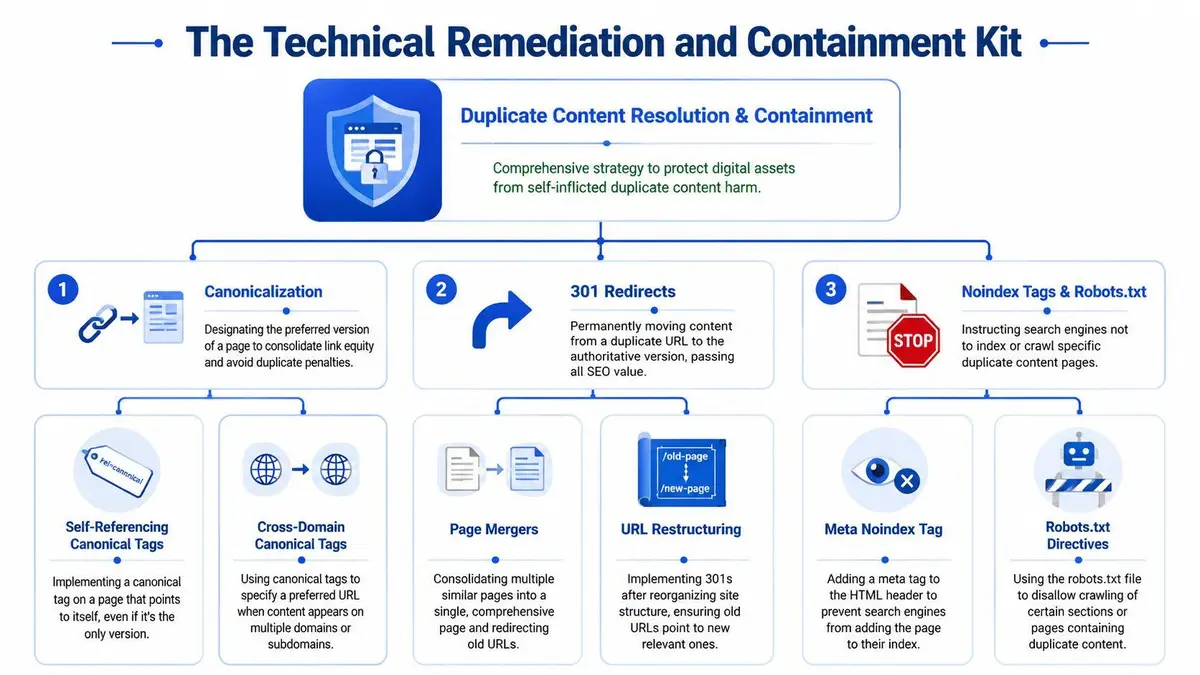
A duplicate content problem becomes expensive the moment your site sends mixed instructions. Engineering says one URL matters. Search engines find four. Users land on outdated pages. Scrapers copy the version you should have retired months ago. Containment starts by forcing one clear answer across the stack.
Use 301 redirects when the duplicate should disappear
If a page has no distinct commercial, legal, or user value, remove it from circulation with a permanent redirect. Google’s own guidance in its duplicate content blog post on 301 redirects is plain. A 301 redirect is the preferred way to consolidate duplicate URLs, while robots.txt and temporary removal tools are poor substitutes for canonicalization.
Indecision is costly here. Teams often leave duplicate pages live because they want a fallback. That usually prolongs index bloat, splits link equity, and leaves the wrong page available for copying or citation. Choose the winner. Redirect the rest.
Use redirects aggressively when you control both URLs. Save exceptions for pages with a real operational reason to stay public.
Use canonical tags when the page must remain live
Some duplicates must remain accessible. Faceted URLs, syndicated versions, print-friendly pages, and alternate renderings are common examples. In those cases, set a canonical tag correctly and make sure it supports the business record you want search engines to trust.
Google’s documentation on consolidating duplicate URLs with rel canonical states that the <link rel="canonical"> element belongs in the <head> and should use absolute URLs. That is the baseline. The strategic use matters just as much. A self-referencing canonical helps establish your original page as the source version, which strengthens your position if copied content later becomes a takedown or de-indexing issue.
Canonical tags are signals, not enforcement. Use them to guide indexing where duplicate versions need to exist. Do not use them to excuse weak publishing controls.
Use noindex for pages that should stay live but stay out of search
Some URLs do not need consolidation. They need exclusion. Staging remnants, printer pages, internal search results, duplicate utility pages, and similar low-value assets often belong behind a noindex directive.
Do not rely on robots.txt when the objective is index removal. If crawlers cannot access the page, they may not see the directive that tells them to drop it. If the page should remain reachable for users, systems, or compliance reasons but should not compete in search, noindex is the cleaner choice.
If the risk extends beyond duplication, use a strategic de-indexing framework for harmful or duplicate pages in search results to decide what should be suppressed entirely instead of merely consolidated.
Fix parameter handling and internal links
Parameter duplication is often self-inflicted. Sorting, filtering, tracking codes, session IDs, and pagination variants can produce large clusters of near-identical URLs. If your templates, sitemap, breadcrumbs, and internal links point to different versions of the same page, your site is arguing with itself.
Clean that up at the source. Standardize internal links to the preferred URL. Review sitemap entries. Remove unnecessary parameterized URLs from crawl paths. Then confirm your CMS is not regenerating duplicates every time merchandising, localization, or campaign tagging changes.
For teams building an implementation checklist across multiple platforms, technical reference collections like Transformy.io resources can help validate edge cases against your internal engineering standards.
Give your team a direct brief
Do not ask engineering to “fix duplicate content.” That instruction is too vague to ship cleanly. Ask for five specific outputs:
- Preferred URL map for every duplicate or near-duplicate cluster
- 301 redirect plan for obsolete, merged, or redundant URLs
- Canonical implementation review confirming correct tags in the
<head>with absolute URLs - Noindex list for pages that must remain live but should not appear in search
- Internal linking correction plan covering navigation, templates, breadcrumbs, and sitemaps
One more point matters for executives and legal teams. Technical remediation contains the problem on assets you control. It does nothing to stop hostile copying, affiliate abuse, impersonation pages, or third-party republication that ignores your signals. That is where containment ends and enforcement begins.
Beyond Redirects with Strategic Content Consolidation
Not every duplicate should be redirected and forgotten. Sometimes the smarter move is to merge weak pages into a stronger asset that deserves to rank.
That’s especially true when duplication is the symptom of indecision. A business launches separate pages for slight service variations, near-identical city pages, or overlapping product copy because internal teams want coverage. Search engines see fragmentation. Users see repetition. Nobody gets a clear authoritative result.
Consolidation beats cosmetic rewrites
Rewriting duplicate pages one by one is often a waste of effort. If several pages target the same intent, combine them into a single complete page and redirect the old URLs into it. You preserve relevance, simplify internal linking, and stop competing against yourself.
This matters even more with AI-assisted publishing. Sitebulb’s 2025 guide notes that 42% of ecommerce sites now suffer from AI-induced near-duplication, and that many teams still treat the problem too casually in its duplicate content guide for SEO. That’s the wrong approach for any brand that depends on product visibility.
AI near-duplicates are the modern trap
AI rarely creates perfect duplicates at scale. It creates lazy similarity. Ten product pages differ by a few adjectives, one paragraph, or a reordered feature list. A content manager may think they’re unique because the wording isn’t identical. Search engines may still treat them as weak alternatives covering the same ground.
The answer isn’t to stop using AI. It’s to stop publishing first-draft AI output as finished copy.
A strong consolidation policy does three things:
- Collapse overlap when pages compete for the same query and buyer intent.
- Retain unique pages only when each one contains clearly distinct facts, examples, or offers.
- Enrich surviving pages with original detail that AI cannot invent safely, such as proprietary processes, client-specific context, manufacturer-exclusive attributes, or jurisdictional nuance.
The fastest way to create duplicate content at scale is to let AI produce dozens of pages from the same prompt pattern. The fix is editorial discipline, not more prompts.
Decide with intent, not sentiment
Use a decision test that senior teams can apply quickly.
| Situation | Best move |
|---|---|
| Two pages serve the same search intent | Merge and redirect |
| Similar pages serve different markets but say almost the same thing | Keep both only if each gains substantial unique content |
| Product pages differ only by trivial wording | Consolidate templates and rewrite for meaningful distinction |
| A page exists only because “we might need it later” | Remove or noindex |
If Google wrongly treats distinct pages as duplicates, a practical remedy discussed in the TechSEO community is to add brief, unique text that makes each page’s identity unmistakable, as described in this TechSEO discussion.
Escalating to Enforcement When Signals Are Ignored
Monday morning. Your team has cleaned up canonicals, redirects, and internal duplication. By Tuesday, a scraper is ranking with your article on a disposable domain, stripping attribution, republishing the full text, and pulling search demand away from the source you own.
That is no longer a technical hygiene issue. It is an enforcement issue.
Technical signals help search engines interpret legitimate sites. They do not compel bad actors to stop copying you. Standard SEO playbooks usually end at canonicals, redirects, and polite outreach. That leaves decision-makers with half a strategy. If the duplicate is harming traffic, reputation, or revenue, you need a combined response: technical containment on your properties and legal pressure on the infringer.
Know when to escalate
Escalate once the facts show intent, impact, or refusal to comply.
Use these triggers:
- The infringing page outranks, mirrors, or fragments the original and the operator ignores contact.
- The duplicate is commercial, deceptive, or part of a scraping network, not a minor citation or syndication error.
- The copied material creates reputational risk, including false association, impersonation, or altered context.
- The publisher removes attribution or republishes full text in a way that defeats ordinary discovery and ownership signals.
Google does not issue a penalty on the grounds that similar text exists across the web. It does act against low-value scraper behavior and doorway abuse, as summarized in this report on John Mueller’s comments. Your objective is not to argue that duplication exists. Your objective is to document harmful misuse and force a result.
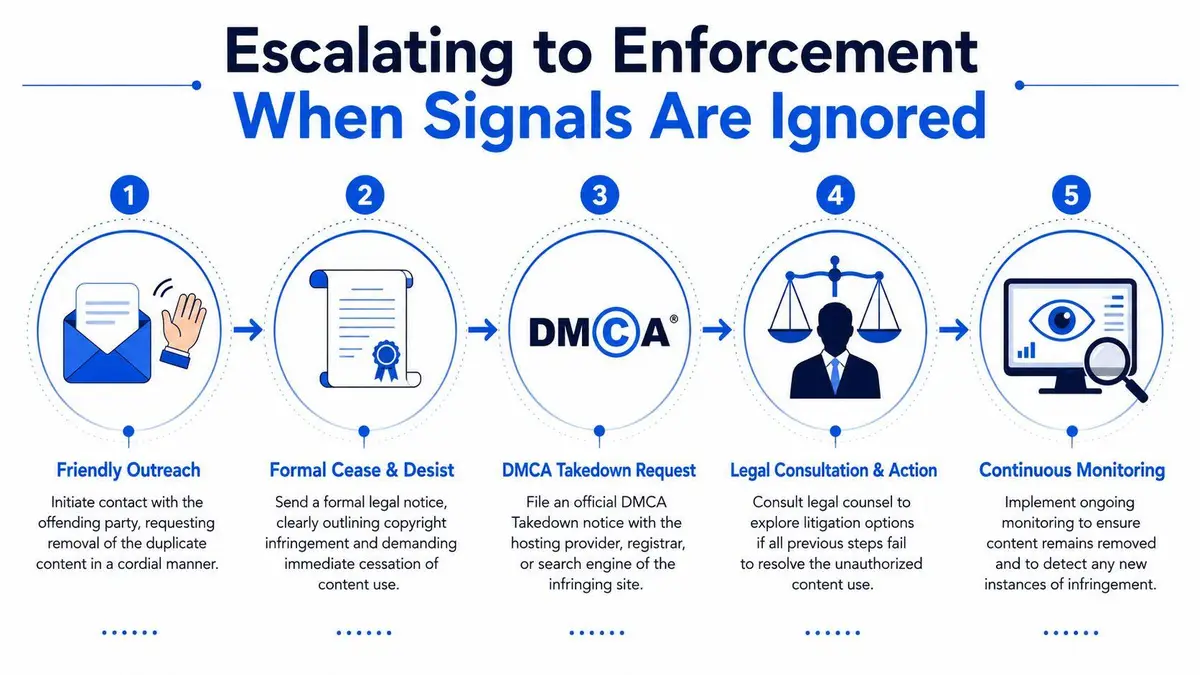
Use a pressure sequence that matches the threat
Start with direct contact only if the operator appears real and reachable. Give a short deadline. Attach evidence. State the exact URL, the original source, and the action required. Do not write a moral lecture. Write a demand that can be acted on.
If the operator stalls or disappears, escalate fast. A cease and desist letter should identify the copyrighted work, the infringing URL, the legal basis for removal, and the deadline for compliance. Precision matters because hosts, platforms, and opposing counsel act on specifics.
One sentence is often enough to reset the posture. If a scraper ignores a canonical tag, stop sending technical hints and start creating consequences.
DMCA is often the quickest route to disruption
For copied articles, product copy, images, and other protected material, a DMCA notice is usually the fastest enforcement tool. Send it to the party that can disrupt the content. That may be the hosting provider, the platform, or the search engine.
The notice should identify the original work, the infringing material, your good-faith statement, and the required declarations. Done properly, it gives intermediaries a clear basis to act. That matters when the site operator is anonymous, offshore, or deliberately evasive.
Some cases go beyond copyright. If the duplicate also creates false affiliation, impersonates your brand, republishes personal data, or damages reputation, the legal route may involve trademark, defamation, privacy, or platform policy claims. Decide early whether your priority is source removal, de-indexing, account suspension, or all three. Then assign ownership across SEO, legal, and communications so the response is not slowed by internal confusion.
Preserve your position after removal
Removal is not closure. Repeat offenders re-upload. Mirror domains appear. Cached copies persist. Keep the evidence file, timestamps, screenshots, correspondence, and notice history intact so you can act again without rebuilding the case.
This is also the point to tighten surveillance. A formal reputation monitoring program for duplicate content and re-upload detection gives your team early warning before the next copy gains traction.
Use technical fixes on assets you control. Use enforcement against actors who ignore them. Executives who treat duplicate content as a pure SEO problem stay stuck in cleanup mode. Executives who combine remediation with takedown strategy protect both visibility and brand position.
Establishing a Proactive Defense and Monitoring Protocol
A duplicate content incident rarely starts with a dramatic warning. It starts on a Monday when your team finds a copied product page outranking the original, a scraped executive bio appearing on a lookalike domain, or a stale mirror page resurfacing in search after you thought the issue was closed. If you wait until that point to decide who owns the response, you have already lost time, visibility, and negotiating position.
The right answer is a standing protocol that combines monitoring, technical containment, and legal escalation rules. Treat duplicate content as an operational risk with search, brand, and enforcement consequences.
Build monitoring into normal operations
Periodic audits miss the copies that appear after cleanup. Set up continuous checks across search results, indexed page changes, brand terms, copied body text, and new domain variations. Your SEO team should not be the only group watching. Legal, brand, and communications need visibility when a duplicate crosses from nuisance to exposure.
For organizations facing repeat scraping, impersonation, or aggressive affiliate abuse, a structured reputation monitoring program for duplicate content and re-upload detection gives leadership early warning and a defined path to action.
Alerts matter only if they trigger a response.
Set internal publishing controls
Your protocol should answer four questions in advance. What gets flagged. Who reviews it. What gets fixed internally. When legal steps begin.
| Control area | What to enforce |
|---|---|
| Editorial | No AI first drafts published without human revision, differentiation, and source review |
| Technical | Self-referencing canonicals, redirect discipline, preferred URL rules, and indexation checks |
| Operational | Evidence capture at discovery, ticket routing, response deadlines, and named ownership |
| Legal | Preapproved thresholds for takedown notices, platform complaints, outside counsel review, and executive escalation |
This is where many companies fail. They have tools, but no decision rule. The duplicate is detected, then sits between SEO, legal, and marketing while traffic and brand confusion continue.
Define trigger points before the next incident
Do not send every case through the same workflow. A copied blog post on a low-traffic domain is different from a duplicated investor page, executive profile, pricing page, regulated claim, or branded landing page used to divert leads. The second category should move immediately into evidence preservation, platform reporting, and legal review.
Be explicit. If a duplicate page targets revenue, trust, regulated statements, or executive identity, the response window should be measured in hours, not weeks.
A sound protocol does one thing well. It removes discretion at the worst possible moment. Your team knows when to update canonicals, when to force de-indexing, when to issue takedown notices, and when to escalate to counsel without waiting for internal debate.
Discipline prevents repeat cleanup. It also protects advantage. Companies that treat duplicate content as a recurring technical annoyance keep paying for the same problem. Companies that monitor continuously and enforce decisively protect search visibility, brand authority, and legal position.
Frequently asked questions
Does Google penalize duplicate content?
Not for the mere existence of similar text across the web. Google does act against low-value scraper behavior and doorway abuse, and duplicate URLs on your own site dilute crawling and split ranking signals. The practical harm is lost authority and the wrong version being trusted, not a formal penalty.
Should I use a canonical tag or a 301 redirect for duplicate pages?
Redirect when the duplicate has no distinct value and should disappear, since a 301 is a directive that consolidates signals. Use a canonical tag when the page must stay live, such as faceted, syndicated or print-friendly versions. Use noindex for pages that should remain reachable but never compete in search.
How do I get a website to remove content it copied from me?
Preserve the live URL, crawl date, screenshot, page source and host details first. Contact the operator with the exact URLs, the original source and a short deadline if they appear reachable. If they stall, send a DMCA notice to the hosting provider, platform or search engine, and consider trademark, defamation or privacy claims if the copy also impersonates or misrepresents you.