
A DMCA takedown letter is a written notice under 17 U.S.C. Section 512(c)(3) sent to a platform’s designated agent, containing six elements: a signature, identification of the copyrighted work, the exact location of the infringing material, contact details, a good-faith belief statement and a declaration of accuracy and authority under penalty of perjury. Platforms act on complete, traceable notices.
Key facts
- Cited studies found technical errors in up to 8.4 percent of requests and substantive errors in at least 1.4 percent.
- A domain or homepage is not enough; each infringing item needs its own exact URL matched to a work.
- Counter-notices give a limited restoration window, commonly described as 10 to 14 business days.
- The DMCA is a U.S. mechanism; foreign hosts may require local procedures or terms of service routes.
Where ContentRemoval.com comes in. One clean notice for one URL is a DIY task. The work changes when the infringer moves accounts, mirrors multiply, the host is offshore or a counter-notice arrives on a deadline. ContentRemoval.com prepares evidence-backed notices, files through the correct intake, escalates with platforms and monitors for reuploads so each new copy gets its own valid submission. Creators, executives and their counsel usually make contact. A free 15-minute Exposure Scan maps what is removable, and the report is yours to keep. Get a Free, Confidential Exposure Scan or read how our content removal work is done.
Most advice about a DMCA takedown letter starts with a template. That’s the wrong starting point. Platforms don’t remove content because a letter sounds formal. They act when a notice is complete, traceable, legally grounded, and easy for their systems and review teams to validate.
The operational record supports that conclusion. Research covering Google-related notices found growth from 4,387 notices and 15,274 requests in 2009 to 443,911 notices and 54,263,600 requests in 2012, more than a 100-fold increase in notices over that period, as documented through the U.S. Copyright Office’s Section 512 resources. At that scale, a technically weak submission doesn’t receive the benefit of the doubt. It gets filtered, rejected, or delayed.
The right objective is not to send a letter. It’s to engineer a notice that survives automated validation, abuse screening, human review, and the possibility of a counter-notice.
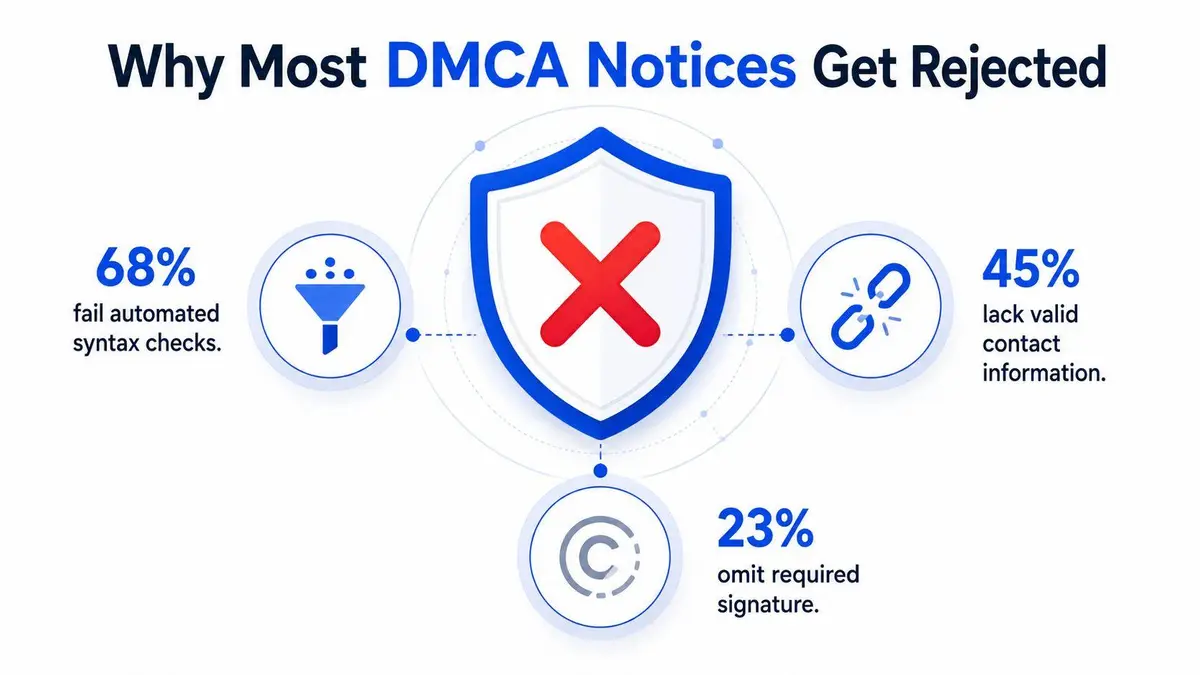
Why Most DMCA Notices Get Rejected
A notice may describe genuine infringement and still fail intake. Platforms screen for missing statutory fields, unusable URLs, vague descriptions of the copyrighted work, defective signatures, weak ownership records, and patterns associated with bulk abuse. Sound legal reasoning matters, but the submission must also operate as a precise, traceable document.
The scale of online enforcement makes small defects consequential. Research found that DMCA notices represented 98.6% of a dataset covering 1.05 billion URLs and 97.8% of domains. Google Search received 94.4% of all notices and 99.9% of all requests in 2012. The same research recorded only 89 counter-notices in 2012, equal to 0.02% of all notices, showing how rarely recipients used the formal dispute route compared with the volume of removals. These findings appear in the Lumen DMCA research paper.
The rejection triggers that matter
Platforms commonly test four functional areas:
- Incomplete statutory fields: The notice lacks a signature, contact information, work identification, infringement location, good-faith statement, or declaration of accuracy and authority.
- Broken targeting: The submission points to a homepage, search result, redirect, or expired page rather than the exact location containing the challenged material.
- Unverifiable claims: The sender asserts ownership broadly but provides no coherent record linking the original work to the claimant.
- Spam-like formatting: Repetitive batches, inconsistent fields, copied descriptions, or unrelated targets can trigger abuse review even when individual claims appear plausible.
A major review cited in WIPO materials and congressional testimony found that roughly 30% of automated copyright takedown requests were inaccurate or otherwise problematic. Another empirical study reported that 28.4% of a sample of roughly 108 million requests raised clear validity questions, including empty or misdirected requests, according to Search Engine Land’s reporting on takedown legitimacy.
Strategic rule: Treat every notice as a packet of evidence and machine-readable fields designed for platform intake.
Automated processing creates another failure point. Research on more than 50 million requests observed exponential filing growth and found that up to 8.4% of successfully processed requests had technical errors, while at least 1.4% had substantive errors, according to the Stanford-hosted empirical study. At scale, even modest defect rates produce substantial rejection volume.
If Google denies a request, review this strategic guide to Google content removal denials. Correct the failed field, replace inaccessible evidence, and resubmit with a cleaner record. Repeated rejection or disputed ownership warrants professional review before further filings.
Required Legal Elements Under Section 512
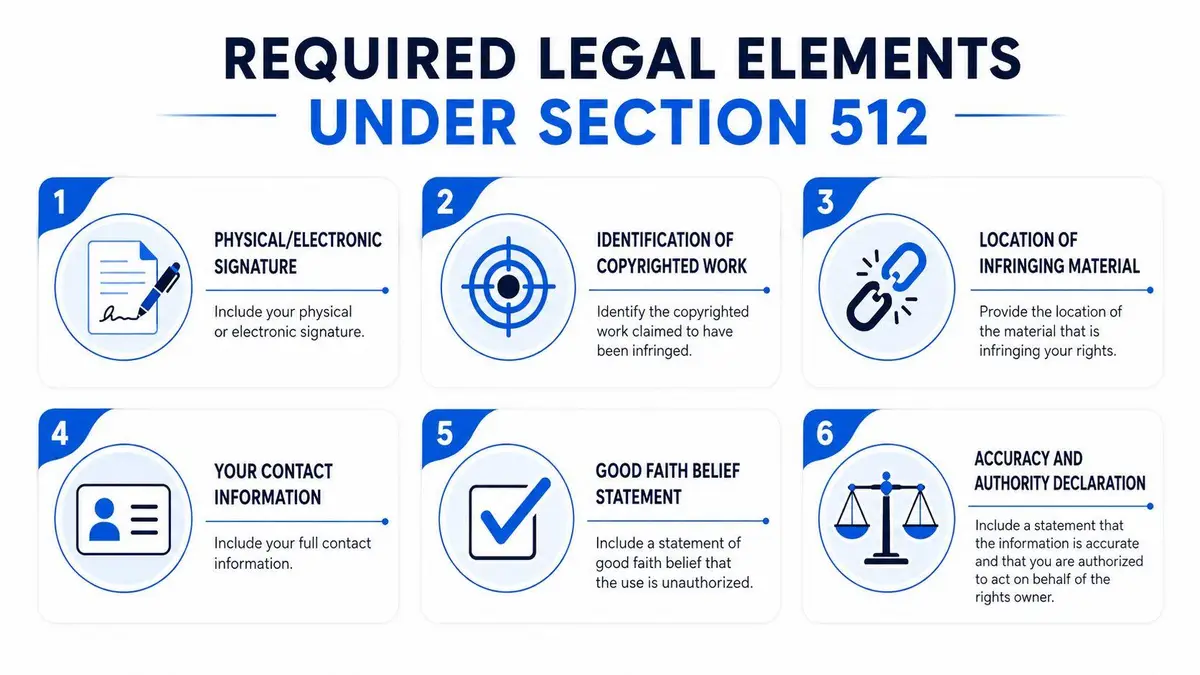
Most notices fail at intake because they contain the right ideas in the wrong operational form. Section 512(c)(3) requires a written notice sent to the provider’s designated agent, with enough accurate information to identify the protected work, locate the challenged material, and confirm the sender’s authority. Platforms apply those requirements through forms, automated checks, and abuse filters, so every field must be specific and internally consistent.
The six elements
- Signature. Include a physical or electronic signature from the copyright owner or an authorized agent. A typed name may work electronically, but follow the platform’s stated format and confirm that the signer has authority.
- Copyrighted work identification. Describe the original work precisely enough for a reviewer to distinguish it from other material. Include its title, publication location, creation record, or another identifying detail. A claim to “all content” on a website is too broad to support reliable matching.
- Infringing material and location. List the exact URL or platform location for each allegedly infringing item. A domain alone is generally insufficient. For a video, repository, post, or product listing, identify the relevant page and the specific material appearing there.
- Contact information. Provide the complaining party’s name, address, telephone number, and email address. Use details that can receive follow-up questions and match the claimant or authorized representative identified elsewhere in the notice.
- Good-faith belief. State that, after reviewing the facts, you believe the challenged use lacks authorization from the copyright owner, its agent, or the law. Do not sign this declaration without addressing obvious fair-use concerns.
- Accuracy and authority declaration. State under penalty of perjury that the information is accurate and that the sender is authorized to act for the rights holder.
These requirements appear in 17 U.S.C. § 512. Functional compliance determines whether the notice survives review. An unreadable signature, changed URL, vague work description, or incomplete contact record can prevent a platform from validating the submission.
Draft for Verification and Functional Compliance
Organize the declarations under clear labels. Match each infringing URL to a corresponding work description, confirm that every target remains live immediately before filing, and keep the submitted page record available for review. If an agent signs, retain the authorization record and state the relationship plainly.
Keep the notice focused. Accusations, threats, and unrelated reputation complaints can obscure the statutory elements and trigger abuse review. Copyright enforcement should remain separate from defamation, trademark, privacy, and search-removal theories. For executive teams handling a sensitive dispute, this professional guide to strategic copyright infringement removal explains how to separate those enforcement paths.
Building a Validated Evidence Packet
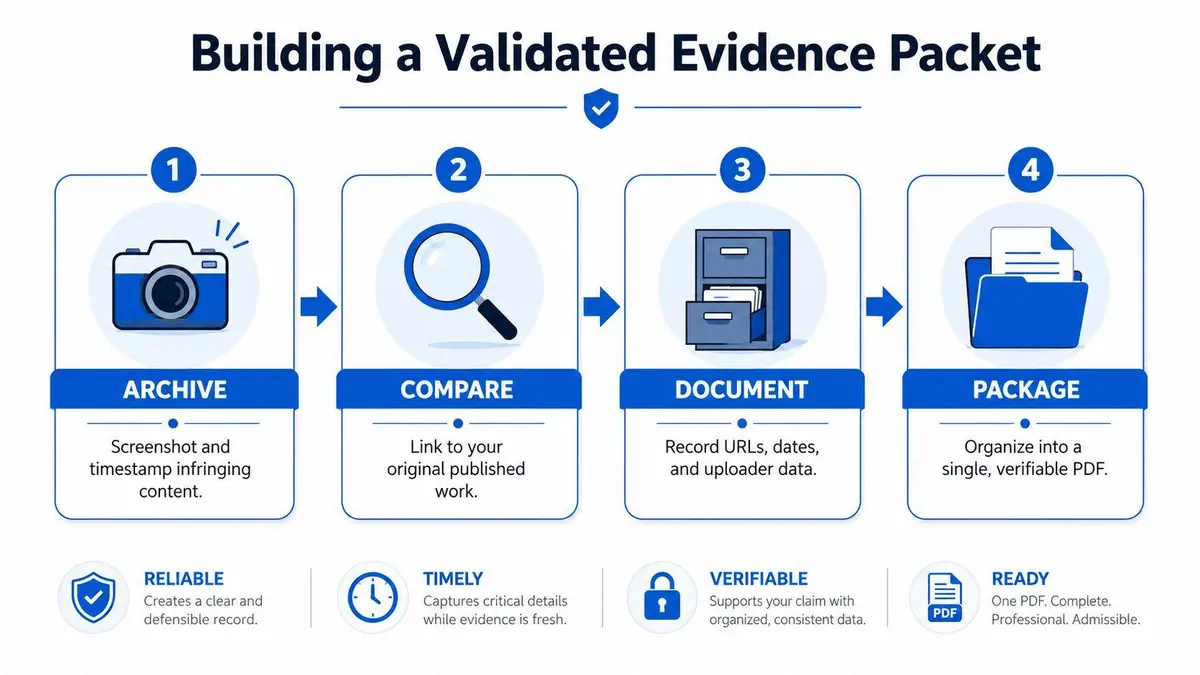
A platform reviewer should be able to validate your claim quickly. Build the evidence packet before drafting the notice, then write only from verified facts. This order exposes common defects early, including a dead original link, changed infringing content, or a signer who cannot prove authority.
Archive the infringement
Capture the infringing page before contacting the platform or uploader. Preserve the complete browser address, visible content, account or publisher details, and the discovery date and time. A screenshot without its URL provides weak proof of location. A URL without a preserved capture may lose value after the page changes.
For visual works, retain the original file, creation records, publication history, and relevant metadata. For written material, preserve drafts, source files, publication records, and internal ownership documents. For commissioned work, locate the assignment or work-for-hire language before asserting ownership.
Compare the original and the copy
Prepare a side-by-side comparison that identifies the copying clearly. Point to distinctive elements appearing in both works, rather than relying on general subject-matter similarity. Generic concepts, facts, and short phrases call for closer analysis than a distinctive photograph, video, illustration, article, or software document reproduced substantially without permission.
The packet should answer three questions immediately:
- What is the original work?
- Where was it published or created?
- What exact material appears without authorization, and where?
Package for review
Create an index linking every original work to each allegedly infringing URL. Record the checking date, URL status, relevant account or uploader, and evidence-file name. A single verifiable PDF can help a reviewer follow the claim, but the required information must remain in the notice. Put the core statutory fields in the notice and use exhibits to support them.
Evidence standard: A packet is ready only when a reviewer can verify the claim without reconstructing your investigation.
Validate every target immediately before sending. Prior analysis of takedown submissions identified defects such as missing copyright-work descriptions, empty requests, misidentified targets, and inactive URIs. Treat those failures as preventable. The pre-send audit should confirm every URL, mandatory field, signature, and authority declaration. If any item remains uncertain, stop filing and obtain professional review before the notice enters the platform’s abuse or validation queue.
Choosing Between Formal and Quick Notice Formats
A single template won’t fit every dispute. The format should reflect the platform, the number of targets, the commercial value of the work, and the likelihood that the recipient will challenge the removal.
A simple web form or email can be appropriate for one clear infringement on a platform with a mature copyright intake process. It reduces unnecessary detail and aligns with the provider’s parsing system. A formal PDF on letterhead is more appropriate when the claim involves valuable proprietary material, multiple works, several URLs, an authorized agent, or a foreseeable counter-notice.
The risk runs in both directions. A quick form can omit context that a human reviewer needs. An overbuilt submission can obscure the required fields or look like mass-generated abuse. Choose structure deliberately.
| Criteria | Formal Notice (PDF/Letterhead) | Quick Email / Web Form |
|---|---|---|
| Best use | Complex claims, multiple works, high-value content, or anticipated disputes | Clear, isolated infringement handled through a platform’s dedicated intake |
| Core presentation | Statutory declarations, itemized URLs, exhibits, ownership records | Direct fields, concise work description, exact target, required declarations |
| Primary strength | Creates a detailed legal and evidentiary record | Fits platform workflows and reduces unnecessary processing friction |
| Primary risk | Excessive argument or attachments can obscure required information | Character limits or simplified fields can leave material facts out |
| Signer control | Easier to document authority and preserve a signed record | Requires careful attention to the platform’s electronic-signature rules |
| Follow-up value | Stronger internal record for escalation or litigation review | Efficient for routine monitoring and straightforward removals |
Language that earns review
Use neutral, specific descriptions. “The image at this URL reproduces the original photograph identified in Exhibit A without authorization” is more useful than a broad accusation of theft. Avoid threats, inflated damages claims, and unrelated allegations. Those additions don’t satisfy Section 512 and may make an abuse team question the submission.
For a formal notice, place a concise summary at the beginning, followed by an itemized schedule of works and URLs. For a quick form, draft the longer evidence record separately before entering the fields. That way, a character limit doesn’t force you to improvise or lose the audit trail.
Delivery Methods and Platform Response Timelines
A legally accurate notice can still fail if it reaches the wrong intake route. Confirm the provider’s designated agent or required copyright form before sending. If the provider’s legal page is unclear, verify the published agent through the U.S. Copyright Office designated-agent directory and use the contact details the provider identifies.
Follow the provider’s stated workflow. Submit through a web form when structured fields are required. Use a published designated-agent email when the matter requires a formal written record. Physical mail can document delivery, but it may slow operational handling. Do not send duplicate notices across unrelated channels unless the provider’s instructions permit it.
What to record after submission
Build the matter log before filing. Save the exact notice, attachments, identified URLs, submission channel, sending time, confirmation number, automated reply, and every later message. Record the status of each URL separately. A platform may remove some targets while rejecting others, so one ticket cannot serve as proof that the entire submission succeeded.
An acknowledgment confirms receipt only. A ticket number confirms routing, not substantive review. If the provider requests clarification, answer the identified defect in the existing thread. Sending a longer replacement narrative can introduce inconsistent ownership statements, URLs, or declarations.
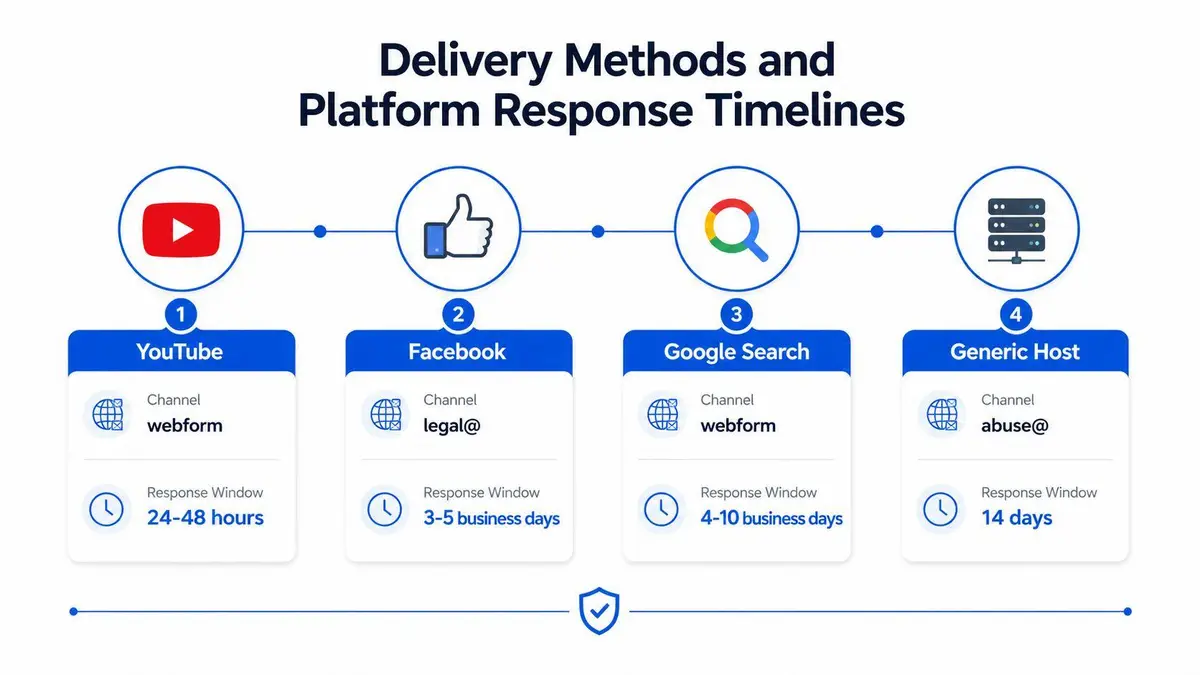
The response windows shown for common channels are operational expectations, not statutory guarantees. YouTube webform matters may receive attention within 24 to 48 hours. Facebook legal submissions may take 3 to 5 business days. Google Search webform reviews may take 4 to 10 business days, while a generic host using an abuse address may require 14 days, as represented in the workflow visual. Use these periods for follow-up planning, not as promises of removal.
Follow up without damaging the record
Follow up after the provider’s stated processing window expires. Use the existing ticket or email thread, identify the original submission date and affected URLs, and request a status update in concise terms. Do not flood the provider with repeated notices. Duplicate submissions can obstruct queue handling and trigger abuse controls.
Google Search removal has a limited effect. It can affect indexing while leaving the source page online. If source removal is the objective, contact the host or platform separately and maintain distinct records for each action.
Handling Counter-Notices and Reupload Persistence
A takedown removes content through a procedure. It does not finally decide ownership. Section 512 also gives the recipient a counter-notice route. A valid counter-notice must include the subscriber’s signature, identify the removed material and its former location, and state under penalty of perjury that removal resulted from mistake or misidentification. It must also provide the sender’s name, address, and telephone number, consent to the appropriate federal court’s jurisdiction, and acceptance of service of process. Treat those requirements as validation checks, not boilerplate.
Treat a counter-notice as a litigation decision
After receiving a valid counter-notice, the rights holder must choose between accepting restoration and pursuing court action. The statutory process gives the sender a limited restoration window, commonly described in practitioner guidance as 10 to 14 business days. Review the platform’s notice and obtain counsel’s advice before relying on that timing.
Assess the position before the content returns. Confirm ownership, examine fair-use risk, identify the claimant, review jurisdiction and registration status, and quantify the likely commercial harm. If litigation is not realistic, preserve a clean record and use another enforcement route. Unsupported threats weaken credibility and can complicate later filings.
Reuploads require a different operating model
A successful removal may expose a distributed infringement. The same file can reappear under a new account, mirror domain, or separate host. Every reupload needs its own exact target and current evidence capture. A prior removal does not prove that each later URL satisfies the platform’s intake requirements.
Maintain a reusable ownership file and a live infringement register. Record hashes or distinctive identifiers where relevant, uploader patterns, account names, hosting relationships, and prior ticket numbers. Request action under applicable repeat-infringer or platform policy provisions when the facts support it. Do not assume one takedown will terminate every related account.
International hosting requires a separate route assessment. The DMCA is a U.S. mechanism, so a foreign provider may require local copyright procedures or rely on its terms of service. An abuse, infringement, or acceptable-use policy may offer another path. Match the submission to that provider’s stated rules instead of labeling every dispute a DMCA matter.
Wikimedia’s 2025 report recorded 13 DMCA requests and six grants, showing that platforms may scrutinize claims rather than remove every reported item. Tumblr’s Jan-Jun 2025 data recorded restoration in all eight affected counter-notice cases, involving nine posts and 55 pieces of content, according to Automattic’s Tumblr transparency report. Build the enforcement process for restoration, reupload detection, and escalation from the start.
When to Escalate to Professional Takedown Services
DIY filing works for a single, clear infringement with documented ownership, a cooperative platform, and no fair-use ambiguity. It stops being efficient when every new URL requires a separate investigation, the infringer changes accounts, the host is difficult to identify, or a counter-notice creates a court decision under time pressure.
ContentRemoval.com is one option for a managed workflow. Its DMCA takedown service handles notice preparation, filing, escalation, and follow-up, with monitoring aimed at identifying reuploads and distributed copies.
| Scenario | DIY Feasible | Professional Recommended |
|---|---|---|
| One exact URL and clear ownership | Yes, after a statutory and evidence audit | Optional review for high-value work |
| Several platforms or mirror sites | Possible, but administratively demanding | Yes, centralize evidence and tracking |
| Repeated reuploads under new accounts | Limited, especially without monitoring | Yes, use continuous detection and escalation |
| Counter-notice received | Only if you understand the legal consequences and deadlines | Yes, involve copyright counsel promptly |
| Foreign host or unclear provider | Research may identify an alternative policy route | Yes, jurisdiction and enforcement strategy matter |
| Ownership or fair-use dispute | Risky to handle without legal analysis | Yes, obtain attorney review before filing |
| High-value corporate or personal material | Technically possible, but exposure is greater | Recommended for confidentiality and record control |
Escalation is rational when the cost of a defective notice, missed response window, or persistent reupload exceeds the cost of controlled intervention. For executives, family offices, creators, and public figures, confidentiality and speed also matter. A professional team can separate source removal, search de-indexing, platform enforcement, and legal escalation instead of treating them as one generic complaint.
ContentRemoval.com prepares and manages evidence-backed DMCA notices, coordinates platform escalation, and monitors for reuploads when a single removal isn’t enough. If stolen content is affecting your reputation, revenue, or privacy, request a confidential assessment at ContentRemoval.com and receive a focused action plan for the specific platforms and URLs involved.
Frequently asked questions
Why was my DMCA takedown notice rejected?
The most common reasons in the article are missing statutory fields such as a signature or good-faith statement, targeting a homepage or search result instead of the exact page, ownership claims with no record linking you to the work, and spam-like formatting that triggers abuse review. Fix the specific defect and resubmit rather than sending a longer narrative.
How long does a DMCA takedown take?
It varies by channel. The article lists operational expectations of roughly 24 to 48 hours for YouTube webforms, 3 to 5 business days for Facebook legal submissions, 4 to 10 business days for Google Search and up to 14 days for a generic host abuse address. These are planning windows, not promises, and an acknowledgment only confirms receipt.
What happens if someone files a counter-notice against my DMCA claim?
The platform may restore the content after a limited window unless you file a court action. Before that deadline, confirm ownership, assess fair-use risk, identify the claimant, check registration and jurisdiction, and weigh the commercial harm. If litigation is unrealistic, preserve the record and pursue a different enforcement route.