
A data broker removal service finds your records across people-search and broker sites and submits opt-out requests at scale. For executives and family offices the harder questions are verification, reappearance and escalation, because consumer tools submit forms but rarely confirm the record is gone or chase it when it returns. Removal is an action. Protection is a managed program.
Key facts
- Consumer Reports found only 35 percent of tracked records removed after four months across tested services.
- Manual opt-outs performed at 70 percent in the same Consumer Reports test, ahead of most paid tools.
- Broker coverage varies widely, from more than 300 sites to over 420 depending on the provider.
- A managed engagement runs in phases: audit, first removal wave, verification and re-submissions, then ongoing monitoring.
Where ContentRemoval.com comes in. ContentRemoval.com handles data broker removal for executives, public figures and family offices as part of a wider privacy program, with verification of each removal, household mapping and escalation when a broker ignores the request. A chief of staff, family office lead or security adviser usually makes contact. A free 15-minute Exposure Scan maps what is removable across brokers and search, and the report is yours to keep. Get a Free, Confidential Exposure Scan or read how our data broker removal work is done.
Most advice on data broker removal is built for consumers shopping for a subscription, not for principals managing risk. That advice tells you to pick an app, pay a monthly fee, and wait for a dashboard to turn green. For an executive, founder, investor, or family office principal, that mindset is reckless.
Your problem isn’t clutter. It’s exposure. Home address, relatives, past residences, work history, phone numbers, and social links can be assembled into a profile that supports harassment, spear-phishing, extortion attempts, activist targeting, and reputational pressure. A cheap tool may submit opt-out forms. It won’t deliver the kind of durable suppression a high-stakes person needs.
A useful parallel comes from outside privacy. Marketers dealing with historic Google Analytics data loss learned the hard way that assuming a platform will preserve what matters is a mistake. Data protection has the same lesson. If the information is important, you don’t trust a default workflow and hope for the best. You build a controlled process, verify outcomes, and plan for recurrence.
The Strategic Misconception of Data Removal
The popular pitch for a data broker removal service is simple. Sign up once, let the software run, and your personal information fades from the internet. That story is convenient. It’s also incomplete in exactly the ways that matter most to people with visible wealth, public authority, or litigation exposure.
The strategic error is confusing removal with protection. Removal is an action. Protection is a managed state. One is a request submitted to a broker. The other is an ongoing program that verifies whether the data disappeared, whether it reappeared, whether it exists on adjacent properties, and whether escalation is needed when the ordinary process fails.
What consumer advice gets wrong
Most ranking articles compare features the way they would compare password managers or note-taking apps. They focus on interface, pricing, and the size of a broker list. That’s the wrong lens.
Executives need to ask different questions:
- Persistence: Does the provider keep monitoring after the first wave of removals?
- Verification: Can anyone confirm that the record is gone, not merely hidden from one search path?
- Escalation: What happens when a broker ignores, delays, or partially processes a request?
- Collateral exposure: Are spouse, children, trusts, properties, and historical records creating fresh pathways back to the principal?
Practical rule: If a service is marketed as effortless, assume it was designed around scale, not around your threat model.
The point isn’t that automation is useless. It isn’t. Automation is the starting layer. The problem is treating that layer as the finished product.
What high-value clients actually need
A serious privacy strategy is closer to executive protection than app management. It combines scanning, matching, takedowns, re-checks, and where necessary, legal pressure. It also accounts for the fact that your digital footprint doesn’t exist in one place. It exists as fragments across brokers, people-search sites, archived pages, public filings, old marketing databases, and search indexes.
If your name carries enterprise authority, political sensitivity, celebrity, or concentrated assets, you shouldn’t be asking which consumer subscription is most popular. You should be asking whether your current exposure profile can be operationalized against you.
The Data Broker Ecosystem and Your Exposure
Treat data brokers as an access infrastructure for strangers. They take scattered personal details from public records, commercial feeds, websites, apps, and purchase histories, then assemble profiles that are faster to search and easier to act on than the underlying sources. For a high-stakes individual, that convenience is the threat.
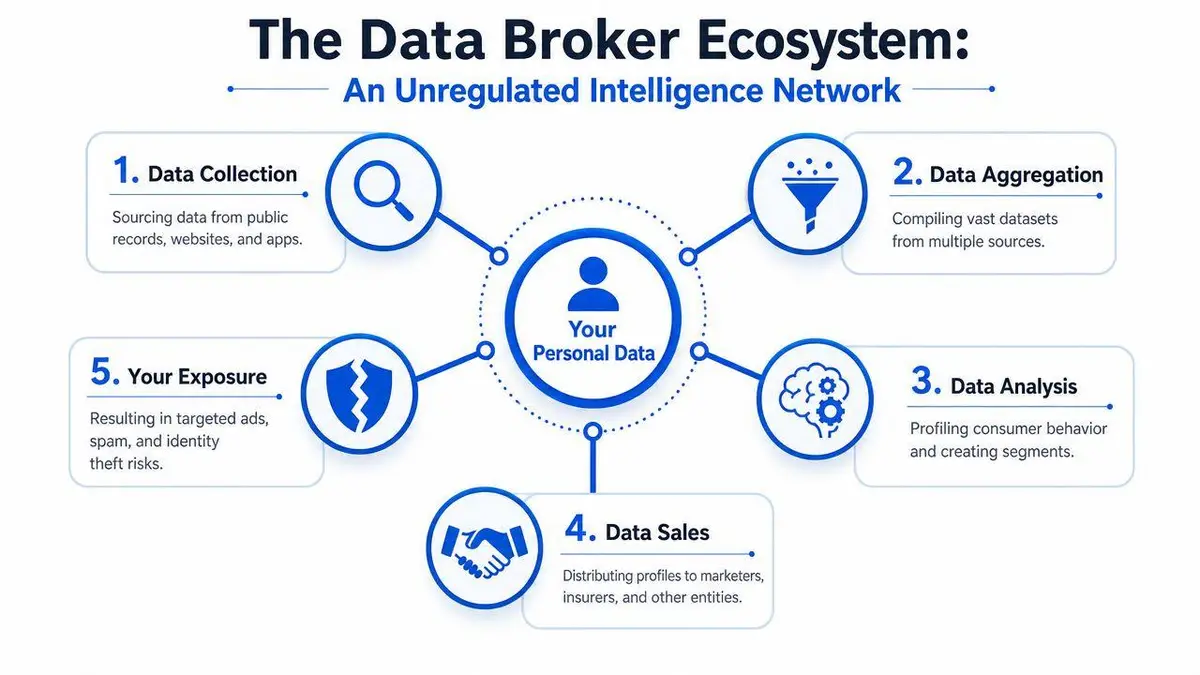
The market is crowded with brokers, resellers, people-search sites, and specialty databases. Some buy data directly. Some scrape it. Some inherit it from affiliates or public-record aggregators. Many do all three. That means your exposure does not sit in one database or one category of site. It spreads across a chain of collectors, enrichers, and republishers, which is why cheap one-pass removal programs leave so much behind.
How the ecosystem turns ordinary records into risk
The core problem is correlation.
One source lists a property address. Another ties that address to relatives. A third adds a mobile number, prior employers, and alias variations. A fourth republishes the combined profile under a different brand. By the time a hostile party searches your name, they are no longer pulling isolated records. They are buying a usable dossier.
That dossier supports several forms of harm:
- Physical exposure: Home addresses, parcel data, and household associations shorten the path to surveillance, trespass, or direct contact.
- Social engineering: Employment history, work emails, and relationship mapping make impersonation attempts more convincing.
- Reputational distortion: Old addresses, litigation references, and identity mix-ups can be repurposed into false narratives about residency, wealth, or conduct.
- Enterprise spillover: Board members, founders, and family office principals often expose the organizations around them through their personal data trails.
The overlap between personal privacy and corporate risk is no longer theoretical. Attackers probe whichever surface gives them the cleanest route in. This discussion of enterprise identity security strategies is useful if you want the business-side view.
Why executives are disproportionately vulnerable
Visibility changes the economics of abuse. A routine consumer profile may attract marketing spam. An executive profile can support pressure campaigns, pretexting, hostile media inquiries, family targeting, or transaction-era intelligence gathering.
The multiplier is linkage across sources that were never designed to be read together. Corporate biographies, licensing records, property filings, charitable disclosures, archived webpages, and family associations create a map that brokers can enrich and resell. Once those records are cross-referenced, removing one listing solves very little.
This is the point many consumer guides miss. Exposure is not measured by how many broker sites list your name. It is measured by how easily an outsider can connect identity, location, family, assets, and authority into an actionable profile. If you need a clearer view of how that market works, this strategic guide to what data brokers are is a useful primer.
The risk is not a single listing. The risk is a distributed profile that can be searched, verified, and used against you.
The Mechanics of Automated Data Removal
A data broker removal service works by finding your records across broker sites and submitting opt-out or takedown requests at scale. That sounds straightforward until you look at what the system is trying to solve.
One provider describes the process as actively searching and issuing removal requests across hundreds of broker platforms in the U.S. and internationally, including records involving names, addresses, phone numbers, work emails, relatives, employment history, and social links, as outlined in VanishID’s explanation of automated data broker removal. The operational challenge isn’t only volume. It’s matching.
Matching the right person to the right record
Human identity data is messy. A broker may list “Jonathan A. Smith.” Another may list “J. Smith.” A third may connect the same person to an old address and a work phone from two employers ago. An automated system has to determine whether those fragments describe the same person without overreaching and targeting unrelated records.
That process is data normalization. In practice, it means standardizing formats, comparing partial fields, accounting for naming variations, and reconciling historical data that appears in different combinations across sites.
A simple way to think about it is this:
| Operational step | What it actually means |
|---|---|
| Discovery | Searching broker inventories for likely matches tied to a person or household |
| Normalization | Determining whether fragmented records refer to the same individual |
| Submission | Sending broker-specific opt-out or deletion requests through forms or structured workflows |
| Verification | Checking whether the listing is actually inaccessible after the request |
| Re-monitoring | Watching for the same data to reappear under fresh indexing or resale pathways |
Why automation helps, and where it stops
Automation is valuable because no individual or assistant should spend their week chasing forms across hundreds of sites. It creates coverage, speed, and repeatability. It also helps maintain a cadence, which matters because records don’t remain static.
But automation has hard limits.
- It can miss edge cases when the data is malformed, outdated, or attached to relatives.
- It can’t always resolve broker ambiguity where the system isn’t sure whether two records belong to the same person.
- It usually doesn’t negotiate with uncooperative publishers, affiliates, or source sites outside the standard broker workflow.
That’s why advanced privacy work uses automation as an engine, not as a substitute for judgment. When the profile is sensitive enough, human review is not overhead. It’s the difference between apparent activity and actual reduction in exposure.
Why Most Data Removal Services Underperform
Consumer-grade services often look busy. They send notifications, show progress bars, and report that requests were submitted. That activity can create false confidence. The more relevant question is whether the data is gone, stays gone, and disappears from the sites that matter.
Independent testing from Consumer Reports tracked 332 pieces of personal information tied to 28 volunteers and found that only 117 items, or 35%, had been removed after four months across the services tested, as reported in Consumer Reports’ review of data deletion services. Performance varied sharply. EasyOptOuts and Optery reached 65% and 68%, while Confidently and ReputationDefender achieved only 4% and 6%. Even manual opt-outs performed at 70%.
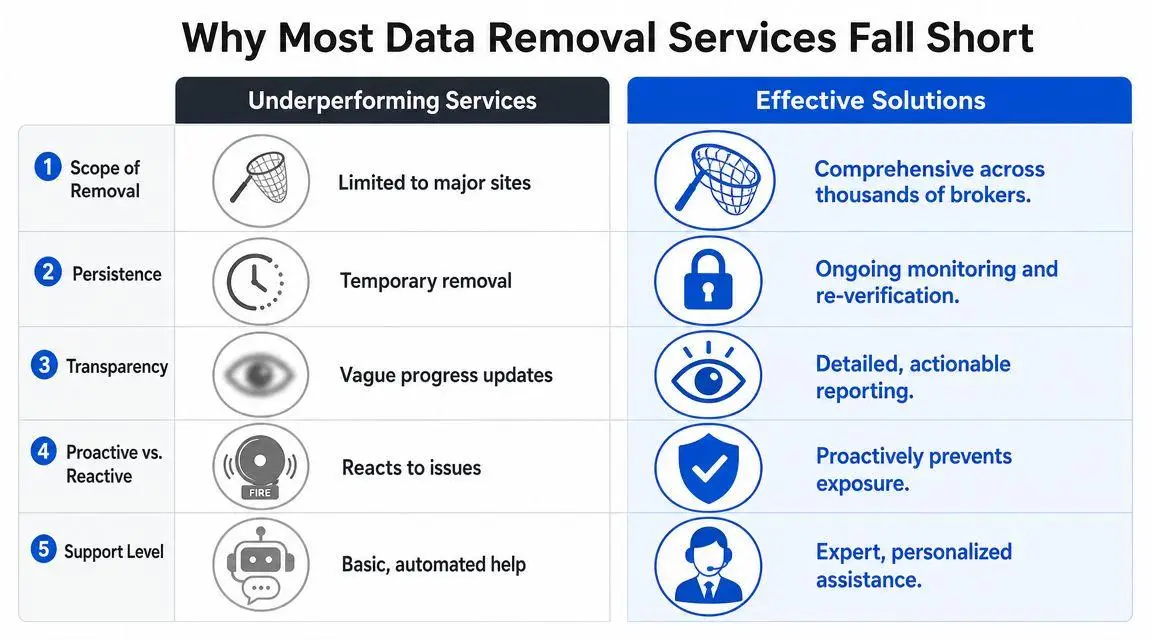
The first problem is shallow coverage
Many low-end services target the obvious people-search sites because those sites are easier to demonstrate in marketing. That creates a polished before-and-after effect. It doesn’t necessarily address the less visible brokers where your data continues to circulate.
Removing the visible layer while ignoring the feeder network is cosmetic. The exposed records may re-enter the ecosystem through resale, repackaging, or data refresh cycles.
The second problem is removal theater
A submitted request isn’t the same as a completed suppression outcome. This distinction matters. Some vendors report actions, not results.
You’ll see language like “request sent,” “in progress,” or “monitoring.” Those phrases may be accurate. They also may conceal the fact that the broker hasn’t complied, the listing still resolves through another path, or the same information remains available on an affiliated domain.
Advisory view: For high-risk clients, dashboards are evidence only if they tie each claim to verified disappearance and follow-up when the record returns.
The third problem is no serious escalation path
When a consumer subscription fails, it often fails unnoticed. There may be no legal follow-up, no source-level analysis, no review of connected entities, and no one accountable for edge cases involving relatives, trusts, shell entities, or mixed records.
That’s where expert intervention changes the outcome. A firm handling broader reputation and privacy matters can connect broker removal to search de-indexing, source takedown strategy, impersonation response, and documentation for counsel or security teams. In that category, ContentRemoval.com handles personal data removal as part of a wider content and reputation protection workflow rather than as a stand-alone app function.
Why underperformance is predictable
The market rewards low-friction subscriptions. High-stakes protection requires labor, review, discretion, and persistence. Those things don’t fit neatly into a bargain monthly product.
If your exposure is tied to board service, public office, litigation, wealth visibility, or family security, underperformance isn’t a minor inconvenience. It’s a category error. You bought hygiene when you needed protection.
Selection Criteria for Executive-Grade Protection
If you’re evaluating a data broker removal service for an executive, don’t begin with price. Begin with failure modes. You need to know how the provider handles the cases that aren’t solved by a routine opt-out form, because those are usually the cases that matter.
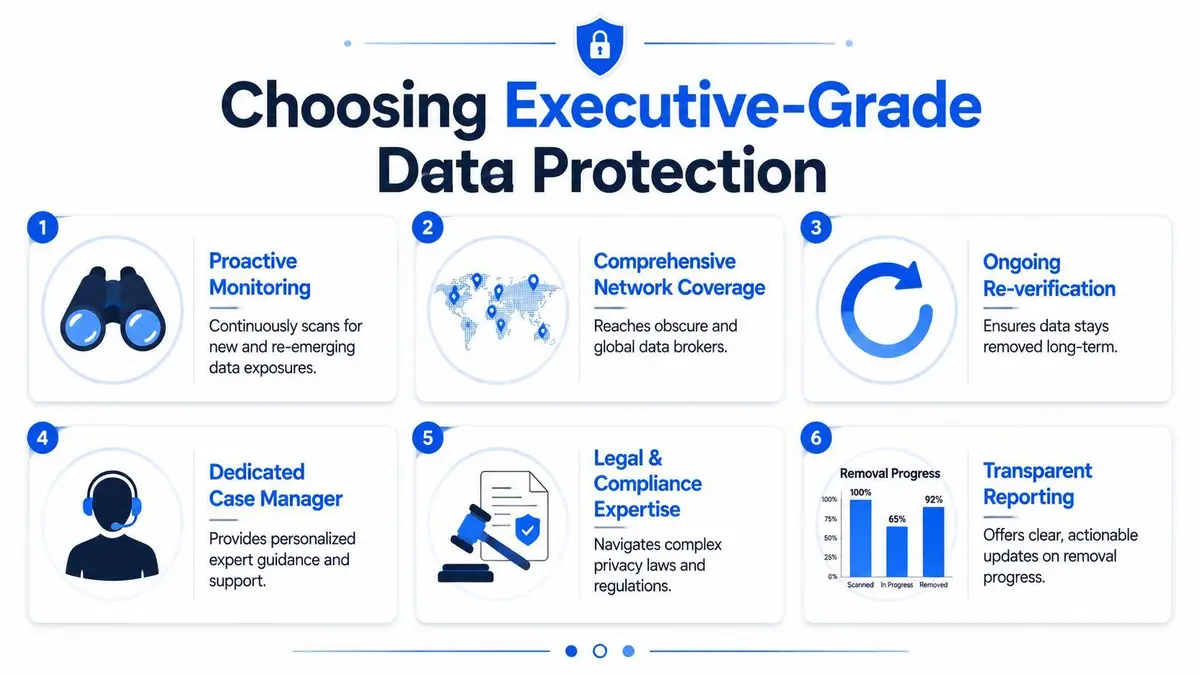
Security.org’s review of leading services found material variation in broker coverage, ranging from over 420 broker sites for one service to more than 300 for another, in its analysis of the best data removal services. That gap matters. Broad claims of “extensive coverage” are meaningless unless the provider can define the network it monitors.
Questions that separate a serious provider from a commodity tool
Start with scope. Ask exactly which broker categories are included, how international exposure is handled, and whether obscure brokers are part of the workflow or excluded.
Then ask about proof. A provider should be able to explain how removals are validated, how reappearance is detected, and what the reporting cadence looks like. If reports are heavy on activity and light on verification, you’re buying motion, not outcomes.
Use this framework with counsel, family office staff, or internal security leads:
- Coverage clarity: Can the provider explain the breadth of broker scanning without hiding behind generic marketing language?
- Reappearance management: What happens after an apparent removal if the same record resurfaces later?
- Household mapping: Does the service account for spouse, children, relatives, and property-linked exposure?
- Escalation capacity: Is there a path beyond automation when brokers or related sites resist compliance?
- Confidential handling: Who sees the client data, how is the case managed, and how are sensitive identifiers protected?
- Reporting discipline: Will the provider deliver decision-useful updates, or only status labels?
What executive-grade service actually looks like
Executive-grade protection isn’t defined by a bigger dashboard. It’s defined by control. You want a process that is narrow in access, documented in execution, and persistent over time.
That usually means a dedicated point of contact, explicit handling protocols, and coordination with legal or security advisors where needed. It also means the provider understands adjacent exposure vectors, not just broker listings. Search results, cached pages, old directories, and source documents can undermine a removal campaign if they’re left untouched.
“Ask what happens when the normal process fails. The answer to that question tells you what you’re really buying.”
For a broader due diligence framework on higher-stakes providers, this guide to evaluating professional content removal services is worth reviewing with your advisors.
Timelines Pricing and Realistic Outcomes
Cheap subscriptions create a dangerous expectation. Clients assume a low monthly fee buys durable privacy control, when it usually buys a light-touch process built for volume. That model has a place for routine digital cleanup. It is poorly matched to a principal dealing with targeted harassment, litigation sensitivity, family security concerns, wealth profiling, or political scrutiny.
Price usually signals operating model. Lower-cost services rely on standardized outreach, limited review, and narrow follow-up. If a listing reappears, if the record is mirrored elsewhere, or if the exposure ties into a broader reputational issue, the subscription model often runs out of room fast.

What realistic timelines look like
Data broker removal works in cycles, not in a single clean sweep. Some records come down quickly. Others persist, reappear, or spread through related sites after the first request is processed. As noted earlier, independent testing and industry analysis point to the same conclusion. Consumer-grade tools produce uneven results, and republishing remains a recurring problem. BlackCloak explains that pattern well in its analysis of data broker removal limits.
For a higher-stakes engagement, expect a phased process:
- Week 1 to 3: exposure audit, identity matching, and priority setting
- Month 1 to 2: first removal wave across major brokers and obvious secondary listings
- Month 2 to 4: verification, re-submissions, exception handling, and cleanup of persistent records
- Ongoing: monitoring and repeat suppression as records are re-aggregated or republished
The key point is simple. You are not buying a single event. You are buying persistence.
A brief explainer is useful here:
What the higher investment buys
A managed engagement costs more because the work is different. The provider is reviewing edge cases, documenting removals, chasing reappearances, protecting sensitive identifiers during the process, and handling exceptions that automation ignores. For some clients, the assignment also touches search visibility, source records, or family-linked exposures that keep rebuilding the footprint.
That cost difference should not be framed as convenience versus premium service. It is a choice between baseline hygiene and actual risk management.
For one principal, the objective is to reduce public access to home and family associations. For another, it is to narrow discoverability during an active dispute, internal investigation, or hostile media cycle. For a family office, the job may involve several related individuals whose records reinforce one another. Those matters require judgment, triage, and follow-through. A flat consumer package cannot do that reliably.
If you are comparing a subscription with a managed engagement, use a pricing framework that reflects scope, persistence, and escalation work. This guide to the true cost of professional content removal services is a practical starting point for internal review.
Your Pre-Engagement Action Plan
Before you hire anyone, prepare the file. Good privacy work moves faster when the client arrives organized and clear about the threat.
Start by writing down the practical concern, not the abstract one. “I value privacy” is too vague. “My family home address is searchable,” “an activist account is naming relatives,” or “our principal is entering contentious litigation” gives the advisor something operational to solve.
Then assemble the known exposures. That includes people-search listings, cached pages, directory entries, old contact details, and any records tied to relatives or entities that could lead back to you. If you already know which sites are surfacing your information, document them. If you don’t, note the search terms an outsider would likely use.
Use this short pre-engagement checklist:
- Define the threat: Harassment, stalking concern, media scrutiny, wealth profiling, litigation sensitivity, or executive impersonation all require different responses.
- Map the protected group: Decide whether the scope is one individual, a spouse, children, household staff, or a wider family office network.
- Identify your internal decision-makers: Legal counsel, chief of staff, security lead, and family office representatives should be aligned before the engagement starts.
- Preserve evidence: Save screenshots and URLs of exposed listings before any takedown work begins.
- Set the confidentiality standard: Decide who may receive reports, who may communicate with the provider, and how records should be labeled and stored.
The clients who get the best outcomes usually know what they’re protecting, who’s in scope, and what failure would look like if nothing changes.
Treat the first consultation as a strategy session, not as a software demo. If the provider can’t discuss exposure, persistence, verification, and escalation in concrete terms, keep looking.
When the stakes involve family security, executive reputation, or sensitive litigation posture, a consumer subscription isn’t enough. ContentRemoval.com works with executives, public figures, and family offices on confidential data exposure, content removal, and long-term reputation protection. If you need a discreet assessment of your current exposure and a practical plan to reduce it, start with a private consultation.
Frequently asked questions
Do data broker removal services actually work?
Results vary sharply. In Consumer Reports testing, the best services removed around 65 to 68 percent of tracked records after four months while the weakest managed 4 to 6 percent, and manual opt-outs outperformed most tools. A submitted request is not the same as a verified removal, and records often reappear through resale and refresh cycles.
How long does it take to remove yourself from data broker sites?
The article describes a phased timeline for a managed engagement. Weeks one to three cover the exposure audit and identity matching, months one to two the first removal wave, and months two to four verification and cleanup of persistent records. Monitoring continues after that because brokers re-aggregate data.
What should an executive look for in a data removal provider?
Ask about coverage clarity, how removals are verified, what happens when a record reappears, whether spouse and family exposure is included, and whether there is an escalation path beyond automation. Confidential handling and decision-useful reporting matter more than dashboard size.