
Dark web monitoring pricing in 2026 typically runs $3,600 to $24,000 a year for small and midsize businesses, $500 to $5,000 a month for standard SaaS plans, and $500,000 to more than $1 million annually for enterprise programs with managed intelligence. The number reveals little on its own, because monitoring detects exposure while remediation is what resolves it.
Key facts
- Four models: subscription, tiered packages, usage or per-asset pricing, and custom value-based enterprise agreements.
- Per-user examples cited range from $5 a month with a minimum commitment to £15 per unit monthly.
- Faster escalation commitments, customized reporting, system integration and legal coordination each move the price materially.
- Monitoring-only leaves four burdens with the client: triage, execution, legal handling and persistence.
Where ContentRemoval.com comes in. ContentRemoval.com sits on the remediation side of that distinction, pairing monitoring with takedown, de-indexing, impersonation handling and recurrence tracking when exposure spills into search, websites or social platforms. Buyers usually come through a CISO comparing quotes, a general counsel or a family office. The firm’s fees are quoted in writing after a free 15-minute Exposure Scan that maps the gap between detection and response, and the report is yours to keep. Get a Free, Confidential Exposure Scan or read how our personal data removal work is done.
Most small and midsize businesses should expect dark web monitoring pricing to start around $3,600 to $24,000 per year, while large enterprise programs can run from $500,000 to more than $1 million annually. That range is real, but it’s also misleading, because the number on the proposal tells you almost nothing about whether you’re buying simple alerts or an actual response capability.
If you’re reading this, you’re likely in one of two positions. Either a vendor has sent over a quote and you’re trying to work out whether it’s inflated, or you’ve already had a scare and realized your organization has no clean answer to a simple board-level question: if our credentials, executive data, or internal records surface on the dark web tonight, who acts, and what happens next?
That’s the right question. Price matters, but passive monitoring is not the same thing as active remediation. Too many buyers compare monthly fees while ignoring the much larger operational cost of owning the response themselves.
Deconstructing Dark Web Monitoring Pricing Models
The dark web monitoring market has matured into a recognizable subscription business. One market analysis valued the dark web intelligence market at $520.3 million in 2023 and projected $2.92 billion by 2032, with 21.8% CAGR, alongside pricing structures that now span $10 to $50 per user per month for some plans through to custom enterprise contracts, according to Market.us dark web statistics. That matters because vendors no longer price these services as rare intelligence engagements. They package them.
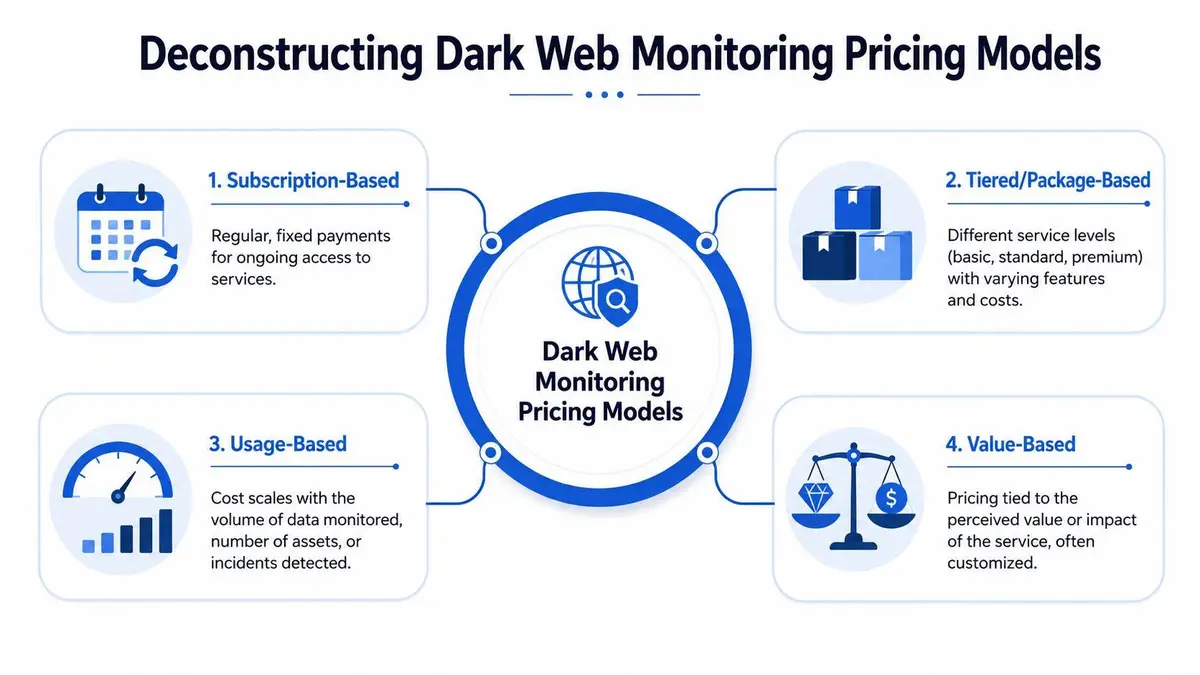
Subscription-based pricing
This is the simplest model. You pay a recurring monthly or annual fee for ongoing monitoring of a defined set of assets. Think of it as a building alarm contract. The provider watches, scans, and alerts. The commercial attraction is predictability.
For a buyer, subscription pricing works when your exposure set is stable and your needs are routine. A company monitoring its corporate domains, common credential leaks, and a fixed employee group can often use this model without much waste.
Tiered and package pricing
Tiered pricing is subscription pricing with marketing wrapped around it. Basic, standard, and premium plans usually reflect different depths of coverage, alerting rules, dashboard access, and analyst support. This is the software market’s preferred structure because it pushes customers toward feature upgrades.
Practical rule: If a vendor’s “premium” tier adds human review, legal escalation, or real incident handling, then the lower tiers are detection products, not resolution products.
For a growing company, tiers can be useful. They create a controlled path from lightweight monitoring into more serious protective coverage. For a principal, family office, or executive team, however, tiering often hides the true issue. The highest-risk identities need bespoke treatment, not a prebuilt package.
Usage-based and per-asset pricing
Many buyers lose discipline when confronting the vendor’s charging approach. The vendor charges based on how many identities, domains, brands, credentials, or records are monitored. The model is logical. The more assets you ask them to track, the more data they must continuously process.
That structure can be efficient when you only need to protect a narrow set of high-value targets, such as a CEO, a founder, a litigation-sensitive matter, or a small set of privileged accounts. It’s less attractive when your monitored population expands quickly and the quote starts climbing without any matching improvement in response capability.
Value-based and custom enterprise agreements
Custom pricing usually appears when monitoring is tied to broader intelligence, internal security workflows, executive protection, or legal handling. At that point you’re not buying a dashboard. You’re buying judgment, escalation, and integration.
That distinction is why discerning buyers increasingly compare these services against wider online brand protection services, not just security tooling. If the actual risk includes reputational damage, extortion potential, impersonation, or publication of sensitive material, a narrow monitoring contract can leave the hardest work outside scope.
Key Factors That Determine Your Final Cost
A dark web monitoring quote is shaped less by the label on the plan and more by what the vendor must watch, verify, escalate, and support. Buyers who miss that end up comparing prices that aren’t remotely equivalent.
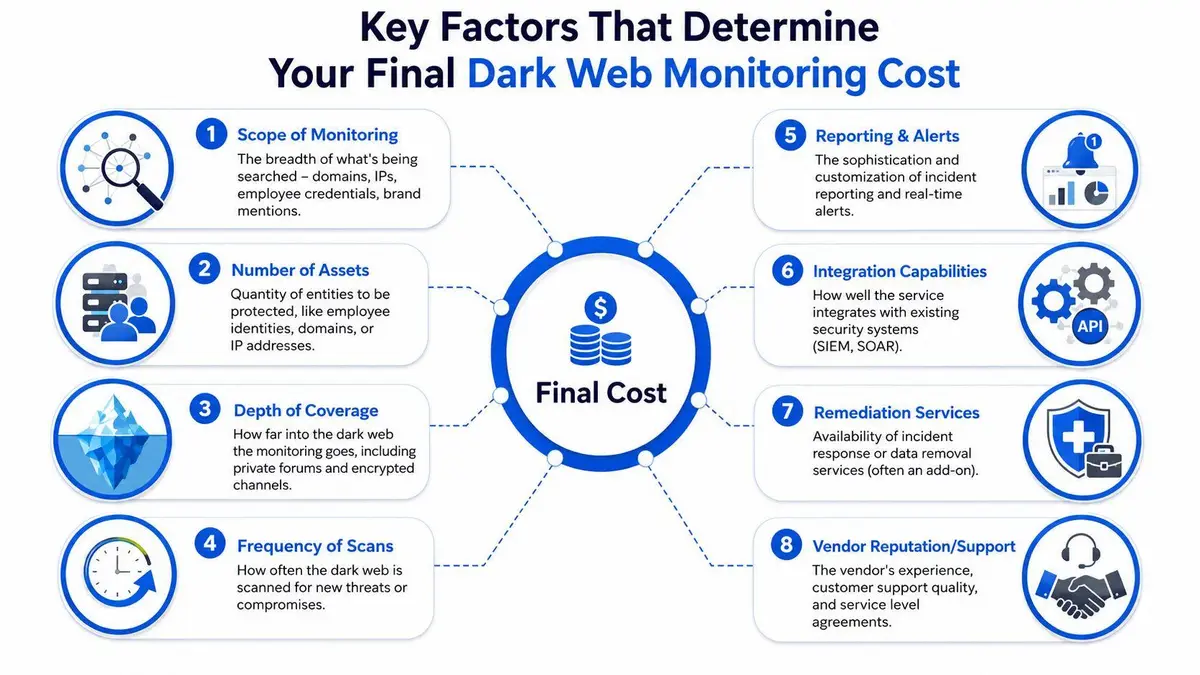
Asset count drives the base price
One reason pricing varies so sharply is that vendors often charge by the identity or asset being monitored. A market comparison cited by Invenio IT’s review of dark web ID pricing notes examples as low as $5 per user per month with a minimum commitment, while a UK public-sector listing showed £15 per unit per month. That isn’t arbitrary. Each additional monitored person adds emails, usernames, domains, and personally identifiable attributes that must be searched continuously.
A company protecting twenty generic employee accounts is buying one thing. A family office protecting principals, assistants, legal counsel, and private operating entities across multiple jurisdictions is buying something else entirely.
Scope changes the labor behind the service
There’s a major difference between credential monitoring and full-spectrum exposure monitoring. The first searches for compromised logins. The second may include executive names, aliases, domains, contact data, brand references, leaked documents, and indicators tied to impersonation or targeting.
Broader scope costs more because the provider has to manage a noisier dataset and make more nuanced decisions. False positives become more expensive. Human review becomes more necessary. Escalation paths become less standardized.
Depth of coverage separates commodity tools from serious intelligence
Many cheap services monitor known breach data and public leak repositories. That may be enough for low-stakes use. It isn’t enough if your concern involves private channels, emerging leaks, or fast-moving abuse that can harm a principal before it becomes common knowledge.
The deeper the provider goes into restricted communities and volatile sources, the more the service depends on analyst time rather than software automation. That’s where cost rises, and where quality starts to matter.
Alerting, SLAs, and integration all add operational expense
A dashboard alert is easy to sell. A reliable escalation process is harder to build. If you want customized alerts, defined triage windows, executive notification rules, or integration with internal counsel and security operations, you are asking the vendor to behave like part of your response apparatus.
That is why the following items move price materially:
- Faster escalation commitments increase staffing pressure because the vendor must maintain coverage and defined workflows.
- Customized reporting costs more because someone has to interpret findings for legal, security, or reputation teams.
- System integration with internal tools adds implementation effort and long-term support obligations.
- Legal coordination changes the service model from monitoring to managed incident handling.
Cheap monitoring usually means you’re still funding the response internally. The invoice looks smaller because the burden hasn’t disappeared. It’s been transferred.
Sample Pricing Benchmarks for SMBs and Enterprises
The useful benchmark is not what one vendor calls “premium.” It’s what the market says buyers generally pay at different levels of operational maturity.
According to DataIntelo’s dark web monitoring market report, the global dark web monitoring market is estimated at $1.2 billion in 2025. The same report places SME annual subscriptions at $3,600 to $24,000, notes standard business SaaS plans at $500 to $5,000 per month, and states that enterprise-grade deployments with managed intelligence can reach $500,000 to over $1 million annually.
What the lower range usually buys
For a small or midsize organization, that lower annual spend usually corresponds to a software-led service. Expect monitoring of a defined asset set, routine alerts, and some form of portal access. You may get periodic reports and basic triage support, but not deep investigative work.
That can be entirely appropriate. If your business mainly wants visibility into leaked employee credentials or domain exposure, there is no reason to purchase an intelligence-heavy engagement.
What the upper range usually buys
Once a program moves into the high-six-figure range, the proposition changes. You are typically paying for managed intelligence, analyst review, customized collection, internal integration, and escalation support that resembles an extension of your security or risk team.
That price difference often shocks first-time buyers, but it’s rational. You are no longer purchasing “monitoring.” You are purchasing a capability that can identify, interpret, prioritize, and route threats in a usable form across a large organization.
Annual benchmark view
| Tier | Typical Annual Cost | Core Services |
|---|---|---|
| SMB | $3,600 to $24,000 | Ongoing monitoring, standard alerts, business SaaS delivery |
| Enterprise | $500,000 to over $1 million | Managed intelligence, custom integrations, analyst-driven support |
There is also a middle ground where companies pay monthly SaaS fees without obtaining meaningful response coverage. That’s often the least efficient position. You spend enough to feel protected, but not enough to secure decisive action when something serious appears.
If your board or principal wants a broader view of downstream response costs, this professional pricing guide to content removal is a better companion document than a vendor price sheet. Monitoring identifies the problem. Cleanup, suppression, takedown, and legal handling determine the business outcome.
The Critical Distinction Between Monitoring and Remediation
Most executives misunderstand this point the first time they buy. That’s not because the services are technically complex. It’s because the market sells reassurance, even as responsibility is limited.
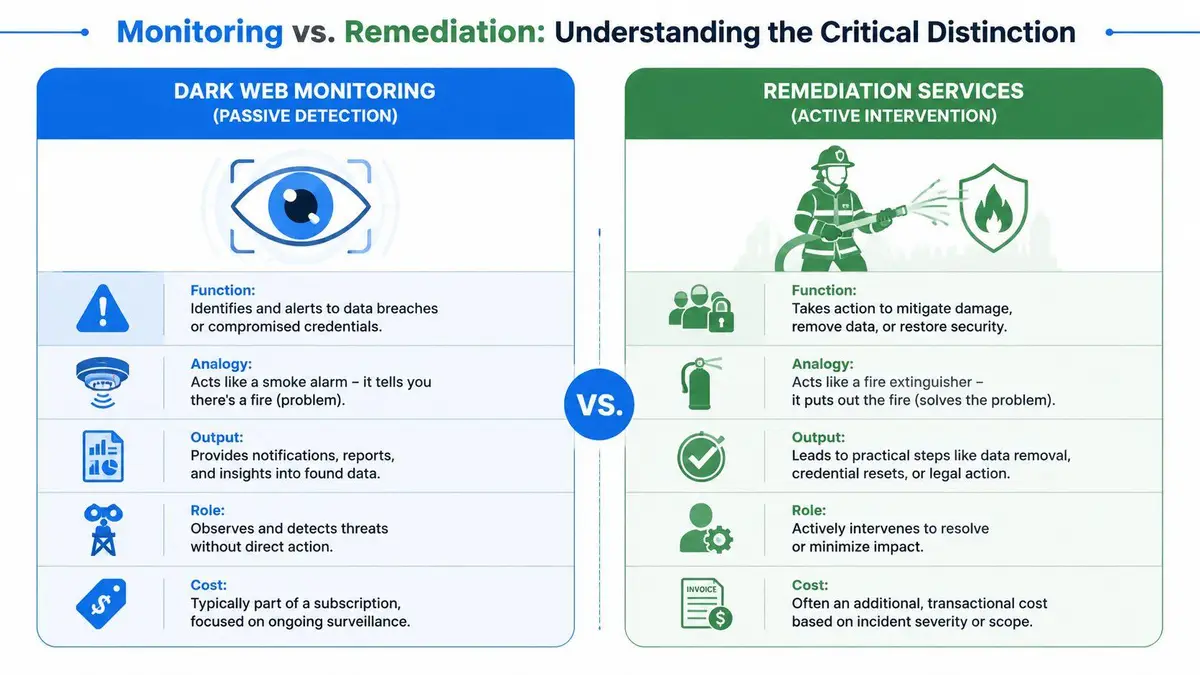
Dark web monitoring is a detection function. It tells you that exposed credentials, leaked records, or sensitive references have surfaced. Neutral guidance from CrowdStrike’s explanation of dark web monitoring is clear on the point: monitoring can identify exposed data and shorten time to detection, but it does not remove that information from the dark web or prevent stolen data from being used.
That single fact should change how you evaluate every quote you receive.
Monitoring is the smoke alarm
A smoke alarm has value. It gives you time. It reduces delay. It may prevent a contained incident from becoming a disaster. But if the house is already burning, the alarm is not the solution.
The same applies here. If a provider finds a credential dump involving your executives, a private document leak, or identity data tied to a principal, the critical questions arrive immediately:
- Who validates the finding
- Who resets access and contains the spread
- Who handles takedowns or platform escalation
- Who coordinates with counsel, insurers, or investigators
- Who protects against republication and secondary abuse
If the answer is “your team,” you didn’t buy resolution. You bought notice.
A closer look at the distinction helps:
Remediation is where the value sits
Remediation means action. It can involve credential resets, containment support, evidence preservation, platform complaints, de-indexing requests, legal escalation, and targeted removal efforts where possible. It may also involve reputation work when the exposure carries public-facing consequences.
The cheapest monitoring service often becomes the most expensive option on the day you need judgment, speed, and discretion.
This is where a bundled model changes the economics. A service that pairs monitoring with response capability is priced on a different basis because it addresses the business problem, not just the detection event. One example is ContentRemoval.com, which offers dark web monitoring alongside remediation and removal work where exposure spills into search, websites, social platforms, impersonation, or leaked material. That isn’t interchangeable with a low-cost alerting tool, and buyers shouldn’t pretend it is.
What monitoring-only leaves with you
Monitoring-only vendors often leave four expensive burdens with the client.
First, triage burden. Your team must decide whether the finding is meaningful.
Second, execution burden. Someone must coordinate password resets, account hardening, and communications.
Third, legal burden. If the incident involves unlawful publication, extortion, or reputational injury, external counsel or specialist advisors still need to be engaged.
Fourth, persistence burden. Even after the initial event, the data may continue to circulate or resurface elsewhere.
That is why dark web monitoring pricing without remediation details is incomplete by definition.
Evaluating ROI and Framing the Investment
Executives often ask the wrong financial question. They ask what dark web monitoring costs. They should ask what unmanaged exposure costs once internal time, external counsel, business disruption, and reputational spillover are included.
Treat this as risk transfer, not software spend
A narrow monitoring product belongs in the software budget. A combined monitoring and response capability belongs in the risk budget. The distinction matters because the expected return doesn’t come from “using the platform.” It comes from avoiding escalation, delay, and public damage.
That framing is especially relevant for principals, founders, and family offices. Their risk isn’t limited to compromised employee passwords. It may include impersonation, leaked personal data, private documents, harassment campaigns, or information used to pressure transactions and relationships.
The avoided costs are usually outside IT
The most damaging consequences of exposure often sit beyond the security team. Legal review, crisis communications, executive time, insurer notifications, customer handling, and platform disputes all create real cost. So does indecision. The incident itself may be technical. The fallout rarely is.
A sensible ROI model asks whether the provider helps you reduce:
- Response delay so exposed accounts and identities are secured faster
- Management distraction by giving counsel, security, and leadership a clear operating path
- Reputational amplification when harmful content migrates from closed channels into public visibility
- Repeat exposure risk through continued monitoring after action is taken
Buyers who frame this as a line-item software purchase almost always underbuy. Buyers who frame it as exposure management buy more intelligently.
For boards and principals, this is close to a continuity decision. You’re deciding whether an exposure event will be managed as a controlled incident or as a scramble. That’s why dark web monitoring should be assessed alongside broader executive frameworks for online monitoring spend, not as an isolated cyber tool.
The right benchmark is readiness
The best return comes from shortening the distance between detection and action. If a service alerts you but leaves you to locate specialists, brief counsel, organize takedowns, and manage reputational fallout from scratch, much of the value is lost at the moment of greatest pressure.
For high-risk organizations, a credible premium is justified when it buys readiness, discretion, and execution.
Essential Questions for Any Monitoring Vendor
Most vendor meetings are too polite. They shouldn’t be. If the provider can’t answer detailed operational questions without retreating into product language, you are looking at a commodity service.
Start with coverage. Ask what, precisely, they monitor on your behalf. Don’t accept “dark web sources” as an answer. Ask whether they cover credentials, executive identifiers, domains, leaked documents, impersonation indicators, and brand abuse. Then ask how they distinguish old breach data from fresh exposure.
Questions that expose weak vendors
Use questions that force operational clarity:
- What assets will you monitor by default, and what requires custom scope? This reveals whether the quote covers your real exposure.
- When you find something significant, who reviews it before we’re alerted? If nobody does, expect noise and poor prioritization.
- What happens in the first hours after a serious finding? You need a workflow, not a promise.
- Do you provide remediation, or only notification? This should be answered in one sentence.
- If removal isn’t possible, what mitigation steps do you coordinate? Serious providers think beyond detection.
- Can you work with external counsel, insurer panels, or internal communications teams? Real incidents rarely stay inside one department.
- How do you handle highly sensitive matters involving executives, family members, or privileged information? Discretion is an operating requirement, not a marketing trait.
Questions that test maturity
The next layer is about judgment.
Ask who performs analyst review. Ask how escalation thresholds are set. Ask whether they can support matters that cross from security into reputation, privacy, and legal exposure. Ask what they do when a finding appears in more than one location and starts to spread.
If the provider speaks fluently about alerts but vaguely about action, they are selling visibility, not protection.
Finally, ask the commercial question that most buyers avoid. What is excluded from the quoted price? You need to know whether response, takedown work, legal coordination, and post-incident follow-up are included, available as add-ons, or entirely outside scope.
That answer tells you whether the quote is cheap, expensive, or incomplete.
If you need a discreet assessment of whether a monitoring quote includes meaningful response capability, ContentRemoval.com can review the exposure scenario, define the gap between detection and remediation, and outline a confidential action plan for monitoring, takedown, and reputation protection.
Frequently asked questions
How much does dark web monitoring cost for a small business?
The market benchmarks cited put SME annual subscriptions at roughly $3,600 to $24,000, which usually buys a software-led service: monitoring of a defined asset set, routine alerts, portal access and basic triage support rather than investigative work.
Why is enterprise dark web monitoring so expensive?
At the high-six-figure level you are paying for managed intelligence, analyst review, customized collection, internal integration and escalation support that acts as an extension of your security or risk team, not a dashboard.
What is usually excluded from a dark web monitoring quote?
Often the response itself: triage of whether a finding matters, credential resets and containment, takedowns and platform escalation, legal coordination and follow-up when data resurfaces. Ask whether those are included, add-ons or outside scope.