
Data breach notification is the legal duty to tell regulators and affected people what happened after personal data is exposed. Deadlines depend on jurisdiction: GDPR expects notice to the supervisory authority within 72 hours where feasible, HIPAA allows up to 60 days, and U.S. state rules vary by resident. Notice quality matters as much as timing.
Key facts
- GDPR requires notice to the supervisory authority without undue delay, within 72 hours where feasible.
- HIPAA requires individual notice without unreasonable delay and no later than 60 days after discovery.
- Singapore’s PDPA sets a three calendar day trigger once a breach is judged notifiable.
- Legal, PR and technical teams should work in parallel tracks, not in sequence.
Where ContentRemoval.com comes in. Once a breach is public, copied notices, leaked records and press coverage tend to follow the people involved into search results. ContentRemoval.com handles the takedown, de-indexing and monitoring side while counsel manages disclosure. General counsel, a chief of staff or the company’s crisis agency usually make contact. A free 15-minute Exposure Scan maps what is removable, and the report is yours to keep. Get a Free, Confidential Exposure Scan or read how our personal data removal work is done.
The breach call came in before breakfast. Your team has found unusual access, outside counsel is already on the line, and someone in communications is asking whether the company needs to notify customers, regulators, or both. At that point, the issue isn’t just containment. It’s whether the next message the company sends will calm the situation or make the reputation damage harder to stop.
Data breach notification is where legal obligation, operational discipline, and public trust collide. Treat it like a document filing and you’ll lose control of the story. Treat it like a crisis communication exercise and you’ll miss legal deadlines. Boards need a process that does both, fast, accurately, and in the right order.
When a Breach Hits and Notification Becomes the Priority
The first mistake executives make is assuming the incident response team can “finish the investigation” before anyone has to be told. That rarely holds. Under GDPR, a controller must notify the supervisory authority without undue delay and, where feasible, within 72 hours of becoming aware of a personal data breach, and the notice has to include the nature of the breach, the approximate number of affected data subjects and records, DPO contact details, likely consequences, and mitigation measures, which means the team needs clean discovery timestamps and a structured way to classify facts quickly. In U.S. health incidents, HIPAA’s Breach Notification Rule requires notice to affected individuals without unreasonable delay and no later than 60 days after discovery, with specifics on what happened, the types of information involved, protective steps, mitigation, and contact information, so forensic scoping and containment speed directly affect the downstream notice clock. See the GDPR breach rules in the EDPS guidance on breach notification and the HIPAA framework in the HHS Breach Notification Rule overview.
The board-level problem is not only timing
Risk starts when executives think in terms of a single announcement. That is not how breach notification works. A single incident can trigger resident notices, regulator notices, and sometimes consumer-reporting agency notices, depending on where affected people live and what data was exposed.
The scale of the problem is now unmistakable. The Identity Theft Resource Center recorded 3,322 data compromises in 2025, up from 3,152 in 2024, while individual victim notices fell from 1.36 billion to 278.8 million in the same period, a sign that breach response is now about volume, timing, and operational burden, not just incident counts. Privacy Rights Clearinghouse also reported 8,019 breach notification filings in 2025 from state and federal agencies, representing 4,080 unique breach events affecting at least 375 million individuals. That is the environment your notice has to survive in, and it’s why sloppy drafting becomes a reputational problem almost immediately. The annual reporting record is documented in the 2025 ITRC Annual Data Breach Report.
Practical rule: If the company doesn’t know which jurisdiction’s notice rules apply to each affected person, it doesn’t know whether it has a compliance plan.
Reputation starts in the first draft
The first notice sets the tone for the entire incident. If it reads like a liability disclaimer, recipients assume the company is minimizing the problem. If it’s too vague, regulators and plaintiffs’ counsel will both see room for attack. The goal is not to sound polished. The goal is to sound specific, controlled, and credible enough that stakeholders believe the company knows what happened and is still governing the response.
Mapping Notification Timelines Across Jurisdictions
No serious company can use one uniform timetable for breach notification. Deadlines differ, trigger points differ, and the people who must be told differ. GDPR pushes fast notice to authorities, HIPAA runs on a different clock for health data, Singapore’s PDPC scheme adds a short calendar-based trigger, and U.S. state law remains a patchwork that forces resident-by-resident analysis.
The practical lesson is blunt, each affected person has to be mapped to a legal regime before the company decides what goes out and when. Executives should stop asking, “What’s our notification policy?” and start asking, “Which notice rules apply to each data subject, and what do they require?” The Washington Attorney General’s guidance on breach laws makes the patchwork obvious, and it is a better reference point than any single global template. The Washington comparison guidance is here.
| Jurisdiction | Deadline | Trigger Threshold | Required Recipients |
|---|---|---|---|
| GDPR | Without undue delay, where feasible within 72 hours | Personal data breach once aware | Supervisory authority, and sometimes affected individuals |
| HIPAA | Without unreasonable delay, no later than 60 days after discovery | Breach of unsecured protected health information | Affected individuals, and in some cases HHS and media |
| Singapore PDPA | Within 3 calendar days after determining a notifiable breach | Notifiable personal data breach | PDPC, and affected individuals when required |
| Washington State | Prompt notice under state rules, with plain-language content | Breach involving personal information of residents | Residents, and specific notice to the attorney general |
| U.S. State Patchwork | Varies by state | Resident personal information exposure | Residents, state attorneys general, sometimes consumer-reporting agencies |
The table only tells part of the story. The same incident can start on one continent and end in another legal regime. A company with clients, patients, or high-net-worth records across several states or countries has to map the legal triggers before it chooses the notification sequence. That matters even more when the affected records involve executives, family-office information, or legal-client data, because the same compromise can create different notice obligations for different people even when the breach itself is identical.
A board should demand a jurisdiction map before it approves any external statement. Without it, legal, security, and communications are guessing under pressure.
For companies that already manage reputation risk in parallel with legal exposure, the cleanest approach is to treat notification as one part of a broader containment strategy. If the incident is also likely to generate search results, articles, or copied content that will follow the people involved, use a structured reputation response plan such as ContentRemoval’s GDPR-focused guidance alongside counsel-led breach handling.
What a Compliant Notice Must Contain
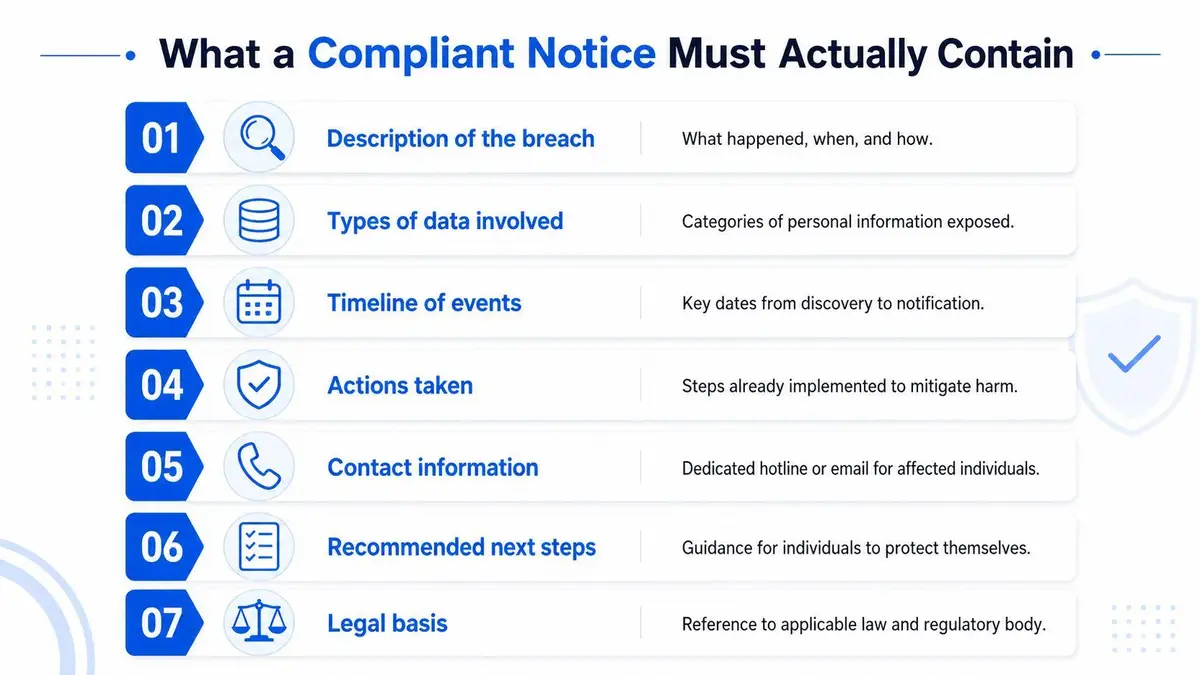
A compliant notice serves three purposes, a factual record, a harm-reduction document, and a regulatory artifact. If it does not answer the obvious questions quickly, recipients will fill in the blanks themselves, and they usually fill them in badly.
Under GDPR, the notice to the supervisory authority has to cover the breach’s nature, the approximate number of affected people and records, DPO or contact details, likely consequences, and mitigation measures. HIPAA requires notice to individuals that explains what happened, what information was involved, what they should do next, what the covered entity is doing, and how to reach the entity for follow-up. Washington’s rules push plain-language resident notices and add specific content for the attorney general, while Singapore’s PDPC framework focuses on fast notification after a breach is determined to be notifiable. The broad point is simple, the notice has to tell people what happened, what was exposed, and what they should do now.
Write for the recipient, not the file cabinet
The most useful notices are written in direct, human language. That does not mean casual language. It means the reader can tell, in one pass, what happened, what data was involved, whether the company has contained the incident, and what action they need to take. U.S. DHS guidance uses headers like “What Happened” and “What You Can Do” for a reason, and Washington’s plain-language requirement points in the same direction.
The FTC’s comparative research found that breach notifications often bury the point under legal padding and generic phrasing. That is exactly why technically compliant notices still fail people. If the notice does not give an affected person a next step, it does not reduce harm. It only documents that the company sent something. Regulators see that difference. So do the people who now have to decide whether to change passwords, freeze credit, watch for fraud, or call their bank.
Use a consistent factual core
A strong notice needs the same core facts across every jurisdiction, even when the legal appendix changes. Those facts should include the breach description, the data categories involved, the timing, the containment steps already taken, the contact path for questions, and practical guidance for the recipient. If the incident involves health data, financial data, or executive records, the notice should make the exposure understandable to a non-lawyer without softening the seriousness of the event.
The best notices also avoid overclaiming. Do not say the threat is “fully resolved” unless the technical team has evidence for that. Do not pretend uncertainty does not exist. Say what is known, say what is still being confirmed, and give the next update path. People can tolerate incomplete information. They do not tolerate evasive language.
For incidents that may also create reputational fallout, pair the notice with a plan for search results, copied content, and public confusion. A practical guide to handling reputational damage from a data breach helps keep the response anchored in harm reduction instead of reactive messaging.
Coordinating Legal, PR, and Technical Teams During Notification
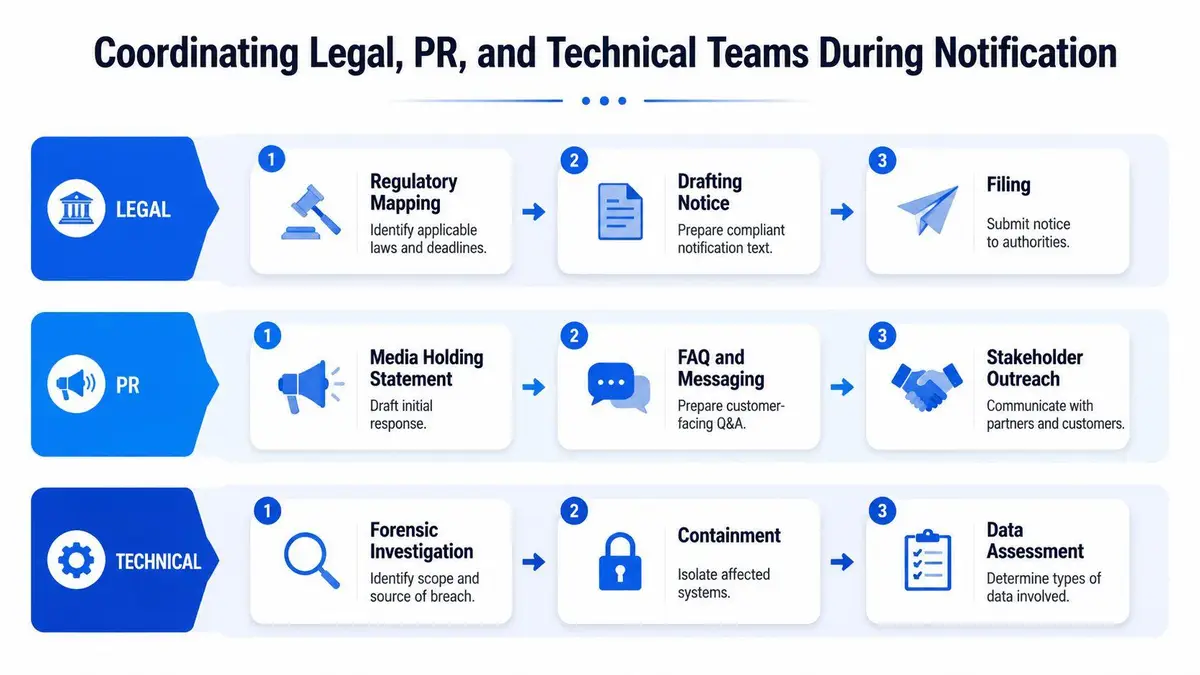
Notification fails when teams work in sequence instead of in parallel. Legal waits for forensic certainty. PR waits for legal approval. Technical teams keep digging while nobody writes the message. By the time the company is ready to send anything, the deadline is already closing in and the first public statement sounds rushed.
The right workflow starts with three parallel tracks, not one. Technical teams identify scope, contain the incident, and classify the data. Legal maps the jurisdictions, chooses the recipients, and drafts the notice language. PR prepares a holding statement, a customer-facing FAQ, and a stakeholder outreach plan so that internal confusion doesn’t spill into public channels. That structure is hard to manage under pressure, but it’s the only structure that keeps the company from sending a notice that is either late or incomplete.
Set ownership before the clock starts
The incident commander should not be the same person writing the consumer notice. That role needs to stay focused on decision flow, timing, and escalation. Legal needs a single accountable lead for jurisdiction mapping and final language. PR needs one spokesperson and one approval chain. Technical teams need a clean handoff process so they can update facts without rewriting the whole document every time scope changes.
The same discipline applies when outside vendors are involved. If a forensic firm, e-discovery provider, or takedown partner is helping the company work through public fallout, make sure the work product is tied to one factual record. A fragmented process creates duplicate versions, conflicting dates, and inconsistent notices, which is exactly how companies end up defending their own paperwork instead of the breach.
Keep the message synchronized with the investigation
Technical containment and public communication can’t pull in different directions. If the team is still determining whether the exposure involved contact details, health records, or credential data, the notice should say that the classification is in progress and explain what the company has already verified. That’s better than pretending certainty. Regulators care that the company acted promptly and responsibly, not that it wrote a perfect memo on the first pass.
For boards under real reputational pressure, the follow-through matters just as much as the first release. A structured reputation response framework, including legal review of search results and source removal when the incident starts circulating publicly, can be part of the same coordinated response. One practical option is ContentRemoval’s strategic guide to handling reputational damage from a data breach, especially when the incident is likely to produce repeated exposure online.
Why Notice Quality Matters More Than Deadline Compliance
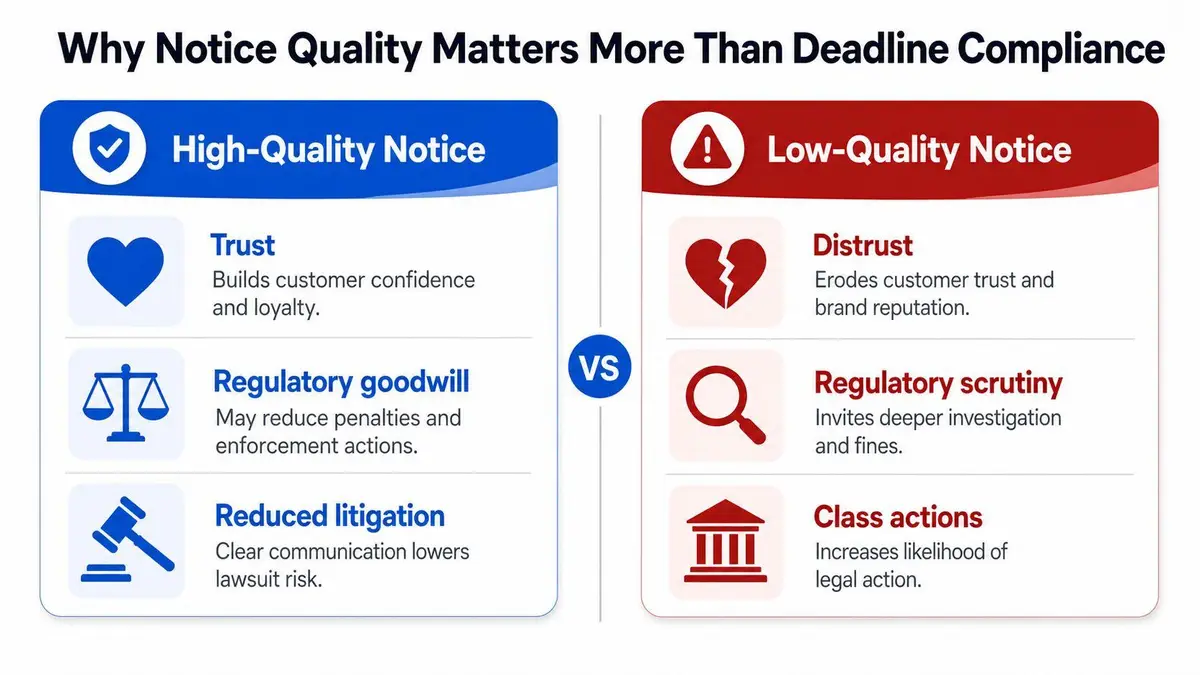
Hitting the deadline means little if the notice does not reduce harm. Regulators and plaintiffs’ counsel both penalize vague drafting, because a notice that confuses recipients can worsen the breach’s fallout instead of containing it.
The FTC’s research on breach notices is blunt about the problem. Many notices are long, vague, and inactionable, which leaves recipients with a legal artifact instead of practical guidance. Washington’s rules push plain-language notice, and DHS guidance calls for a structure that tells people what happened and what they can do next. The direction from regulators is clear, usefulness matters. A notice that gives recipients a path forward is easier to defend than one that only proves the company met a clock.
Quality lowers the downstream damage
High-quality notices reduce confusion. They help affected people decide whether to change passwords, contact banks, monitor accounts, or take other protective steps. They also cut down the follow-up calls, incomplete complaints, and angry escalations that land on customer service, compliance, and the executive team after the notice goes out.
Low-quality notices do the opposite. They create distrust because recipients cannot tell whether the company understood the incident. They invite regulatory scrutiny because vague drafting looks like avoidance. They also give plaintiffs’ counsel a clean argument that the company failed to communicate in a way that reduced harm.
Precision is a reputational control, not a stylistic choice
Boards should stop treating notice quality as a communications preference. It is a control. Plain language, clear dates, concrete remediation steps, and an obvious contact path make the company look credible because they show the company is managing the event instead of hiding behind legal boilerplate.
That does not mean oversharing. It means choosing the facts that matter and presenting them in a way that an affected person can use. If the notice does not help the recipient act, it is not good enough. Executives should hold the same standard across regulators, customers, partners, and employees. Anything less creates noise at the exact moment the company needs clarity.
How to remove personal information from Google after a data breach is the kind of follow-on step that can help limit exposure when breach details start surfacing in search results.
Post-Notification Remediation and Ongoing Monitoring
The notice is not the finish line. It’s the start of the recovery phase, and the company’s reputation will depend on how quickly it proves the incident won’t repeat. That means closing the technical gap, monitoring for reappearance, and tracking where the exposed information shows up next.
Immediate remediation starts with securing the affected systems and closing the vulnerability. Short-term response should include the protections the company is offering to impacted people, such as credit monitoring or identity theft support where appropriate. Longer-term, the security team needs ongoing monitoring, regular audits, and a plan to catch reused or resurfacing data before it becomes a second crisis.
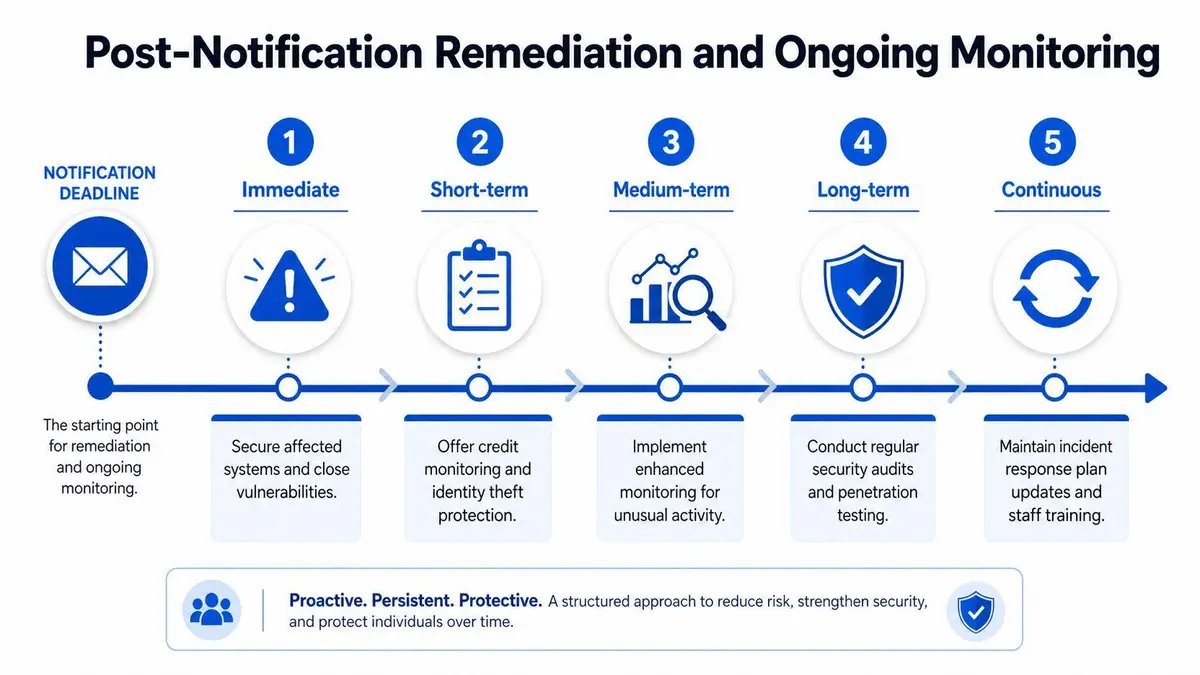
Stop the reappearance problem early
Once data is out, it tends to move. It shows up in forums, mirrored sites, search results, and scraped reposts. That is why post-notification work has to include monitoring for renewed publication, not just internal cleanup. If the company ignores reuploads, it will keep reliving the breach every time the material gets indexed again.
A targeted removal and monitoring workflow matters. For executives, family offices, and legal professionals, the reputational harm often spreads beyond the original incident report. ContentRemoval.com offers takedown, de-indexing, and continuous monitoring services that focus on finding and addressing personal data when it reappears online, which can be useful when breach fallout is turning into an ongoing visibility problem.
Make remediation visible to stakeholders
The company should not disappear after the notice is sent. It should show that controls are improving, that staff are retrained, and that the incident response plan is being updated. That visible follow-through matters because people judge breach response by whether the organization appears to have learned anything from the event.
This is also the point to coordinate any search-result cleanup, source removal, and public-content suppression work with legal counsel. If the breach already generated posts, copied notices, or leaked records, use a structured remediation plan to reduce the number of places the information can spread. For a practical guide to that process, see how to remove personal information from Google after a data breach.
Executing a Defensible Notification Strategy Under Pressure
The right strategy is simple to say and hard to execute. Map the jurisdictions first. Draft the notice for usefulness, not just compliance. Run legal, PR, and technical work in parallel. Then keep monitoring after the notice goes out so the same data doesn’t resurface and reopen the damage.
Boards should demand one incident record that ties together discovery time, affected populations, legal triggers, draft notice versions, and remediation steps. That record becomes the defensible backbone of the response. If a regulator, journalist, customer, or plaintiff later asks what the company knew and when it knew it, the answer has to be traceable. If it isn’t, the company has a documentation problem on top of a breach problem.
The companies that handle breach notification well do three things consistently. They move fast without guessing. They tell the truth without writing for lawyers only, and they keep working after the notice is sent, because reputation damage rarely stops at disclosure. That is the standard executives should set, and the standard their teams should be prepared to defend.
If your breach has already reached search results, copied notices, or unwanted press coverage, ContentRemoval.com can help with targeted takedowns, de-indexing, and continuous monitoring while your legal team handles disclosure obligations. Visit ContentRemoval.com to start a confidential assessment and get a focused plan for reducing the reputational fallout around the incident.
Frequently asked questions
How quickly do you have to report a data breach?
It depends on which rules apply to each affected person. GDPR expects notice to the supervisory authority within 72 hours where feasible, HIPAA allows up to 60 days after discovery for individual notice, and Singapore’s PDPA runs on three calendar days. U.S. state laws vary, so each resident has to be mapped to a regime before anything goes out.
What should a data breach notification letter include?
At minimum it should explain what happened, what data was involved, when it occurred, what containment steps have been taken, what the recipient should do next and how to reach the company with questions. Plain language matters. Regulators and recipients both penalize notices that read like liability disclaimers.
Who should own breach notification inside the company?
The article recommends three parallel tracks. Technical teams scope and contain the incident, legal maps jurisdictions and drafts the notice, and communications prepares holding statements and FAQs. One incident record should tie discovery time, affected populations, legal triggers and draft versions together.