
A crisis management service for digital incidents is a coordinated response system, not a PR retainer or a one-off takedown vendor. It stabilizes the situation, preserves evidence, maps where harmful material has spread, then runs legal review, technical takedowns, search de-indexing, monitoring and communications control as one campaign, in phases from triage to deployment, active remediation and aftercare.
Key facts
- Three provider models: PR-led, legal-led and integrated digital response; the third fits crises that live online.
- Three timelines matter: provider response time, platform or publisher response time, and search normalization.
- Active remediation can run days or weeks; search repair is often slower than source removal.
- Ask who has authority to act without a committee call and who watches for the second wave.
Where ContentRemoval.com comes in. ContentRemoval.com is an integrated digital response firm: de-indexing, source removal, impersonation takedowns, leaked media removal, defamation remediation and re-upload monitoring, coordinated with the client’s counsel and PR rather than replacing them. The approach usually comes from general counsel, a family office or the principal’s assistant. A free 15-minute Exposure Scan maps the exposure points and what can be actioned first, and the report is yours to keep. Get a Free, Confidential Exposure Scan or read how our content removal work is done.
A digital crisis rarely arrives as a neat, isolated problem. It starts with a call from your assistant, a message from your general counsel, or a screenshot forwarded by a board member. A false allegation is ranking in search. A private image has been reposted. An impersonation account is contacting investors, customers, or journalists. Someone inside the organization wants to “get a statement out quickly.” Someone else wants silence. Both instincts can be dangerous.
What you need in that moment isn’t noise reduction. You need control.
A serious crisis management service is not a glorified PR retainer and it is not a one-off takedown vendor. It is a coordinated response system built to contain exposure, make decisions under pressure, protect evidence, and restore operational order while the facts are still moving. If you are the principal, the CEO, the family office representative, or outside counsel, your decision is not whether to “do something.” Your decision is whether you will run this as an improvised scramble or as a disciplined campaign.
Responding to a Digital Crisis
The first mistake clients make is treating a digital reputation event as a communications problem. Sometimes it is. Often it isn’t. A search result can be a legal issue, a platform enforcement issue, a cyber issue, a media issue, and a stakeholder confidence issue at the same time. If you assign it to one internal function, that function will predictably overuse its own toolset.
That is why ad hoc responses fail. PR teams try to message around content that should be removed. Lawyers threaten where speed and platform process matter more than posture. Internal staff spread screenshots, speculate in email threads, and create a wider confidentiality problem than the original incident. Meanwhile, the harmful material keeps circulating.
The market has matured because buyers have learned this lesson the hard way. The crisis management services market is projected at USD 103.32 billion in 2026, driven by rising operational disruptions, stronger regulatory compliance requirements, greater enterprise risk-management adoption, and increasing awareness of reputational risk, according to Research and Markets’ crisis management market outlook. That scale matters. It tells you this is not an informal cottage industry. It is a professional service category built around urgent, high-consequence events.
If your exposure is unfolding across social platforms, search, press, and stakeholder channels at once, communications strategy needs to reflect how information now spreads. For a useful outside view, the guide for CMOs on 2026 trends is worth reading because it captures the operational pressure created by social-first news cycles.
Practical rule: The first objective is not public persuasion. It is factual control, channel control, and decision control.
For organizations dealing with online fallout specifically, a more relevant frame is a coordinated reputation response, not generic media handling. That distinction is the difference between issuing statements and reducing visibility, circulation, and repeat publication. A more tactical overview appears in this strategic guide to handling online reputation for a business in a crisis.
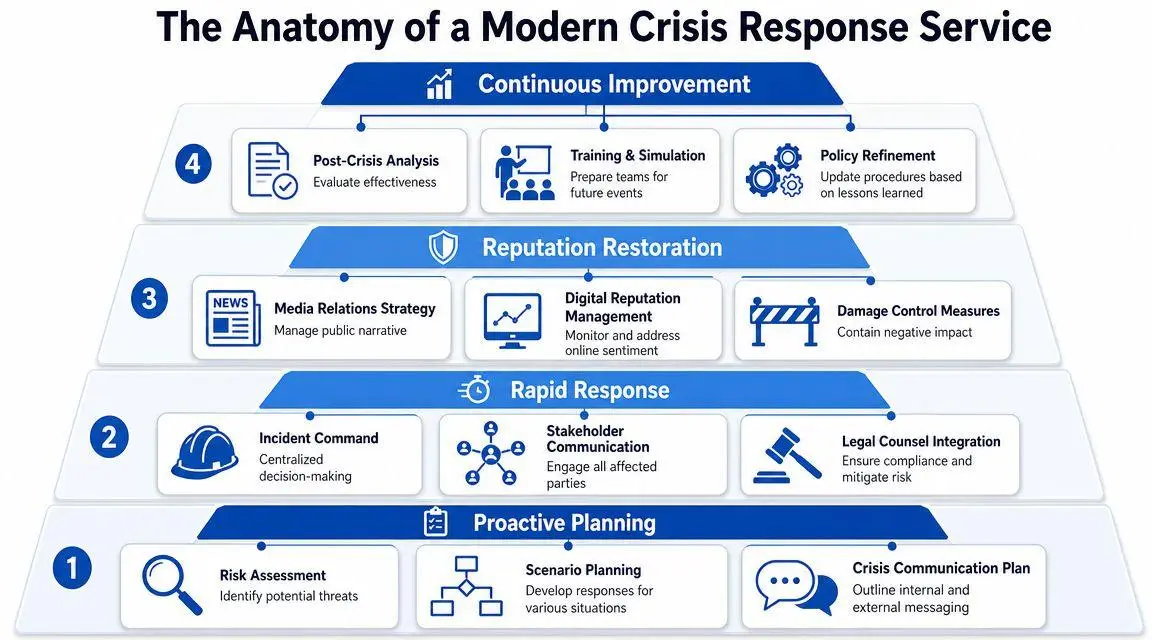
The Anatomy of a Modern Crisis Response Service
A premium crisis management service should look integrated from the outset. If a provider talks only about media outreach, or only about legal notices, you’re not looking at a complete response model. You’re looking at one instrument.
According to the Business Continuity Institute’s 2021 report, 79.7% of organizations have institutionalized their crisis management processes, and 75.1% rate their capabilities as “good” or “excellent,” as reported in the Business Continuity Institute’s 2021 Crisis Management Report. The field has moved beyond simple emergency response. Your provider should have done the same.
What the service is actually doing
At the front end, the service should stabilize the situation. That means identifying the source material, mapping where it has propagated, preserving evidence, and deciding what can be removed, what can be suppressed, and what must be answered directly.
Then come the active levers. In digital reputation matters, those usually include source removal requests, search engine de-indexing where available, impersonation and account abuse reporting, defamation remediation, leaked content takedowns, and monitoring for copies or reposts. These are not separate products. They are parts of one campaign.
A short comparison helps.
| Service component | Strategic purpose | What a weak provider gets wrong |
|---|---|---|
| Legal review | Determines viable claims, platform standing, and exposure | Sends threats without a platform strategy |
| Technical takedowns | Removes or limits access to harmful content | Chases individual URLs without source mapping |
| Search remediation | Reduces discoverability where removal is incomplete | Confuses suppression with removal |
| Monitoring and intelligence | Detects reposts, aliases, and secondary spread | Treats the first takedown as the end |
| Communications control | Keeps stakeholders aligned and prevents contradiction | Publishes statements before facts are verified |
Why coordination matters more than the individual tactic
Clients often ask which single tactic works best. That is the wrong question. The useful question is which sequence reduces harm fastest without creating secondary exposure.
A well-run service coordinates actions so they support each other. Legal review informs takedown wording. Technical analysts document mirrors and reposts before they disappear. Search specialists prioritize the most damaging visibility points. Communications personnel prevent a public response from undermining platform enforcement or litigation posture.
When different teams act from different facts, you don’t have a response. You have collision.
For example, a false review campaign may require platform reporting, reviewer pattern analysis, evidence packaging, and selective legal escalation. A hacked or impersonated account may demand immediate platform intervention, security remediation, audience messaging, and monitoring for resale or duplication. A leaked image case may require removal from source pages, reverse-image monitoring, search result cleanup, and repeat-upload controls.
One provider you may evaluate in this category is ContentRemoval.com, which states that it handles de-indexing, source removal, impersonation takedowns, leaked image and video removal, defamation remediation, dark web monitoring, and ongoing reupload monitoring. That combination is the right shape of service for digital crises because it matches how online harm spreads.
Understanding the Crisis Management Team Structure
In a real crisis, your outcome depends less on titles and more on whether the right people are authorized to act at the same time. A firm that routes everything through one account manager will be slow, cautious, and overloaded. That model is fatal under pressure.
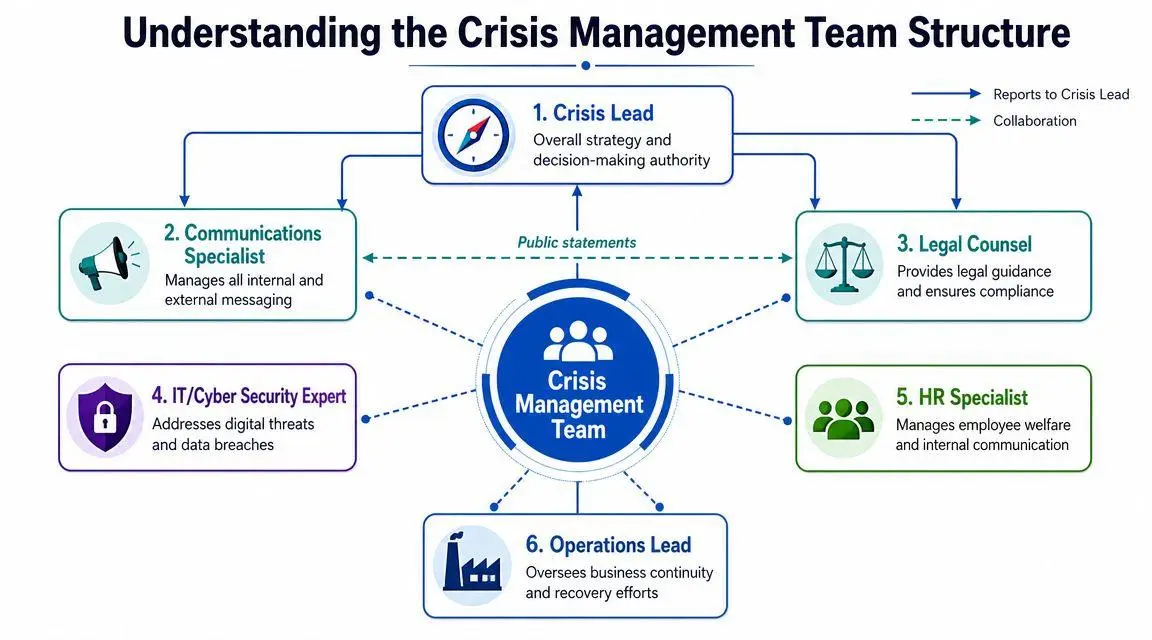
Research-oriented guidance on crisis teams emphasizes distinct roles such as a chief decision-maker, communication leader, and subject-matter experts so fact verification, message approval, and operational containment can happen in parallel under tight timelines. That structure is summarized in Continuity2’s guidance on crisis management software and team design.
The roles that matter under pressure
The crisis lead should own the decision path. Not every task, but the decision path. That person sets priorities, resolves conflicts between legal and communications considerations, and tells you what happens next in plain language.
The communications specialist should control outbound language and inbound consistency. Their job is not to “say something quickly.” Their job is to prevent contradictory statements to staff, media, counterparties, and platforms.
The legal counsel function should assess rights, liability, privilege, and escalation posture. In digital crises, this role is often most valuable when it is tightly integrated with technical enforcement rather than operating as a separate advisory silo.
Then you need the operators. Technical analysts, cyber personnel, platform escalation specialists, and intelligence researchers do the evidence gathering, source tracing, reporting, and monitoring that move a matter from outrage to resolution.
What to ask about staffing
Don’t ask a provider whether they have experts. Every firm says that. Ask how work is split in the first phase of an engagement.
Use questions like these:
- Who has authority: Ask who can approve urgent tactical action without waiting for a committee call.
- Who handles legal-platform overlap: Many matters fail here because legal language and platform standards are not the same thing.
- Who monitors replication: Harmful content rarely stays in one place.
- Who manages client communications: You need one accountable point of contact, not six fragmented updates.
A credible provider can tell you, with no hesitation, who is verifying facts, who is drafting requests, who is handling approvals, and who is watching for the second wave.
A mature team also knows what not to do. It won’t let junior staff freelance outreach. It won’t let PR draft around unresolved facts. It won’t let a legal letter become a substitute for a removal strategy. That discipline is not bureaucracy. It is speed.
Crisis Response Timelines and Expectations
Clients under pressure usually ask one question first. How long will this take? The honest answer is that different parts of the problem move at different speeds. Fast action matters, but false precision is a red flag.
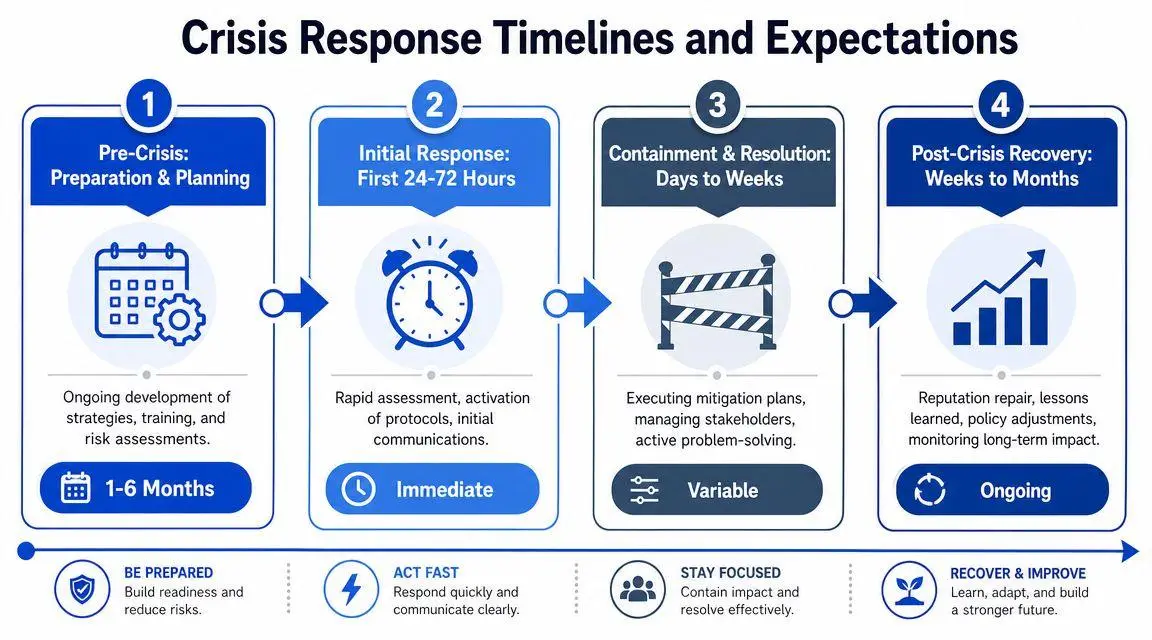
A proper crisis management service should divide the matter into phases. You are not buying a single “fix.” You are buying containment, remediation, and prevention in sequence.
What happens first
The first phase is triage. That is where the team identifies what exists, where it sits, how visible it is, whether the source is still active, and whether there is a legal, technical, or platform route to immediate action. This is also when evidence preservation happens. If a provider skips that step, they are acting on instinct.
The second phase is deployment. The team starts the actual intervention. That may include filing platform reports, issuing takedown notices, contacting hosts or publishers, engaging counsel, preparing search remediation, and locking down internal messaging so nobody worsens the record.
For reputational events tied to cyber incidents, the public-facing issue and the operational issue often unfold together. This strategic guide to handling reputational damage from a data breach is useful because it reflects that dual-track reality.
What takes longer than clients expect
The active remediation campaign can run for days or weeks depending on the content type, the jurisdiction, the platform, and whether republication is already underway. Account impersonation may be stoppable relatively quickly if platform reporting is strong and evidence is clear. A defamatory article on a resistant site may require a very different approach. Search result repair is often slower than source removal because visibility lags behind action.
Here is the practical distinction:
| Phase | What you should expect | What you should not expect |
|---|---|---|
| Immediate triage | Fast issue mapping and action plan | Full resolution before evidence is reviewed |
| Early deployment | Visible action on highest-risk items | Every platform to respond on the same schedule |
| Active remediation | Progressive reduction of exposure | Linear results with no setbacks |
| Ongoing monitoring | Detection of reposts and recurrence | A permanent end to all future resurfacing without monitoring |
The timeline that matters most
The first timeline is the provider’s response time. The second is platform or publisher response time. The third is search and reputational normalization. Clients often focus on the second and ignore the first. That is backwards.
If a provider cannot mobilize decisively at intake, it won’t become more decisive later.
Judge the first hours ruthlessly. Did they ask the right questions? Did they isolate the highest-risk assets? Did they explain what was controllable, what was not, and where discretion mattered? That is the timeline that predicts the rest of the engagement.
How Elite Crisis Management Providers Differ
Most providers sound competent in a proposal. The separation happens in operations.
An average firm is reactive. It waits for you to send links, then submits requests one by one. A mature firm works from a command model. It establishes ownership, defines escalation triggers, organizes incoming facts, and keeps legal, technical, and communications decisions synchronized. That maturity is what reduces error when the pressure is highest.
Guidance on crisis management capability models describes this clearly. High-performing services are measured by capability maturity, moving from ad hoc coordination to advanced, repeatable processes with predefined triggers, simulations, playbook refinement, and central coordination hubs, as outlined in the BCM Institute’s overview of crisis management capability levels.
Three provider models you will encounter
The first model is the PR-led shop. These firms are useful when the issue is primarily narrative management, stakeholder reassurance, or media relations. They are less useful when the core problem is harmful content that should be removed, de-indexed, or prevented from spreading.
The second model is the legal-led shop. These firms are strongest where claims, injunctions, pre-publication issues, and liability posture dominate. They can be indispensable. They can also be slow if they lack platform process knowledge or digital enforcement capability.
The third model is the integrated digital response firm. This is usually the right fit when the crisis lives online and moves across search, social platforms, websites, messaging channels, and repost networks. The best version of this model doesn’t replace legal counsel or PR. It coordinates with them.
What maturity looks like in practice
A mature provider will already have escalation logic. It won’t need a long internal debate to decide whether an impersonation case, leaked content event, coordinated review attack, or false accusation requires one path or another.
Look for signs like these:
- Predefined triggers: They know what facts move a matter from monitoring to active intervention.
- Centralized command: One operating view for incident status, evidence, outreach, and decisions.
- Playbook discipline: They adapt tactics, but they don’t improvise the entire framework.
- After-action thinking: They plan for recurrence, not just initial resolution.
A weaker provider confuses activity with control. It sends more emails, copies more people, and generates more updates. That can reassure an anxious client for a day. It won’t resolve a high-risk digital event.
Elite providers also understand jurisdictional friction. Cross-border matters involve different platform rules, privacy rights, media norms, and legal risks. If a firm talks confidently about “global removal” without asking where the content is hosted, who published it, where the target is located, and what rights apply, you are hearing sales language, not operational judgment.
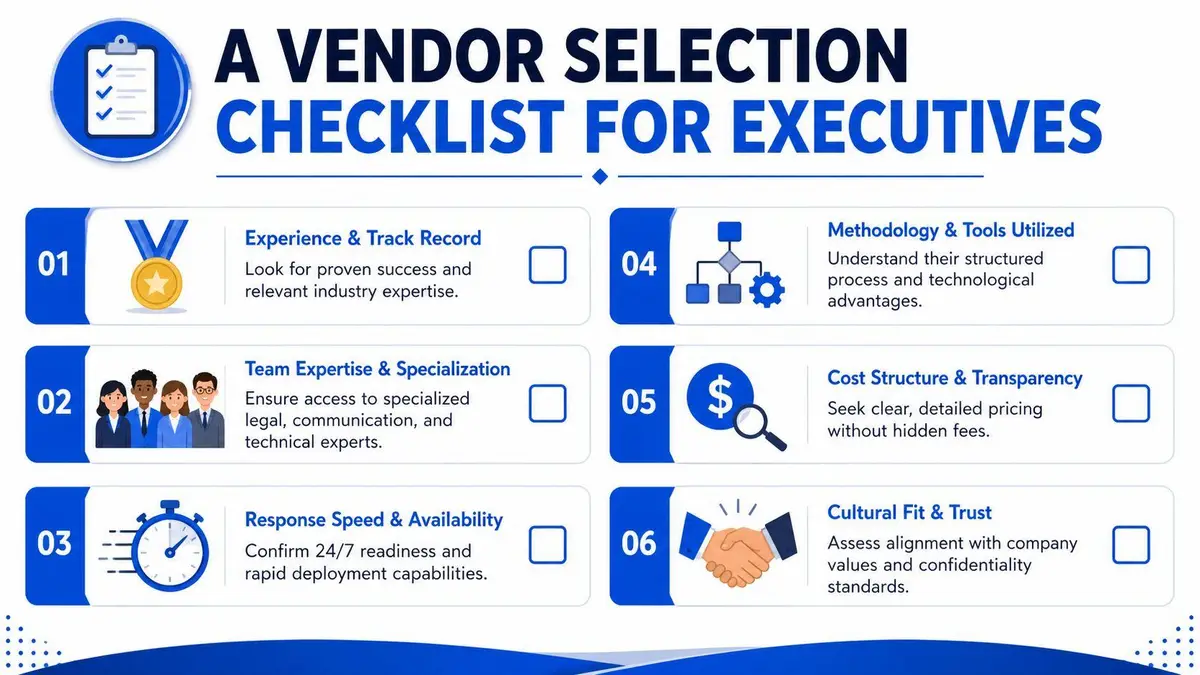
A Vendor Selection Checklist for Executives
When the pressure is acute, executives become vulnerable to the wrong sales pitch. “We move fast.” “We have relationships.” “We’ve seen this before.” None of that is enough. Your diligence should focus on how the provider behaves once the matter becomes messy, contested, and repetitive.
A useful principle comes from crisis care research. The overlooked issue is continuity and aftercare. In digital terms, a central question is what happens after the initial takedown attempt. What prevents relapse, resurfacing, or re-upload? That continuity problem is discussed in the National Library of Medicine article on crisis care and aftercare.
The questions that cut through marketing
Ask the provider what happens in the first intake window. Who receives the material, who classifies it, and who decides whether to preserve, report, escalate, or hold. If the answer is vague, they don’t have a real intake protocol.
Ask how they handle confidentiality. Not with broad promises, but operationally. Where does evidence sit, who can access it, how are client identities masked when appropriate, and how do they coordinate with outside counsel under sensitive conditions.
Ask about recurrence. Harmful content often returns in slightly altered form, through mirrors, cropped assets, new usernames, or secondary sites. If the provider has no clear monitoring and repeat-response system, they are offering a first pass, not a crisis management service.
A practical executive checklist
- Operational ownership: Who is the crisis lead, and what authority do they hold?
- Integrated capability: Can the firm combine legal reasoning, technical enforcement, and communications discipline without handoffs breaking down?
- Channel coverage: Which platforms, publishers, search environments, and secondary surfaces can they work across?
- Evidence handling: How do they preserve records before pursuing removal?
- Aftercare process: What monitors for reposts, impersonation relaunches, or content resurfacing?
- Client reporting: Will you get concise decision-grade updates, or a stream of low-value activity logs?
For a broader comparison framework, this guide to reputation management companies for executives and high-net-worth individuals is useful as a screening tool.
Don’t hire on confidence. Hire on process clarity.
The answer you’re listening for
The right provider sounds calm, specific, and unsentimental. They won’t promise universal removal. They won’t tell you every platform behaves rationally. They will tell you what can be actioned now, what requires evidence development, what may need legal escalation, and what demands ongoing suppression or monitoring.
That is what competence sounds like in this market.
Conclusion The Path to Resolution
A digital crisis feels chaotic because you are seeing the external symptoms all at once. Search visibility, leaked content, account abuse, hostile commentary, internal panic, legal uncertainty, media interest. The mistake is to treat those as separate fires. They are usually one event with several surfaces.
The path to resolution is disciplined coordination. You need a service that can classify the threat correctly, preserve evidence, assign the right specialists, control communications, and continue working after the first burst of activity is over. That is the difference between temporary relief and actual risk reduction.
The decision criteria are straightforward. Choose a provider that can operate under confidentiality, move quickly without becoming reckless, and explain its team structure and response logic in plain English. Choose one that treats recurrence as part of the job, not an unfortunate surprise. Choose one that understands that a digital crisis is part legal matter, part technical enforcement problem, part intelligence exercise, and part executive decision problem.
If you’re in the middle of one now, don’t waste another cycle trying to solve it with fragmented vendors and improvised internal debate. Get the matter into a controlled process. Establish the facts. Stop the spread where you can. Reduce visibility where you can’t. Protect the principal. Then build the aftercare needed to keep the issue from returning.
That is how serious reputation crises are resolved. Not with a single statement. Not with one lawyer’s letter. With a managed campaign.
If you need a confidential assessment, ContentRemoval.com handles digital crisis matters involving harmful online content, impersonation, leaks, search visibility, and ongoing monitoring. The right next step is a private review of the facts, the current exposure points, and the available legal, technical, and platform options so you can act with precision rather than urgency alone.
Frequently asked questions
What is the difference between a crisis management service and a PR firm?
A PR-led shop handles narrative, stakeholder reassurance and media relations. A crisis management service for digital events adds legal review, technical takedowns, search remediation and monitoring so harmful content is removed or made less visible, not just messaged around.
How long does a crisis management engagement take?
Different parts move at different speeds. Triage and an action plan come first, visible action on the highest-risk items follows, then active remediation runs days or weeks depending on content type, platform and jurisdiction, with monitoring continuing afterward.
What should I ask a crisis management provider before hiring them?
Ask what happens in the first intake window, who classifies and preserves material, how confidentiality is handled operationally, how they coordinate with outside counsel, and what monitors for reposts and resurfacing after the first takedown.