
Credential stuffing protection is a layered defense against automated replay of stolen username and password pairs: breached-password screening at login, phishing-resistant MFA on sensitive accounts, bot detection with rate limiting, external monitoring for exposed credentials, an executive incident playbook, and post-incident removal of leaked data and breach references that stay searchable long after containment.
Key facts
- Attack success rates run about 0.1% to 2%, so attackers rely on volume, not on cracking passwords.
- CAPTCHA and password complexity alone do not stop replay of credentials already stolen elsewhere.
- First hour: one incident lead, forced resets, session invalidation, MFA re-enrollment, locked recovery paths, evidence preserved.
- Passwordless authentication and passkeys remove the stolen-password reuse vector for those login flows.
Where ContentRemoval.com comes in. Once the security team has contained the intrusion, ContentRemoval.com handles the part that keeps the incident alive: leaked credentials, exposed personal data, impersonation pages and breach references still discoverable through search, removed at source and de-indexed, with monitoring for reposts. Incident counsel, a CISO or a family office typically make contact. A free 15-minute Exposure Scan maps what remains findable, and the report is yours to keep. Get a Free, Confidential Exposure Scan or read how our content removal work is done.
At 6:10 a.m., your phone lights up with alerts from Microsoft 365, Google Workspace, your bank, and a retail account you barely remember creating. None of the passwords were weak. None of this feels random. Your team sees a spike in failed logins, then a few successful ones, then mailbox rules changing, recovery emails rewritten, and messages sent from accounts that now look legitimate to staff, customers, and journalists.
That is credential stuffing in practice. It starts as an authentication event and turns into an executive crisis. The immediate risk is account takeover. The secondary risk is worse: fraud, impersonation, internal disruption, customer distrust, leaked personal data, and searchable evidence of the incident that remains online long after the technical team says containment is complete.
If you’re responsible for a company, a family office, or a public profile, treat credential stuffing protection as a board-level control. The attackers already have the usernames and passwords from breaches elsewhere. Their advantage isn’t brilliance. It’s scale, speed, and persistence.
Credential Stuffing Is Not a Technical Problem It Is a Business Crisis
The first mistake leaders make is classifying credential stuffing as an IT nuisance. It isn’t. It’s a direct threat to operational continuity, personal security, and reputation.
A typical pattern looks like this. Attackers replay stolen username and password pairs against your login pages. One employee reused a password on a consumer service that was breached years ago. An assistant used the same password structure across several platforms. A senior executive’s personal email was linked to business recovery workflows. Within hours, the attacker has enough access to redirect invoices, scrape correspondence, trigger password resets, or impersonate a trusted voice.
The volume alone should end any debate about seriousness. A large content-delivery network reported more than 193 billion credential-stuffing attacks in a single year, and New York State cited research showing more than 15 billion stolen credentials circulating online in its guidance on the threat, as summarized in the New York State business guide on credential stuffing attacks. That isn’t background noise. It’s industrialized abuse.
What executives get wrong
Many leaders still assume this is a password problem. It isn’t. OWASP defines credential stuffing as the automated injection of stolen credentials into login forms to gain unauthorized access, which means the attacker isn’t trying to crack your password policy. The attacker is replaying credentials that already worked somewhere else. That distinction matters because it changes the defense model completely.
Practical rule: If an account still depends on a reusable password, assume it will be tested by automation.
The business impact moves fast because access creates credibility. A compromised inbox can authorize transfers, approve documents, and reassure colleagues that a malicious request is genuine. A compromised social or public-facing account can trigger reputational fallout before security teams finish log review. A compromised personal account belonging to a founder or principal can expose travel plans, family details, and financial signals that become a means for extortion, stalking, or targeted fraud.
Why this becomes a reputation matter
The market rarely cares whether the intrusion began with reused credentials or malware. Stakeholders care that an executive account sent suspicious messages, that private information surfaced online, or that customers received fake outreach from what appeared to be a legitimate source.
Use a simple lens:
| Threat event | Immediate security issue | Business consequence |
|---|---|---|
| Executive email access | Unauthorized mailbox control | Fraud, privilege abuse, leaked correspondence |
| Consumer account takeover tied to a public figure | Recovery chain exposure | Impersonation, media pickup, harassment |
| Staff login replay across multiple systems | Lateral access opportunities | Operational disruption and customer notifications |
This is why credential stuffing protection belongs with crisis preparedness. Security contains the intrusion. Legal preserves options. Communications controls narrative. Reputation specialists remove what should never remain public.
Fortifying Your Digital Perimeter Against Automated Attacks
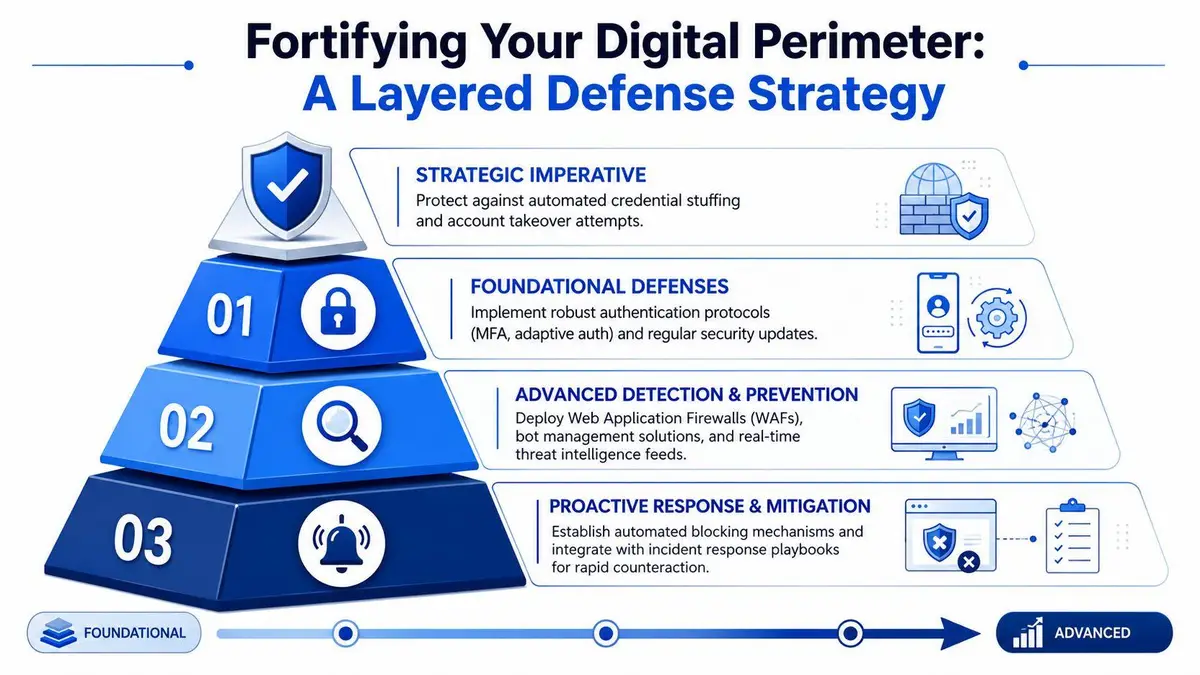
Most organizations still deploy controls as if they’re facing human trial-and-error. They’re not. They’re facing automation designed to test stolen credentials at scale. Your perimeter has to force the attacker into failure quickly and repeatedly.
Start with the controls that actually matter
Independent guidance notes that credential stuffing success rates are typically only about 0.1% to 2%, which means attackers depend on volume, not elegance. That same guidance recommends a layered stack of breached-password screening, MFA on risky logins, and rate limiting to stop high-volume automation, while warning that CAPTCHA or password complexity alone is not enough. See the Wiz guidance on credential stuffing detection and response.
That gives you the right operational priority order.
- Screen for breached passwords at login. If a credential is already known to be compromised, don’t let it into the environment. This is the cheapest place to stop bad access.
- Enforce MFA where compromise hurts most. Privileged users, executive accounts, finance staff, administrators, and anyone with broad mailbox or document access shouldn’t get a choice.
- Use bot detection and rate limiting together. One control identifies automation. The other slows or blocks it before scale produces account takeover.
What each layer is really doing
Breached-password screening cuts off recycled credentials before they become valid sessions. That’s basic hygiene, but it isn’t enough on its own because fresh breach data often appears before your users admit reuse.
MFA changes the economics of the attack. It doesn’t remove all risk, but it forces the attacker past a second gate. For high-risk users, choose phishing-resistant methods over weak fallback options.
Bot detection matters because credential stuffing protection is really automation control. A modern login request can look superficially normal. The distinction emerges in pattern, repetition, and orchestration across many accounts.
The minimum viable control stack
If you’re deciding where to spend money this quarter, use this order:
- First, harden privileged and sensitive accounts: Put executives, administrators, finance, legal, and IT under strict MFA and review recovery workflows tied to those identities.
- Next, deploy breached-password screening: This directly addresses stolen credential reuse, which is the attack’s core mechanism.
- Then, configure rate limits around behavior: One security guide gives a practical threshold example of triggering MFA when a bot attempts roughly 1,000 logins per hour from the same IP, while other guidance recommends throttling users who attempt logins across multiple accounts in rapid succession. Use those principles to design controls around abuse patterns, not convenience.
- Finally, add bot mitigation that understands sessions: A web application firewall helps, but generic WAF settings without behavioral bot management won’t solve the problem.
CAPTCHA is a speed bump, not a strategy. Attackers bypass it with proxies, solving services, and headless browser tooling.
What to stop doing
A lot of defenses fail because they’re built for appearance. Strong password rules alone won’t stop credential reuse from other breaches. Account lockout rules can punish legitimate users if they trigger too early. CAPTCHA creates executive comfort because it’s visible, but visible doesn’t mean effective.
Use this comparison when reviewing your current stack:
| Control | Keep | Why |
|---|---|---|
| Password complexity rules | Yes, but don’t rely on them | They don’t stop replay of already-stolen credentials |
| CAPTCHA | Limited role only | It can be bypassed and shouldn’t stand alone |
| Static IP throttling | Improve it | Attackers distribute attempts across infrastructure |
| Risk-based MFA | Non-negotiable | It interrupts successful replay on sensitive logins |
| Bot management | Non-negotiable | It addresses the automation layer directly |
A blunt recommendation
If your login is public-facing and your main plan is passwords plus CAPTCHA, you are exposed. If your executives can still log into critical systems with a password and SMS fallback alone, you are exposed. If you haven’t tested what happens when thousands of attempts hit the login surface in a short period, you are guessing.
Credential stuffing protection requires a stack. Not a widget. Not a policy memo. A working stack.
Early Warning Systems for Credential Compromise
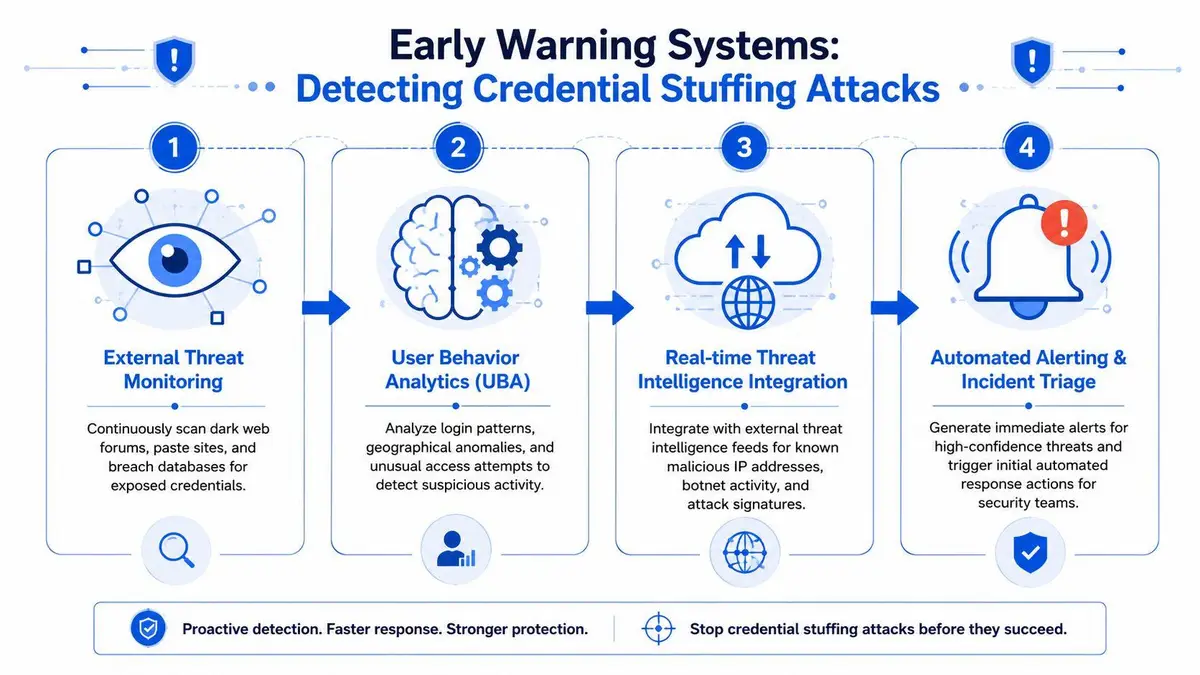
Organizations often discover credential stuffing too late. They watch failed logins, then investigate after an account is already in use by someone who shouldn’t have it. That is lagging detection. It tells you the attack touched your environment. It doesn’t tell you when your credentials entered the attacker’s supply chain.
What internal logs can and can’t tell you
Your SIEM, identity platform, and access logs are essential. They show velocity anomalies, unusual geographies, repeated failures, impossible account behavior, and post-login changes that don’t fit the user. But those are signs that something is happening now, or already happened.
Leading indicators sit outside your network. They include newly exposed credentials tied to corporate domains, executive emails appearing in breach compilations, mentions of internal systems on criminal forums, and packaged credential lists that combine personal and business identifiers. Those signals give you room to act before the attacker gets a clean run at your login infrastructure.
A sensible approach combines both views:
| Signal type | What it tells you | Why it matters |
|---|---|---|
| Failed logins across many accounts | Attack traffic is hitting your environment | Useful, but reactive |
| Unusual login geography or behavior | An account may already be under pressure | Strong operational alert |
| Credentials appearing in external monitoring | Your identities may be entering attacker tooling | Earliest actionable warning |
| Mentions of executives or domains in criminal channels | You may face targeted follow-on abuse | Critical for high-profile individuals |
Where proactive monitoring earns its keep
For executives, founders, and family offices, external monitoring isn’t optional. Their identities bleed across personal and corporate systems. One exposed personal mailbox can affect travel accounts, legal document platforms, investor communications, and social profiles.
Professional monitoring should look for:
- Corporate domain exposure: Staff credentials tied to your company appearing in breach repositories or circulation lists.
- Executive identity exposure: Personal email addresses, aliases, and known usernames associated with principals or public figures.
- Impersonation risk: Fake accounts, cloned domains, or references that indicate someone plans to exploit the access for fraud or public deception.
For organizations under pressure, professional online monitoring and peace-of-mind services close the gap between raw technical alerts and actionable executive protection.
Here is a useful explainer on the mechanics of early detection and response:
What good alerting looks like
A flood of warnings is useless. Executives need triage, not noise. A strong early warning system separates probable bot pressure from meaningful identity exposure and escalates only when a decision is required.
Watch for evidence that your credentials exist outside your control, not just evidence that someone is typing them into a login form.
That means your team should receive alerts that answer four questions quickly. Which identities are affected. Which systems those identities can reach. Whether the credentials are current enough to be dangerous. Whether the exposure is likely to lead to fraud, impersonation, or public harm.
The transition from reactive defense to proactive intelligence is where mature credential stuffing protection starts to look like risk management rather than dashboard watching.
The Executive Playbook for Incident Response
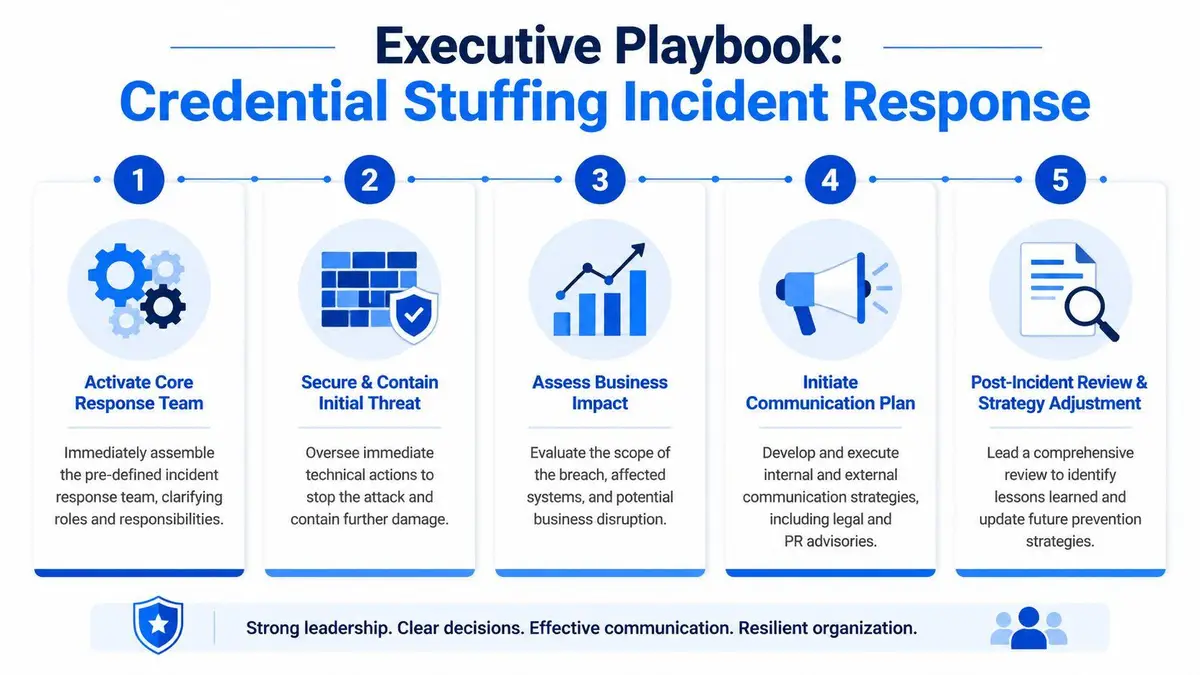
When the attack is live, indecision is the main accelerant. Your job isn’t to debug the stack. Your job is to impose order, preserve evidence, and stop the incident from widening into regulatory, legal, and reputational damage.
The first hour
Start with command discipline. One executive sponsor. One incident lead. One legal point of contact. One communications owner. If everyone speaks, no one controls the event.
Then order immediate containment. Force password resets where exposure is credible. Invalidate active sessions for affected users. Require MFA re-enrollment for sensitive roles. Lock recovery options that could let attackers regain access after initial eviction. If executive accounts are implicated, restrict them first and explain later.
Use a concise leadership checklist:
- Freeze unauthorized access paths: Terminate suspicious sessions, disable risky recovery channels, and suspend accounts where confidence is high.
- Protect the most damaging identities first: Prioritize executives, finance, legal, administrators, and anyone whose access can approve payments or issue trusted communications.
- Preserve evidence: Keep authentication logs, mailbox rule changes, login histories, device records, and communication artifacts intact for counsel and forensics.
The next decisions that matter
Don’t rush into broad public statements before you know which identities were used. But don’t wait so long that rumor outruns fact. Internal communication should go out early with simple instructions: don’t click old login prompts, expect forced resets, report suspicious messages, and route all media or customer questions to a single channel.
Legal should be involved immediately when privileged communications, executive accounts, regulated data, or likely customer impact are in play. That preserves optionality. It also disciplines documentation.
A useful decision matrix looks like this:
| Decision | Trigger | Leadership action |
|---|---|---|
| Engage forensic specialists | Evidence of successful login or post-login changes | Approve full timeline and artifact collection |
| Notify legal and privacy counsel | Sensitive data or regulated accounts affected | Preserve privilege and assess obligations |
| Activate external communications | Customer-facing systems or public accounts implicated | Control messaging before impersonation spreads |
| Escalate to law enforcement liaison | Financial fraud, extortion, or persistent targeting | Prepare evidence package through counsel |
Communication under pressure
Most damage after a credential stuffing incident comes from sloppy messaging. Staff receive mixed instructions. Customers hear different explanations. Journalists find screenshots before you have a timeline. Control that immediately.
Keep communications factual, narrow, and centralized. Don’t speculate. Don’t minimize. Don’t improvise.
Tell affected stakeholders what you know, what you’re doing, and what they need to do now. Avoid technical jargon. If public-facing accounts were abused, state that the organization is investigating unauthorized access and that official communications will come only through verified channels.
The final leadership task is review. Not a ceremonial postmortem. A hard assessment of why a password remained reusable, why the account lacked stronger controls, why detection arrived when it did, and whether the response process worked under pressure.
Neutralizing Leaked Credentials and Pursuing Takedowns
Containment is not the end of the problem. If the stolen or exposed credentials remain online, the attack can restart with a different botnet, a different actor, or a different target list. Security teams often stop at password resets and control updates. That leaves the ammunition in circulation.

Why technical containment isn’t enough
Leaked credentials have a long afterlife. They move from breach repositories to paste sites, indexing pages, forums, reseller channels, and searchable references that connect names, companies, and email patterns. Even when the underlying password has changed, the presence of the data can still fuel impersonation, doxxing, harassment, and targeted follow-on attacks.
That is why post-incident work must include source identification and removal strategy. If your executives, staff, or clients are named in exposed datasets that remain easy to find, you’re not finished. You’ve only reduced immediate access risk.
Many organizations need a broader incident model. Technical response addresses the account. Content and legal response addresses the exposure. For a plain-language overview of how incident processes are typically structured across teams, TekRecruiter’s guide on incident response is a useful operational reference.
What removal work actually involves
Removal isn’t a single notice. It is a sequence.
First, identify where the exposed data lives. That may include public web pages, cached search results, forum posts, copied directories, breach mirrors, and profile pages that associate the victim with the exposure. Second, classify the content. Is it credentials, personal information, impersonation material, or a combination. Third, choose the route: direct platform notice, legal escalation, search de-indexing, host-level complaint, or jurisdiction-specific privacy argument.
A disciplined removal program usually includes:
- Source mapping: Identify original publication points, mirrors, reposts, and indexed traces that keep resurfacing the material.
- Priority ranking: Focus first on pages that combine identity, searchable names, and exploitable credentials or personal data.
- Parallel action: Pursue source removal and search de-indexing together so the exposure loses visibility even when the host is slow.
- Reappearance monitoring: Watch for reposts, clones, and derivative abuse after the first wave of removals.
Search visibility is part of the threat
Executives often focus on the criminal forum and overlook search engines. That is a mistake. If exposed information, impersonation pages, or breach references are discoverable through ordinary search, the incident becomes reputationally sticky. Counterparties, journalists, litigants, and bad actors can all locate fragments that should have been buried or removed.
For individuals dealing with the aftermath of a breach, a strategic guide to removing personal information from Google after a data breach is the right frame. It treats search visibility as a remediation issue, not a public relations inconvenience.
The objective is simple. Remove the source where possible, suppress discoverability where necessary, and monitor for reappearance until the material stops circulating.
Legal escalation when voluntary removal fails
Some hosts cooperate. Some won’t. Some are designed to evade accountability. That’s when legal escalation matters. The right route depends on the material, the jurisdiction, the platform, and whether the content includes credentials, personal data, impersonation, or other harmful elements that violate terms or law.
This isn’t about threatening everyone with litigation. It’s about using the right procedural pressure at the right point. Preservation notices, privacy claims, intellectual property arguments, impersonation complaints, and platform-specific abuse channels each have a place. Used correctly, they shorten exposure. Used badly, they alert hostile actors and create more copies.
The strategic point is blunt. Credential stuffing protection doesn’t end at the login page. Real protection continues until the exposed material is removed, de-indexed, or rendered too difficult to weaponize.
Establishing Long-Term Credential Security Governance
Short-term fixes calm the room. Governance prevents recurrence. If you don’t convert the incident into a standing discipline, your organization will drift back to the same weak recovery paths, inconsistent account controls, and fragmented ownership that made the attack viable.
What leadership should measure
Don’t chase vanity metrics. Measure what indicates reduced exposure and faster control.
Use governance questions instead of decorative dashboards. Which privileged accounts still rely on passwords in critical workflows. Which business units allow weak recovery methods. How quickly newly exposed credentials tied to your domain are identified and actioned. Whether public-facing accounts have a defined owner, stronger authentication, and an incident contact path that works after hours.
A vendor review should be equally direct:
- Authentication providers: Can they enforce phishing-resistant methods for your highest-risk users and workflows.
- Monitoring partners: Can they surface relevant identity exposure early, not just send generic breach alerts.
- Remediation specialists: Can they handle takedowns, de-indexing, and privacy escalation across jurisdictions with discretion.
- Incident counsel and forensics: Can they operate together without turning every response into confusion and duplicated work.
Remove the root cause where you can
The strongest long-term move is reducing the role of passwords altogether. Recent vendor guidance increasingly frames passwordless authentication and phishing-resistant MFA as the strongest way to eliminate the stolen-password reuse vector. Cyberhaven states that passwordless authentication eliminates credential stuffing entirely for those login flows, and it notes Google’s published finding that passkeys let users sign in 40% faster than with passwords, as discussed in Cyberhaven’s analysis of credential stuffing and passwordless defenses.
That should settle the investment debate for sensitive access paths. Keep bot defenses. Keep runtime controls. But migrate high-risk users and admin workflows to passkeys or hardware-backed methods as fast as your environment allows.
Governance for individuals, not just enterprises
Executives and family offices need a personal governance layer too. Corporate controls won’t protect a principal whose personal accounts expose the recovery chain. That means regular review of personal email security, financial account authentication, public exposure, and data-broker footprint.
Reducing searchable personal data lowers the quality of attacker targeting and impersonation. For that reason, an executive privacy guide to removing yourself from data broker lists belongs in the same conversation as credential security.
The right end state is clear. Fewer passwords. Stronger authentication on sensitive systems. Continuous monitoring for identity exposure. A response process that includes legal and reputational remediation, not just technical cleanup. That is what mature credential stuffing protection looks like.
Credential stuffing rarely stays confined to security logs. It spills into search results, inboxes, public narratives, and legal risk. If you need discreet help containing identity exposure, removing harmful content, de-indexing breach-related material, and protecting executive reputation after an account compromise, ContentRemoval.com provides confidential assessments and rapid action plans for high-risk individuals and organizations.
Frequently asked questions
Why is credential stuffing a reputation problem and not just an IT problem?
Because access creates credibility. A compromised executive inbox can authorize transfers and send convincing messages, a hijacked public account can trigger media pickup, and leaked personal data can fuel extortion or stalking. Stakeholders remember the fallout, not the technical cause.
What should executives do first when accounts are being taken over?
Impose command discipline with one sponsor, one incident lead, one legal contact and one communications owner. Then force resets, invalidate sessions, require MFA re-enrollment for sensitive roles, lock recovery options and preserve logs and mailbox rule changes for counsel.
Is resetting passwords enough after a credential stuffing attack?
No. Leaked credentials move to paste sites, forums and searchable pages that still connect names, companies and email patterns. Post-incident work should map where the data lives, pursue source removal and search de-indexing together, and watch for reposts.