
A corporate reputation management firm operates where law, technology and digital enforcement meet. Unlike a PR agency that shapes what a company says, it alters exposure: removing harmful content at source, petitioning search engines to de-index, suppressing only when removal fails, taking down impersonation accounts, challenging abusive reviews and monitoring for re-uploads after the acute phase ends.
Key facts
- Seven capabilities: source removal, de-indexing, suppression, impersonation response, review intervention, crisis coordination, monitoring.
- Fast wins usually involve clear policy violations: impersonation, some leaked media, copyright misuse, abusive content.
- AI-generated search summaries can spread damaging content in hours and need de-indexing and source takedown protocols.
- Ask a firm what share of its work is source removal versus suppression and how it preserves evidence first.
Where ContentRemoval.com comes in. ContentRemoval.com is that kind of firm: a compact team handling source removal, de-indexing, impersonation takedowns, leak response and monitoring for companies and the executives named alongside them. The first call usually comes from general counsel, a communications lead or the CEO’s chief of staff. A free 15-minute Exposure Scan produces the threat map and priority sequence, and the report is yours to keep. Get a Free, Confidential Exposure Scan or read how our reputation management work is done.
At some point, most serious reputation crises look deceptively small. A board member forwards a link. General counsel flags a post. An assistant notices a search result that wasn’t there yesterday. Then the issue expands. A false allegation starts ranking for the company name. An old legal filing resurfaces without context. A leaked internal document gets mirrored on secondary sites. A fake executive profile begins contacting customers or investors.
That’s the moment clients usually reach out. Not when perception is abstract, but when damage becomes operational. Sales teams start fielding questions. Investors begin quiet diligence. Prospective hires look you up and hesitate. Someone on the board asks the worst question in the room: why is this still online?
If that’s where you are, you don’t need reassurance. You need a precise response, and you need to understand one thing early. A corporate reputation management firm is not automatically a PR agency with nicer language. The right firm functions more like a cross between crisis counsel, digital investigations, and technical enforcement. That distinction decides whether the problem gets managed or reduced.
When Your Reputation Is Under Attack
The first hours matter because most executives make the same initial mistake. They treat a digital threat like a communications issue when it’s a visibility and persistence issue.
A CEO sees a defamatory article indexed under branded search. The instinct is to draft a statement. A family office finds leaked material spreading across forums. The instinct is to keep it quiet and hope it burns out. A public company executive discovers impersonation accounts posting false updates. The instinct is to report the profile and wait.
Waiting is usually what entrenches the problem.

What a live attack feels like
It rarely arrives as one clean event. It arrives as overlap.
A negative article gets picked up by search. Review platforms start reflecting the narrative. Social commentary gives the issue a second life. AI-generated summaries begin surfacing the worst version of the story to people who never would have clicked the original source.
That last point changes the risk profile. The issue is no longer confined to one URL or one platform. It becomes a distributed reputation event.
Practical rule: If harmful content is searchable, screen-captured, or being repeated by third parties, you are no longer dealing with optics. You are dealing with infrastructure.
Why generic PR advice fails under pressure
Traditional PR can help with stakeholder messaging. It can’t usually remove a leak, de-index a defamatory page, stop a reupload cycle, or unwind impersonation across multiple platforms. Those are separate functions requiring legal analysis, platform-specific procedures, technical tracking, and evidence discipline.
This is why high-stakes clients often feel frustrated after the first round of outreach. They’ve spent critical time refining a public narrative while the underlying asset remains accessible, indexable, and quotable.
A serious reputation response starts with triage:
- Identify the source problem: Is the threat a published article, leaked media, fake review cluster, impersonation account, scraped data set, or copied forum post?
- Map the spread: Which platforms, search results, and secondary domains are carrying it?
- Decide the objective: Source removal, de-indexing, suppression, account takedown, legal escalation, or controlled response.
Once you frame it that way, the path becomes clearer. You’re not trying to “improve perception” in the abstract. You’re trying to reduce availability, prominence, and repetition.
The Modern Corporate Reputation Management Firm Defined
Many people still assume reputation management means press releases, media calls, and a cleaner brand narrative. That’s outdated.
A modern corporate reputation management firm operates where law, technology, and digital enforcement meet. The market is expanding because the need is real. The global Corporate Reputation Management Services market is projected to reach approximately $15 billion by 2033, growing at a 6.5% CAGR, with online reputation management as the largest segment, according to Strategic Revenue Insights on the corporate reputation management services market.
PR shapes perception. Specialist firms alter exposure.
That distinction is the whole game.
A PR agency asks, “What should we say?”
A specialized reputation firm asks, “What can we remove, reduce, de-index, or contain?”
Those aren’t competing questions. But in a live digital crisis, the second one usually matters first.
Here’s the practical difference:
| Function | Traditional PR firm | Specialized reputation firm |
|---|---|---|
| Media messaging | Strong | Secondary to enforcement |
| Journalist relations | Core capability | Situational |
| Source content removal | Limited | Core capability |
| Search de-indexing strategy | Usually limited | Core capability |
| Platform takedown workflows | Inconsistent | Core capability |
| Evidence preservation | Often partial | Essential |
| Multi-jurisdiction issue handling | Rare | Often necessary |
The work is technical, not cosmetic
A proper firm doesn’t just “push down” bad results and call it strategy. It analyzes whether the content can be attacked at the source, whether search engines can be petitioned to reduce visibility, whether the platform’s policy framework creates a takedown route, and whether repeated uploads require ongoing detection.
That’s why the best operators in this category don’t look like ad agencies. They look like compact special situations teams.
They typically combine:
- Legal process: Defamation review, intellectual property claims, privacy rights, impersonation complaints, and platform policy escalation.
- Technical process: Search tracking, content fingerprinting, discovery across mirrors and reposts, and structured monitoring.
- Strategic process: Sequencing actions so one move doesn’t make the issue more visible.
A reputation problem isn’t solved when you’ve answered it. It’s solved when the damaging asset stops controlling discovery.
That’s also why industry-specific context matters. A law firm, for example, faces a very different threat profile than a consumer brand. If you need a narrower example of how reputation strategy applies in legal services, Gorilla’s guide to reputation management for attorneys is a useful reference point.
What clients should demand from the definition itself
If a vendor defines reputation management only as media coverage, content creation, and review response, they’re describing partial protection.
A corporate reputation management firm should be able to discuss, in plain language, all of the following without hand-waving:
- removal at source
- de-indexing pathways
- suppression only when removal isn’t viable
- monitoring after resolution
- confidentiality protocol
- platform and jurisdiction differences
If they can’t, they’re probably selling image management, not digital threat resolution.
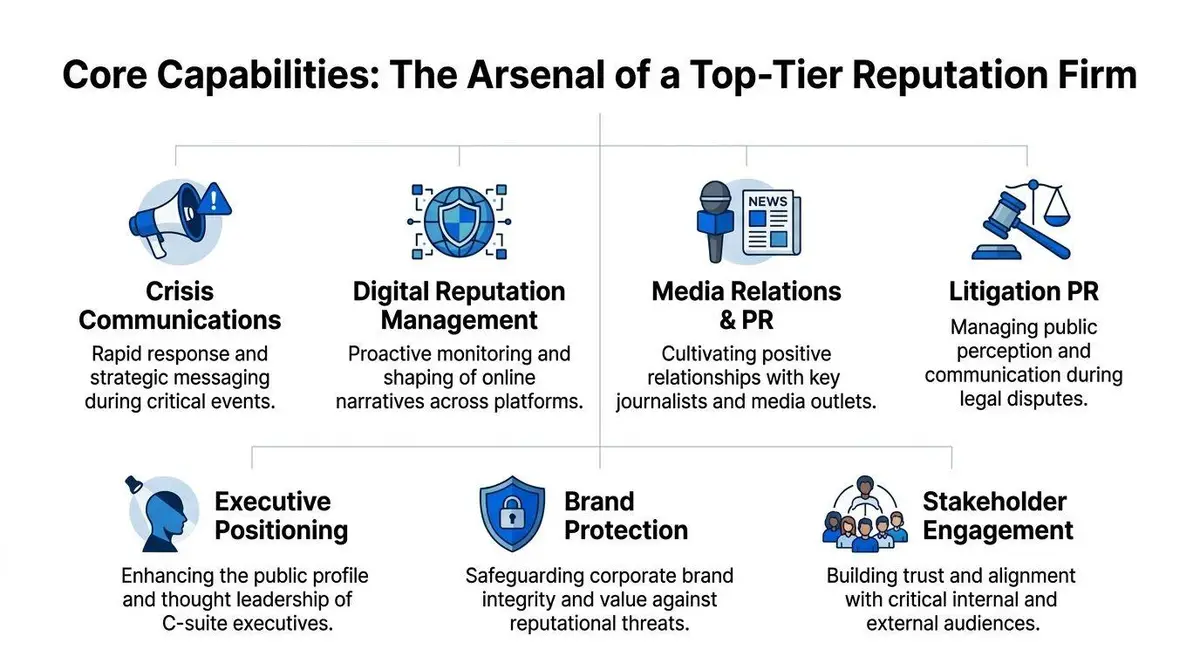
Core Capabilities The Arsenal of a Top-Tier Firm
Reputation defense works like surgical medicine. The first step is diagnosis. The second is choosing the right instrument. Too many firms reach for one tool and call it a strategy.
That’s backward.
The practical arsenal includes content removal, de-indexing, suppression, impersonation response, review intervention, crisis coordination, and monitoring. Each solves a different problem. Use the wrong one and you either waste time or make the issue harder to contain.
Source removal
This is the cleanest outcome. If harmful material can be removed from the original publisher, host, forum, or platform, you eliminate the primary node of exposure.
This applies when content violates policy, infringes rights, discloses private material, impersonates an executive, republishes copyrighted assets, or crosses legal lines. It also applies to some false review situations and some leaked media events.
Clients often underestimate the value of source removal because they focus on Google. That’s shortsighted. If the source remains live, it can be reindexed, reshared, screen-captured, or cited indefinitely.
De-indexing
De-indexing is different from removal. The content may still exist on the site, but it becomes materially less visible in search.
The simplest analogy is a library catalog. The book may still sit in a back room, but if it no longer appears in the index, far fewer people will find it.
That matters because search visibility drives commercial harm. According to Electro IQ’s reputation management statistics, 90% of consumers read online reviews before visiting a business, 86% will hesitate to purchase from a business that has negative online reviews, and it takes approximately 40 positive customer experiences to undo the damage of a single negative review.
Those figures explain why clients shouldn’t rely on “let’s just out-message it.” In many cases, reducing discoverability is more valuable than arguing with the content.
Suppression
Suppression is the option clients hear about most, and understand least.
It means promoting stronger, accurate, controlled assets so they occupy the search territory that negative results currently hold. This can be useful when a harmful page can’t be removed and won’t de-index quickly.
It’s not fake. It’s not spin. Done correctly, it’s an evidence-based effort to ensure the public record isn’t dominated by the worst or least accurate material available.
For teams thinking beyond defense and into controlled visibility, broader digital work around increasing brand awareness can complement suppression campaigns, but it doesn’t replace enforcement.
Impersonation and account abuse response
This sits in a category of its own because speed outranks elegance.
A fake executive account can move markets internally before legal issues are even analyzed. A cloned brand profile can redirect customers, harvest trust, or provoke media attention. The response has to be immediate, documented, and synchronized across the platform, search layer, and internal stakeholders.
Typical actions include:
- Identity verification packages: Proof bundles prepared for platform escalation.
- Account mapping: Identifying connected handles, duplicated bios, mirrored avatars, and linked domains.
- Preservation before complaint: Screenshots, metadata capture, and timestamped evidence.
- Follow-on watch: Monitoring for recreated accounts after takedown.
Review intervention
Not every bad review is removable. Some are. The skill is knowing the difference.
A firm should separate genuine criticism from coordinated abuse, fabricated customer status, competitor manipulation, or policy-violating review content. That determines whether the path is response management, challenge, escalation, or suppression.
This isn’t only a local-business issue. For executives, law firms, financial professionals, clinics, and premium service brands, a review cluster can become a due diligence problem quickly.
Crisis response and message discipline
PR and legal-tech work should meet here, not compete.
Once an issue breaks, someone must control the sequence. Who speaks first. What gets acknowledged. What stays under legal review. Which stakeholders receive direct outreach. Which claims are challenged publicly, if at all.
The right statement can buy time. The right takedown can end the cycle.
A statement without enforcement often extends the story. Enforcement without internal message discipline can create confusion. Serious matters require both, in the right order.
Monitoring after the obvious fix
This is the function most clients skip, then regret.
If the issue involved copied media, leaked documents, fake accounts, or persistent attackers, the first takedown is rarely the final event. You need a standing watch across search, platforms, forums, and AI-exposed surfaces.
For that reason, many clients maintain dedicated reputation monitoring after the acute phase is resolved. Monitoring is what turns a one-time cleanup into ongoing control.
How to Select the Right Reputation Partner
Under pressure, buyers default to familiarity. They hire the PR firm they already know, the digital agency their CMO likes, or the law firm that handled the last dispute. That’s understandable. It’s also how crises drag on.
The right partner isn’t the one with the broadest service list. It’s the one whose operating model matches the problem you have.

Use a decision filter, not a beauty contest
A reputation vendor should be judged by method, not presentation.
RepTrak’s methodology quantifies reputation across 7 drivers, and a 6-point increase in reputation score correlates with 6% revenue growth and makes stakeholders 2.5 times less likely to defect during a crisis, according to RepTrak’s explanation of how to quantify reputation. That matters because it reframes reputation work as measurable business protection, not soft communications spend.
When money, board confidence, recruitment, and counterparties are at stake, vendor selection should be just as rigorous as any other risk decision.
The questions that matter
Ask direct questions. Don’t ask whether they “handle crises.” Everyone says yes.
Ask these instead:
- What percentage of your work is source removal versus suppression? You want to know whether they can solve the root issue or only dilute it.
- Do you rely on proprietary workflows or standard outreach? Generic templates don’t resolve specialized matters.
- How do you preserve evidence before initiating contact? A firm that can’t answer this may compromise later escalation.
- What happens if the content reappears on mirrors or new accounts? The answer tells you whether they think in campaigns or one-off tickets.
- How do you separate legal risk, platform policy risk, and search risk? Those are different problems.
- Who sees the matter internally? Confidentiality isn’t a slogan. It’s an operating discipline.
Red flags you shouldn’t ignore
Some vendors should be ruled out in the first call.
| Red flag | What it usually means |
|---|---|
| “We commit to removal of anything” | They’re overstating control or hiding method |
| Heavy emphasis on blog posts and press releases | They may lack technical enforcement capacity |
| Vague language about platform relationships | Often a substitute for process |
| No discussion of evidence preservation | Amateur handling |
| No confidentiality framework | Dangerous for executives and family offices |
If a firm can’t explain failure modes, it probably hasn’t handled enough serious matters.
What good diligence looks like
You should expect a partner to be candid about constraints. Some content can be removed quickly. Some can only be de-indexed. Some must be suppressed over time while related enforcement runs in parallel.
That kind of honesty is a positive sign.
If you want a broader checklist for screening vendors before you hire, this guide on how to find a legitimate online reputation management company is a useful place to pressure-test claims.
The objective is simple. You need a partner whose first instinct is to reduce the harmful asset itself, not merely decorate the internet around it.
From Crisis to Control Realistic Timelines and Outcomes
Clients under pressure usually ask two questions immediately. How long will this take, and what does success look like?
Both questions deserve blunt answers.
Some actions start fast. Source outreach, evidence capture, platform complaints, and emergency account escalation can begin almost immediately. Other matters take longer because the issue isn’t just a page. It’s a network of copies, rankings, references, and machine-generated summaries pulling from the same core material.

What fast work looks like
The quickest wins usually involve clear policy violations.
Impersonation profiles, some leaked media, certain forms of copyright misuse, and some obviously false or abusive platform content can move on compressed timelines if the evidence package is clean and the request is routed correctly. In those matters, success means the asset is gone, search begins to clear, and monitoring catches reappearance attempts.
The publisher information for this article notes that ContentRemoval.com begins most actions quickly and focuses on source removal, de-indexing, and reupload prevention for issues such as leaks, impersonation, and harmful search visibility. That’s the kind of operational framing you should expect from any serious specialist. Specific method first. Marketing language second.
What longer campaigns look like
Other matters are slower because the content sits on high-authority domains, has been copied, or has become part of broader discovery around the executive or company name.
In those cases, the engagement often blends:
- source challenge where possible
- search de-indexing requests where appropriate
- suppression through authoritative controlled assets
- stakeholder messaging to reduce secondary fallout
- continuous monitoring for repeats and derivatives
That’s not inefficiency. That’s what reality looks like when the harmful content has already spread.
Outcomes should be measured by control, not emotion
Clients often define success emotionally at first. “I want it gone.” Fair enough. But operational success is more precise.
Using the Harris-Fombrun RepQ model, analysis shows that a single point gain in reputation score can drive a 2.6% uplift in revenue, and firms with integrated crisis response and real-time monitoring can improve crisis recovery velocity by 25%, according to Reputation X’s corporate reputation guide.
That tells you how to think about outcomes. Not whether an insult still exists somewhere online, but whether the harmful material still controls discovery, trust, and stakeholder decisions.
The target isn’t emotional closure. The target is regained control over what counterparties, customers, recruits, and investors find.
A practical timeline model
Different threat types move on different clocks. This is the correct way to set expectations.
| Threat type | Early objective | Medium-term objective |
|---|---|---|
| Impersonation | Account takedown and evidence capture | Watch for recreation and search cleanup |
| Leaked confidential material | Source enforcement and spread mapping | Reupload prevention and residual cleanup |
| Defamatory article | Evaluate removal and de-indexing paths | Suppression and narrative correction |
| Review attack | Challenge policy violations and respond selectively | Rebuild rating profile and reduce prominence |
If you’re trying to gauge what a removal or search intervention may realistically involve over time, this overview of professional timelines for removing a search result is worth reviewing before you commit to any vendor promises.
A disciplined firm won’t promise fantasy outcomes. It will give you a timeline tied to the type of asset, the platform involved, the search footprint, and the likelihood of recurrence.
Critical Mistakes to Avoid in Reputation Defense
Most digital reputation damage gets worse because the first response is wrong, not because the underlying issue was unbeatable.
The pattern is familiar. A company hires the wrong type of advisor. Someone internally starts emailing platforms without preserving evidence. A junior team member flags the content publicly and drives more attention to it. Weeks pass. The issue hardens.
Mistake one: hiring a communications shop for an enforcement problem
A standard PR firm can be useful once message discipline matters. It is not a substitute for takedown strategy, de-indexing analysis, or platform escalation.
If the issue is a leak, impersonation, copied media set, fake review cluster, or defamatory asset with a possible removal path, then the wrong lead advisor will burn the most valuable resource in a crisis: time.
Mistake two: trying to solve it yourself
Executives often assume that direct outreach will look reasonable and lower the temperature. Sometimes it does the opposite.
Poorly framed contact can alert the publisher, trigger reposting, destroy clean evidence trails, or turn a quiet problem into a public contest. This is especially risky with hostile forums, bad-faith operators, and extortion-adjacent sites.
The instinct to act is right. The instinct to act personally usually isn’t.
Mistake three: ignoring AI-amplified search exposure
This is the mistake I see most often now.
A significant unaddressed risk is AI-amplified negative content in generative search, which can surface and spread damaging reviews or articles in hours, not weeks, and many firms still lack specific protocols for de-indexing or source takedowns in response to those summaries, as noted by OtterPR’s discussion of online reputation management in 2025.
If your advisor treats AI summaries as an SEO footnote, they’re behind. Harm now moves through summarized visibility, not just direct clicks.
Mistake four: choosing on price
Low-cost reputation vendors usually default to volume tactics. More content. More profiles. More generic “positive assets.”
That’s not always useless. It’s just often insufficient. When the threat is legally sensitive, reputationally concentrated, or personally invasive, cheap work tends to create expensive residue.
Mistake five: failing to protect confidentiality from the start
High-stakes matters attract internal curiosity. That’s dangerous.
The fewer people who know the exact scope of the issue, the better. Loose intake procedures, casual email chains, and poorly segmented vendors create secondary risk. For executives, founders, and family offices, discretion is part of the solution itself.
Your Next Steps for Engaging a Firm
If your name, company, or leadership team is under digital pressure, don’t spend the next week debating whether the issue is “serious enough.” If it’s visible to customers, investors, employees, journalists, or AI-generated search summaries, it’s serious enough.
Start with containment.
Take these actions immediately
- Preserve the evidence first. Capture URLs, screenshots, timestamps, search results, and any messages tied to the issue.
- Stop informal outreach. Don’t have staff, friends, or outside agencies begin contacting publishers or platforms without a coordinated plan.
- Classify the asset. Determine whether the problem is a review issue, leaked content, impersonation, defamation, search visibility problem, or a combination.
- Engage a specialist for initial assessment. You need a view on removal potential, de-indexing options, spread risk, and recurrence risk.
- Control internal circulation. Limit discussion to the smallest practical group.
What to expect from a proper intake
A serious firm should be able to review the asset set confidentially, identify the primary threat vector, and tell you which path is viable first. Not every matter will support source removal. Not every matter should begin with public response. Not every bad result deserves litigation.
What you need is clarity.
The right engagement should leave you with three things quickly: a threat map, a priority sequence, and a realistic view of timelines. That is how you move from reactive anxiety to controlled execution.
If the issue affects both corporate and personal exposure, treat them together. A CEO’s search results, a company’s review profile, and an investor’s due diligence process often collide in the same decision cycle. Split advisors create gaps.
The first correct move is usually the most valuable one. Make it count.
If you need a discreet assessment of a live issue, ContentRemoval.com handles source removal, de-indexing, impersonation takedowns, leak response, and ongoing monitoring for executives, brands, and high-profile clients. Start with a confidential review of the threat, the affected platforms, and the search footprint. Then insist on a direct action plan, not a vague campaign.
Frequently asked questions
What is the difference between a PR firm and a reputation management firm?
A PR firm asks what the company should say and is strong on media messaging and journalist relations. A specialist reputation firm asks what can be removed, de-indexed or contained, with source removal, platform takedown workflows and evidence preservation as core capabilities.
How long does corporate reputation repair take?
Different threats move on different clocks. Impersonation and clear policy violations can move quickly with a clean evidence package. Content on high-authority domains that has been copied or picked up by AI summaries needs a longer blend of source challenge, de-indexing, suppression and monitoring.
What should a company do in the first hours of an online attack?
Preserve URLs, screenshots and timestamps, stop informal outreach by staff or agencies, classify the asset as review, leak, impersonation, defamation or search visibility, limit internal circulation, and get a specialist assessment of removal and recurrence risk.