
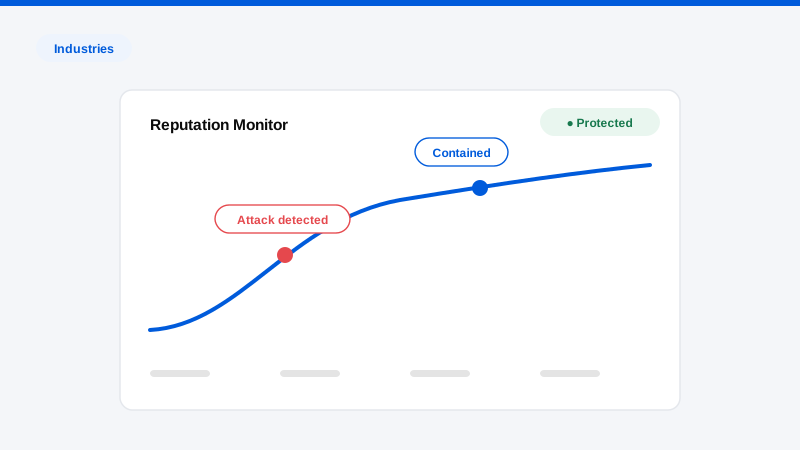
Reputation management for nonprofits and charities is the discipline of protecting what donors, grantmakers, volunteers, and beneficiaries find when they search an organization’s name, and removing the defamatory, harassing, outdated, and unlawful content that corrodes the trust every mission depends on. A nonprofit’s only real currency is credibility. It has no product to fall back on, no switching costs holding its supporters in place. When search results turn hostile, giving simply goes elsewhere, quietly, and the organization may never learn why.
The exposure is sharper than most boards appreciate. Donor diligence now begins, and often ends, with a search. Watchdog and charity-rating platforms sit permanently on page one of most nonprofits’ branded results. Scandal coverage, once published, outlives the leadership that caused it, the reforms that answered it, and sometimes the decade in which it happened, and board members and executives discover that their personal names have become attack surfaces for anyone with a grievance against the mission.
This guide defines the threat landscape nonprofits and charities actually face online, what is at stake when harmful content goes unmanaged, and what professional, removal-first protection looks like, and why organizations that treat this as specialist work, rather than a task for an already-stretched communications staffer, protect their missions better.
What reputation management for nonprofits actually means
Reputation management for nonprofits is not fundraising copy and it is not annual-report polish. It is the systematic identification, assessment, and removal of harmful online content targeting the organization, its leadership, and its board, combined with continuous monitoring so new threats are caught while they are still easy to address.
In the nonprofit sector, the caseload concentrates in four categories:
- Defamation: false statements of fact about how the organization uses funds, whom it serves, or what its people have done: published on complaint sites, social platforms, blogs, and forums. Defamation removal is evidence work: proving falsity and pursuing the correct removal pathway for each venue until the content comes down or is delisted.
- Harassment and coordinated attacks: campaigns targeting staff and leadership (doxxing, impersonation, pile-ons) often driven by opposition to the mission itself rather than any conduct by the organization. This is cyber abuse removal, and it operates on an emergency clock.
- Outdated content: coverage of a long-resolved controversy, a departed executive’s misconduct, or a superseded rating that still ranks as if current. The remedy is frequently search result removal or delisting rather than takedown at the source.
- Unlawful content: fake donation pages and impersonation accounts diverting funds from the real organization, leaked donor or beneficiary data, and infringing misuse of the organization’s name and materials, categories where law and platform policy both provide firm ground.
Equally important is what this work is not. It is not the suppression of accurate journalism, honest donor criticism, or legitimate watchdog findings. An organization with a real accountability problem needs governance, not takedowns, and a reputable removal firm will say exactly that.
Why nonprofits and charities are targeted
Nonprofits carry structural exposures that make them disproportionately attractive targets for harmful content.
Their missions create adversaries. Advocacy organizations, faith-based charities, public-health nonprofits, environmental groups. Many exist precisely to change something that someone else wants unchanged. Ideological opponents do not need a factual grievance to run a campaign of fabricated claims, manipulated screenshots, and coordinated one-star reviews. The attack is the point; the mission is the provocation.
Trust is the product, so trust is the target. Anyone who wants to hurt a nonprofit knows exactly where to aim: allegations of financial impropriety. “They pocket the donations” is the sector’s universal smear: cheap to assert, viral by design, and devastating in search results even when wholly invented, because donors have no easy way to verify and every incentive to simply give elsewhere.
Watchdog-site ratings dominate their search results. Charity evaluators, rating platforms, and complaint aggregators rank prominently for nearly every nonprofit’s name. These platforms serve donors well in aggregate, but stale ratings based on years-old filings, unverified complaints, and profile errors sit in that same privileged position, framing the organization for every searcher. Most nonprofits have never systematically reviewed what these third-party profiles say, let alone pursued the correction and dispute processes the platforms themselves provide.
Passionate communities cut both ways. Former employees, ex-volunteers, disaffected donors, and estranged founders remain emotionally invested, and nonprofit disputes have a distinctive intensity (schisms, board fights, founder transitions) that produces motivated, persistent online grievance. One embittered insider with real details and false conclusions can outrank a decade of mission work.
They are under-defended by design. Nonprofit budgets prioritize programs, as they should. The result is that most organizations have no monitoring, no exposure map, and no removal capability, which attackers understand. Harmful content aimed at a nonprofit tends to stand unchallenged for years, accumulating rank precisely because nobody was assigned to answer it.
Key takeaway: Nonprofits are targeted at the exact point of their value, donor trust, by adversaries their missions create, on platforms their budgets leave unwatched. The vulnerability is structural, not a sign of anything the organization did wrong.
See what's out there before it becomes the story.Free confidential Exposure Scan: live results on a 15-minute call, yours to keep either way.
Book Your Free ScanWhat’s at stake
The consequences of unmanaged online harm run through every channel a nonprofit depends on.
Individual giving. Donor diligence is a search. A prospective donor who encounters a fabricated financial-impropriety claim, a hostile complaint thread, or a stale scandal headline does not email the development office for clarification. They redirect the gift to a similar organization with cleaner results. The loss is invisible: no declined ask, no complaint, just a donation that never arrives. Over the years, harmful page-one content functions as a permanent tax on every appeal the organization sends.
Institutional funding. Foundations, corporate giving programs, and government grantmakers run formal due diligence, and reputational review is part of it. Adverse search content triggers questions at minimum and quiet disqualification at worst, often without the organization ever knowing its application was shadowed by something a former employee posted years earlier.
Scandal-coverage permanence. When a nonprofit does suffer a genuine crisis (an executive’s misconduct, a program failure) the coverage is legitimate. What is not legitimate is a permanent penalty: five or ten years later, with new leadership, reformed governance, and clean audits, the original headlines can still define page one, misleading every current donor about the organization that exists today. Managing the afterlife of old coverage (corrections where reporting has become materially inaccurate, delisting where search-engine policies provide for it, and monitoring of what AI systems now say when donors ask about the organization) is among the highest-value work in the sector.
Board recruitment and exposure. Serious board candidates search the organization: and know that joining means their own names inherit its controversies. Hostile content thus shrinks the governance talent pool. It also runs the other way: board members and executives get personally targeted over the organization’s work, with defamatory posts and doxxing attached to names that also carry their careers. Organizations that protect their people the way corporations protect their executives retain leaders that under-defended organizations lose.
Staff, volunteers, and beneficiaries. Recruitment pipelines respond to search results just as donations do, and for service organizations, there is a quieter casualty: people in need who read a false claim and never seek the help.
Key takeaway: For a nonprofit, harmful search content is a permanent, invisible tax on giving, grants, and governance, collected silently from every donor who searches and never says what they found.
What professional reputation management for nonprofits looks like
Professional, removal-first protection for a nonprofit is a defined, continuous process rather than a one-time cleanup.
1. Exposure audit. A complete map of the organization’s online surface: branded search results for the organization and its key people, watchdog and rating-site profiles, complaint platforms, social content, news archives, impersonation accounts, and what AI assistants answer when asked about the organization. For most nonprofits this audit is the first time anyone has seen the whole picture, and it routinely surfaces fake donation pages and impersonation accounts no one knew existed.
2. Disciplined classification. Each item is assessed against removal standards: demonstrably false, harassing, unlawful, policy-violating, or materially outdated, versus accurate and merely unwelcome. This sorting is where specialist judgment matters most, and where ethics are enforced. We decline work aimed at suppressing truthful reporting of serious wrongdoing; we remove defamation, harassment, outdated and unlawful content, and that standard is precisely why our filings are taken seriously by the platforms and search engines that receive them.
3. Removal execution. For each qualifying item, the strongest available case is built and filed through the correct channel (platform policy reports with documented evidence, legal notices where law provides them, host-level escalation where platforms fail, impersonation and fraud reports for fake accounts and donation pages) and pursued through follow-up and escalation until resolution. Every venue has different standards and adjudication habits; knowing them from daily practice is the difference between removal and a templated denial.
4. Correction and delisting. Watchdog-profile errors are pursued through the platforms’ own dispute processes, with the documentation those processes actually credit. Outdated coverage that cannot be removed at the source is evaluated against search engines’ delisting policies, so that what donors see reflects the organization as it is, not as it was.
5. Continuous monitoring. Reputation monitoring across search, platforms, complaint sites, and AI outputs catches new content within days, the window in which removal is fastest and cheapest. Mature organizations run this under a standing protection plan sized to nonprofit budgets, converting reputation defense from an occasional emergency into a quiet operational function with board-ready reporting.
6. Incident response. When a campaign hits mid-fundraising-season, hours matter. Organizations with an existing program get response from a team that already holds their exposure map, no cold start, no lost week.
Why specialists beat DIY
Most nonprofits first respond to harmful content in-house, and most get poor results, not for lack of intelligence, but because removal is a specialized, adversarial process that punishes improvisation.
Venue fluency only comes from volume. Platforms, hosts, complaint sites, rating services, and search engines each maintain their own removal standards, evidentiary expectations, and unwritten tendencies, all constantly changing. Specialists file across these systems daily and know what each accepts and how each actually decides. A development director encounters each system once, under pressure, and a first filing that is vague or overreaching often hardens the venue’s position on that item permanently.
Filing credibility is cumulative. Removal venues triage requests, and they learn which filers bring disciplined, well-evidenced cases. An organization filing angry, generalized complaints trains platforms to ignore it. A firm that files only qualifying cases, properly documented, gets adjudicated, which is why our selectivity is not just ethics but efficacy.
Missteps amplify. A heavy-handed public demand or an ill-judged legal threat against a critic can convert a low-visibility post into a story about the nonprofit trying to silence someone, catastrophic framing for an organization built on trust. Knowing when to file quietly, when to escalate, and when to leave something alone is the judgment being purchased. We are not a law firm; where litigation is genuinely the right tool, we say so and work alongside counsel.
Opportunity cost is mission cost. Every staff hour spent learning takedown procedure mid-crisis is an hour taken from programs and fundraising. Specialist handling is usually cheaper than the internal time it replaces, before counting the difference in outcomes.
See what's out there before it becomes the story.Free confidential Exposure Scan: live results on a 15-minute call, yours to keep either way.
Book Your Free ScanWhy nonprofits and charities choose Content Removal
Content Removal LLC is a removal-first firm. We do one thing (identify and remove defamatory, harassing, outdated, and unlawful content) and everything about our practice is built around doing it at a professional standard: senior practitioners on every case, evidence-grade documentation suitable for board and counsel review, confidentiality as the default posture, and honest assessment before any engagement.
Nonprofits choose us because our assessments are blunt. We will tell you which items are strong removal candidates, which are delisting or correction cases, which require patience, and which are accurate content that no ethical firm should touch, before you commit a dollar of mission funding. We never promise outcomes, because no honest practitioner can; what we commit to is the strongest available case for every qualifying item, filed correctly, pursued to conclusion, and reported transparently. Our case studies show that discipline at work across sectors.
For the nonprofit sector specifically, we cover the full surface: the organization’s name, executives and board members, watchdog-profile disputes, complaint-site casework, impersonation and fake-donation-page takedowns, the afterlife of old scandal coverage, and the AI-generated answers donors increasingly rely on, under reputation management programs and monitoring scoped to nonprofit budgets and governance cycles.
Frequently asked questions
Can a nonprofit get false claims about misusing donations removed?
Often, yes. Fabricated financial-impropriety claims are false statements of fact, and platforms’ defamation and misinformation policies, along with legal remedies where warranted, provide removal pathways when falsity is properly documented. The strength of the case turns on evidence: filings, audits, and records that demonstrate the claim is invented. What cannot be removed is accurate reporting of real financial problems; if that is the situation, the organization needs governance reform first, and we will say so in the assessment.
What can be done about an old scandal that still dominates our search results years after we fixed everything?
More than most boards assume. Where coverage has become materially inaccurate (charges dropped, findings overturned, individuals long departed) update and correction requests to outlets are viable. Search engines maintain policies under which certain outdated or unlawful content can be delisted from results, and monitoring what AI systems now say about the organization catches the places where old coverage is being repeated as current fact. None of this erases history; it ensures donors evaluating the organization today are not misled about which organization they are evaluating.
Are watchdog and charity-rating sites something a removal firm can help with?
Yes: through the platforms’ own processes, not against them. Rating platforms maintain dispute, correction, and update mechanisms, and outcomes depend on submitting the documentation those mechanisms actually credit, in the form they expect. The same is true of complaint aggregators, which typically have policies against fabricated or impersonated complaints. This is correction work, not suppression: the goal is profiles that are accurate and current, which serves donors as much as it serves the organization.
We’re a small nonprofit. Is professional protection realistic on our budget?
That is what scoped engagements and monitoring-first plans are for. A small organization rarely needs everything at once; it needs an exposure map, removal of the handful of items doing real damage, and lightweight monitoring so new threats are caught early, when they are cheapest to address. The honest comparison is not against zero cost but against the silent, compounding cost of donors deflected by content no one was watching.
Somewhere right now, a donor is searching your organization’s name and deciding what your mission is worth. A free, confidential Exposure Scan shows you exactly what they’re finding, live results on a 15-minute call, yours to keep whether or not we ever work together. Book it before the next campaign, and make sure the organization donors find online is the one you actually run.