
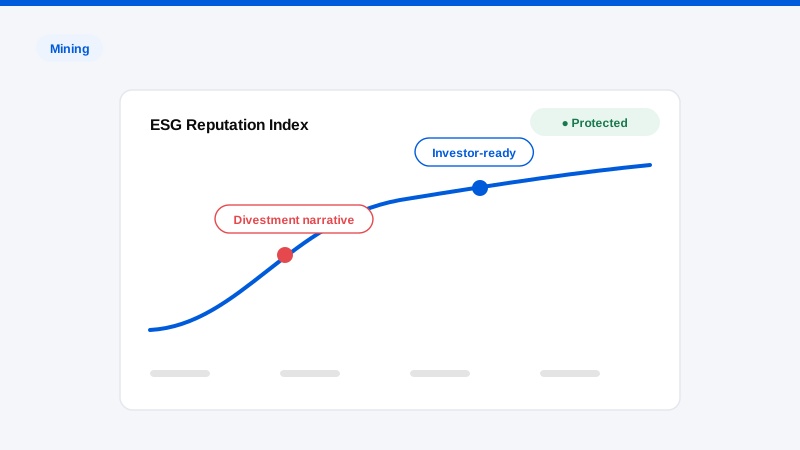
Reputation management for mining companies is the practice of controlling what regulators, host communities, institutional investors, lenders, joint-venture partners, and journalists find when they research a mining company, a project, or the executives behind it, and removing the damaging content that would otherwise decide permits, financings, and partnerships before the company ever sits down at the table. Mining is unusual among industries in that its most important asset is not on the balance sheet: the social license to operate (the ongoing acceptance of governments, communities, and capital markets) determines whether reserves in the ground ever become revenue. That license is negotiated continuously, and every party to the negotiation now conducts its research the same way: through search. A project’s search results are read by the permitting official before the hearing, by the community leader before the consultation, by the fund analyst before the ESG screen, and by the local journalist before the story. Whatever ranks there is, functionally, the company’s file.
That file fills up fast, and rarely in the company’s favor. Environmental incidents anywhere in the industry, opposition campaigns anywhere in the world, decades-old legacy issues, and coordinated divestment narratives all accumulate under company and project names, and unlike the ore body, hostile content does not deplete. It compounds. The mining companies that protect their standing effectively have stopped treating this as a communications problem and started treating it as an asset-protection problem, with removal as the first lever.
Why mining companies are targeted
Mining generates organized, motivated, well-funded opposition in a way few industries do, and the content that opposition produces behaves differently from ordinary consumer criticism.
Environmental-incident coverage never closes. A tailings event, a water-contamination allegation, a dust or noise dispute, each generates coverage that ranks for the company and project name indefinitely. Remediation, regulatory closure, and third-party verification arrive years later and receive a fraction of the visibility. Worse, incident coverage is contagious across the industry: a disaster at one company’s operation revives and re-ranks content about every company with a similar facility, because journalists and campaigners explicitly draw the comparisons.
Community opposition campaigns are professionally organized. Project opposition today is rarely a few local objectors. It is a networked campaign, local groups connected to national and international NGOs, shared playbooks, coordinated petitions, hostile project-specific websites and social channels, and content production designed for permitting timelines. These campaigns build durable online infrastructure whose entire purpose is to dominate the project’s search results during the exact windows when regulators and financiers are looking.
ESG-driven divestment narratives target the capital stack. Campaigners have learned that pressuring lenders, insurers, and institutional investors works faster than pressuring miners. Divestment campaigns produce ranking content that names companies as ESG pariahs, compiles allegation dossiers, and tags every financing announcement with protest. Fund managers running exclusion screens find this content precisely because it is engineered to be found.
Executives are targeted personally, including near mine sites. Mining executives and country managers are named in campaign materials, blamed personally for incidents, and targeted with doxxing that publishes home addresses, family details, and travel patterns. Around contested projects, that exposure has a physical dimension few industries share: site managers and visiting executives operate in communities where tensions are real, and published personal information elevates genuine security risk. Data-broker networks make assembling that information trivial for anyone motivated to do it.
Legacy and inherited content attaches to the current company. Mergers, acquisitions, and rebrandings do not reset search results. Content about a predecessor company’s conduct, a divested asset’s problems, or a decades-old incident continues ranking against the current name: presenting historical issues, sometimes under entirely different ownership and standards, as the company’s present identity.
Misinformation fills the technical vacuum. Mining is technically complex, and complexity favors fear. Exaggerated contamination claims, misread monitoring data, and fabricated health scares spread through community social-media groups and campaign channels faster than any technical rebuttal can follow, and once indexed, they rank alongside legitimate reporting with equal authority in the eyes of a casual searcher.
What damaging content actually costs a mining company
Permitting is decided in a search-shaped environment. Permitting officials, environmental regulators, and elected decision-makers are human beings operating under public scrutiny. A project whose search results are dominated by opposition content, incident allegations, and hostile coverage raises the political cost of every approval. Conditions multiply, timelines stretch, and marginal decisions tip against the applicant, and in mining, a year of permitting delay on a capital project is an enormous, quantifiable loss.
Capital access is screened, and screens read search. Project finance, bond issuance, insurance, and equity placement all now pass through ESG review. Analysts building those assessments rely heavily on public-domain research, which means the indexed allegation dossier, the divestment campaign page, and the unresolved incident coverage feed directly into risk premiums, exclusion decisions, and lending terms. Hostile search results are not an image problem; they are a cost-of-capital problem.
Community consent is negotiated against the online record. Consultation processes, benefit-agreement negotiations, and ongoing community relations all take place among people who research the company first. A community reading years of unanswered contamination rumors and incident content enters every meeting predisposed to distrust, and organized opposition makes sure the worst content is what they find.
Partners and governments run diligence. Joint-venture partners, offtakers, and host governments evaluate reputational risk before committing. State actors weighing license awards compare bidders’ public profiles; majors evaluating juniors as acquisition or partnership targets do the same. A hostile search profile quietly removes a company from consideration without a single conversation about it.
Talent and share price feel the drag. Mining already struggles to attract young engineering talent, and candidates researching employers find the campaign content first. Meanwhile, for listed companies, incident narratives and divestment campaigns translate directly into valuation pressure, activist shareholder attention, and vulnerability during capital raises.
Why generic PR and SEO approaches fail in mining
The conventional toolkit (sustainability reports, community newsletters, positive-content SEO, and crisis communications) consistently underperforms against mining’s threat model.
Opposition content is built to outrank corporate content. Campaign sites, petitions, and incident coverage earn links, engagement, and updates continuously, the exact signals search engines reward. A sustainability microsite does not accumulate backlinks the way a contamination controversy does. Suppression strategies that try to bury organized opposition under owned media are betting against the algorithm and against a professional adversary at the same time.
Corporate rebuttal has a credibility ceiling. On environmental questions, audiences systematically discount the company’s own statements; a technically accurate rebuttal from the operator often persuades no one and provides the campaign a fresh news hook. Engagement with campaign content also elevates it: replies, statements, and disputes all add the activity that keeps it ranking.
Local dynamics defeat centralized comms. The decisive content often lives in community Facebook groups, local forums, and regional outlets that head-office communications teams do not see, in languages and contexts they do not operate in. By the time a rumor surfaces at corporate level, it has become local common knowledge.
None of it touches the removable layer. A meaningful share of hostile mining content violates enforceable standards: fabricated claims and manipulated data presented as fact, defamatory attacks on the company and its executives, doxxing of personnel, impersonation accounts, policy-violating harassment, and outdated or legally deficient content with de-indexing paths. PR firms do not investigate removability, build evidentiary cases, or execute takedowns across platforms and jurisdictions. Removal-first specialists exist for exactly that gap.
What removal-first protection looks like
Removal-first reputation management treats deletion as the highest-value outcome available: content that no longer exists cannot rank during a permitting window, cannot be cited in an ESG screen, and cannot be circulated at a community meeting. Content Removal structures mining engagements in four phases.
Assessment. The work begins with a full map of exposure across every audience that matters: company- and project-level search results in relevant languages and markets, opposition campaign infrastructure, incident and legacy coverage, ESG and divestment content, community social channels, impersonation and fabricated content, and the personal search results and data-broker exposure of executives, country managers, and site leadership. Each item is graded for severity, audience, and removability: does it defame, fabricate, dox, impersonate, or violate platform policy or law? Most companies begin with a free, confidential Exposure Scan, which converts a diffuse sense of siege into a prioritized, factual inventory.
Removal. Removable content is pursued at the source through the correct channel for each item: platform policy enforcement against doxxing, harassment, impersonation, and coordinated inauthentic behavior; legal process where content is defamatory or publishes private information; and direct engagement with site operators and administrators where that is the effective route. Mining cases frequently span jurisdictions, languages, and platforms simultaneously, and outcomes depend on building each case to the receiving platform’s or court’s evidentiary standard the first time.
De-indexing. Some content survives at the source: campaign sites built for persistence, offshore hosts, abandoned pages no one will take down. Where that content violates search-engine policies or applicable law, it can often be removed from search results even though the page remains. For an industry whose critical audiences all research through search, de-indexed content has lost most of its force: the permitting official, the fund analyst, and the journalist no longer encounter it.
Monitoring. Mining reputation threats run on external calendars: permitting milestones, financing windows, incident anniversaries, campaign cycles. Continuous monitoring covers company and project search results, executive and site-leadership names, community channels, data-broker reappearance, and campaign infrastructure, so new threats surface in hours rather than at the public hearing. Our Protection Plans keep that posture standing between crises, which is when removal is cheapest and most effective.
Removal-first is not removal-only, and the boundary is principled: accurate reporting, genuine community concern, and lawful advocacy are not removal targets, and no reputable firm treats them as such. The objective is to strip out the violating layer (fabrication, defamation, doxxing, impersonation) so the company engages only with criticism that has actually earned its place, on a search landscape that is no longer rigged.
Protecting mining executives and site leadership as individuals
Mining’s personal reputation layer carries risks most industries never face. Executives, country managers, and site leaders are searched by regulators, journalists, community leaders, and campaigners, and, uniquely, they and their families often live or travel near the operations that opposition campaigns contest.
The threat pattern is distinctive: campaign materials that name individuals as personally responsible for environmental harm; doxxing that pairs an executive’s role with home address and family details harvested from data brokers; hostile content timed to hearings, AGMs, and site visits; defamatory attacks that follow leaders across companies and decades; and, around contested sites, personal exposure that translates directly into physical-security risk for the individual and their family. A published address near an inflamed dispute is not a privacy issue. It is a security incident waiting for a trigger.
A serious program treats each named leader as a protected asset: full personal search audits; systematic removal of addresses, family information, and personal data from people-search and broker networks, with continuous re-suppression as records regenerate; takedown of doxxing and harassment content; platform and legal action against defamation; and standing monitoring of every covered name. This is the core of our digital executive protection practice, and for mining leadership it belongs in the security budget alongside site protection and journey management, because it addresses the same threat model from the digital side.
Company and personal reputations also compound. An executive whose search results are dominated by campaign attacks weakens the company at every hearing and negotiation; a company drowning in incident content stains every leader’s record permanently. Defending both, together and continuously, is materially more effective than defending either in crisis.
The strategic case for acting before the next permitting window
Every mining company has a next event on the calendar: a permit hearing, a financing, an AGM, a drill result that draws attention. What determines the outcome’s difficulty is the search landscape it lands on. A company that arrives with clean, monitored results and protected leadership contests the issue on its merits. A company that arrives with years of accumulated hostile content contests the issue plus a decade of everything else, because opposition campaigns will make sure the decision-makers see all of it.
Removability also decays. Doxxing challenged in days is contained; in months it is mirrored and archived. A fabricated contamination claim addressed early is one case; entrenched, it is cited by campaign dossiers and local media as established background. The economics of this work favor quiet, early, continuous action over crisis response by an overwhelming margin.
If you are responsible for corporate affairs, legal, security, or investor relations at a producer, developer, or royalty company, the rational first step is precision. A free, confidential Exposure Scan maps the hostile content attached to your company, your projects, and your people, identifies exactly what can be removed, and gives you a factual basis for action, before the next campaign or permitting window finds the old content waiting.
Frequently asked questions
Can coverage of a real environmental incident be removed?
Accurate reporting of genuine incidents generally cannot be removed, and pursuing it would be both wrong and counterproductive. What can often be addressed is the surrounding layer: fabricated or exaggerated claims, manipulated data presented as fact, defamatory attacks, impersonation accounts, and outdated content that misstates long-resolved matters. An assessment separates the coverage a company must manage honestly from the content it can eliminate.
Opposition groups run entire websites against our project. Is anything actionable?
Often, yes, not the lawful advocacy, but the violating layer within and around it. Defamatory factual claims, doxxing of personnel, fabricated documents, impersonation, and coordinated inauthentic amplification each have removal or de-indexing paths through platforms, hosts, search engines, or legal process. Mapping the campaign’s infrastructure and identifying which components cross enforceable lines is exactly what the assessment phase does.
Our ESG profile is being shaped by old content about assets we sold years ago. Can that be fixed?
Frequently, in part. Content that is outdated, misattributed, or factually wrong about current ownership and operations may qualify for correction, removal, or de-indexing depending on the platform and jurisdiction, and the removable layer around it (fabrications, defamation, duplicates) can be pursued directly. The remainder is then addressed through accurate positioning, but only after the landscape has been cleaned of what never belonged there.
Our country manager’s home address appeared in campaign materials. How urgent is this?
Treat it as a security incident, not a reputation issue. Published personal information near a contested operation elevates physical risk, and the response should be immediate: takedown action against the doxxing content, systematic removal of the underlying data from broker and people-search networks so it cannot simply be re-harvested, and continuous monitoring of the individual’s name. Speed matters enormously, content is easiest to contain before it is mirrored.
How is this different from our existing PR and community-relations work?
Community relations and PR build the positive relationship; removal-first protection eliminates the violating content those functions cannot argue with. PR firms do not investigate removability, build platform or legal cases, or scrub executive data from broker networks, and removal specialists do not run town halls. Mining companies get the best results running both, coordinated but distinct, with removal handled quietly by specialists.