
Reputation management for aerospace and defense companies is the practice of controlling what contracting officers, prime contractors, security evaluators, investors, journalists, and adversarial activists find when they research a defense firm, its programs, or the executives and engineers who run them, and removing the damaging content that would otherwise shape source selections, teaming decisions, and clearance-level trust before the company ever presents its case. No industry operates under a harsher asymmetry between secrecy and exposure. Aerospace and defense firms cannot publicly rebut most criticism: programs are classified, contract details are restricted, and personnel matters are governed by security considerations. Their critics face no such constraints. Activists, competitors’ surrogates, disgruntled insiders, and hostile foreign-aligned amplifiers can publish freely, and whatever they publish becomes the visible record, because the company’s side of the story is, by design, invisible.
That asymmetry defines the sector’s reputation problem. When a program overruns, a test fails, a protest is filed, or an activist campaign names an executive, the resulting content ranks under the company’s name indefinitely, and the audiences that matter (government customers, primes assembling teams, cleared talent weighing offers) all conduct their research through the same search results. In a sector where trust is literally adjudicated, what search returns is not public relations. It is past performance, character, and security posture as the outside world perceives them.
Why aerospace and defense companies are targeted
Defense firms attract hostile content from more directions than almost any other industry, and much of it is produced by motivated, organized adversaries rather than unhappy customers.
Activists target employees and executives by name. Anti-war, environmental, and single-issue campaigns have shifted tactics from protesting companies to naming individuals, publishing lists of executives and program staff, picketing homes, flooding LinkedIn profiles with hostile commentary, and building pressure campaigns designed to make employment at a defense firm personally costly. Doxxing of leadership and even mid-level engineers, including home addresses and family details harvested from data brokers, has become a recurring feature of these campaigns.
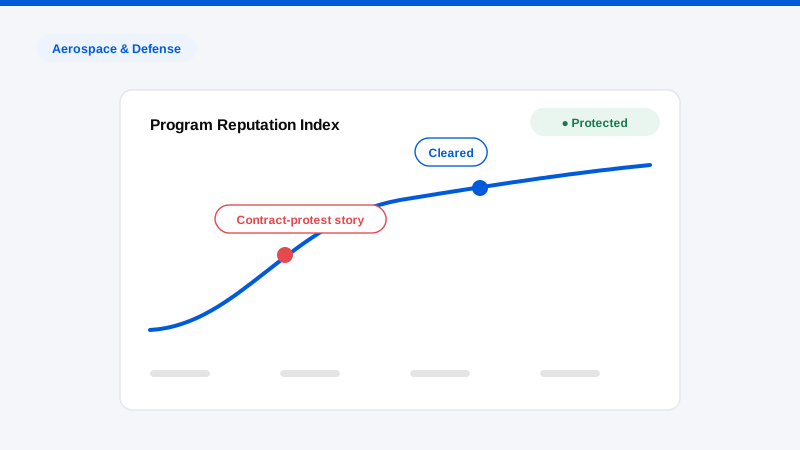
Contract-protest narratives frame the company as the villain. Bid protests are a routine feature of federal contracting, but their public coverage is not neutral. Protest filings, trade-press stories, and competitor-friendly commentary cast awards as improper and incumbents as entrenched, and those stories rank for the company’s name long after the protest is resolved in its favor. The resolution rarely gets the coverage the accusation did.
Whistleblower-adjacent content blurs protected disclosure and attack. The sector rightly protects whistleblowers, but around genuine protected disclosures grows a penumbra of adjacent content: anonymous forum posts alleging fraud or safety failures without evidence, ex-employee grievance campaigns dressed in whistleblower language, and litigation-driven publicity that presents unproven allegations as established fact. Companies cannot respond in detail without touching restricted matters, so the allegations stand alone in search results.
Program-failure coverage becomes permanent past performance. Test anomalies, schedule slips, and cost overruns are intrinsic to developing complex systems, but each generates coverage that fixes the failure in the public record while the eventual success arrives quietly or classified. A search for the company plus a program name can return a decade of failure-framed headlines that evaluators, journalists, and congressional staff absorb as the program’s identity.
Insider grievances carry unusual weight. Employer-review platforms and forums host content from, or purporting to be from, cleared engineers and program staff, alleging toxic programs, security shortcuts, or ethical lapses. Because readers assume insiders know things outsiders cannot, this content is disproportionately credible and disproportionately damaging, whether or not it is true or even authored by a real employee.
Foreign-aligned amplification distorts everything. Defense companies are legitimate targets of adversary information operations, which amplify genuine criticism, launder fabricated claims through fringe outlets, and pile onto activist campaigns to degrade trust in Western defense industrial capacity. This layer is difficult for in-house teams to even identify, let alone counter.
What damaging content actually costs an aerospace and defense company
Source selection and teaming are decided by people who research. Contracting officers, program executive officers, and source-selection teams evaluate past performance, responsibility, and integrity, and while formal records dominate, the humans involved search the company like anyone else. Primes assembling teams run reputational diligence on potential subcontractors; a subcontractor whose search results are dominated by fraud allegations, protest narratives, and program-failure coverage is a liability a prime can avoid by simply choosing someone else. No debrief will ever say so.
Congressional and regulatory attention follows visible narratives. Appropriators, oversight committees, and inspectors general operate in a media environment. A program whose search profile screams failure invites budget scrutiny, hearing questions, and audit attention that a quietly performing program never draws. Hostile content does not just embarrass. It shapes which programs get defended and which become political offerings.
Cleared talent is the scarcest resource, and it searches too. The sector’s binding constraint is cleared, experienced engineering talent, and candidates weighing offers read employer reviews, forum threads, and activist coverage. A firm portrayed online as ethically compromised or program-cursed loses candidates it never knew it had, particularly younger engineers already ambivalent about defense work. Activist campaigns explicitly target this pipeline, aiming to make recruitment itself the casualty.
Investors price reputational and ESG risk directly. Defense primes and their suppliers face ESG screens, divestment campaigns, and analyst narratives in which hostile content is evidence. Sustained negative search profiles feed exclusion decisions by funds and lenders, raise the cost of capital, and hand activist shareholders material for proxy contests.
Security itself is implicated. Doxxed executives and program staff are not just reputational casualties. They are counterintelligence and physical-security exposures. Published home addresses, family details, travel patterns, and program affiliations are exactly the data hostile intelligence services and violent extremists collect. In this sector, personal data exposure is a security incident, not a privacy annoyance.
Why generic PR and SEO approaches fail in aerospace and defense
The standard corporate playbook fails here for reasons rooted in the sector’s structure.
The company cannot out-communicate its critics. Classification, contract restrictions, and litigation posture mean most damaging claims cannot be rebutted in detail, or at all. A PR strategy premised on “telling our story” collapses when the story is restricted. Critics publish; the company issues a two-sentence statement; search engines index the imbalance.
Suppression campaigns look worse than silence. SEO-based burying, flooding search with thin positive content to push down criticism, is transparently visible to sophisticated audiences, and defense audiences are the most sophisticated there are. Journalists and congressional staff who detect a suppression campaign treat it as consciousness of guilt, converting a content problem into a credibility problem.
Engagement amplifies organized adversaries. Responding publicly to activist campaigns gives them the confrontation they are engineered to produce; replying to anonymous insider allegations elevates them into news. Communications instincts calibrated for consumer brands reliably misfire against motivated, organized opposition.
The removable layer goes untouched. A substantial fraction of the sector’s hostile content violates enforceable rules: doxxing and targeted harassment breach platform policies and, in many jurisdictions, law; fake insider reviews violate platform terms; impersonation accounts, fabricated documents, defamation, and inauthentic amplification networks all have removal and escalation paths. PR firms and SEO vendors are not built to investigate, document, and execute those removals. That gap is the entire opportunity.
What removal-first protection looks like
Removal-first reputation management begins from the premise that in a sector where the company cannot argue, the highest-value outcome is content that no longer exists. It cannot rank, cannot be cited in a protest or a hearing, and cannot be amplified by the next campaign. Content Removal structures aerospace and defense engagements in four phases.
Assessment. The engagement starts with a comprehensive map of exposure: corporate and program-level search results, employer-review and forum content, activist campaign infrastructure and its targeting of named individuals, protest and litigation coverage, impersonation and fabricated-document content, amplification patterns suggesting inauthentic coordination, and, critically, the personal search results and data-broker exposure of executives and key program personnel. Each item is classified by severity, audience, and removability: does it violate platform policy, publish private information, defame, impersonate, or break the law? Most firms begin with a free, confidential Exposure Scan, conducted with the discretion this sector requires, which converts diffuse concern into a prioritized inventory.
Removal. Removable content is pursued at the source through the correct channel for each item: platform policy enforcement against doxxing, harassment, and fake-insider reviews; terms-of-service action against impersonation accounts and inauthentic networks; legal process where content is defamatory or publishes private facts about protected individuals; and direct engagement with site operators where that is the effective route. Every platform has its own evidence standards, and defense-sector cases often require careful handling of what can and cannot be disclosed in a takedown filing, precisely the kind of judgment that separates specialists from form-fillers.
De-indexing. Some hostile content sits on sites that ignore takedowns: offshore hosts, activist archives, gripe sites engineered for persistence. Where that content violates search-engine policies or applicable law, it can often be removed from search results even though the page survives. For defense audiences who research through search, de-indexed content has lost most of its operational effect: it exists, but it no longer greets the contracting officer, the recruiter’s candidate, or the journalist on deadline.
Monitoring. Activist campaigns, protest cycles, and program milestones generate hostile content on a schedule the company cannot control. Continuous monitoring covers corporate and program search results, executive and key-personnel names, activist channels, data-broker reappearance, and employer-review velocity, so new threats surface in hours, when removal is fastest and before content is amplified into permanence. Our Protection Plans exist to keep that posture running between incidents rather than rebuilding it after each one.
Removal-first is not removal-only, and in this sector the boundary matters: genuine protected whistleblower disclosures, accurate reporting, and lawful criticism are not removal targets, and a reputable firm will say so plainly. The objective is to strip away the violating layer (the doxxing, the fabrication, the impersonation, the defamation) so the company faces only the criticism that is actually legitimate.
Protecting defense executives and program leaders as individuals
In no other industry is the personal layer of reputation so directly a security matter. Defense executives, program managers, and senior engineers are searched by contracting officials, journalists, foreign intelligence services, and activists, and what those searches return determines everything from board invitations to physical risk.
The threat pattern is distinctive: activist campaigns that publish target lists of named personnel; doxxing that pairs program affiliation with home addresses pulled from data-broker networks; hostile content timed to congressional testimony or program milestones; defamatory attacks that follow an executive across future roles; and grievance content from litigation and employment disputes that dominates a leader’s personal search profile. For cleared personnel, visible personal exposure can also complicate the individual’s own security posture, publicized allegations and financial or personal attacks become things that must be explained.
A serious program treats each named leader as a protected asset: a full personal search audit; systematic removal of home addresses, family details, and personal data from people-search and broker sites, with continuous re-suppression as records reappear; takedown of doxxing and harassment content; legal and platform action against defamation; and standing monitoring of each name. This is the core of our digital executive protection practice, and for defense leadership it belongs alongside physical security and counterintelligence in the corporate-security portfolio, because that is the threat model it addresses.
The strategic case for acting before the next campaign
Every defense company will face another protest, another test anomaly, another activist cycle timed to a contract award. What determines the damage is the search landscape those events land on. A firm that enters a milestone with clean, monitored results and protected executives absorbs the wave. A firm that enters with years of accumulated hostile content watches the new event fuse with the old into a single narrative: the one evaluators, staffers, and reporters will find first for the next decade.
Removability also decays. Doxxing challenged within days is a contained incident; a year later it has been mirrored, archived, and cross-posted. A fabricated insider review disputed early is one case; entrenched, it is quoted in roundups and treated as record. The economics of this work overwhelmingly favor early, quiet, continuous action over crisis response.
If you are responsible for security, legal, communications, or the leadership team at a prime, a subcontractor, or a defense-technology firm, the rational first step is precision about what is actually out there. A free, confidential Exposure Scan maps the hostile content attached to your company, your programs, and your people, identifies what is removable, and gives you a factual basis for decisions, before the next campaign chooses the timing for you.
Frequently asked questions
Can content about a bid protest or program failure be removed?
Accurate news coverage of real protests and program events generally cannot be removed, and pursuing it would be counterproductive. What can often be addressed is the surrounding layer: defamatory exaggerations, fabricated claims, impersonation accounts, policy-violating forum content, and outdated material that misstates resolved matters. An assessment distinguishes the coverage you must manage from the content you can eliminate.
Our executives have been named on activist target lists. What can be done?
Quite a lot, in most cases. Doxxing, targeted harassment, and publication of private information violate the policies of major platforms and, in many jurisdictions, the law, creating removal paths for the most dangerous content. In parallel, personal data can be systematically removed from the broker and people-search networks that campaigns harvest from, and each name can be monitored continuously. The goal is to make targeting expensive and ineffective rather than easy.
How do you handle content that claims to be from whistleblowers?
Carefully and lawfully. Genuine protected disclosures are not removal targets, and no reputable firm treats them as such. But much whistleblower-styled content is something else (anonymous defamation, fabricated claims, or grievance campaigns that violate platform rules) and that layer can often be removed through policy and legal channels. The assessment phase is where those lines get drawn, with counsel involved where appropriate.
Will pursuing removals draw attention or look like a cover-up?
Removal work is conducted quietly, case by case, through platform policy channels, legal process, and direct engagement, not through public statements. Unlike SEO suppression campaigns, which sophisticated audiences can detect, a removed piece of content simply stops existing in search. Discretion is a core requirement in this sector, and the work is structured around it.
Does this replace our communications or government-relations functions?
No: it complements them. Communications and government relations shape the narrative the company can tell; removal-first protection eliminates the violating content the company cannot argue with. Defense firms get the best results running both, with removal handled by specialists who work alongside counsel and security rather than through the press office.