
Search for internet removal companies and you’ll find a market that looks like one industry but is actually five different businesses wearing the same label. A $99-a-month data-broker opt-out tool, a DMCA takedown mill, a reputation management agency, a law firm with a takedown practice, and a full-service removal specialist will all tell you they “remove harmful content from the internet.” They are not doing the same work, they do not cost the same money, and hiring the wrong category for your problem is the most common, and most expensive, mistake buyers in this market make.
This guide is a map of that market. We are a removal-first firm, so we have a position, and we’ll state it plainly where relevant. But the honest truth is that each category on this map is the right answer for somebody, including categories we don’t compete in. Our goal here is to help you figure out which somebody you are.
By the end you’ll know the five provider types, what each is genuinely good at, where each predictably fails, the critical difference between removal and suppression, and how to match your specific problem to the provider built for it.
The five categories of internet removal company
1. DIY data-broker removal tools
What they are: Subscription software (typically $99 to $300 per year, some monthly) that submits opt-out requests to hundreds of people-search and data-broker sites, the Spokeos and Whitepages of the world, and re-submits when your data reappears.
Right for: Reducing your general data footprint. If your problem is “my address and phone number are on forty people-search sites,” these tools are cheap, effective, and you should probably use one whether or not you hire anyone else.
Where they fail: Everything else. These tools operate on cooperative sites with established opt-out processes. They cannot touch a defamatory blog post, a news article, a revenge post, a mugshot site that ignores requests, or anything requiring an argument rather than a form. Some buyers subscribe expecting their “problem content” to disappear and discover the tool was never designed to see it.
2. DMCA and copyright takedown services
What they are: Services, from automated platforms to boutique agencies, that send copyright takedown notices at volume. Pricing ranges from per-notice fees to monthly plans, commonly low hundreds of dollars per month for creators with ongoing piracy problems.
Right for: Content you own the copyright to: stolen photos and videos, pirated courses, leaked intimate images you took yourself (copyright is often the fastest lever there), scraped creative work. When the copyright claim is clean, this machinery is fast and cheap.
Where they fail: Content you didn’t create. A defamatory article about you is not your copyrighted work, and a DMCA notice against it is not just useless, a fraudulent copyright claim can expose you to counter-claims and can itself become a story. Volume shops also tend to be weak on the follow-through: contested notices, counter-notices, and uncooperative hosts require judgment that automation doesn’t have.
3. Online reputation management (ORM) agencies
What they are: Marketing agencies that improve what people see when they search your name, primarily by suppression: creating and promoting positive content (profiles, articles, websites, press) to push negative results off page one. Typically sold as retainers from around $1,000 to $10,000+ per month, with enterprise engagements far above that.
Right for: Situations where removal is impossible or insufficient: truthful negative press that no one will take down, a thin search presence that makes any single negative result dominant, executives and brands that need a durable, controlled search landscape. Suppression is a legitimate discipline, and the good agencies are genuinely skilled at it.
Where they fail: Two places. First, when removal was actually available, suppressing content for thousands a month that could have been deleted for a one-time fee is a bad trade the client usually never learns about, and the incentive problem is structural: retainers renew, removals end. Second, durability: suppressed content still exists. A news event, an algorithm shift, or a viral share can resurface it in a day. More on this below, because it’s the most important distinction in this market.
4. Legal-route firms
What they are: Law firms and legal-adjacent practices that pursue removal through formal legal process: demand letters, defamation actions, court orders that hosts and search engines will honor, statutory claims under privacy and image-abuse laws. Costs vary enormously: four figures for letter campaigns to five and six figures for litigation.
Right for: Cases that need legal force: identifiable defamers worth pursuing, anonymous posters who must be unmasked through process, hosts that ignore everything except a court order, and situations where you want damages, not just deletion. When you need this category, nothing else substitutes, and a good removal firm will tell you when you do.
Where they fail: Cost-efficiency on ordinary cases. Litigation timelines are measured in months and years; most harmful content can come down through platform policy and negotiated routes for a fraction of the cost. Suing first is also occasionally counterproductive, legal filings are public documents, and a lawsuit about a defamatory post can generate coverage of the defamatory post (the amplification risk practitioners informally call the Streisand effect).
5. Full-service removal specialists
What they are: Firms whose core product is getting specific content deleted or de-indexed: combining platform policy expertise, negotiated takedowns, search engine removal programs, and coordination with legal counsel when a case needs force. This is our category; you can see how we run engagements on our process page. Professional per-link pricing in this category typically runs four figures per item: we quote every removal per link, in writing, after a free assessment, so the exact price sits beside each URL before any commitment, with complex and news cases quoted individually.
Right for: Specific, serious content: defamation and attack pages, mugshots, leaked images, harassment posts, scraper clusters, and the coordination-heavy cases where one article has spread across a dozen sites. The craft is knowing every removal lever and which one fits, and having the persistence to appeal, escalate, and finish.
Where they fail: Problems that aren’t removal problems. A specialist can’t remove truthful reporting or your own past statements, and shouldn’t pretend otherwise, the honest move on those cases is referral to suppression or a candid “no one can fix this the way you want.” A removal firm that never says no is a red flag (our companion buyer’s guide on choosing a content removal company covers vetting in depth).
Key takeaway: The five categories solve five different problems. Data footprint → DIY tools. Stolen owned content → DMCA services. Unremovable negatives → ORM/suppression. Cases needing legal force → legal-route firms. Specific harmful content that can come down → removal specialists.
Removal vs. suppression: the distinction that decides everything
Every provider on this map ultimately sells one of two outcomes, and buyers who don’t understand the difference get sold the wrong one.
Removal means the content ceases to exist at its source, or is de-indexed so search engines no longer return it. The article is deleted; the post is taken down; the URL dies or disappears from results. Removal is finite, a project with an end, and durable: deleted content can’t rank, get shared, or resurface in next year’s news cycle. Its limitation is availability: not everything can be removed, and no honest firm claims otherwise.
Suppression means the content still exists, but other content outranks it. Done well, it moves damaging results off page one, where the overwhelming majority of clicks live. Its strengths are universality (it works even on unremovable content) and control (you decide what people see instead). Its limitations are permanence and maintenance: the content is still there for anyone who looks harder (opposing counsel, investigative journalists, thorough employers) and rankings require ongoing investment to hold. Stop paying, and results drift back.
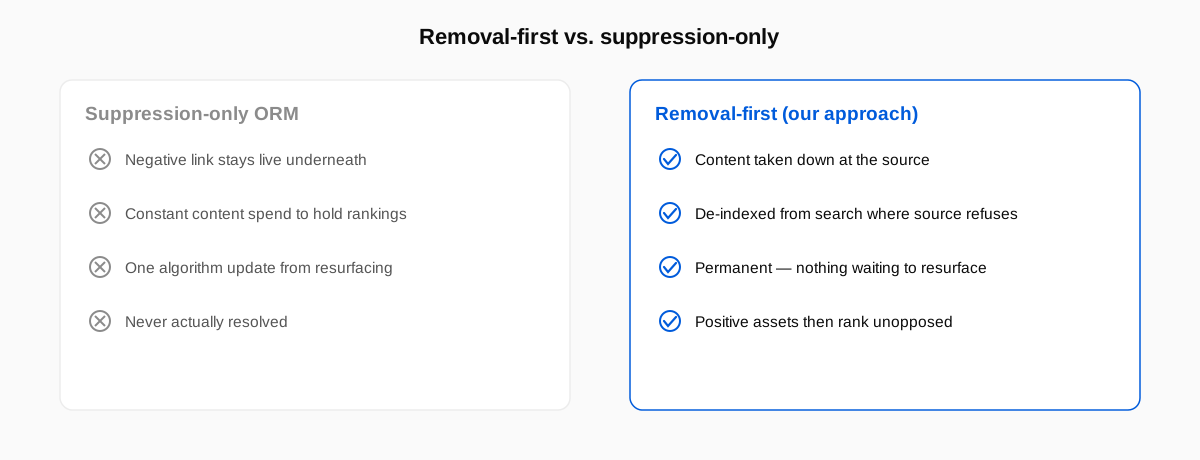
Neither is “the scam” and neither is “the answer.” The professional sequencing is: remove what can be removed first, then suppress what remains, then monitor. Removal shrinks the problem permanently; suppression manages what’s left; monitoring catches recurrence. Buyers get hurt when the order is inverted, paying open-ended retainers to suppress content that a finite project could have deleted.
The uncomfortable market reality: suppression retainers are recurring revenue and removals are one-time fees, so the market structurally over-recommends suppression. When a provider proposes a monthly plan, always ask the question that keeps them honest: “Which of these specific items could be removed outright instead, and what would that cost?” A provider who can’t or won’t answer item-by-item hasn’t done the analysis, or doesn’t like where it leads.
Key takeaway: Removal is permanent and finite; suppression is universal but ongoing. Always exhaust removal first, and treat any provider who pitches a retainer without an item-by-item removability analysis with caution.
Not sure which category your problem falls into?Our free confidential Exposure Scan tells you exactly what's removable, what would need suppression, and what each path costs, even if the right answer is a provider that isn't us.
Book Your Free ScanMatching provider type to problem type
Here is the practical crosswalk. Find your problem; the right category follows.
“My personal info is all over people-search sites.” DIY data-broker tool. Don’t pay professional rates for this unless it’s part of a broader threat picture (stalking, doxxing risk), where a specialist or protection retainer adds coordinated monitoring.
“Someone is reposting my photos/videos/content.” DMCA service if the volume is high and the claims are clean; a removal specialist if the host is hostile, notices are being contested, or the leak includes intimate images (which usually deserve a multi-lever approach, not just copyright).
“Someone wrote false, damaging things about me or my business.” Removal specialist first, defamation-related content often comes down via platform policy or negotiated routes without litigation. Escalate to a legal-route firm when the poster must be unmasked, refuses, or is worth suing. ORM only for whatever residue survives both.
“My mugshot / arrest record is ranking for my name.” Removal specialist. This niche has established removal paths, and a notorious scam history of extortion sites charging “removal fees” for content they themselves posted, so vet operators hard and never pay a site to delete its own post about you without advice.
“A news article about me ranks #1 and it’s accurate.” The hardest case, and the one where honesty matters most. True reporting by established outlets is rarely removable; some outlets have updating or de-indexing policies worth pursuing, and a specialist can assess that. Beyond it, this is suppression territory, a legitimate reputation management engagement, entered with clear eyes about ongoing cost.
“Bad reviews are hurting my business.” Policy-violating reviews (fake, off-topic, prohibited content) are removable and worth a specialist’s time at sufficient stakes. Genuine negative reviews are not a removal problem; they’re an operations and review-generation problem, and anyone selling you “guaranteed review removal” at scale is describing fraud.
“Content keeps coming back after every takedown.” You’ve outgrown project work. Recurring threats (serial harassers, leak communities, scraper networks) are what monitoring retainers exist for. Ours are Protection Plans, scoped to the exposure and quoted at member rates after a free scan; the market ranges from cheap alert tools to enterprise programs at five figures monthly.
“I don’t actually know how bad my exposure is.” Start with an assessment, not a purchase. Any serious firm will map your exposure before quoting; ours is free. What you learn determines everything above.
Get the map before you pick the vehicle.The free Exposure Scan inventories every harmful item, sorts removable from unremovable, and gives you honest pricing for each, no retainer pitch attached.
Book Your Free ScanWhat the categories cost, side by side
Honest market anchors, so no quote ever surprises you:
- DIY data-broker tools: roughly $99 to $300/year. Software, not service.
- DMCA services: per-notice fees to a few hundred dollars monthly for volume plans.
- ORM/suppression agencies: commonly ~$1,000 to $10,000+/month, open-ended; enterprise programs run five figures monthly.
- Legal-route firms: four figures for demand campaigns; five to six figures for litigation, plus time measured in months or years.
- Removal specialists: typically four figures per item. Our model: every link quoted individually, in writing, after a free assessment: complex/news cases priced case by case. Our removal work is scoped as projects that end. See what’s included.
- Ongoing protection retainers: from $99/month alert tools at the bottom of the market to five-figure enterprise retainers; our Protection Plans are quoted at member rates, scoped to the exposure.
Three pricing-model notes that apply across categories. Per-item project pricing aligns incentives with finishing, confirm what counts as an “item” and what happens if content returns. Retainers fit ongoing threats and suppression work, confirm the monthly deliverable, or you’re buying a subscription to reassurance. Contingency (“pay after removal”) shifts risk to the provider and is legitimate, but expect the highest per-item prices in the market, expect cherry-picked case acceptance, and get the definition of “removed” (host deletion vs. de-indexing, and for how long) in writing before you sign.
Key takeaway: Compare total cost to outcome, not sticker price. A $99 tool that can’t see your problem costs more than a professional removal that ends it, and an open-ended monthly retainer suppressing removable content costs most of all.
Frequently asked questions
Are internet removal companies legitimate?
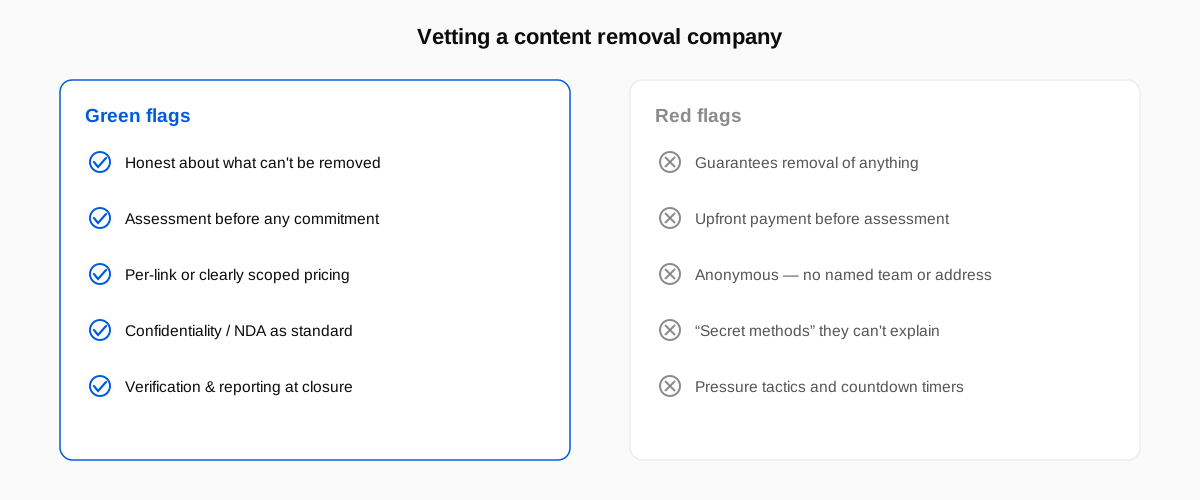
The legitimate core of the industry is real and effective, but the industry also has a documented scam fringe: fake “guaranteed removal” operations, anonymous outfits that take payment and vanish, and extortion schemes where the people charging removal fees are connected to the sites hosting the content. The reliable filters: named and verifiable operators, free substantive assessment before any quote, no blanket guarantees, no full-payment-up-front demands, and published evidence like case studies and reviews you can check.
What’s the difference between an internet removal company and a reputation management company?
Removal companies get specific content deleted or de-indexed, finite projects with permanent outcomes, limited by what platforms, publishers, and law allow. Reputation management companies primarily practice suppression, building positive content to outrank negatives, which works on almost anything but is ongoing and leaves the content in existence. Many firms sell both; what matters is the sequence. Removal-first is the client-aligned order, because every item removed is one you never pay to suppress.
Can these companies remove news articles?
Sometimes, and any firm claiming “always” is lying. Realistic paths exist, outlets with unpublishing or updating policies, articles that are defamatory or violate the outlet’s own standards, syndicated copies on low-standards sites, and de-indexing routes for certain content categories. Accurate reporting by major outlets is the hardest case and often cannot be removed; an honest firm says so at assessment, not after payment. News cases are quoted individually for exactly this reason.
How do I know if I need removal, suppression, or both?
It’s an item-by-item question, not a one-answer question. Inventory every damaging result, then ask of each: does a removal lever apply (policy violation, copyright, defamation, privacy statute, cooperative host)? Removable items get removed. Whatever survives, typically accurate press and official records, is suppression’s job, and recurring threats add monitoring. This triage is precisely what a professional assessment produces, and it’s what our free Exposure Scan delivers in writing.
Start with the diagnosis, not the vendor
The market map only matters once you know what’s actually out there about you, and most people discover their exposure is both worse in spread and better in removability than they feared. Our free, confidential Exposure Scan gives you the complete inventory: every item, its removability, the right provider category for it, and an honest quote for anything we’d handle ourselves. Book your free Exposure Scan and choose your internet removal company, whichever category it turns out to be, with the diagnosis already in hand.