
Digital privacy for ultra-high-net-worth families is a fundamentally different discipline from personal privacy for a wealthy individual. The unit of exposure is not a person; it is a household: principals, spouses, children, elderly parents, and the staff who move through their lives. Adversaries understand this instinctively. Someone researching a family does not stop when the patriarch’s information proves hard to find; they pivot to the spouse’s charity-board bio, the teenager’s tagged photos, the estate manager’s LinkedIn profile, the college student’s roommate. The family’s effective privacy is set by its most exposed member, and in almost every family we assess, that member is not the principal.
This is why individually purchased privacy tools and piecemeal cleanups consistently fail wealthy families. A principal with an immaculate digital footprint married to a spouse whose gala photos, alma-mater features, and people-search profiles map the family’s addresses and routines has, in practical terms, no privacy at all. The same is true of a family whose minor children’s schools, teams, and social accounts broadcast the weekly schedule that the parents so carefully keep out of view.
This guide defines the family attack surface as security professionals see it, explains the specific harm models, from extortion to virtual kidnapping, that family exposure enables, and describes what a genuinely family-wide protection program looks like when it is run by specialists rather than assembled from consumer products.
The family as attack surface: how adversaries actually research households
Threat actors (whether financially motivated criminals, fixated individuals, hostile litigants, or social-engineering crews) build what protection professionals call a pattern of life: who is in the family, where each member lives, works, and studies, how they move, and who has access to them. The internet assembles this dossier from sources no single family member controls.
The principal is usually the best-defended and least useful entry point. Wealth coverage, deal announcements, and board listings establish that the family is worth researching, but principals increasingly keep their direct footprint thin.
The spouse is frequently the connective tissue. Charity leadership pages, event photography, alumni features, and social profiles tie the family name to neighborhoods, schools, friendships, and causes. Data brokers link the spouse’s records to the principal’s, re-exposing addresses the principal spent years shielding, the correlation problem our data broker removal practice confronts daily.
Children are the highest-risk surface and the least protected. Minors appear in school directories, athletic rosters, tournament brackets, recital programs, and the social feeds of friends who tag freely. Teenagers self-publish location-rich content in real time. Adult children at universities have their own leases, their own broker profiles, and social histories that began before anyone taught them discretion. From an adversary’s perspective, a child’s exposure answers the most operationally valuable questions: where the family is predictably located, at what times, with what supervision.
Household and family-office staff complete the picture. An estate manager’s public résumé names the family or the property. A security driver’s profile reveals the protective detail’s existence and structure. A nanny’s social account documents the children’s routines. A contractor’s portfolio photographs the residence. Staff are not careless; they are simply operating under normal professional norms that were never designed for the households they serve.
Extended family (parents, siblings, cousins) carry the surname and the broker linkages without the security awareness, and are routinely used as pivot points to reach the core family.
Key takeaway: Adversaries research families laterally, not vertically. Hardening the principal while leaving the spouse, children, and staff exposed does not reduce the family’s risk; it merely redirects the research path.
Why family exposure converts into physical and financial risk
The reason ultra-high-net-worth families warrant a different standard of digital privacy is not sensitivity to attention. It is that, above a certain level of visible wealth, exposure changes the economics of specific crimes.
Kidnap and abduction risk logic. Physical abduction of a family member is rare precisely because it is hard: it requires knowing who to take, where they will be, and when they are unprotected. Family digital exposure erodes each of those difficulties. A tagged photo stream establishes routine; a roster establishes location and schedule; a broker profile establishes the home. Security professionals do not assess kidnap risk by asking whether a family is famous. They ask whether the reconnaissance is already done. For many families, the honest answer is yes.
Virtual kidnapping and family-emergency fraud. Far more common than physical abduction is its synthetic version: a call claiming a child or parent is being held, engineered for panic payment. These schemes are built entirely from open sources: the child’s name, school, travel dates, voice samples from public video, and the parents’ direct numbers from broker sites. With voice-cloning tools now trivial to use, the raw material for a convincing family-emergency scam is whatever the family has left findable. This is one of the clearest cases where removing personal data from circulation directly defeats a crime’s mechanics.
Extortion and coercion. Wealthy families are extorted through their members’ vulnerabilities: a teenager’s compromising content, an elderly parent’s romance-scam entanglement, a staff member’s leverage. Exposure maps who in the family is reachable and through what channel. Families targeted this way also face the follow-on problem of leaked or weaponized material, the territory of our doxxing and leaked-content removal work.
Social engineering against the family’s finances. Wire-fraud and account-takeover crews impersonate family members to family offices, assistants, and private bankers. Their scripts are written from public detail: travel visible on social media, relationships visible in tagged photos, phone numbers and emails from broker files. The family’s digital footprint is, quite literally, the fraud kit.
Fixated persons and household intrusion. Individuals who fixate on wealthy or visible families escalate along the path of available information. Every address, school, and routine that remains findable is a rung on that ladder.
Know exactly what's exposed, before someone else finds it.Free confidential Exposure Scan, live results on a 15-minute call, covered by strict confidentiality.
Book Your Confidential ScanWhy consumer privacy tools fail at the family level
Families who take this seriously often begin with the obvious moves: a subscription data-removal app for each adult, locked-down social accounts, a stern conversation with the teenagers. These steps are not worthless, but they fail structurally, for reasons worth understanding before investing further in them.
They protect accounts, not identities. Privacy settings govern what a platform shows; they do nothing about the broker records, archived pages, press mentions, school publications, and third-party photos where family exposure actually lives.
They cover individuals, not linkages. The family’s risk is relational: the fact that this spouse connects to this principal at this address with these children. Consumer tools process one name at a time and never see, let alone sever, the correlations.
They cannot handle the hard categories. Minor children’s data, staff-borne exposure, archived listings of the family residence, press coverage, forum chatter, and leaked material all require judgment, escalation, and sometimes coordination with counsel or platforms, none of which an automated opt-out service performs.
They have no threat model. A subscription tool treats a retired teacher and a billionaire’s household identically. Families with genuine adversary risk need prioritization: what would a kidnapper, an extortionist, or a fraud crew use first, and is that gone?
Nobody owns the whole. Perhaps most fundamentally: when privacy is a stack of individual subscriptions, no one is accountable for the family’s aggregate exposure. There is no baseline, no reporting, no answer to the question a principal or a family office risk lead actually asks, where do we stand?
Key takeaway: Family privacy is a program, not a product. It requires a single accountable party that sees the whole household, prioritizes by threat, handles the categories automation cannot, and reports against a baseline.
What a family-wide protection program looks like
When a specialist firm takes on an ultra-high-net-worth family, the engagement has a recognizable architecture, one that families and their advisors should expect and insist upon.
A household-wide exposure baseline. The work begins with a comprehensive audit across every family member and, with appropriate consent, key staff: broker and people-search profiles, address and property exposure, social and tagged-photo footprints, school and organization publications, press references, forum and paste-site mentions, and the linkage map that connects them. For most families this is the first time anyone has seen the full picture, and it reframes the conversation immediately.
Threat-prioritized remediation. Removal proceeds in the order an adversary would exploit, not the order a checklist suggests: home addresses and children’s identifiers first; direct-contact channels and routine-revealing content next; historical and reputational material after. Each category is worked through the mechanisms appropriate to it: broker suppression cycles, platform processes for minors’ data, publisher outreach, search-layer suppression for what cannot come down.
Generational coverage. A serious program covers three generations by design. Elderly parents, who are both scam targets and record-rich linkage points. Principals and spouses, and children, with age-appropriate handling that protects minors now and prepares young adults to inherit a defensible footprint rather than a documented one. As children reach independence, coverage follows them, because adversaries certainly will.
Staff and perimeter protocols. The program extends to the household’s human perimeter: discreet guidance and exposure review for staff whose public profiles touch the family, and vendor-facing standards for photography and publicity. This is done with tact. The goal is a protected household, not a surveilled one.
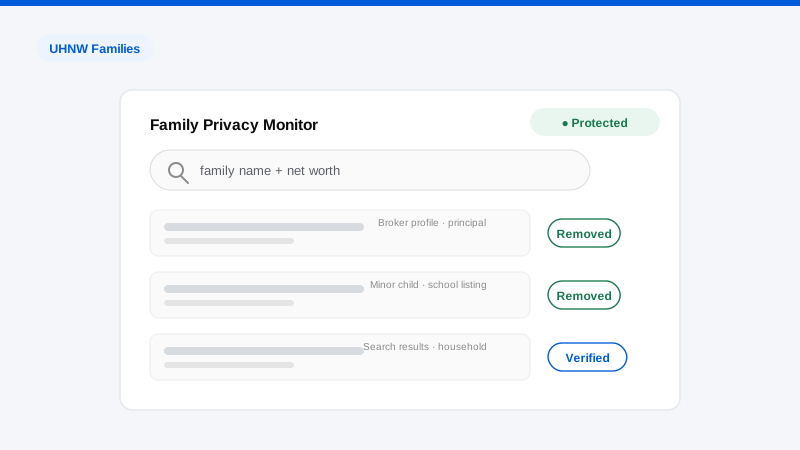
Continuous monitoring and standing response. Broker records regenerate. Children post. Events get photographed. A family under real protection is monitored continuously, the function of our reputation and exposure monitoring, with a standing response capability for the day something acute appears: a doxxing attempt, a leak, an emerging story. Families on our protection plans are not starting from zero when that day comes; they are calling a firm that already holds their baseline.
Discretion as an operating principle. Every element of the engagement is handled confidentially: communications, work product, even the fact of the engagement. Removal requests do not carry the family’s fingerprints. For families whose privacy is the asset being protected, the protecting firm must itself be quiet, which is the standard our private client practice is built around.
Know exactly what's exposed, before someone else finds it.Free confidential Exposure Scan, live results on a 15-minute call, covered by strict confidentiality.
Book Your Confidential ScanDigital privacy for ultra-high-net-worth families is now part of the security stack
A decade ago, family security meant physical measures, insurance, and perhaps media training for the principal. Today, every serious family security review (whether run by an executive-protection firm, an insurer, or the family office itself) includes digital exposure, because every physical and financial threat now begins online. The families that handle this well treat digital privacy the way they treat their other institutional functions: professionally delivered, continuously maintained, quietly reported, and owned by a specialist rather than improvised by an assistant.
It bears repeating what a reputable specialist will and will not say. No firm can promise a family total erasure, and no honest practitioner guarantees outcomes controlled by third-party platforms. What a specialist firm delivers is the full picture, removal of what is removable, suppression of what is not, severed linkages where they can be severed, and permanent watch over the rest, with the judgment to know which is which. That combination is what changes a family from an open book into a hard target.
Key takeaway: The question a family should ask is not “are we private?” but “who is accountable for knowing?” If no single party holds the household’s complete exposure picture and maintains it, the family’s privacy is an assumption, not a fact.
Frequently asked questions
Our family keeps a low profile. Do we still need a family-wide privacy program?
A low public profile and low exposure are different things. Families who never seek press are still documented by data brokers, property records, school publications, event photography, and relatives’ social media, none of which required the family’s participation. The only way to know whether a quiet life has produced a quiet footprint is to audit it; in our experience, discreet families are often the most surprised by what a scan reveals, precisely because they assumed silence equaled invisibility.
How do you handle our children’s information, including accounts we don’t control?
Children’s exposure is addressed through the channels appropriate to each source: platform processes that give special weight to minors’ data, direct outreach to schools and organizations that publish rosters and photos, broker suppression for the records that attach children to household addresses, and family-facing guidance for the content the children themselves control. For adult children, coverage works like any principal engagement, with additional attention to the social history accumulated before protection began. No firm can control what a third party posts tomorrow, which is exactly why monitoring is part of the program rather than an add-on.
Does a family privacy program include household staff?
The core engagement covers family members; extending review and guidance to key staff (estate managers, assistants, security personnel, nannies) is common and recommended, always with the staff member’s knowledge and consent. The purpose is not oversight of employees but closure of a known research path: staff public profiles are one of the most reliable pivots adversaries use to reach a family, and modest, respectful adjustments usually resolve them.
How is this different from the privacy services our family office already subscribes to?
Subscription data-removal services automate opt-outs for individual names across a set of broker sites. That is one layer of one family member’s exposure. A family-wide program adds what automation cannot: the linkage analysis that connects family members to each other and to addresses, children’s and staff exposure, property and press material, judgment-driven escalations, acute-incident response, and a single accountable relationship with consolidated reporting. Many of our family-office clients keep a subscription tool in place for baseline hygiene; none consider it protection.
Every family is one search away from knowing where it stands. A confidential Exposure Scan shows you (live, on a 15-minute call) what an adversary researching your household would find today: the addresses, the linkages, the children’s exposure, the open doors. It is free, covered by strict confidentiality, and conducted by the team that would close those doors. Book the call before someone else does the research.