
You can sue someone for false accusations when the statement is a false assertion of fact, published to a third party, identifies you and causes provable harm, with defamation as the core claim. Public figures must also prove actual malice. Because circulation damages you faster than the accuser, containment through takedowns and de-indexing often comes before any lawsuit.
Key facts
- New York City Bar guidance frames the claim around four elements: false statement, identification, publication, reputational damage.
- Truth is an absolute defense and statements of opinion are generally not actionable.
- Private figures typically prove negligence; public figures must prove knowledge of falsity or reckless disregard.
- Three first questions: was a factual claim made, was it communicated beyond the accuser, can you prove concrete harm.
Where ContentRemoval.com comes in. ContentRemoval.com handles the circulation side of a false accusation: platform reports, publisher pressure, source removal and de-indexing so the allegation stops spreading through search and reposts while counsel decides whether to sue. Executives, founders and their lawyers usually make contact together, often the morning a board member forwards the screenshot. A free 15-minute Exposure Scan maps what is removable, and the report is yours to keep. Get a Free, Confidential Exposure Scan or read how our content removal work is done.
Your phone is already telling you what matters. A board member forwards a screenshot. A journalist asks for comment. Human resources says a complaint has been filed. Search results start surfacing a post that didn’t exist yesterday. At that point, the question isn’t abstract. It is brutally practical: can you sue someone for false accusations, and if you can, will that protect your name, your company, and your standing?
Yes, sometimes you can. But a lawsuit is only one instrument, and often not the first one I’d reach for.
For a high-profile client, false accusations create two parallel problems. One is legal. The other is reputational, which usually moves faster and causes damage before any court can help you. That distinction matters because a weak legal case can still cause severe commercial harm, and a strong legal case can still be the wrong strategic move if filing suit gives the accusation a second life.
Responding to a False Accusation
The first mistake people make is emotional overreaction. They fire off a text, post a thread, call the accuser a liar in public, or threaten a lawsuit before they’ve preserved evidence. That usually makes the situation worse.
A false accusation can appear in several forms at once. A social post turns into workplace gossip. A private complaint leaks to the press. An anonymous forum post gets indexed by search engines and starts appearing beside your name. For an executive, founder, or public-facing professional, the speed of spread is often more dangerous than the initial statement.
A widely cited review of sexual-assault case files found that 8 of 136 reported cases over a 10-year period were coded as false allegations, a 5.9% rate, and the same analysis stated that prior research places false allegations in a broader 2% to 10% range according to the National Sexual Violence Resource Center summary of the underlying review. That doesn’t mean false accusations are common. It means they are real, legally consequential, and impossible to dismiss when your own name is attached.
Practical rule: A denial is not a defense strategy. It is only your position. Strategy starts when you secure proof.
If you’re dealing with an accusation that has online traction, start by preserving the record and controlling distribution. Archive posts, comments, direct messages, timestamps, profile names, and any republication by third parties. Then separate the audiences involved: employer, investors, customers, media, family, and platforms. Each requires a different response cadence.
For online spread, this strategic guide on what to do if someone is posting lies about you online is a useful starting point because it focuses on executive-level response rather than generic internet advice. If the accusation intersects with military service or UCMJ exposure, this guide for service members facing false allegations is worth reviewing for procedural pressure points and evidence preservation logic.
What to do in the first hours
- Freeze the evidence: Capture screenshots, URLs, dates, usernames, and any edits or deletions you can identify.
- Stop casual communication: Don’t negotiate facts by text, don’t post emotional rebuttals, and don’t try to out-shout the allegation online.
- Determine the core issue: Ask whether the immediate threat is employment loss, investor panic, media pickup, family fallout, or search visibility.
- Get counsel before escalation: The wording of your first formal response can affect defamation, employment, and platform-removal options.
The right response is controlled, not loud.
Understanding Your Legal Grounds for Action
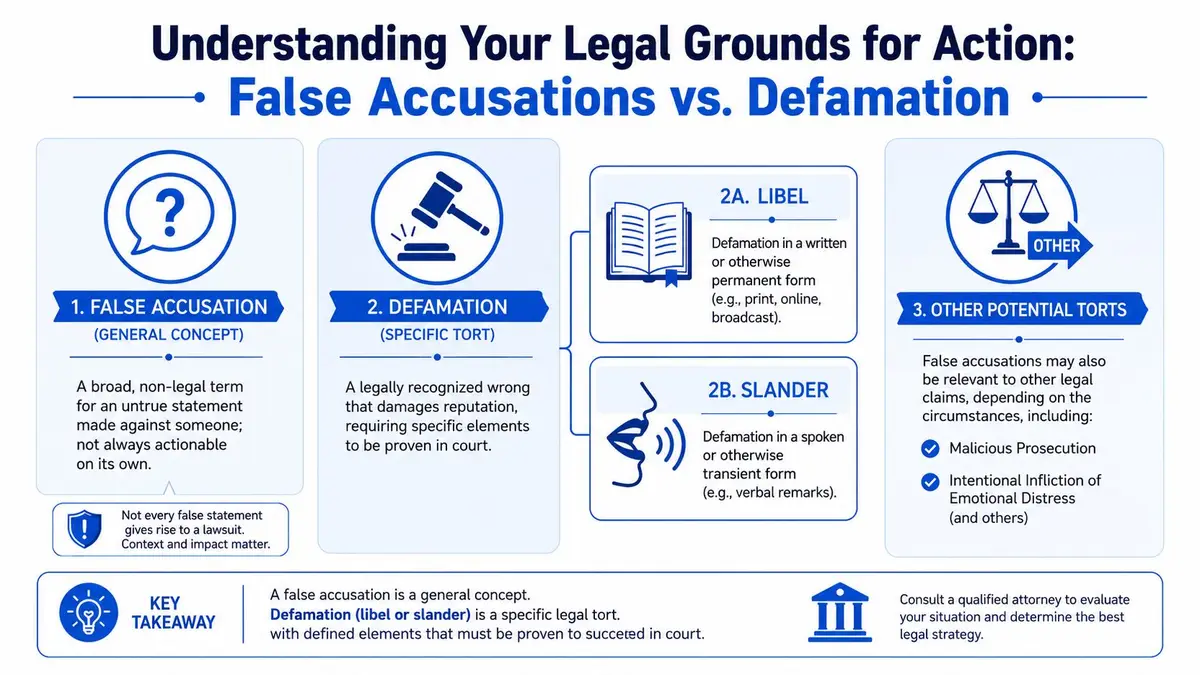
Suing over a false accusation usually means suing under a recognized civil claim. The one that matters most is defamation. Clients often use “false accusation” as the umbrella phrase, but courts don’t. Courts look for a specific cause of action with specific elements.
Defamation is the core claim
In most common-law settings, the clearest path is defamation. That means a false statement of fact was communicated to someone else, identified you, and caused harm. The form of the statement affects how the claim is framed.
| Claim type | Typical form | What it usually covers |
|---|---|---|
| Libel | Written or otherwise fixed statements | Articles, posts, emails, reviews, captions, screenshots, newsletters |
| Slander | Spoken or transient statements | Verbal allegations in meetings, calls, events, interviews |
| Other torts | Context-specific | Claims where false accusations are part of a larger wrong |
A LinkedIn post accusing a founder of criminal conduct is usually a libel problem. A whispered allegation to investors at a dinner can become a slander problem. A knowingly false police report can also trigger other legal theories depending on the facts, but defamation is still where many viable civil cases begin.
Don’t confuse offense with actionability
Not every ugly statement is actionable. If someone says, “I think he’s unethical,” that may be opinion. If someone says, “He stole client money,” that’s a factual assertion and far more dangerous. The difference is not semantics. It determines whether a court can intervene.
Some jurisdictions also recognize related claims such as false light, malicious prosecution, or intentional infliction of emotional distress in certain fact patterns. Those claims are not interchangeable with defamation and shouldn’t be pleaded casually. The publication method, the audience, and the exact wording decide the path.
The legal label matters because it determines the proof you need, the defenses you’ll face, and whether the case has settlement value.
If you need a sharper breakdown of online publication issues, this guide to what constitutes online defamation is useful because online accusations often blur the line between publication, republication, commentary, and platform amplification.
My blunt advice
Don’t ask, “Was I falsely accused?” Ask these three questions instead:
- Was a factual claim made?
- Was it communicated beyond the accuser?
- Can I prove concrete reputational or business harm?
If the answer to those questions is weak, litigation may be a poor use of time. If the answers are strong, you may have a strong case.
The Four Pillars of a Defamation Claim
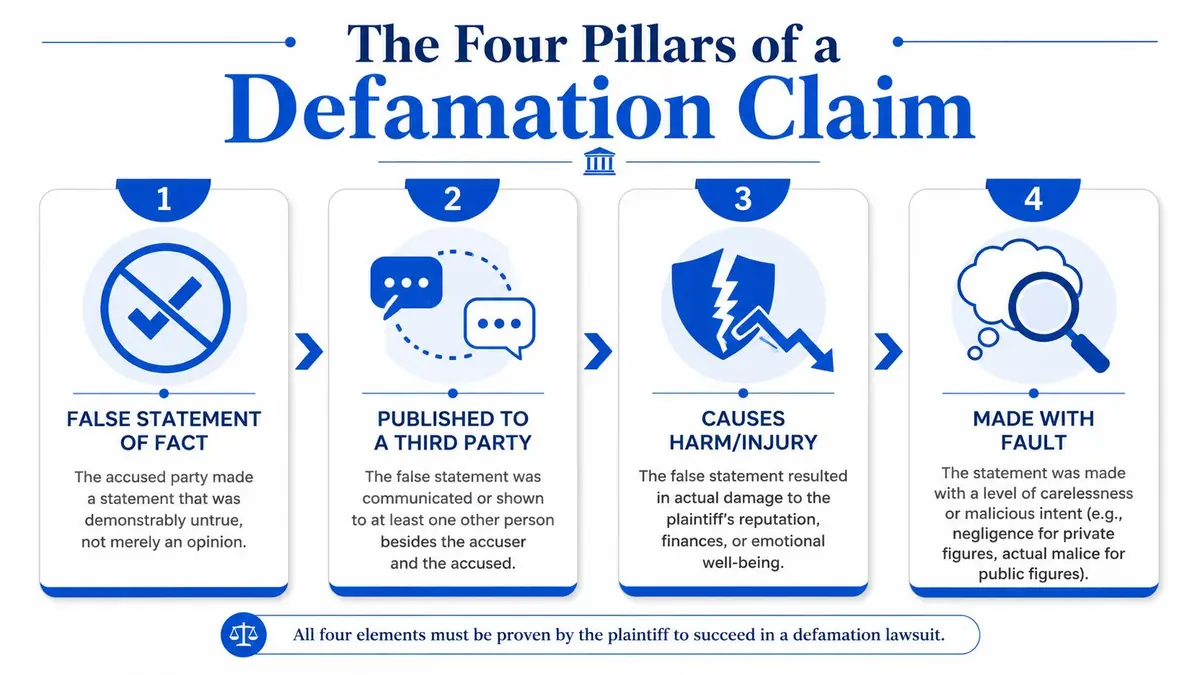
New York legal guidance frames a false-accusation defamation claim around four elements: a false statement, identification of the target, publication to at least one third party, and reputational damage. The same guidance also states that truth is an absolute defense and that statements of opinion are generally not actionable, as explained by the New York City Bar guidance on false accusations.
That framework is clean, and clients should think about it exactly that way. If one pillar is missing, the case weakens fast.
False statement of fact
The law cares about falsity, not outrage. “I believe she is dangerous” may be protected opinion depending on context. “She fabricated billing records” is a factual claim that can be tested against documents and witness evidence.
For executives, this usually surfaces as allegations of fraud, harassment, theft, abuse, or professional misconduct. The statement must be capable of being proven false. If it can be checked against records, you’ve got something the court can work with.
Identification and publication
The statement must be about you, and someone else must have received it. Naming you directly makes this easy. So does enough detail that a reasonable audience knows who is being accused.
Publication is broader than many clients assume. A direct message to one investor can qualify. An email copied to a small leadership group can qualify. A post seen by the public obviously qualifies.
To ground this visually, this summary is useful:
Harm and fault
Courts also want to see injury. For high-profile individuals, that may mean a lost deal, a cancelled speaking invitation, board pressure, a recruiting setback, adverse press inquiry, or reputational deterioration traceable to the accusation.
Fault matters too. In some cases that means showing carelessness. In others, the hurdle is much higher. That issue becomes decisive when the plaintiff is prominent.
A defamation case succeeds when you translate humiliation into proof. Courts don’t award relief because the accusation felt devastating. They award relief when the evidence shows it was false, published, and harmful.
What courts tend to look for
- Falsity grounded in records: Contracts, emails, HR files, travel logs, access records, receipts, or other contemporaneous materials.
- Clear identification: Your name, title, photo, company role, or details that unmistakably point to you.
- Third-party exposure: Forwarded emails, reposts, articles, comments, witness accounts, or internal circulation.
- Business impact: Lost opportunities, damaged negotiations, client concerns, or documented professional consequences.
That is the difference between “I was attacked” and “I can prove defamation.”
The Public Figure Hurdle and Actual Malice
If you’re well known, run a visible company, speak publicly, or have a meaningful media profile, your case may be harder than you expect. The law gives public figures less room to sue because it places a higher burden on them.
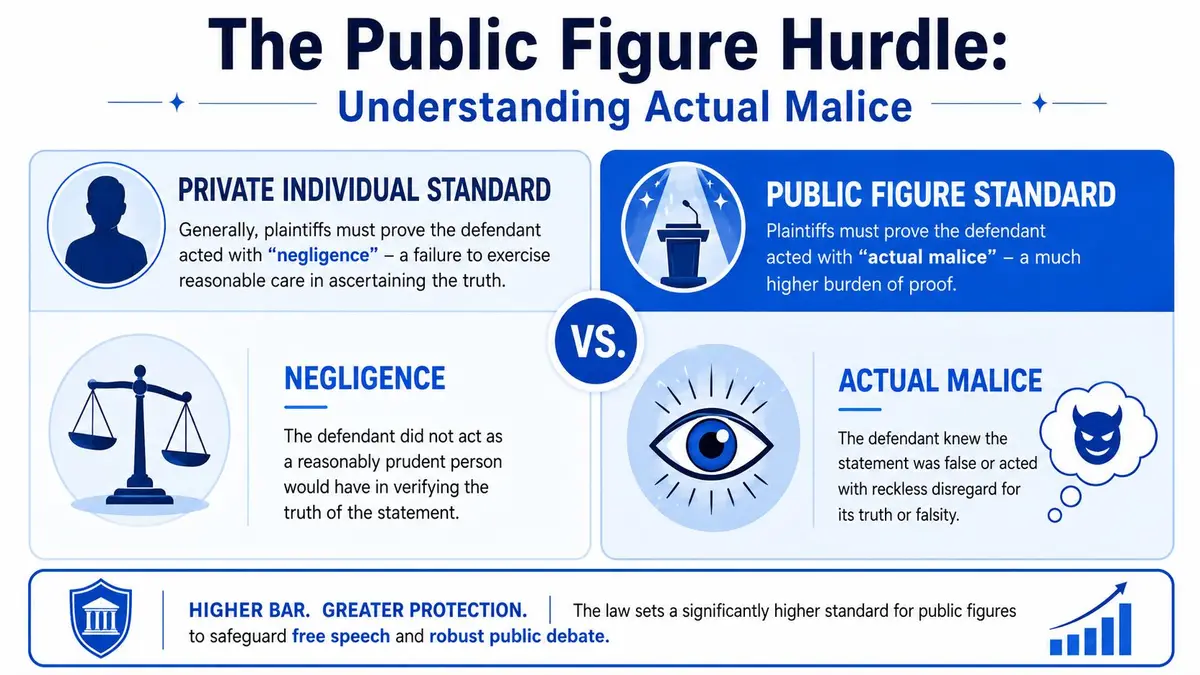
According to this overview of false accusations and defamation standards, private figures typically need to prove negligence, while public figures usually must prove actual malice. In plain English, negligence asks whether the speaker failed to use reasonable care before making the statement. Actual malice asks whether the speaker knew it was false or acted with reckless disregard for the truth.
Why this changes your case
For a private individual, the argument may be straightforward: the accuser ignored obvious contradictions, failed to verify basic facts, or repeated a claim carelessly.
For a public figure, that’s often not enough. You may need evidence showing the accuser had reason to know the allegation was false and pushed it anyway, or deliberately avoided the truth while publishing a damaging claim. That usually requires a deeper record.
| Plaintiff status | Fault standard | Strategic focus |
|---|---|---|
| Private figure | Negligence | Failure to verify, careless repetition, ignored contradictions |
| Public figure | Actual malice | Knowledge of falsity, reckless disregard, internal evidence of awareness |
What actual malice can look like
Actual malice isn’t about personal dislike. It isn’t proven just because someone hated you. It turns on the speaker’s relationship to the truth.
Relevant evidence may include:
- Contradictory messages: Private texts or emails showing the accuser admitted uncertainty or inconsistency.
- Ignored documents: Records sent to the accuser that disproved the claim before publication.
- Deliberate avoidance: Refusal to review obvious evidence while making a serious accusation publicly.
Public prominence gives you influence. It also gives the other side legal room unless you can prove they crossed the line knowingly or recklessly.
That is why many public figures have technically valid grievances but commercially weak lawsuits. The statement may be false. The damage may be severe. Yet if you can’t prove the required level of fault, the litigation value drops.
Assembling Your Arsenal of Evidence
Not in a press statement. Not in a demand letter full of adjectives. Cases are won or lost in the file.
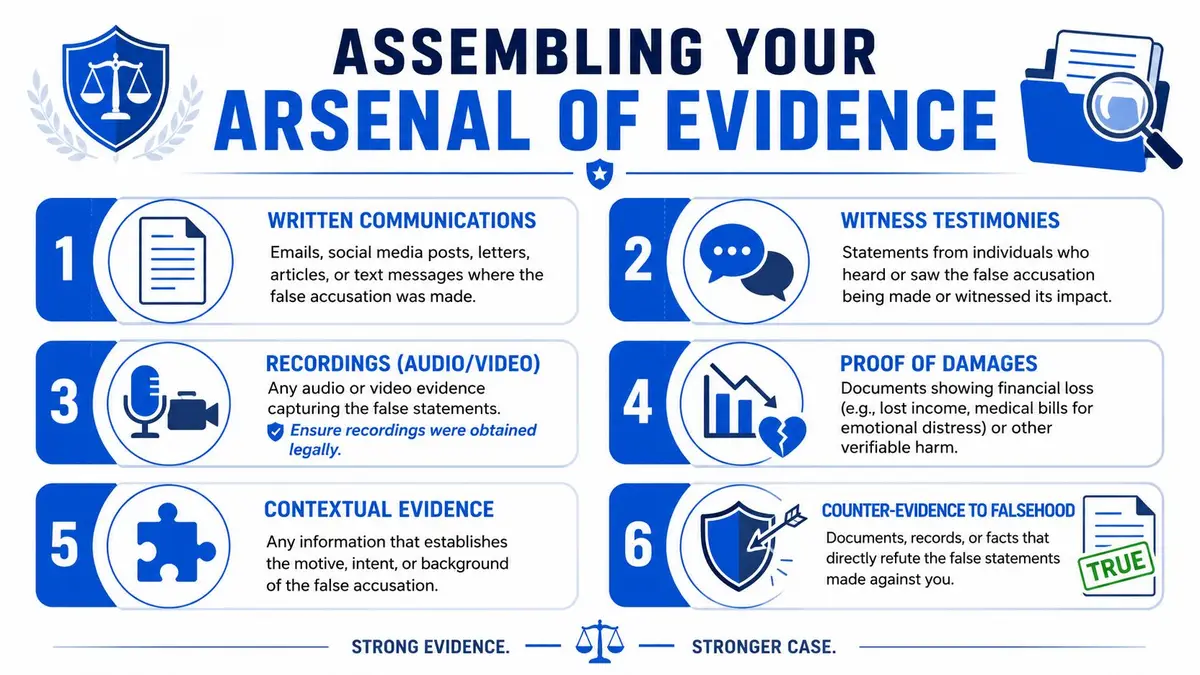
Practical guidance on these cases emphasizes that viability often depends on witness statements, digital communications, surveillance footage, employment records, or proof of income or reputation loss, and that public figures need especially strong evidence because of the higher fault hurdle, as noted in this discussion of proof and damages in false-accusation cases.
What to collect first
Start with the accusation itself in its original form. Save the URL, screen-record the page, capture surrounding comments, and note who published it and when. If it was spoken, identify everyone who heard it and write down the timeline immediately.
Then move to direct contradiction.
- Digital communications: Emails, text messages, DMs, Slack messages, calendar entries, and metadata that undercut the accusation.
- Third-party proof: Witness statements, attendee lists, call records, travel records, meeting logs, or security access data.
- Independent records: Surveillance footage, employment records, invoices, contracts, booking confirmations, or HR documentation.
- Damages materials: Lost client correspondence, paused transactions, rescinded invitations, therapy invoices, professional cleanup costs, and search-result captures showing publication impact.
Preserve before you persuade
Clients often want to send legal threats immediately. Sometimes that’s right. Often it isn’t. If you alert the accuser too early, they may delete posts, scrub messages, or align stories with others.
A disciplined evidence hold can matter more than your first response. If investigators are needed, use them carefully and lawfully. The mechanics of gathering corroborating material can be surprisingly technical, and this guide to cohabitation case investigations is useful for understanding how professional investigators think about timelines, records, and verification methods.
Preserve the ugly facts too. If part of the accusation is true, your strategy must account for it. Selective honesty destroys credibility faster than the allegation itself.
What executives usually miss
The missing file is often the damages file. People preserve the lie and forget to preserve the fallout.
Create a parallel damages record with:
- Commercial impact evidence such as delayed deals, investor concerns, customer churn discussions, or recruitment withdrawals.
- Reputational spread evidence such as media inquiries, search captures, reposts, and internal company circulation.
- Remediation cost evidence such as legal review, forensic support, counseling, or reputation repair expenses.
If you can’t show consequence, your legal claim may exist but remain economically weak.
Beyond Litigation Immediate Reputation Defense
A CEO wakes up to a false allegation ranking on page one, board members forwarding screenshots, and a reporter asking for comment before markets open. At that point, filing a lawsuit is not the immediate problem. Containing distribution is.
The first line of pressure
Use legal pressure early, but use it with a removal plan. A well-drafted cease-and-desist letter can force choices on a rational target. It should demand preservation, retraction, non-republication, and disclosure of who received the accusation. It also creates a record of notice, which strengthens your position if the speaker repeats the claim.
That alone will not clean up search results, copied posts, anonymous reposts, or commentary built around the allegation. For online incidents, this strategic guide to removing defamation from the internet for executives explains the operational side that many trial lawyers ignore.
Speed matters here.
Every day harmful content stays live, it reaches investors, customers, recruiters, donors, licensing bodies, and journalists who will never read your future complaint or your eventual win.
Faster remedies that often matter more
Start with the point of distribution. If the allegation sits on a platform, file a policy-based report. If a trade publication, blog, or gossip site repeated it without checking facts, press the publisher directly. If search visibility is driving the commercial harm, focus on source removal and de-indexing before you turn a private dispute into a public lawsuit.
Services like ContentRemoval.com handle false allegations, defamatory reviews, de-indexing, and other harmful online content through removal and visibility-reduction processes. That is not a substitute for a legal claim. It is a separate response track, and for high-profile clients it is often the one that protects value fastest.
The key business question is simple. What damages you more right now: the speaker, or the circulation?
Who you should target first
The right first target is usually the actor controlling reach, not the person who first said it.
| Problem source | Often the best immediate move |
|---|---|
| Original accuser | Preservation demand, legal notice, negotiated retraction |
| Publisher or site owner | Correction demand, takedown request, counsel-to-counsel pressure |
| Platform or search layer | Policy reporting, de-indexing requests, escalation under harmful content rules |
Clients often fixate on punishment. I focus on containment. If the accusation is spreading through search, social reposts, newsletter mentions, or internal forwarding inside your industry, a lawsuit may help later. Immediate reputation defense protects the asset under attack now.
The Strategic Choice Litigate or Remediate
By the time clients reach me, they usually want vindication. I understand that. But vindication and strategy are not always the same thing.
When litigation makes sense
Sue when you have strong proof, a viable defendant, measurable harm, and a reason to create public consequences. That may include forcing disclosure, deterring future repetition, obtaining a formal judgment, or correcting a narrative that is already public and entrenched.
Litigation can also work when the accuser has assets, insurance, a professional license, or institutional exposure that creates a settlement advantage. Without this advantage, even a righteous case can become an expensive exercise.
When remediation is smarter
Don’t sue just because you’re angry. Don’t sue because your team wants to “send a message.” If the filing itself will attract coverage, validate a fringe allegation, or expose private facts in discovery, the cost may exceed the benefit.
For many executives, the better outcome is quieter. Remove the content. Cut off republication. Stabilize stakeholders. Repair search results. Preserve the file in case you need to sue later.
The best result is often not a courtroom win. It’s a situation that stops getting worse, then disappears from public view.
A false accusation creates pressure to act visibly. Resist that impulse. Act precisely instead. The right answer depends on who said what, where it spread, what you can prove, and what outcome you value. Public exoneration is one goal. Speed, discretion, and containment are others. For most high-profile people, those latter goals are often worth more.
If a false accusation is already affecting your name, business, or search results, get a confidential assessment from ContentRemoval.com. The right plan may involve legal action, platform pressure, de-indexing, source removal, or all of them at once. What matters is speed, discretion, and a response built around evidence rather than emotion.
Frequently asked questions
What should I do first when someone falsely accuses me online?
Freeze the evidence with screenshots, URLs, dates, usernames and any edits, stop casual communication and public rebuttals, identify the immediate threat such as investor panic or search visibility, and get counsel before any formal response. The article stresses that a denial is a position, not a strategy.
Is a false accusation the same as defamation?
Not automatically. Courts look for a specific cause of action, and defamation requires a false statement of fact rather than opinion. Saying someone is unethical may be protected opinion; saying they stole client money is a factual assertion that can be tested and, if false, actionable.
Who should I target first, the accuser or the websites spreading the accusation?
Usually the actor controlling reach. The article suggests a preservation demand or legal notice to the original accuser, correction and takedown demands to publishers, and policy reports or de-indexing requests at the platform and search layer, with containment prioritized over punishment.