
A Yelp review removal service works through policy-based disputes with Yelp Trust and Safety, not private back channels. Yelp removes reviews only for clear content guideline violations such as conflict of interest, private information, threats or non-customer posts, never because a review is negative or inaccurate. Reported success rates are low, so containment and response planning run in parallel.
Key facts
- Yelp states negative reviews cannot be removed by buying advertising or hiring private takedown vendors.
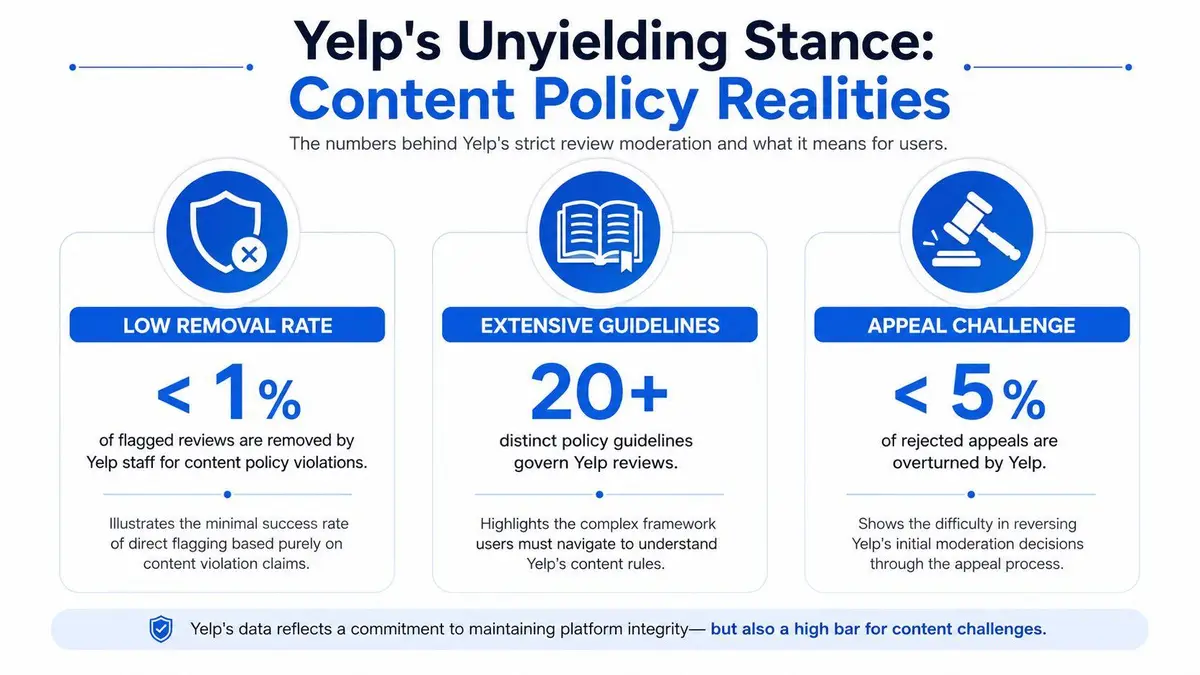
- As of 2022 Yelp reported a 3% success rate for reviews flagged by businesses, targeted violation reports average about 10%.
- Strong grounds are conflict of interest, irrelevant content, hate speech or harassment, and private information.
- Third-party services may charge $425 to $550 per successful removal, and court-ordered removal is rare.
Where ContentRemoval.com comes in. ContentRemoval.com handles Yelp matters the way this post describes, as a case file: viability assessment, evidence assembly, a report drafted to a specific policy violation, then escalation, response planning and monitoring for reposts if Yelp declines. A general counsel, head of marketing or the founder usually makes the first call. A free 15-minute Exposure Scan maps which reviews have a viable route and which need containment, and the report is yours to keep. Get a Free, Confidential Exposure Scan or read how our review removal work is done.
You see the review before your team does. It’s detailed, angry, and confident. It names people. It hints at misconduct. It may be false, or half true in the most damaging way possible. By the time your general counsel, chief of staff, or head of marketing sends the internal thread, the main issue isn’t whether the post is “fair.” The issue is whether a public accusation is now the first impression for customers, investors, recruits, referral partners, and journalists.
That’s why a Yelp problem should never be handled like a routine customer service complaint. A bad review on a high-visibility business profile can become a brand governance issue within hours. If the review targets an executive personally, references internal staff, or alleges unlawful conduct, it also becomes a personal risk issue.
Most executives make the same mistake at this stage. They either overreact and threaten, or they underreact and let a weak internal process drag on. Both are expensive. Yelp is not a platform where volume, outrage, or status gets you special treatment. You need a disciplined decision process that separates reviews you can realistically remove from reviews you must strategically contain.
The Executive’s Dilemma with a Malicious Yelp Review
A founder of a premium service business calls after a board meeting. Revenue isn’t collapsing. The phones are still ringing. But a single review has changed the tone of every conversation. Prospects ask different questions. Existing clients want reassurance. Employees start wondering whether leadership can control the narrative around the company.
That’s the actual executive dilemma. The damage rarely arrives as a dramatic collapse. It arrives as friction. More scrutiny in sales calls. More hesitancy from referral sources. More brand drag in a market where trust compounds or erodes subtly over time.
A useful framing comes from Sift AI’s reputation management guide, which treats reputation as an operational asset rather than a cosmetic concern. That’s the right lens. Yelp reviews sit at the intersection of discoverability, trust, and conversion. If a malicious or fabricated review gains visibility, the question isn’t whether it’s emotionally upsetting. The question is whether it’s now impairing a revenue-producing asset.
What pressure looks like inside the business
The CEO wants it gone immediately. Marketing wants to respond publicly. Legal wants to assess defamation exposure. Operations wants to identify the customer, if there was one. None of those instincts is wrong. The problem is sequencing.
A well-developed response starts with triage:
- Exposure: Is the review ranking prominently on the Yelp profile or appearing in branded search behavior?
- Content risk: Does it include threats, full names, accusations of crimes, privacy breaches, or competitor language?
- Business sensitivity: Does the review hit a regulated service line, a key location, or a decision-maker’s personal reputation?
Practical rule: Treat the first review assessment like incident response. Preserve evidence, limit internal speculation, and decide quickly whether you’re pursuing removal, rebuttal, or parallel containment.
If the post can’t be removed, you still need to control downstream trust. That’s where a broader recovery plan matters. A strong framework for that is this guide on rebuilding trust with customers after bad reviews. Removal is one lever. Trust repair is the larger mandate.
The Hard Reality of Yelp’s Content Policies
Most business owners still believe some version of the same myth. If a review is false enough, harmful enough, or costly enough, Yelp will eventually “do the right thing” and remove it. That belief leads to wasted time, poor escalation decisions, and easy exploitation by vendors selling fantasy.
Yelp’s position is much stricter than most executives expect. Yelp explicitly states that negative reviews can’t be removed by paying for advertising or using private takedown vendors, and that reviews are removed only when they clearly violate content guidelines, not because they’re negative, inaccurate, or commercially damaging, according to the cited policy summary and platform statements documented here. The same source states that, as of 2022, Yelp reported a 3% success rate for review removals flagged by businesses.
Why Yelp is designed to resist pressure
Yelp’s business model depends on appearing resistant to manipulation. That matters more to the platform than your view of fairness in any particular case. If users suspect businesses can buy cleaner profiles, Yelp loses credibility. So the system is built to reject exactly the kind of influence many executives assume will work.
That has two consequences.
First, paying Yelp for advertising won’t remove a review. Second, hiring a Yelp review removal service doesn’t create a private back channel that overrides policy. Any credible provider is still working through policy arguments, evidence, and platform procedures. Anyone promising guaranteed deletion for lawful but negative speech is selling fiction.
What Yelp will and will not care about
Use this distinction:
| Yelp tends to ignore | Yelp may act on |
|---|---|
| “This review is unfair” | “This review contains a specific policy violation” |
| “This statement hurts our business” | “This reviewer was not a customer” |
| “The reviewer misunderstood what happened” | “This post includes threats, hate speech, or private information” |
| “We spend money on the platform” | “This review breaches a non-negotiable content rule” |
Yelp doesn’t moderate for business pain. It moderates for rule violations.
Executives need to absorb that early. If your team spends a week drafting emotional rebuttals about lost revenue, Yelp won’t care. If your team submits a concise, evidence-backed report tied to a precise policy violation, you at least have a viable path.
Identifying Viable Grounds for Removal
The right question isn’t “Can this review be removed?” The right question is “What exact policy or legal theory gives us an advantage?” That shift changes everything. Effective Yelp review removal service work is not persuasion in the abstract. It is issue-spotting.
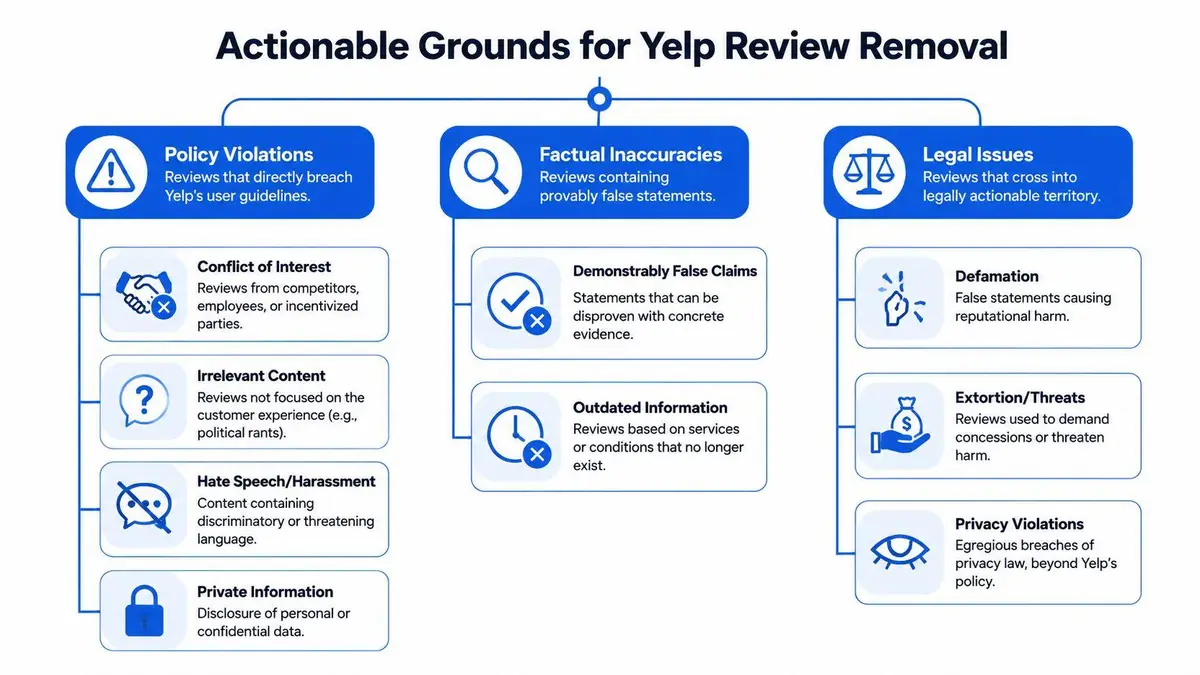
Professional services in this area work through policy-based disputes with Yelp Trust & Safety, and targeted reports for clear violations such as privacy breaches or threats have been cited as having a higher success rate, averaging approximately 10%, because they trigger specific enforcement rules rather than general complaints about unfairness as described here.
Policy violations that create real leverage
Some categories are much stronger than others.
- Conflict of interest: Reviews posted by competitors, former employees, vendors with a stake in the outcome, or anyone with a concealed relationship to the business.
- Irrelevant content: Political commentary, personal vendettas, or posts that don’t describe a customer experience at all.
- Hate speech or harassment: Discriminatory language, direct abuse, or language that crosses into threats.
- Private information: Full names of staff, personal contact details, confidential information, or identifying details that should never be public.
Privacy issues deserve special attention. If a review includes a team member’s full name or other identifying data, that often gives you a cleaner reporting path than arguing over whether the reviewer’s opinion is wrong.
Factual falsehoods versus legally actionable falsehoods
Not every false statement is useful. Yelp often leaves up reviews that contain disputed accounts of events, exaggerated impressions, or subjective judgments. “Terrible service” isn’t removable because you disagree. “The doctor wasn’t licensed” or “the company stole my deposit” can become far more serious if demonstrably false.
Use this internal filter:
- Can you disprove the statement with records?
- Is the statement factual rather than opinion?
- Did the statement cause material reputational harm?
If the answer is yes across all three, you may have a stronger platform report and, in some cases, a legal claim.
The strongest removals usually come from narrow arguments, not broad indignation.
Defamation, extortion, impersonation, and serious privacy breaches sit in a different category from ordinary review disputes. So do situations where the reviewer was never a customer. If your team hasn’t separated those categories, they’re still operating at the wrong altitude.
For a more focused framework on fabricated posts and evidentiary strategy, this resource on removing fake reviews for executives and founders is worth keeping close.
The Professional Removal Process Explained
A credible Yelp review removal service should operate like a case team, not a call center. If the provider’s strategy begins and ends with “we’ll flag it for you,” you’re not hiring expertise. You’re outsourcing a click.
The right process starts with classification. The effectiveness of any takedown action depends on a strategic analysis of the hosting location of the content, the specific violation type, and the legal jurisdiction governing the host, because a generic delete request fails without that targeted assessment as outlined in this content takedown guide.
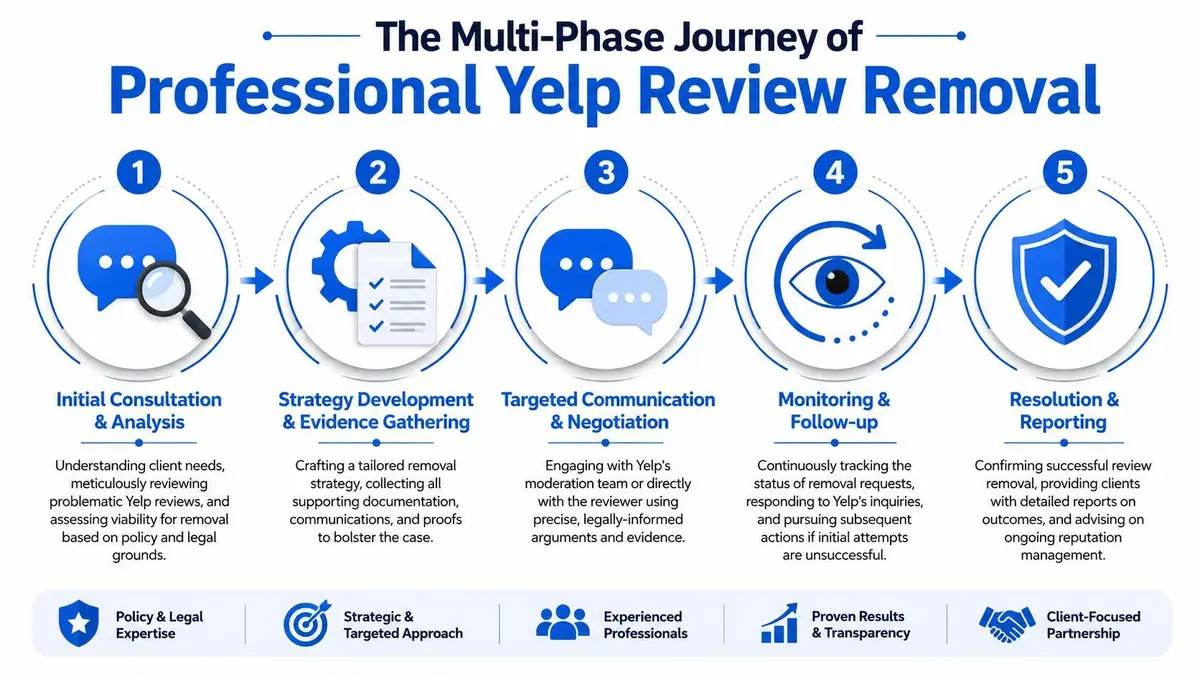
To visualize the workflow, review the process below.
Phase one through phase three
A disciplined engagement usually begins with three immediate actions.
- Initial viability assessment. Counsel or a specialist reviews the text, screenshots the review, preserves timestamps, captures the reviewer profile, and scores the matter for policy and legal viability.
- Evidence assembly. Transaction records, appointment logs, employee rosters, prior communications, identity inconsistencies, and internal chronology are collected. Most DIY efforts often fail at this stage.
- Precise platform submission. The report is drafted to fit Yelp’s categories, not your internal outrage. One strong violation beats five weak accusations.
At this stage, quality of framing matters more than length. Yelp moderators don’t need your full corporate history. They need a crisp explanation tied to a rule they can enforce.
For executives who want a broader view of how advanced providers handle review disputes across platforms, this overview of the strategic approach to online review removal services for executives is aligned with how serious firms think about the problem.
A useful primer on public-facing review handling appears below.
Escalation and monitoring
If Yelp rejects the first report, the next move depends on the underlying issue. Sometimes the answer is a refined re-submission with better evidence. Sometimes it’s direct contact with the reviewer through a controlled channel. Sometimes it’s legal escalation.
A serious provider should explain which path applies and why. They should also warn you about repost risk, search visibility, and whether the review is likely to remain discoverable elsewhere through screenshots, syndication, or discussion.
Decision point: If a matter implicates defamation, privacy, or extortion, you need legal review early. Waiting until a public dispute escalates usually reduces your options.
Monitoring matters almost as much as removal. A review taken down today can reappear in modified form tomorrow. If the attack is coordinated or the reviewer is motivated, containment has to continue after the first apparent win.
Assessing Costs Timelines and Success Likelihood
Executives should evaluate a Yelp review removal service the same way they evaluate outside counsel in a fast-moving dispute. What is the likely outcome, what does the process cost, how long will management attention be tied up, and what residual risk remains if the first strategy fails?
On pricing, expert services may charge $425 to $550 per successful removal according to this analysis. That number is useful only if you understand what it does and doesn’t buy. It may cover policy-based reporting and case handling. It does not buy platform control. It does not guarantee a court order. It does not stop the same reviewer from posting again.
What executives should price into the decision
A smart budget discussion includes more than the vendor fee. It should include internal time, legal review, executive distraction, staff morale impact, and possible downstream sales friction.
Use this framework:
| Variable | Executive question |
|---|---|
| Direct cost | Is the fee tied to success, milestones, or mere activity? |
| Time burden | Who inside the company must gather evidence and approve statements? |
| Exposure risk | Is this review visible enough to justify escalation now? |
| Repost risk | If removed, what prevents a reappearance in similar form? |
| Legal cost | If Yelp refuses, are you prepared for counsel-led escalation? |
Legal escalation is real, but limited
When Yelp refuses voluntary removal after a policy flag, the remaining options may include a cease-and-desist letter or a defamation lawsuit, but the same source notes that court-ordered removal is rare and jurisdiction-dependent. That means litigation should be treated as a powerful option only when the facts justify it and the business stakes are high enough.
This is why candid advisors are valuable. They’ll tell you when a matter is worth pursuing aggressively and when the economics are poor. A weak case can consume executive bandwidth and still leave the review online. A strong case with a narrow, documented theory may justify immediate action.
The timeline question is harder because the platform controls moderation speed and outcomes. Anyone promising certainty on timing is guessing. The right expectation is controlled process, not guaranteed pace.
Strategic Alternatives When Removal Is Not an Option
If removal fails, the assignment doesn’t end. It changes. Advanced reputation defense never relies on a single point of failure, especially on a platform whose moderation system is heavily automated.
The evidence gap around third-party success rates, combined with Yelp’s automated handling of the “not recommended” filter and the reality that even internal employees often can’t override those decisions, makes alternative strategies essential rather than optional as discussed here.
The public response strategy
A good response is not written for the reviewer. It is written for the next prospect reading the page.
That means your reply should do three things only:
- Signal professionalism: Stay calm, brief, and controlled.
- Correct without overexposing: Address broad inaccuracies without disclosing private facts.
- Move the issue offline: Offer a real path to contact, review, or resolution.
A defensive essay usually backfires. So does a legalistic threat posted in public. Readers don’t know who is right. They judge temperament.
The public response is evidence of management quality. Treat it that way.
Reputation building and suppression
When removal isn’t available, the next objective is dilution and displacement. That requires a coordinated program, not random acts of optimism.
One track is reputation building. Improve service recovery, tighten customer follow-up, strengthen profile accuracy, and create more opportunities for satisfied customers to speak where policy allows. Another track is content suppression. If branded search results surface negative Yelp visibility, you may need supporting content that outranks or at least competes for attention, especially for executive names or branded service lines.
The mistake is treating these as fallback options. They’re not fallback. They’re parallel protections. A resilient reputation strategy assumes some harmful content will remain online and plans for that reality in advance.
A Checklist for Selecting Your Removal Partner
Most vendors in this space sell certainty because fear converts. High-value clients should reject that instantly. The right partner doesn’t promise easy wins on Yelp. They show you how they evaluate facts, where they draw legal lines, and when they’ll tell you no.
That means your selection process should look more like outside counsel procurement than marketing vendor shopping. You are not buying software. You are buying judgment under pressure.
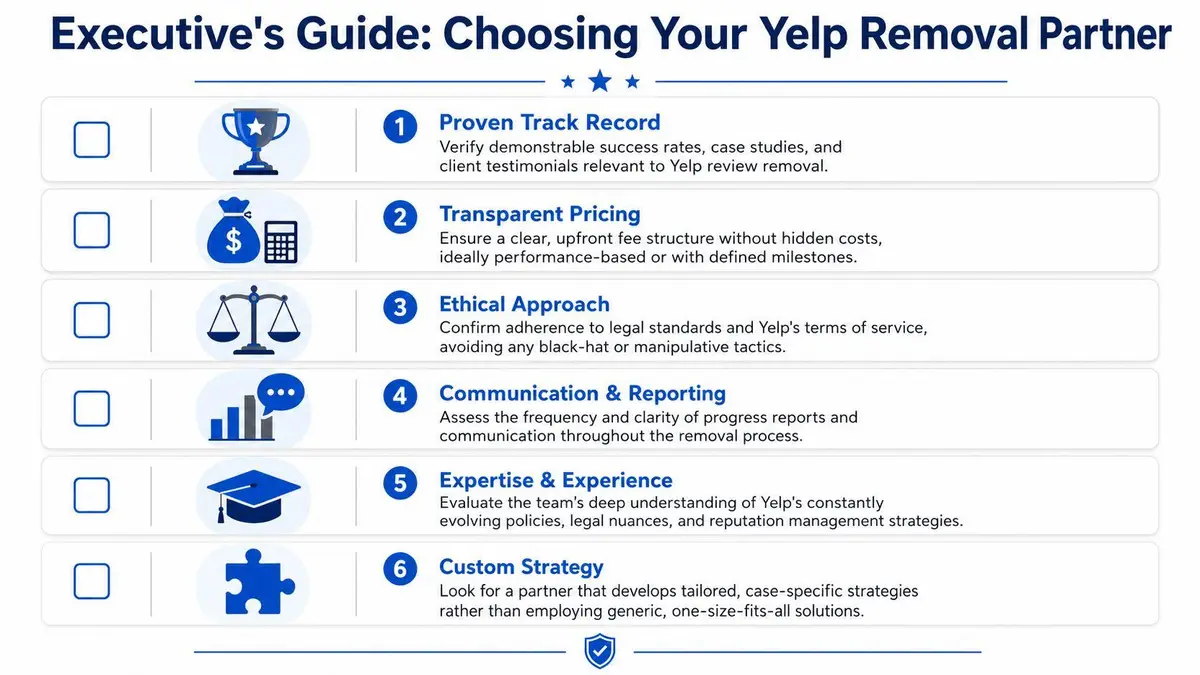
What to verify before engagement
- Proven track record: Ask for examples of Yelp-specific policy work, not generic online reputation claims.
- Transparent pricing: Insist on a clear explanation of whether fees are success-based, milestone-based, or front-loaded.
- Ethical approach: If a provider hints at secret relationships, paid removals, or manipulation outside policy and law, walk away.
- Communication discipline: You need structured updates, evidence handling, and a named point of contact.
- Cross-functional expertise: The team should understand platform policy, defamation risk, privacy exposure, and search visibility.
- Case-specific strategy: One-size-fits-all vendors are usually just submitting the same report repeatedly.
Questions that separate serious firms from pretenders
A strong provider should be able to answer the following without hand-waving:
| Question | What a strong answer sounds like |
|---|---|
| What grounds do you see for removal? | Specific policy categories, not vague optimism |
| What evidence do you need from us? | Transaction data, chronology, identity indicators, internal records |
| What happens if Yelp refuses? | A defined escalation tree |
| How do you address reposting? | Monitoring, response planning, and broader reputation containment |
| What cases should not be pursued? | Clear admissions that some reviews are better managed than attacked |
If a firm guarantees Yelp deletion before reviewing the facts, it’s either inexperienced or dishonest.
The best advisors are blunt. They’ll tell you when the review is likely to stay up. They’ll tell you when legal action is disproportionate, and they’ll tell you when the actual assignment is not takedown, but protection of the asset around the takedown.
If you’re dealing with a damaging Yelp review that threatens brand equity, executive credibility, or deal flow, ContentRemoval.com offers confidential assessments for complex removal, suppression, and digital risk matters. The firm works with executives, founders, legal teams, and high-profile clients who need a precise action plan, not generic reputation advice.
Frequently asked questions
Can you pay Yelp to remove a bad review?
No. Yelp explicitly states that negative reviews cannot be removed by buying advertising or using private takedown vendors, and its model depends on appearing resistant to that kind of influence. Removal happens only when a review clearly breaches content guidelines.
What kind of Yelp review can actually be removed?
Reviews that trigger a specific rule: posts by competitors, former employees or others with a concealed interest, content unrelated to a customer experience, hate speech or threats, and reviews exposing staff names or private details. A demonstrably false factual claim, such as an unlicensed doctor, is stronger than a complaint about terrible service.
What should I do if Yelp refuses to remove the review?
Refine and resubmit with better evidence, consider controlled contact with the reviewer, or seek legal review where defamation, privacy or extortion is involved. In parallel, post a brief professional public response written for the next prospect, and build reputation and search assets so a single review does not define the profile.