
White glove reputation management is a controlled, confidential intervention for high-profile clients that contains exposure, removes what can be removed, suppresses what cannot, documents every action and reduces the chance of recurrence. It is not a nicer label for PR. It combines surgical takedown and de-indexing, leak remediation, continuous monitoring and jurisdiction-aware legal pressure under one coordinated plan.
Key facts
- Removal targets the source, de-indexing targets search visibility, and the two require different arguments.
- Intake sorts matters into containment, correction or hardening, each with its own immediate posture.
- Pricing follows three models: project-based, retainer, or a hybrid of acute crisis then safeguarding.
- A serious provider commits to defined actions, timelines and reporting, never to erasing you from the internet.
Where ContentRemoval.com comes in. ContentRemoval.com runs white glove engagements for executives, founders, family offices and public figures: a narrow communications channel, a named decision-maker, evidence preserved before any outreach, and removal, de-indexing and monitoring sequenced from one plan. A chief of staff, general counsel or the principal’s lawyer usually opens the conversation. A free 15-minute Exposure Scan maps what is live and what can be removed, and the report is yours to keep. Get a Free, Confidential Exposure Scan or read how our reputation management work is done.
A damaging article appears on page one before your board meeting. A private image is copied to mirror sites overnight. A competitor, former employee, or anonymous account starts feeding review platforms and social channels with just enough material to create doubt. By the time your communications team drafts a statement, the issue has already spread into search results, screenshots, and secondary commentary.
That’s the moment it becomes clear that reputation risk isn’t a public relations problem. It’s an operational problem with legal, technical, and timing dimensions. If you’re high profile, wealthy, or responsible for institutional capital, delay is expensive and visibility is dangerous.
White glove reputation management exists for exactly this kind of pressure. It is not a nicer label for PR. It is a controlled intervention designed to contain exposure, remove what can be removed, suppress what cannot, document every action, and reduce the chance of recurrence.
Beyond Public Relations The Need for Surgical Intervention
Most clients arrive with the same assumption. They believe a strong PR firm can manage the narrative and a capable lawyer can force the rest. That assumption fails online.
A PR team can shape messaging, place favorable coverage, and advise on tone. It cannot compel a platform to remove nonconsensual imagery, persuade a search engine to de-index a result on the right grounds, or coordinate a fast-moving response across forums, review platforms, social accounts, and copycat domains. PR is built for persuasion. Digital harm often requires enforcement, platform fluency, and constant monitoring.
Traditional legal counsel faces a different limit. Litigation is often slow, public, and confined by jurisdiction. Even when your legal position is strong, filing a claim can amplify the very material you want contained. Courts work on procedural time. Search and social systems work on velocity.
Practical rule: If the harmful material is spreading faster than your advisers can act, you don’t have a messaging problem. You have a containment problem.
That gap is why specialist intervention has become a distinct market. The online reputation management market is projected to reach $585 million by 2030 with a 16.28% CAGR, and one reason is simple: 86% of consumers avoid companies with negative online reviews, according to reputation management market statistics. For a high-net-worth individual or executive, the same logic applies beyond commerce. Investors, partners, journalists, schools, counterparties, and prospective employers all search first and judge quickly.
What specialist intervention does that general advisers don’t
A white glove team starts from a different premise. The first objective is not public explanation. It is reducing the attack surface.
That usually means several actions running at once:
- Source-focused removal efforts aimed at the host platform, publisher, or account owner using the strongest available legal or policy basis.
- Search-layer intervention through de-indexing requests, suppression planning, and rapid publication of defensible positive assets.
- Spread control by identifying mirrors, reposts, forum threads, fake profiles, and review clusters before they multiply.
- Evidence preservation so later enforcement doesn’t collapse because screenshots, URLs, and timestamps were handled badly.
Why discretion matters as much as speed
High-profile clients often make things worse by overreacting in public. A broad legal threat sent too early can trigger fresh coverage. A defensive statement can validate a fringe allegation. A takedown request framed badly can alert operators that they have an advantage.
White glove reputation management is valuable because it treats exposure as a managed risk. The work is quiet. Access is restricted. Communications are controlled. The objective is to solve the problem without creating a second problem.
If you’re dealing with defamatory coverage, leaked material, impersonation, review abuse, or search pollution, stop treating it as a branding exercise. It requires surgical intervention.
The Core Components of White Glove Service
White glove reputation management works when it operates like a coordinated unit, not a collection of disconnected services. Removal without monitoring is temporary. Monitoring without legal strategy is passive. Content publishing without a suppression plan is cosmetic.
The discipline rests on a set of operational pillars that have to work together under pressure.
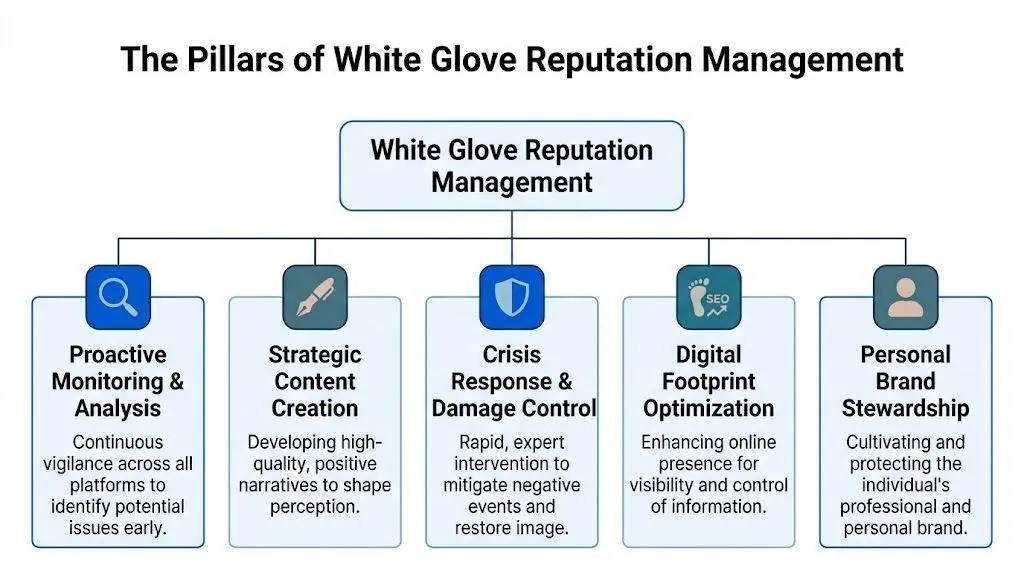
Surgical takedown and de-indexing
This is the part most clients ask about first, and it’s usually the part least understood. Removal and de-indexing are related, but they are not the same.
Removal targets the source. That may involve a platform policy request, a copyright claim, a privacy-based complaint, a defamation analysis, an impersonation report, or direct negotiation with a site operator. The standard depends on the platform and the facts. Good operators don’t send generic complaints. They match the argument to the rule set that governs the page.
De-indexing targets search visibility. A result may remain live at the source while becoming far harder to discover through branded search. That matters when removal is blocked, delayed, or strategically unwise. Search engines, publishers, and platforms each have their own standards. Effective firms know when to pursue one path, when to run both, and when to avoid alerting a hostile publisher prematurely.
Leak and piracy remediation
Leaks create a special category of risk because they spread through replication, not just publication. One file becomes ten links. Ten links become clips, thumbnails, reposts, archive copies, and discussion threads.
The response has to account for that chain. A serious team maps where the material originated, where it migrated, what versions exist, which platforms are most likely to cooperate, and which need a different pressure point. With intimate imagery, stolen video, private documents, or subscriber content, the process usually combines takedown demands, repeat detection, and persistent search cleanup.
This is also where many generalist firms fail. They may remove the obvious URL and leave the ecosystem untouched. That isn’t remediation. That’s triage.
Proactive monitoring and threat intelligence
The best time to address a reputational attack is before it hardens into search history. In crisis situations, brands that respond within the first 48 hours are 2.5 times more likely to recover public trust, and social media crises can spread 1200% faster than traditional news, according to crisis response statistics for reputation management. That speed is the reason specialist firms rely on continuous detection, not occasional review.
Tools such as Mention and Brand24 are commonly used to surface mentions quickly across news, social platforms, and public web sources. But tools alone aren’t enough. Someone has to interpret what matters, distinguish noise from escalation, and decide whether to ignore, document, engage, or remove.
Fast detection only helps if someone has authority to act. Otherwise you’re just measuring the spread.
A practical monitoring setup typically watches for several categories at once:
- Name and brand variations including misspellings, aliases, and former entities
- High-risk assets such as leaked media, review profiles, executive bios, and company listings
- Adversarial patterns including coordinated posting, repeat usernames, mirrored uploads, and synthetic amplification
- Search-result movement so a contained issue doesn’t slip onto page one
Jurisdictional strategy and lawful pressure
The same fact pattern can be weak in one jurisdiction and strong in another. Privacy, copyright, defamation, harassment, and platform liability rules vary. So do procedural realities.
A capable white glove provider doesn’t posture about “knowing the law.” It identifies the pressure point that has the highest probability of producing action with the lowest collateral exposure. Sometimes that means a narrow privacy claim. Sometimes it means a copyright path. Sometimes it means platform impersonation rules. Sometimes it means saying nothing publicly and building a suppression shield while counsel prepares a more formal route.
Why the model has to be integrated
Clients under stress often ask for a single remedy. Remove the article. Kill the review. Delete the video. That mindset is understandable, but it’s incomplete.
White glove reputation management succeeds because it layers tactics. Removal reduces exposure. De-indexing reduces discoverability. Monitoring catches recurrence. Legal strategy sharpens its advantage. Positive asset development gives search engines and stakeholders something better to find.
Used together, those pillars turn a digital crisis from an open-ended threat into a managed file.
The Engagement Process From Crisis to Resolution
When clients are under pressure, uncertainty becomes its own form of risk. They want to know who sees what, what happens first, what can realistically be achieved, and whether the process will create more visibility. A serious engagement answers those questions immediately.
The first stage is controlled intake. Not a theatrical “discovery call.” A structured assessment of threat, exposure, objectives, and urgency.

Confidential assessment
At the outset, the firm should establish a narrow communications channel, identify decision-makers, and gather the evidence set. That means URLs, screenshots, dates, platform identifiers, prior outreach, known adversaries, and the commercial or personal stakes attached to the issue.
This phase also defines the primary objective. Clients often say they want content “gone.” Sometimes the better goal is to prevent investor exposure before a transaction closes, stop family information from circulating, or keep a false allegation from becoming the dominant branded search result. Precision matters because it changes the strategy.
A disciplined intake usually sorts the matter into three categories:
| Priority | Typical issue | Immediate posture |
|---|---|---|
| Containment | active leak, impersonation, viral review attack | isolate spread, preserve evidence, begin platform actions |
| Correction | false article, misleading listing, inaccurate profile | challenge source, seek edits or removal, prepare search response |
| Hardening | recurring harassment, repeat reposts, long-tail search damage | build monitoring, establish triggers, create durable suppression assets |
Strategic planning
Once the threat is mapped, the engagement shifts from intake to sequencing. Expertise is then demonstrated.
The plan should identify primary targets, secondary targets, legal theories, platform routes, search priorities, response scripts, and a communications rulebook for your internal team. It should also define what not to do. In many matters, restraint is as valuable as action.
If you want a clear example of what a structured workflow should look like, review a specialist reputation protection process. The details will vary by case, but the principle is consistent. Good firms don’t improvise under pressure. They execute against a controlled plan.
Agile execution
Execution is rarely linear. One platform cooperates. Another delays. A publisher edits but won’t remove. A fake account disappears and reappears under a variant handle. The team has to adjust without losing momentum.
Consequently, real-time monitoring becomes operationally useful rather than decorative. Brand mentions can be detected within minutes, and proactive responses within the first hour correlate with a 35% higher resolution rate, according to monitoring and response benchmarks for reputation teams. In practice, that means dashboards, alerts, and search tracking support the active campaign rather than sit in a reporting folder no one uses.
The execution phase usually combines several moving parts:
- Immediate platform actions for the clearest policy violations
- Publisher and host outreach where direct resolution is possible
- Search suppression work for assets likely to persist
- Protective content placement to strengthen the visible record
- Status reporting that tells the client what changed, what is pending, and what requires approval
Later in the engagement, process discipline matters even more.
Long-term safeguarding
The file isn’t closed when the first bad link disappears. It’s closed when the issue stops regenerating.
That requires ongoing watchfulness, especially for executives, creators, litigants, and families with recurring visibility. The monitoring stack should look for reposts, archived copies, changed headlines, new review bursts, and copycat accounts. Internal teams should also know when to escalate and when to stay silent.
The strongest outcome isn’t a dramatic takedown. It’s a stable environment where the problem doesn’t come back.
That’s the difference between emergency cleanup and actual reputation defense.
Confidentiality Guarantees and Pricing Structures
High-net-worth clients ask three questions before they ask anything else. Who will know. What can you deliver. How is this priced.
Those are the right questions. If a provider answers them vaguely, walk away.

What confidentiality should mean in practice
Confidentiality is not a slogan. It is a workflow.
At minimum, the provider should limit access to a need-to-know team, use secure communications, and document who is authorized to approve outreach, settlement language, or platform submissions. Many matters also require NDAs across vendors and specialists, especially where family, health, litigation, or intimate content is involved.
You should also ask whether the firm masks its own involvement when appropriate. Some interventions are more effective when they appear as direct rights-holder, counsel, or authorized representative actions rather than a visible reputation-management campaign. Discretion is not just about privacy. It is often part of the success strategy.
What can be guaranteed and what can’t
No credible firm should promise to erase you from the internet. That’s unserious.
A serious guarantee is narrower and more useful. The firm can commit to defined actions, documented timelines for initial deployment, a clear rationale for each removal path, and reporting that distinguishes between source removal, de-indexing, suppression, and monitoring. It can also speak openly about risk. Some material is removable. Some is suppressible. Some requires a containment strategy while parallel legal steps mature.
There is operational value here. Advanced response protocols can support rapid takedown actions, including 80% de-indexing success within 48 hours, according to white-label reputation management technology benchmarks. That does not mean every matter will produce that outcome. It does mean premium pricing is justified when a provider has the systems, staffing, and judgment to move quickly where the facts support it.
Ask for guarantees tied to process, scope, and reporting. Distrust guarantees tied to fantasy.
How pricing is usually structured
Pricing in white glove reputation management generally falls into three models.
- Project-based work suits isolated incidents with a defined target set, such as one article, one leak event, or one impersonation cluster.
- Retainer arrangements suit executives, public figures, family offices, and brands that need ongoing monitoring, standing response capability, and regular search stewardship.
- Hybrid structures are common when an acute crisis is followed by long-term safeguarding.
Cost moves with complexity. Jurisdiction matters. Volume matters. Whether the issue involves media outlets, hostile operators, private platforms, search suppression, or recurring reposts matters. So does the level of discretion required.
Clients often benefit from comparing this with adjacent outsourced services. A practical reference point is this guide on decoding social media management costs, not because the work is the same, but because it shows how service pricing changes once discretion, response speed, and strategic oversight become part of the mandate rather than simple execution.
For a more direct discussion of how specialist firms frame fees, review a detailed content removal pricing guide. The right way to view the spend is not as a commodity purchase. It is a risk-management expenditure tied to reputation, relationships, and future optionality.
How to Evaluate a Reputation Management Provider
Most providers sound competent in a proposal. Under pressure, many are not. They outsource the difficult parts, overstate what they can remove, and confuse software access with strategic capability.
You should evaluate a provider the way you would evaluate anyone handling security-sensitive personal or corporate risk. The framework used in other trust-heavy industries is useful here. This guide to evaluating legitimate service providers is about transportation, but the underlying logic applies perfectly. Verify the operator, the process, the accountability chain, and the practical safeguards.
Ask how they think, not just what they sell
A strong provider should be able to explain why your issue is primarily a removal matter, a search matter, a platform matter, or a legal influence matter. If every answer sounds like “we do everything,” you’re probably listening to a sales script.
Ask direct questions:
- Legal capability. Who assesses privacy, copyright, defamation, impersonation, and jurisdictional options?
- Technical capability. What monitoring tools do they actively use, and who interprets the alerts?
- Operational control. Who writes outreach. Who approves escalation. Who owns the timeline.
- Search understanding. How do they decide between removal, de-indexing, suppression, and content reinforcement?
Demand evidence without requiring them to breach discretion
You should not expect a reputable firm to parade named clients. You should expect anonymized proof of competence.
A credible provider can describe matters similar to yours in enough detail to show judgment. It should be able to explain the obstacle, the chosen route, the timeline shape, and the limiting factors. If all you hear are generic success claims, assume the underlying experience is thin.
A useful comparison is below:
| What weak providers say | What serious providers say |
|---|---|
| “We can clean up anything.” | “Some targets are removable. Others require suppression and monitoring.” |
| “Results are guaranteed.” | “We commit to a defined process and clear reporting. Outcomes depend on the facts and platform rules.” |
| “Our software handles it.” | “Software detects. Analysts, strategists, and counsel decide the action.” |
Test their communication discipline
Reputation engagements fail when too many people talk, too many updates say too little, or the client has no clear point of contact.
Ask how often you’ll receive reporting. Ask what a useful update looks like. Ask whether they escalate by channel and urgency. Ask who handles after-hours developments. If the answers are vague before signing, they will be worse after signing.
You are not hiring a dashboard. You are hiring judgment under pressure.
Check ethical boundaries
This matters more than many clients realize. A provider using deceptive, abusive, or unlawful tactics can expose you to a second crisis. The right firm works within platform rules, legal frameworks, and defensible strategic boundaries.
The best question is simple: “What methods won’t you use?” A serious provider can answer immediately.
Case Studies in Digital Reputation Defense
Abstract descriptions help. Concrete scenarios are better. The following examples are anonymized, but they reflect the kind of work that defines white glove reputation management in practice.
The executive facing defamatory media
A senior executive entered a sensitive corporate transaction while an online publication circulated a false allegation tied to prior business conduct. The article was written to sound investigative, but the sourcing was weak and the timing was not accidental. The immediate danger was not public outrage. It was diligence risk. Counterparties searching the executive’s name would see the allegation first.
The response began with evidence preservation and a line-by-line legal assessment of the article’s vulnerabilities. At the same time, the team mapped republication risk and identified related pages likely to rise in branded search. Direct pressure on the publisher was paired with search-layer work and controlled publication of stronger authoritative assets.
The outcome was not theatrical. It was what the client needed. The harmful result stopped defining the search narrative, secondary spread was contained, and the transaction proceeded without the issue becoming the visible center of discussion.
The family office dealing with a privacy breach
A family office learned that private identifying material had surfaced online through a mix of forum posts and data-sharing pages. The material itself was dangerous, but the larger risk was aggregation. Once enough fragments connect, personal routine, residence patterns, relatives, and staff become easier to profile.
The strategy focused on quiet containment. The team documented each exposure point, separated removable material from persistent references, and prioritized the pages most likely to be indexed, copied, or screenshotted. Outreach was narrowly drafted. The objective was to solve the problem without signaling to bad actors that the data had strategic value.
The key to success was persistence rather than spectacle. Copies were tracked, secondary appearances were addressed quickly, and the office moved from remediation into standing monitoring. For a family office, that is often the right end state. Less visibility, fewer entry points, and no public fight.
The founder targeted by coordinated review abuse
A founder in a trust-sensitive sector saw an unusual burst of negative reviews across major platforms. The language patterns overlapped, several reviewer profiles looked manufactured, and the timing coincided with a competitive dispute. The danger was commercial and reputational. Prospective clients would not investigate the backstory. They would see a credibility problem.
The response separated authentic criticism from fabricated activity. That distinction matters. Credible firms don’t try to remove legitimate complaints just because they are uncomfortable. They target manipulation, impersonation, false factual claims, and coordinated abuse. The team prepared platform challenges, built a review-response protocol, and reinforced higher-quality public assets so search and review environments did not become one-note hostile.
If you’re comparing providers, you should ask for examples at this level of specificity. A capable firm should be able to walk you through similar matters with discretion intact. A useful benchmark is a curated set of reputation defense case studies that shows how different problem types require different strategies.
Frequently Asked Questions and Your Next Steps
The last questions are usually the most practical. They should be answered directly.
How quickly will I see movement
Some actions can begin almost immediately. Initial outreach, evidence preservation, platform reporting, and monitoring setup should not take weeks. Meaningful visible change depends on the target, the platform, and whether the issue is best handled through removal, de-indexing, suppression, or all three. The right expectation is early action first, then measured progress as the strongest channels start to respond.
Is the process legal
It should be entirely lawful. White glove reputation management is not about fabricating a record or intimidating critics for legitimate opinion. It is about using valid platform mechanisms, lawful rights assertions, accurate evidence, search strategy, and disciplined escalation. If a provider sounds evasive on this point, stop the conversation.
What stops removed content from coming back
Nothing stops recurrence by magic. Systems stop it.
That means watchlists, keyword triggers, repeat-image detection where available, structured search reviews, and standing escalation rules. The goal is not only removal. It is reducing the life span of reappearances and preventing a fresh cycle from building momentum.

Should I respond publicly right away
Usually not until someone has assessed the exposure map. Public responses can validate fringe allegations, feed search demand, or alert hostile actors that they have an advantage. Sometimes a public response is necessary. Often it is not the first move.
What should I prepare before speaking to a specialist
Bring the facts, not a long narrative.
- Capture the evidence with URLs, screenshots, usernames, and dates
- List prior actions including any messages already sent to platforms, publishers, or adversaries
- Define the actual risk whether it is deal friction, family privacy, professional credibility, or personal safety
- Name the decision-makers so approvals don’t slow down urgent action
The first useful step is not explaining everything. It is preserving the right evidence and narrowing who speaks.
If your concern is serious enough to disrupt your sleep, distract your team, or alter a commercial decision, it is serious enough for a confidential assessment. The value of that first conversation is not sales theatre. It is clarity. You find out what the problem is, which paths are viable, what should happen first, and what should not be touched yet.
If you need discreet, specialist help, speak with ContentRemoval.com. The firm handles high-risk online content removal and white glove reputation management for executives, founders, family offices, legal professionals, and public figures who need a controlled plan, rapid action, and strict confidentiality.