
Trade secret protection is the legal and operational framework that keeps valuable nonpublic business information, such as pricing logic, source code, supplier terms and deal strategy, from becoming a competitor’s shortcut. A trade secret is defensible only when it is not generally known, has economic value because it is secret, and the owner took reasonable steps to keep it confidential.
Key facts
- TRIPS Article 39 binds all 164 WTO members to protect undisclosed information meeting three criteria.
- Trade secrets need no registration, but the owner must prove documented, verifiable safeguards in court.
- Plaintiffs won only 39% of 671 civil trade secret decisions between 2015 and July 2022.
- Courts increasingly view rapid de-indexing and source removal as part of reasonable efforts to maintain secrecy.
Where ContentRemoval.com comes in. ContentRemoval.com works the exposure-response layer this post describes, getting leaked memos, pricing files and internal documents removed from forums, file hosts and search results while counsel pursues the misappropriation claim. General counsel, founders and family offices usually make contact within days of a leak. A free 15-minute Exposure Scan maps every public copy and the route for each, and the report is yours to keep. Get a Free, Confidential Exposure Scan or read how our content removal work is done.
A senior employee resigns on Friday. By Sunday, your sales team has screenshots of an internal pricing matrix circulating in a private industry chat. On Monday, a competitor suddenly shifts its bid strategy in exactly the way your confidential planning anticipated. That’s when most CEOs start searching for what is trade secret protection.
At that point, you’re not looking for a law school definition. You’re trying to answer four harder questions. What exactly did the company lose. Is it still legally protectable. Can you stop further spread, and did your own internal practices just weaken your position before the fight even starts.
Trade secret protection matters because it covers the information that often creates the essential margin in a business. Not the brand language on your website. Not the product brochure. The hidden machinery behind performance. Pricing logic, source code, supplier terms, customer acquisition playbooks, manufacturing tolerances, deal strategy, product roadmaps, and internal research that tells your team what not to pursue.
The dangerous mistake is treating trade secret protection like a paperwork issue. It isn’t. It’s a live risk system. If secrecy breaks, value can collapse fast. If your controls were loose, your legal position can collapse with it.
The Moment Your Competitive Edge Is Exposed
The classic breach doesn’t start with a masked hacker. It starts with convenience.
A departing executive forwards documents to a personal account “for transition.” A product manager shares a cloud folder with a contractor and forgets to revoke access. An internal memo appears in a forum post, then gets indexed, screenshotted, reposted, and discussed by people who were never supposed to see it. The leak isn’t just embarrassing. It changes the bargaining power of every negotiation tied to that information.
What the CEO feels first
The first reaction is usually operational, not legal. You worry about the next board call, the next financing conversation, the next customer renewal. If the exposed material includes pricing, vendor terms, M&A planning, or regulatory analysis, the threat moves beyond competitive annoyance and into enterprise risk.
Three problems usually hit at once:
- Market position weakens: Competitors can undercut, imitate, or preempt.
- Internal trust fractures: Employees start asking who had access and who failed to lock it down.
- Legal options narrow quickly: Once information spreads online, containing it gets harder by the hour.
Practical rule: The first day after a leak is not about drafting elegant legal theories. It’s about preserving secrecy, limiting further distribution, and building evidence before facts disappear.
Most executives underestimate the internet’s role in this. A leak that once might have stayed inside a rival company can now ricochet across search results, social platforms, archived pages, AI systems, and screenshots stored on employee phones. If confidential material has already surfaced publicly, a focused response like this strategic response to an employee posting confidential information online becomes part of damage control, not a side task.
Why this isn’t just an IP issue
Trade secret exposure can damage more than product advantage. It can disrupt financing, invite shareholder scrutiny, complicate employment disputes, and expose weak security governance. For founders and CEOs, that means trade secret protection sits at the intersection of legal strategy, cybersecurity, HR, and reputation management.
If you’re asking what trade secret protection is, the useful answer starts here. It’s the legal and operational framework that keeps valuable nonpublic information from becoming everyone else’s shortcut.
The Three Pillars of a Defensible Trade Secret
A trade secret is only defensible when three elements exist at the same time. That standard is global, not just American. The 1995 TRIPS Agreement Article 39 framework obligates all 164 member countries of the World Trade Organization to protect “undisclosed information” when it meets three criteria: it isn’t generally known, it has economic value because it’s secret, and the owner took reasonable steps to keep it confidential.
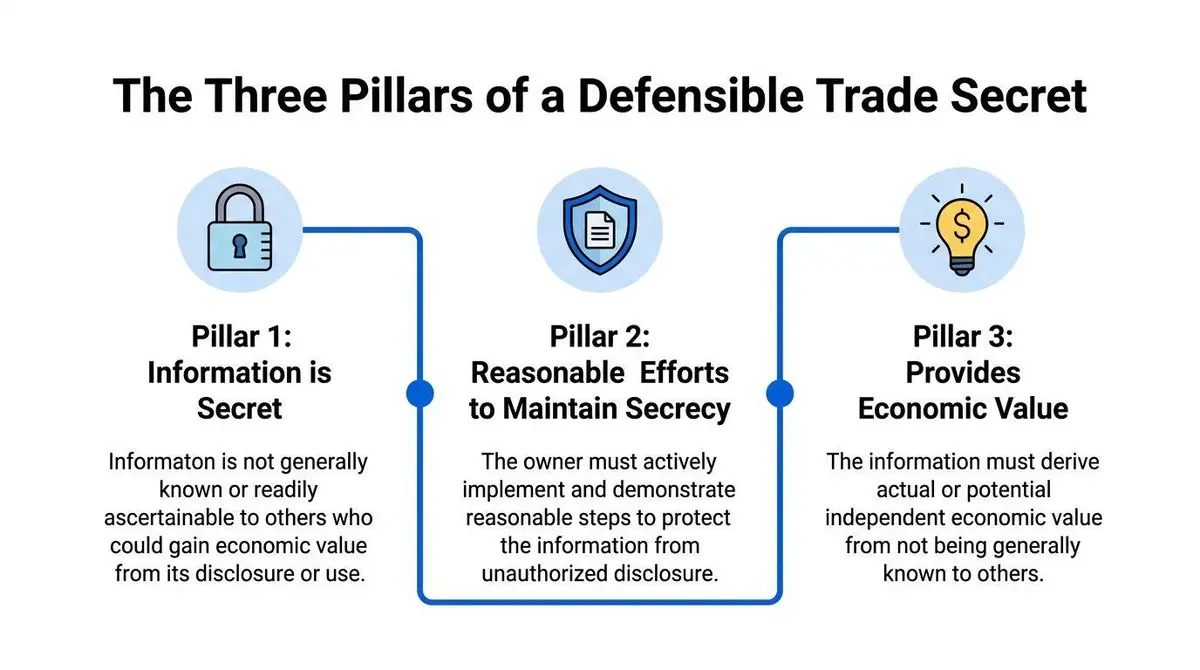
A trade secret is like a vault. The contents must be valuable. The vault must be closed, and guards must be posted. Miss any one of those, and you don’t have a protected secret. You have exposed business information.
Pillar one is secrecy
If the information is already generally known, or easy for others to obtain lawfully, stop calling it a trade secret. Courts won’t rescue wishful thinking.
Secrecy doesn’t require total invisibility. Employees, vendors, and advisors can know the information. But access has to be limited and controlled. If sensitive pricing files sit in a widely shared drive, or confidential process documents circulate without restriction, you’ve weakened the first pillar before litigation even begins.
Pillar two is economic value from secrecy
The information must matter because competitors don’t have it.
That can include a manufacturing method, a customer segmentation model, a source code architecture, a bid formula, or negative R&D findings that save your company from repeating costly mistakes. The key is causation. The advantage comes from secrecy itself, not merely from the fact that the material is useful.
Valuable information is not enough. It must be valuable because others don’t know it.
Pillar three is reasonable efforts
Many companies make a common mistake. They assume a confidentiality label or generic NDA solves the problem. It doesn’t.
Reasonable efforts mean the company behaved like the information was worth protecting. In practice, that usually involves measures such as:
- Access discipline: Need-to-know limits, role-based permissions, and immediate access termination when roles change.
- Contract structure: NDAs, confidentiality clauses, contractor controls, and return or deletion obligations.
- Technical protection: Secure storage, restricted downloads, audit trails, and active monitoring around sensitive systems.
The executive test
Ask yourself three blunt questions:
| Question | If the answer is weak |
|---|---|
| Is this information actually secret? | Protection may fail at the threshold |
| Would a competitor gain an advantage from it? | It may not qualify as a trade secret |
| Can we prove we protected it in real, documented ways? | Your claim may collapse in court |
That’s the practical answer to what trade secret protection is. It’s not a label. It’s a condition you maintain.
Why Trade Secrets Are Not Patents or Copyrights
Executives often lump trade secrets into the same bucket as patents, copyrights, and trademarks. That’s a strategic mistake. These rights solve different problems, impose different burdens, and force different business choices.
The sharpest distinction is this. Trade secrets don’t come from filing anything with the government. According to this global IP enforcement analysis, trade secrets do not require registration with any government authority, and there are no formal compliance requirements to meet. Protection is automatic upon creation, but it depends entirely on the owner proving objective, verifiable safeguards.
That sounds efficient. It also means the burden sits on you.
The strategic tradeoff
A patent gives you a state-backed right, but only after disclosure, examination, cost, and delay. A trade secret gives you immediate protection if the criteria are met, and that protection can continue indefinitely so long as secrecy holds. Copyright protects original expression, not confidential business know-how.
If your advantage can be reverse-engineered from a product, trade secret law may be weak protection. If your advantage lives in internal process, data handling, or business logic that never needs to be disclosed publicly, trade secret protection may be the stronger move.
Intellectual Property Comparison Strategic Considerations
| Attribute | Trade Secret | Patent | Copyright |
|---|---|---|---|
| How protection begins | Automatic if legal elements are met | Requires application and government grant | Automatic upon creation of original expression |
| Public disclosure required | No | Yes | No filing required for existence |
| Duration | Can continue indefinitely if secrecy remains | Limited term | Limited by copyright term |
| Core burden on owner | Prove secrecy, value, and safeguards | Prosecute application and enforce granted rights | Prove ownership and copying |
| Best for | Confidential methods, data, processes, strategy | Inventions you can disclose and claim | Creative works and fixed expression |
A practical overview of intellectual property protection strategy helps when you’re deciding which asset belongs in which legal bucket. But the executive rule is simpler. Don’t patent what should stay hidden, and don’t call something a trade secret if your own systems treat it like general company clutter.
What leaders usually miss
Trade secrets are broader than patents in one sense and weaker in another.
They’re broader because they can cover internal playbooks, negative test data, customer intelligence, logistics methods, and negotiation strategy. They’re weaker because there’s no certificate to wave around. If you can’t prove what the secret was, who had access, and how you protected it, the right becomes difficult to enforce.
That’s why trade secrets belong in board-level risk planning, not just legal ops.
Identifying Your Most Valuable Hidden Assets
Most companies protect the obvious assets and ignore the expensive ones.
Everyone remembers source code, formulas, and product prototypes. Fewer leaders identify the information that drives speed, margin, and execution. That’s where hidden exposure lives. If you only inventory “IP” in the narrow sense, you’ll miss the materials a competitor wants.
The assets executives overlook
In research and development, the most valuable secret may be failed work. Negative experimental results, abandoned model paths, testing thresholds, and internal QA protocols tell your team where not to waste time. A rival who gets that information can skip dead ends you paid to discover.
In sales, the true secret often isn’t the customer list by itself. It’s the layered intelligence around the account. Discount thresholds, objection handling patterns, renewal timing, stakeholder maps, procurement behavior, and sequencing rules for enterprise deals.
In operations, hidden assets usually look mundane until they leak. Vendor fallback plans, manufacturing tolerances, fulfillment logic, routing methods, staffing ratios, internal escalation scripts, and quality-control exceptions often explain why one company executes better than another.
Four categories worth auditing
A fast executive audit should review these buckets:
- Strategic materials: Board decks, market entry plans, acquisition target lists, financing strategy, and unannounced product roadmaps.
- Commercial intelligence: Pricing formulas, margin models, client segmentation, bid structures, and negotiation playbooks.
- Technical know-how: Source code repositories, deployment workflows, internal tools, testing protocols, and nonpublic product architecture.
- Operational advantage: Supply chain methods, vendor scorecards, process improvements, service scripts, and issue-response procedures.
If a competitor got the file tomorrow and your team’s advantage shrank next quarter, treat it like a trade secret candidate today.
A more realistic lens
Trade secret analysis should follow business function, not legal labels. Ask each department head what information would harm the company if a direct competitor obtained it and used it immediately. That question produces better answers than asking what counts as “confidential.”
Use examples that force specificity:
| Business function | Often overlooked trade secret candidates |
|---|---|
| R&D | Failed tests, validation methods, internal benchmarks |
| Sales | Pricing logic, retention tactics, escalation scripts |
| Operations | Workflow shortcuts, supplier substitutions, routing rules |
| Executive team | Deal pipeline strategy, M&A screening, launch timing |
Most companies already possess protectable secrets. The failure is rarely absence. It’s failure to identify, classify, and restrict them before someone copies, posts, or exports them.
The Digital Fragility of Modern Trade Secrets
Traditional trade secret advice is outdated. NDAs, locked offices, and standard confidentiality labels still matter, but they don’t solve the modern failure point. Digital exposure can destroy secrecy before your lawyers finish drafting the demand letter.
That’s the digital fragility gap. A single cloud misconfiguration, screenshot, repost, AI scrape, or indexed leak can push confidential information into public circulation fast enough to break the secrecy element altogether.
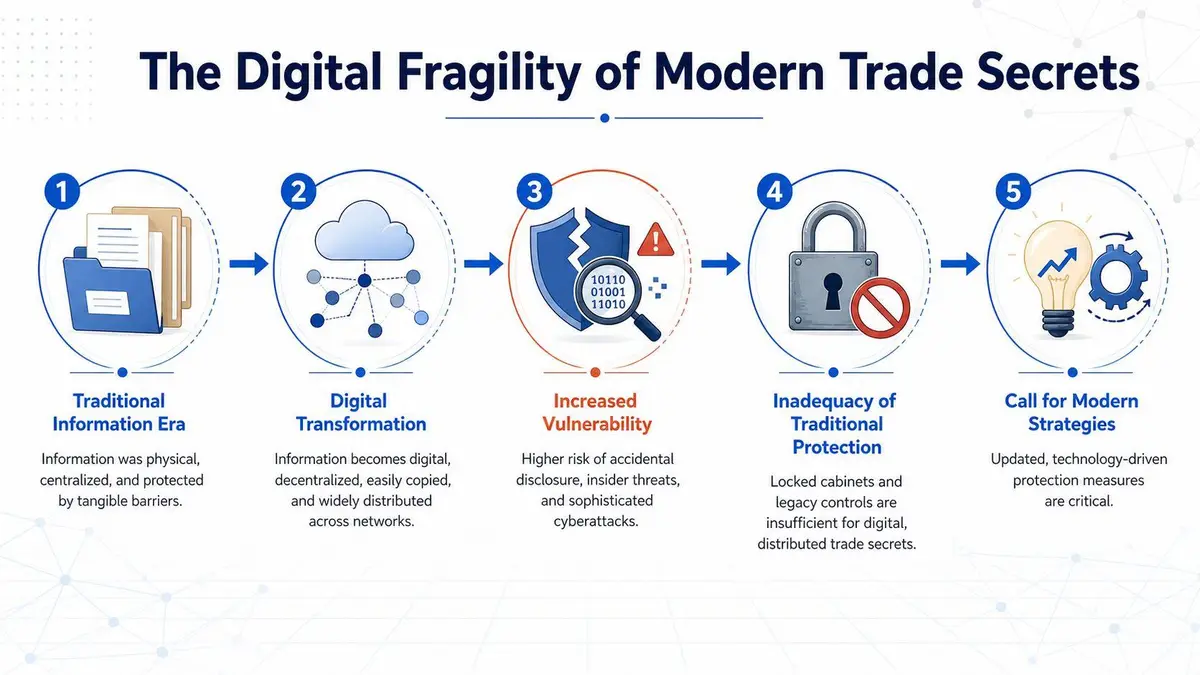
The legal problem is severe because secrecy isn’t damaged gradually. It can fail abruptly.
According to the USPTO trade secret policy discussion, if information becomes generally known through digital leaks, protection ceases immediately. That same source states that 68% of misappropriation cases now involve digital channels, and that proactive measures such as rapid de-indexing or source removal are increasingly viewed by courts as part of the reasonable efforts required to maintain secrecy.
Why old advice fails
A paper file in a locked cabinet had friction. A leaked PDF has none. It can be copied endlessly, quoted selectively, uploaded anonymously, cached, indexed, and fed into systems you don’t control.
That changes the CEO’s job. Trade secret protection is no longer just about stopping theft at the perimeter. It’s about reducing the legal consequences of exposure when prevention fails.
The most dangerous misconception is that once litigation starts, the situation is under control. Often the opposite is true. Public dissemination can outrun your injunction strategy.
Here’s a useful overview of the broader problem in visual form:
What counts as digital fragility
The risks are ordinary, not exotic:
- Cloud leaks: Shared folders, bad permissions, stale contractor access.
- Insider screenshots: Internal dashboards or strategy decks captured on personal devices.
- Search visibility: A leaked document becomes searchable, cached, and discussable.
- AI ingestion risk: Once public material is copied and redistributed, practical containment becomes harder.
The question isn’t whether your company has NDAs. The question is whether you can act fast enough when secrecy escapes into public systems.
The modern implication
If you still define reasonable efforts as contracts plus cybersecurity perimeter tools, you’re behind. A modern standard has to include active monitoring for exposure, rapid takedown work, de-indexing strategy, and source removal where possible. That isn’t reputation management in the cosmetic sense. It’s secrecy preservation.
That’s what makes digital fragility so dangerous. It converts a technical incident into a legal extinction event.
Enforcing Your Rights After a Breach
Once a trade secret is stolen or exposed, your legal options are real but narrower than most executives assume.
In the United States, the Defend Trade Secrets Act of 2016 created a federal civil cause of action for trade secret misappropriation. It allows owners to sue in federal court when the secret relates to a product or service used in, or intended for use in, interstate or foreign commerce. Courts can also order seizure of misappropriated secrets in extraordinary circumstances. But strong remedies don’t guarantee easy wins.
The hard data is sobering. In the cross-border trade secret enforcement review, plaintiffs won only 39% of 671 civil trade secret decisions between 2015 and July 2022. That tells you what experienced litigators already know. Trade secret claims are fact-heavy, expensive, and often unforgiving when your internal controls were weak.
What a court can do
If your claim is strong, a court may issue powerful remedies, including:
- Injunctions: Orders stopping use or disclosure of the secret.
- Seizure in extraordinary cases: A narrow but potent tool when immediate action is necessary.
- Damages and fees: Depending on the facts and the forum.
But enforcement starts with proof. You must identify the secret with precision, show that it had protected status, prove access or acquisition, and connect the defendant’s conduct to misappropriation. If your company treated the material casually before the breach, the defense will exploit that immediately.
Litigation is reactive by design
Trade secret lawsuits often begin under severe time pressure. You’re preserving evidence, interviewing employees, freezing accounts, and deciding whether to seek emergency relief. Then comes discovery, where the dispute gets more invasive and more expensive. If you want a plain-language explanation of what the litigation path looks like after that stage, understanding legal discovery’s conclusion offers useful context.
A trade secret case is rarely won by outrage. It’s won by records, system logs, access controls, agreements, and a disciplined chronology.
The international complication
Global enforcement is uneven. The U.S. offers a strong federal pathway, but other jurisdictions approach trade secret protection differently. The EU, China, and India don’t offer identical procedures, remedies, or practical enforcement environments. If your data crossed borders, the legal map gets complicated fast.
That’s why breach response has to run on parallel tracks. Legal action may stop a competitor from using stolen material. It may not remove the leaked copies already circulating online. When the problem includes publicly available files, screenshots, or reposted business documents, a response focused on removing leaked business documents from the internet becomes critical to limiting further spread while legal counsel handles the claim.
The main executive takeaway is blunt. Litigation matters. It is also the slowest part of the response.
A Modern Framework for Proactive Protection
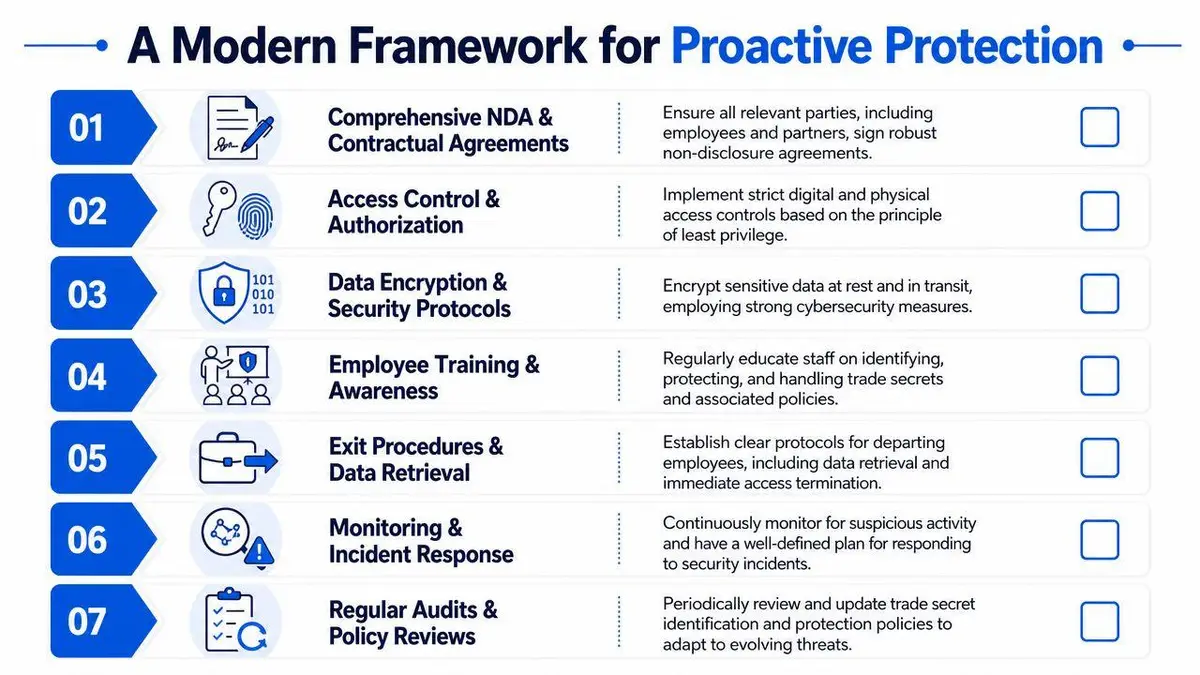
A defensible trade secret program in 2026 needs three layers. Legal controls. Technical controls. Exposure-response controls. If one layer is missing, the system is weak.
This isn’t theory. Under the DTSA reasonable efforts guidance discussed here, reasonable efforts are defined by active cybersecurity measures such as strong encryption, multi-factor authentication, and intrusion detection systems, alongside organizational protocols. Failure to demonstrate those technical and procedural safeguards can result in the immediate loss of trade secret status in court.
The framework that actually works
Start by treating trade secrets as a mapped asset class, not a vague confidentiality concept. Identify the exact datasets, repositories, plans, models, and process documents that create enterprise advantage. Then restrict access aggressively.
The operational stack should include:
- Contract discipline: Customized NDAs, contractor restrictions, return-of-data clauses, and confidentiality reminders during offboarding.
- Access architecture: Need-to-know permissions, segmented repositories, device controls, and immediate revocation when employment status changes.
- Security controls: Encryption, MFA, intrusion detection, logging, audit reviews, and alerting around unusual downloads or exports.
- Human process: Training employees on what the company treats as secret, not just making them sign generic policy acknowledgments.
The missing layer most companies ignore
Most programs stop there. That’s no longer enough.
You also need a response system for digital exposure. That means continuous monitoring for leaked documents, screenshots, and reposted materials. It means knowing who makes the takedown decision, who preserves evidence, who contacts outside counsel, and who handles search de-indexing and source removal. If no one owns those actions, your “reasonable efforts” story may fall apart at the worst possible moment.
Executive directive: Build for the breach you hope never happens. Courts care less about your policy binder than about what your company actually did when secrecy was threatened.
What the board should ask
A serious board or founder review should ask:
| Question | Why it matters |
|---|---|
| Have we identified our top trade secret assets? | You can’t protect what you haven’t defined |
| Is access limited by role and business need? | Broad access weakens secrecy claims |
| Do we have technical proof of protection? | Courts want verifiable safeguards |
| Can we respond rapidly to public leaks? | Digital spread can destroy the secret itself |
That is the practical answer to what trade secret protection means now. It is an active system of secrecy, security, and rapid containment. Anything less is outdated.
When confidential business information leaks online, delay is expensive. ContentRemoval.com helps executives, founders, family offices, and legal teams remove leaked documents, de-index search results, shut down reposts, and contain digital exposure before it hardens into permanent damage. If your trade secret, internal memo, or sensitive file is already circulating, start with a confidential assessment and get a clear action plan fast.
Frequently asked questions
Does a leaked document lose trade secret status?
It can, and abruptly. The article cites USPTO policy that protection ceases once information becomes generally known through digital leaks. That is why rapid takedown, de-indexing and source removal now form part of the reasonable efforts a company must show, not just NDAs and perimeter security.
Is an NDA enough to protect a trade secret?
No. Reasonable efforts mean the company behaved as if the information were worth protecting: need-to-know access, role-based permissions, immediate revocation on role change, encryption, multi-factor authentication, logging and staff training. A confidentiality label on a widely shared drive weakens the claim before litigation begins.
What can a court do after trade secret theft?
Under the Defend Trade Secrets Act a federal court can issue injunctions, order seizure in extraordinary cases and award damages and fees. Enforcement still requires precise identification of the secret, proof of protected status and a documented chain linking the defendant to the misappropriation, and it is the slowest part of the response.