
Online identity theft is the coordinated misuse of a person’s digital identity signals, including credentials, contact details, bios, social accounts and the trust attached to their name, across financial, criminal, reputational and synthetic identity attacks. For public figures it rarely stops at money. It targets access, relationships and search visibility, and the fake version of you can outlast the fraud.
Key facts
- The FTC recorded over 1.1 million identity theft reports in 2023, with about $43 billion stolen.
- Four attack types: financial theft, criminal impersonation, reputational attacks and synthetic identities.
- Early signs include unexpected password resets, duplicate profiles, stray verification codes and search anomalies.
- Lock primary email first, then financial platforms, then every account used for password recovery.
Where ContentRemoval.com comes in. ContentRemoval.com handles the public-facing side of an identity theft incident: fake profiles, impersonation pages, leaked personal details and false content that has reached search results, while your security team closes the access path. Chiefs of staff, family office advisors and counsel usually make the first call. A free 15-minute Exposure Scan maps every impersonation artifact and what can be removed, and the report is yours to keep. Get a Free, Confidential Exposure Scan or read how our content removal work is done.
At some point, this stops feeling like a fraud problem and starts feeling personal. An executive learns that a private email signature is being copied into messages sent to investors. A founder sees a new social profile using her name, headshot, and old company bio. A family office principal gets a password reset notice for an account he didn’t touch, followed by a call from a bank asking about a transaction he never approved.
That’s usually when people ask the wrong question. They ask whether this is “just identity theft,” as if the issue were limited to a card charge or a credit bureau dispute. For high-profile individuals, online identity theft is rarely confined to money. It targets trust, access, relationships, and search visibility. Once an attacker can convincingly pose as you, they can pressure staff, manipulate counterparties, damage your name, and plant false information that lingers long after the direct fraud is addressed.
Defining the Stakes of a Digital Compromise
For many, the phrase what is identity theft online sounds abstract. For a public figure or executive, it usually arrives as a sequence of sharp signals. A board member forwards a suspicious email that appears to come from your account. A journalist asks for comment on statements you never made. Someone opens a financial product in your name, but the deeper problem is that your name now exists in two places at once: your real life and the attacker’s version of it.
That’s why online identity theft should be understood as a strategic compromise of identity signals. Those signals include credentials, contact details, public bios, social accounts, personal data, and the trust attached to your name. Attackers don’t need to steal everything. They only need enough to pass as plausible.
In 2023, the scale was already severe. The Federal Trade Commission recorded over 1.1 million identity theft reports, criminals stole approximately $43 billion from U.S. consumers, and over 70% of victims experienced some form of digital account takeover, according to McAfee’s identity theft statistics guide. Those numbers matter because they show the problem isn’t isolated or hypothetical. It’s industrial.
Practical rule: If an attacker can control your inbox, clone your profile, or intercept your reset paths, you don’t have a minor security issue. You have an identity control problem.
High-net-worth clients often focus first on unauthorized charges. That’s understandable, but incomplete. The financial cleanup is only one front. Credit damage, false profiles, leaked contact details, and reputational contamination need parallel handling. If credit file rehabilitation is part of the fallout, a practical reference on nationwide credit repair after identity theft can help frame the remediation path while the larger containment strategy is underway.
The Anatomy of an Online Identity Attack
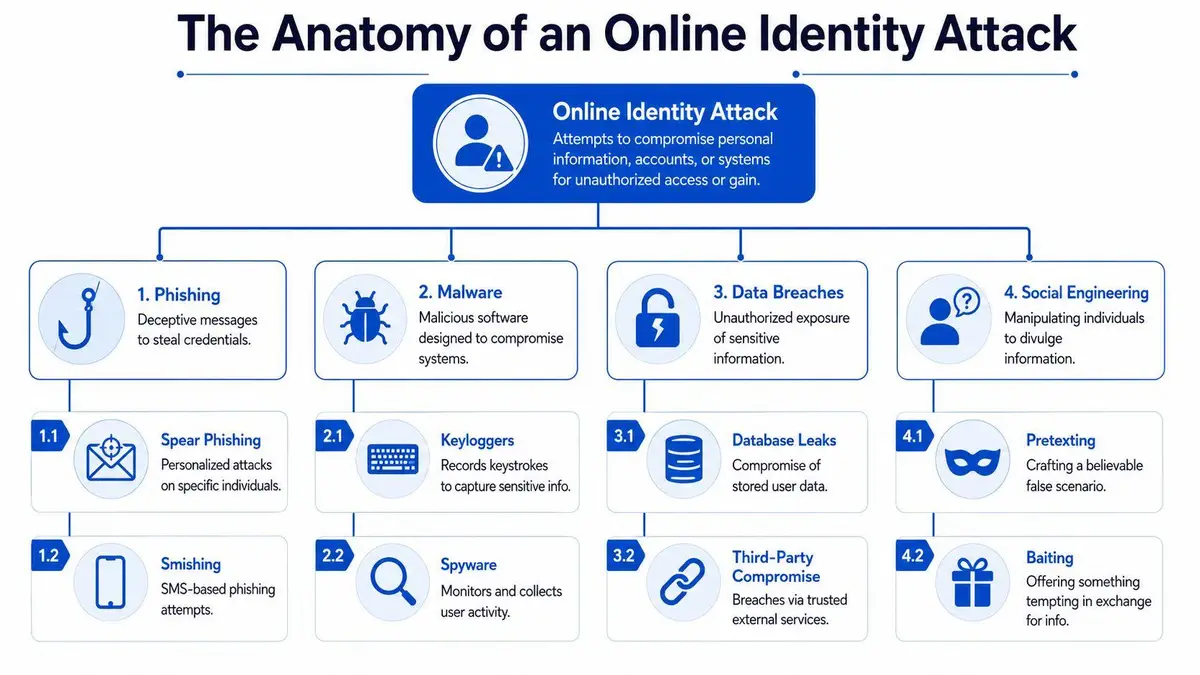
Identity theft online isn’t one crime. It’s a cluster of tactics built around impersonation, access, and advantage. The cleanest way to assess your exposure is to sort the threat into four categories.
Financial theft
This is a widely recognized category. An attacker uses your identity to access accounts, open new credit, reroute payments, or exploit trusted payment channels. For wealthy individuals, the danger often sits in linked systems rather than a single bank login. Private banking portals, brokerage communications, card-on-file merchant accounts, and assistant-managed subscriptions all create entry points.
Financial theft becomes more dangerous when the criminal knows how you operate. They don’t send random requests. They imitate your transaction habits, your preferred communication style, and your urgency.
Criminal impersonation
This form is less discussed and often more disruptive. Someone uses your identity while dealing with vendors, platforms, business contacts, or even authorities. The objective may be fraud, concealment, harassment, or pressure on third parties.
A fake identity that sends threatening messages under your name can create legal headaches before anyone proves the account is false. A bogus executive email can induce an employee to transfer funds or release internal files. The theft isn’t limited to money. It hijacks accountability.
Reputational attacks
Many generic guides often miss this point. Online identity theft can be used to publish false statements, create counterfeit profiles, contact journalists, damage professional standing, or contaminate search results with impersonation artifacts. For founders, investors, public officials, and visible families, this category can outlast the fraud itself.
A fake profile doesn’t need a large audience to cause damage. It only needs to reach the wrong audience. One investor, one reporter, one school administrator, one client.
A convincing impostor profile can do more reputational harm in a day than a conventional fraud claim does in a month.
Synthetic identities
Synthetic identity fraud sits at the edge of finance, technology, and deception. Attackers assemble fragments of real personal data with fabricated details to create an identity that passes superficial checks. Sometimes that identity is used to open accounts. Sometimes it becomes a staging tool to attack the actual person later.
Anyone who wants a sharper view of manipulation mechanics in adjacent fraud environments should review the anatomy of crypto social engineering. The same persuasion patterns appear in identity theft campaigns aimed at executives, only with more personal detail and better timing.
Here’s the practical distinction:
| Attack type | Primary objective | Typical consequence |
|---|---|---|
| Financial theft | Extract money or credit | Direct financial loss |
| Criminal impersonation | Act under your name | Legal and operational disruption |
| Reputational attack | Poison trust around your identity | Public confusion and long-tail damage |
| Synthetic identity | Create a believable identity construct | Fraud that bypasses standard review |
Modern Attack Vectors and Evolving Tactics
Advanced attackers don’t rely on one method. They stack methods. A breach supplies raw data. Social media fills in context. AI sharpens the impersonation. Malware or phishing captures the final credential.

Targeted phishing is built for people with public profiles
Standard phishing is crude. Targeted phishing is not. Executives get messages that mirror real deal flow, conference schedules, legal correspondence, and banking procedures. Smishing and vishing add pressure because they arrive through channels people treat as more immediate and more personal.
The message usually asks for one of three things: a login, a code, or a decision. If the attacker gets any one of those, the rest of the compromise becomes easier.
What makes these attacks effective isn’t just technical mimicry. It’s behavioral precision. Attackers study assistants, spouses, children, and staff. They learn who replies quickly, who handles travel, who approves invoices, and which platform your team trusts without much scrutiny.
AI has changed both scale and believability
Many security controls were designed to stop ordinary fraud, not highly adaptive impersonation. That gap is widening. Evidence shows that 60% of financial institutions now report AI was used in identity theft attempts in 2025, with synthetic identity fraud rising 350% since 2020, according to Thomson Reuters.
That matters because AI lets attackers generate polished text, realistic profile histories, and convincing identity combinations at speed. They can test narratives, improve language, and create fake personas that survive initial scrutiny. If your data is already circulating, the attacker doesn’t need to guess much.
A major blind spot is the secondary market for personal information. Data brokers, people-search sites, and leaked databases create a map of your life that attackers can mine for verification answers, family names, prior addresses, and contact patterns. If you haven’t reviewed what data brokers are and how they affect executive privacy, you’re likely underestimating how much identity scaffolding is publicly accessible.
Breach data becomes operational intelligence
A breach isn’t just a loss event. It’s reconnaissance material. Attackers use old passwords for credential stuffing, pair leaked emails with social context, and exploit reuse across business and personal systems. Once they access a primary email account, they can reset other services, search old messages for financial records, and impersonate you from a real address.
This short briefing shows the attack chain clearly:
Malware closes the loop
When phishing doesn’t get everything, malware often does. A keylogger can capture credentials and one-time codes. Spyware can map how you work, which accounts matter, and when you’re distracted. For a high-profile target, the value isn’t always immediate theft. Sometimes the attacker wants observation first, action later.
If you’re asking what is identity theft online from a risk-management perspective, this is the answer: it’s the coordinated misuse of your digital identity across channels, often by attackers who know far more about you than most victims realize.
Early Warning Signs of a Compromised Identity
The first signs are often dismissed because they don’t look dramatic. A password reset email arrives for an account you rarely use. A social platform asks you to confirm activity you didn’t initiate. A colleague mentions a message that seemed slightly off, but still plausible. Those aren’t annoyances. They’re reconnaissance indicators or early-stage compromise signals.
Signals executives often miss
Public-facing individuals tend to focus on banking alerts and credit notifications. Those matter, but they’re late-stage evidence. Earlier signs usually appear in communications, search results, and account behavior.
Watch for the following:
- Reset friction in core accounts such as repeated password reset emails, MFA prompts you didn’t trigger, or app sign-in challenges from unfamiliar locations.
- Profile duplication where a new account appears under your name, image, or biography on social or professional platforms.
- Unusual inbound verification traffic including texts, calls, or emails with one-time codes that suggest someone else is trying to enter your accounts.
- Search anomalies such as false profile pages, odd directory listings, or cached content tying your name to information you didn’t publish.
- Third-party confusion when clients, staff, or journalists ask about a message you never sent.
Why phishing attempts are themselves a warning
Many people treat phishing as background noise. That’s a mistake. If the message is tailored to your travel, business, family, or investment activity, someone has already profiled you. Benchmark data from the FTC indicates that phishing remains the most common method for identity theft, with over 2.4 million phishing reports filed in 2025, and 45% of victims losing money due to successful credential theft, according to Bitdefender’s overview of digital identity theft.
If the phishing email feels unusually specific, assume the attacker already has some of your data.
That’s the point many clients miss. An advanced phishing attempt is not the beginning of the problem. It’s often evidence that the attacker is already several steps into the operation. By the time a message references a real colleague, a real trip, or a real financial institution, the adversary has likely assembled enough context to pursue broader impersonation.
Immediate Takedown and Containment Protocols
Once you confirm or strongly suspect online identity theft, speed matters more than perfection. Delayed action gives the attacker time to deepen access, spread impersonation content, and create conflicting records that are harder to unwind later.
First moves that can’t wait
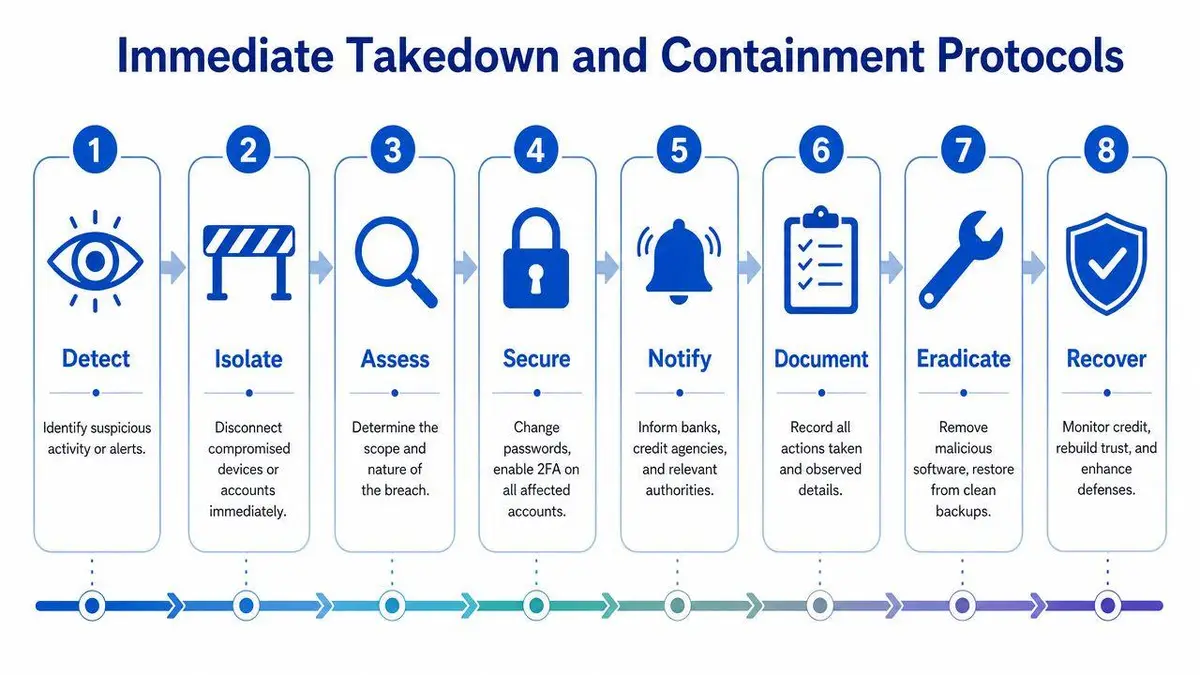
Start with control points, not paperwork. Secure the primary email account first, then financial platforms, then any account used for password recovery or executive communications. If a device appears compromised, isolate it from active sessions and stop using it for sensitive logins until it’s examined.
The public-facing side of the response must happen in parallel. Fake profiles, impersonation pages, leaked personal details, and defamatory posts should be queued for takedown immediately. Waiting until “after the bank issue is sorted” is how reputational damage becomes entrenched.
Here’s the operating sequence we advise:
- Lock the identity core. Reset credentials for primary email, password manager, and critical financial access points. Revoke unknown sessions and review recovery options.
- Freeze public confusion. Report fake profiles, preserve evidence, and begin de-indexing or source removal where false content appears in search.
- Alert institutions with precision. Notify banks, advisors, platforms, and selected counterparties. Give them a short factual notice, not a rambling explanation.
- Preserve the record. Save screenshots, timestamps, headers, URLs, and communications before content disappears.
- Escalate fast if search visibility is affected. Impersonation that ranks in search or appears on major platforms needs specialized removal work, not generic customer support tickets.
Reputation containment is not optional
Many firms still treat identity theft as a financial remediation issue. That’s incomplete for anyone with a visible name. If someone has posted your address, cloned your profile, or tied your identity to false claims, the remedy has to include search suppression, source-level removal, and privacy cleanup. A tactical reference on how to remove personal information from Google after a data breach is useful when exposed personal data starts surfacing in search.
Crisis posture: Don’t argue with the attacker, don’t publicly speculate, and don’t let junior staff improvise the response.
Effective action requires a coordinated team. Counsel handles preservation and platform escalation. Security specialists determine the access path. Reputation professionals manage takedowns and search contamination. Among the options available, ContentRemoval.com handles de-indexing, impersonation takedowns, and removal workflows for harmful material that affects identity control and online reputation.
A sloppy response creates its own damage. Public overreaction can amplify false content. Underreaction gives the attacker room to normalize the fake version of you. The right response is controlled, documented, and immediate.
Strategic Prevention for High-Profile Individuals
Most identity theft advice is written for mass-market consumers. It says to use strong passwords, turn on MFA, and monitor statements. Fine. That’s baseline hygiene. It is not a serious defense model for someone whose name, family, holdings, and movements are already visible online.
Reduce the attack surface
Your first priority is to shrink the amount of usable information attached to your identity. Public bios, archived staff pages, family social posts, charity listings, event pages, and property traces often give attackers enough material to answer security prompts, build trust narratives, or fake familiarity.
A proper defense starts with a digital footprint audit. Search your name, family members, prior addresses, old employers, shell entities, assistants, and phone numbers. Then remove what doesn’t need to be public and suppress what cannot be removed.
If you’re building a more formal privacy program, online privacy for high-net-worth individuals offers a governance lens that most consumer identity-theft content ignores.
Treat your inner circle as part of the perimeter
Attackers rarely go straight at the principal if an easier route exists. They target assistants, household staff, children, former employees, and service providers. One overshared photo, one school post, one travel confirmation can become the missing piece in an impersonation scheme.
Emerging 2025 data reveals a 42% surge in social engineering-based identity theft where AI-generated fake profiles mimic friends to extract sensitive info, according to the National Disability Institute’s identity theft resource. For prominent individuals, that means the threat often arrives wearing a familiar face.
Use practical controls:
- Separate devices by purpose. Keep a cleaner device environment for banking, legal matters, and sensitive communications.
- Formalize assistant protocols. No wire changes, document releases, or verification-code sharing without a second channel confirmation.
- Limit real-time posting. Travel, family events, and location-tagged content give attackers timing intelligence.
- Review recovery paths. Backup emails, phone numbers, and security questions are frequent weak spots.
- Harden family habits. The least security-aware relative often becomes the attacker’s easiest route.
Stop relying on convenience as a security model
Convenience makes routines predictable. Predictability gives attackers structure. If your team always handles requests the same way, from the same channels, under the same assumptions, a skilled impersonator only has to mimic the pattern.
The fix isn’t paranoia. It’s operational discipline. High-profile individuals need friction in the right places: confirmation protocols, reduced public exposure, controlled devices, and periodic privacy reviews. That’s what lowers identity risk.
Long-Term Reputation Recovery and Monitoring
A contained incident isn’t the same as a resolved one. The immediate fraud may stop, the accounts may be secured, and the fake profile may be removed, but your identity can remain exposed in data sets, breach archives, cached pages, and underground markets long after the visible crisis fades.

Why recovery takes longer than most people expect
Online identity theft leaves residue. A copied profile may reappear on another platform. A leaked credential can be tested months later. A defamatory impersonation post can persist in search fragments even after source removal. That’s why reputation recovery needs active monitoring, not one-time cleanup.
According to OCC.gov, 54% of identity theft victims discover their data was compromised in dark web breaches 6 to 12 months before actual fraud occurs. Recent 2025 FTC reports indicate that 31% of victims were unaware their SSN was sold on dark markets until 9 months post-breach, as summarized on OCC identity theft resources. For a high-profile client, that lag is unacceptable. If your name is commercially or publicly valuable, delayed discovery creates unnecessary exposure.
What sustained monitoring should include
Long-term recovery should cover more than credit file review. It needs search monitoring, impersonation watchlists, dark web surveillance for credentials and identifiers, and periodic checks of people-search databases and public data brokers.
A disciplined recovery program usually includes:
- Search result review for false profiles, resurfaced leaks, and stale harmful pages.
- Dark web monitoring for credentials, identifiers, and mentions tied to your name or known aliases.
- Platform surveillance for account cloning on social, messaging, and professional networks.
- Credit and account review for delayed fraud attempts and new account openings.
- Reputation correction work when false or misleading content remains visible to clients, investors, media, or schools.
Recovery is finished only when the false version of you stops resurfacing.
If the financial side still needs repair after a breach or impersonation event, LifeBack Law’s credit rebuilding tips offer a useful legal-adjacent perspective on restoring stability while broader identity monitoring continues.
The objective is control. You want early detection, less public exposure, and a documented response path before the next attempt occurs. That’s how high-profile individuals recover properly. Not by waiting for the next alert, but by making sure they see it first.
If your name, accounts, search results, or personal data are being misused online, ContentRemoval.com can assess the exposure confidentially and map a response that covers takedowns, de-indexing, privacy cleanup, and ongoing monitoring. The right time to start is when you see the first sign of impersonation, not after the damage spreads.
Frequently asked questions
How do I know if someone is impersonating me online?
Watch for a new account under your name, image or biography, clients or journalists asking about messages you never sent, one-time codes arriving unprompted, and false profile pages or odd directory listings in search. The article treats highly specific phishing as a sign the attacker already has your data.
What should I do first when my identity is stolen online?
Secure the control points before the paperwork: reset your primary email, password manager and critical financial logins, revoke unknown sessions and review recovery options. In parallel, report fake profiles, preserve screenshots and URLs, notify banks and platforms with a short factual notice, and escalate any impersonation that is ranking in search.
Why does identity theft recovery take so long for public figures?
Because the residue persists. A cloned profile can reappear on another platform, a leaked credential can be tested months later, and impersonation posts can linger in search fragments after removal. The article cites OCC data showing many victims’ data circulated 6 to 12 months before fraud occurred, so recovery needs ongoing monitoring, not a one-time cleanup.