
A cease and desist letter is a formal written demand that a person or company stop a specific harmful action such as defamation, copyright or trademark infringement, brand impersonation or harassment. It is not a court order, but it creates a documented pre-litigation warning, cites the laws violated, sets a compliance deadline and signals that legal action will follow.
Key facts
- A letter is sent by you or counsel; an order is issued by a judge and enforceable by law.
- A DMCA notice covers copyright only; a cease and desist covers defamation, trademark, impersonation and privacy.
- Professional drafting for a straightforward matter typically costs $1,500 to $3,000.
- An unfounded letter can trigger a declaratory judgment action or a tortious interference claim.
Where ContentRemoval.com comes in. ContentRemoval.com pairs the demand with the takedown work that actually clears the content, acting as the intermediary when the client needs to stay out of the direct correspondence. Founders, brand managers and public figures usually reach out after an impersonation account, defamatory review or stolen asset has appeared, often before any lawyer is involved. A free 15-minute Exposure Scan maps what is removable, and the report is theirs to keep. Get a Free, Confidential Exposure Scan or read how our content removal work is done.
A cease and desist letter is a formal, written demand that an individual or entity stop a specific harmful action, whether that action is defamation, copyright infringement, or brand impersonation. It is a calculated first move in defending your reputation or intellectual property.
While not a court order, it serves as a documented, pre-litigation warning. It establishes a formal record of your demand and communicates your unequivocal intent to pursue legal remedies if the offending conduct does not stop immediately.
Your First Move Against Online Threats

When your reputation, brand, or intellectual property is under attack, a cease and desist letter is the first strategic step. It puts the offending party on formal notice, eliminating ambiguity about the wrongful conduct and your demand for its immediate cessation. This document is a cornerstone of reputation defense, demonstrating that you are aware of the violation and fully prepared to enforce your rights.
The primary strategic advantage of a cease and desist letter is its capacity to secure compliance without the expense, time, and public exposure of litigation. It creates an official record of your attempt to resolve the matter, which becomes critical evidence should court proceedings become necessary.
Warning vs. Court Order: A Critical Distinction
A cease and desist letter must not be confused with a cease and desist order. The distinction lies in the issuer. The letter is sent by you or your legal counsel. An order is issued by a judge and carries the full force of law, enforceable by law enforcement.
This table clarifies the fundamental differences between a private demand and a judicial mandate.
Cease and Desist Letter at a Glance
| Attribute | Cease and Desist Letter | Court-Issued Order |
|---|---|---|
| Issuer | You, your company, or your attorney | A court or government agency |
| Legal Power | Not independently binding; serves as a warning of legal action | Legally binding and enforceable by law |
| Purpose | To demand an action stop and warn of impending litigation | To legally compel an action to stop under penalty of law |
| Consequence | Ignoring it risks a lawsuit and liability for damages | Violating it can result in fines, contempt of court, or imprisonment |
The letter is a formal warning; the order is a legal command.
For executives, founders, and public figures, this distinction is paramount. A precisely drafted letter provides a mechanism to terminate a damaging situation quietly and swiftly, before it escalates into a public crisis. While preventative measures like robust data security technologies to avert cyber threats are ideal, a cease and desist letter is the essential reactive tool.
Assessing the Efficacy of a Cease and Desist
Does a cease and desist letter work? When drafted and deployed by legal specialists, the answer is yes. A professionally constructed letter functions as a potent pre-litigation tool that compels the offending party to cease their actions in a significant majority of cases.
Frequently, this single intervention resolves the entire matter within weeks. This efficacy allows our clients to circumvent protracted and costly legal conflicts, preserving both capital and reputation.
The Anatomy of a Letter That Commands Action
An effective cease and desist letter is not a polite request. It is a formal, strategic instrument of enforcement. Its authority derives from its clear demonstration of a well-founded legal case and the sender’s readiness to litigate. Consider it the opening argument of a lawsuit you are prepared to file.
Using a generic template from the internet is a critical error. Such documents signal a lack of investment in proper legal counsel and are often rife with vulnerabilities that a sophisticated adversary will exploit. An authentic demand letter is custom-drafted by an expert, establishing irrefutable authority from the opening sentence.
The Core Components of an Effective Demand
A letter that compels compliance is meticulously constructed to present an unassailable legal position. Each component is engineered to convince the recipient that non-compliance is the far more costly and damaging option.
A legally potent letter must incorporate these elements:
The clear identification of both the sender (the aggrieved party) and the recipient is fundamental. Any ambiguity compromises the document’s validity from the outset.
A factual, dispassionate account of the harmful conduct is required. This section must precisely detail the wrongful acts, including dates, URLs to offending content, and references to evidentiary materials such as screenshots.
The specific laws being violated must be cited. This is where the letter connects the recipient’s actions to legal statutes governing defamation, copyright infringement, or trademark violation. This transforms a complaint into a formal legal notice.
An unambiguous demand for cessation must be articulated. The language must be direct and unequivocal: “You are to immediately cease and desist all…” There can be no room for interpretation regarding the required action.
The objective is not to initiate a dialogue; it is to terminate harmful behavior. The letter should read like a closing argument delivered before trial, making it self-evident that challenging the demand is a losing proposition.
This structured, evidence-based approach is what distinguishes a professional demand from an empty threat. It lays the complete groundwork for litigation, showing the recipient that ignoring the demand will result in substantial financial and legal consequences. By including a firm compliance deadline and outlining the legal remedies you will pursue, the letter becomes a powerful tool for resolution. While a professionally crafted letter can achieve a swift and cost-effective outcome, a poorly constructed one can backfire, potentially inviting a countersuit. To fully understand the process, review the strategic steps before sending a letter.
When to Use a Cease and Desist Letter
A cease and desist letter is a powerful legal instrument, but its deployment must be strategic. Understanding the opportune moment to send one is as critical as its content. It is your first formal offensive when your reputation or assets are under direct attack.
For executives, brands, and public figures facing immediate and ongoing harm, this letter is the primary response mechanism. It serves as a clear, professional warning to the adverse party, demanding immediate cessation before the conflict escalates into full-scale litigation.
Primary Use Cases for a Cease and Desist
A cease and desist letter is most effective in specific scenarios where an individual or entity is causing direct, provable harm.
For online defamation, libel, and slander, it is the standard first action. When false statements about you or your business are published (in a defamatory review, a misleading article, or a social media attack) they cause direct reputational damage. The letter demands immediate removal. Our guide on how to report a defamatory website provides further detail.
In cases of copyright and trademark infringement, the letter is essential. If a competitor misappropriates your logo or a website illegally distributes your copyrighted material, a cease and desist is the formal demand to stop.
For brand impersonation and cybersquatting, where malicious actors create fraudulent social media profiles or register domains mimicking your brand to deceive the public, a letter is the standard initial step to demand the shutdown of the fake asset.
Finally, in situations of harassment and privacy violations, such as the unauthorized publication of private information (doxxing) or the nonconsensual distribution of intimate images, a cease and desist serves as a formal demand to stop the harassment and remove the content.
Research underscores the tool’s impact. A survey of executives revealed that while 92% report that online reputation issues have directly affected their business, well-executed cease and desist letters resolve 65% of these conflicts without litigation.
Data consistently demonstrates the value of these letters. For instance, 82% of brands in a recent study reported positive outcomes after sending C&D letters to combat fraudulent reviews. This is a critical capability when negative online sentiment can reduce revenue by 20-30%. The effectiveness is not confined to the U.S.; in Europe, letters citing GDPR for personal data misuse achieve a 78% compliance rate, proving their utility across jurisdictions.
Navigating Responses and Potential Risks
Once a cease and desist letter is dispatched, the onus shifts to the recipient. Your subsequent actions are dictated by their response, and you must be prepared for multiple contingencies. This is not a single act but the opening move in a strategic exchange.
First, the letter must be sent via a tracked delivery service. This is not merely a best practice; it is a crucial step in evidence preservation. Should the matter escalate, you will possess indisputable proof of receipt, neutralizing any claim that the warning was never received.
Evaluating the Recipient’s Reaction
In the optimal scenario, the recipient complies with the demand, removes the content, and the matter is resolved. While this outcome is frequent, you must be prepared for other responses. The recipient may attempt to negotiate, ignore the demand entirely, or respond aggressively.
If your compliance deadline passes without a response, inaction is not an option. This is a critical juncture. Failure to proceed with the threatened next step signals that your demand was a bluff, undermining your credibility.
The moment you send a cease and desist letter, you must be fully prepared to follow through on its threats. An empty threat destroys your credibility and can embolden the very behavior you seek to stop, making future enforcement significantly more difficult.
The Risks of Escalation and Unintended Consequences
If the recipient ignores the letter, the situation escalates. Your next actions may include filing a lawsuit for damages, petitioning the court for a temporary restraining order (TRO), or seeking a preliminary injunction to compel cessation. Each of these legal maneuvers requires significant time, capital, and a coherent litigation strategy.
Escalation carries its own risks. The recipient could file for a declaratory judgment, asking a court to affirm the legality of their conduct. A public legal battle can also trigger the “Streisand Effect,” where the attempt to suppress information inadvertently causes it to go viral, attracting far more attention than the original content.
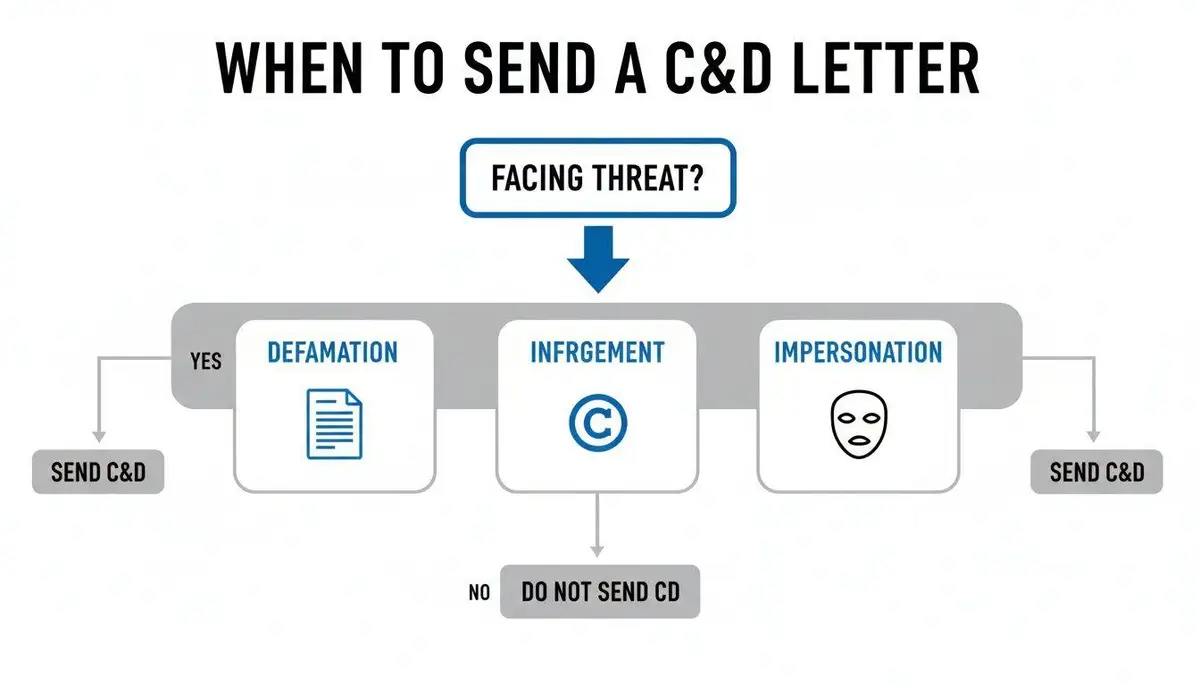
This flowchart illustrates the typical scenarios (defamation, infringement, or impersonation) that precipitate the sending of a cease and desist letter.
Understanding these potential outcomes and risks is vital. If a website operator refuses your demand, knowing what to do when a website won’t remove your information is the essential next phase of your strategy.
Comparing Your Content Removal Options
Having decided to take action against harmful online content, you must select the appropriate tool. A cease and desist letter is a potent instrument, but it is one of several options in your strategic arsenal.
Choosing the correct legal or procedural tool for a specific problem from the outset saves time, capital, and significant frustration. The wrong choice can delay resolution and introduce unnecessary complications.
DMCA Takedown vs. Cease and Desist
These two instruments are frequently confused, but they serve distinct legal functions.
The Digital Millennium Copyright Act (DMCA) provides a specific, powerful remedy for copyright infringement. If another party has misappropriated your original photos, videos, or text and published them online, a DMCA takedown notice is the correct instrument. This formal notice creates a legal obligation for a U.S.-based hosting provider or website to remove the infringing material. It is highly effective but is strictly limited to copyright violations.
A cease and desist letter offers much broader applicability. It is a versatile tool for addressing a wide range of harmful activities, including:
- Defamation, libel, and slander
- Trademark infringement
- Brand impersonation or cybersquatting
- Harassment and privacy violations
A DMCA notice is a scalpel, designed for the precise task of excising stolen copyrighted content. A cease and desist letter is a comprehensive legal instrument for confronting a wider spectrum of online attacks. We detail the mechanics of the former in our guide on how to write and file a DMCA takedown notice.
A professionally drafted cease and desist letter is often the most strategic first move because it addresses a wider array of issues than a DMCA notice without incurring the immediate, substantial costs of litigation.
Platform Reporting and Court Orders
Beyond these two primary tools lie platform-specific reporting mechanisms and, at the highest level of escalation, a court order.
Nearly all online platforms provide internal reporting tools for flagging content that violates their terms of service, such as spam, hate speech, or graphic violence. While useful for clear-cut violations, enforcement is often inconsistent and at the sole discretion of the platform’s moderators, offering no legal weight.
A court order represents the ultimate legal remedy. It is an official, binding directive from a judge, enforceable by law. Non-compliance results in severe penalties. However, obtaining a court order is an expensive, time-consuming, and public process. It is the appropriate course of action only after other methods, including a strongly worded cease and desist letter, have failed.
This table compares these tools, clarifying their strengths and appropriate applications.
Comparison of Reputation Management Tools
| Tool | Primary Purpose | Legal Basis | Best Use Case |
|---|---|---|---|
| Cease and Desist Letter | To demand an individual or entity stop a harmful action. | Common law, various statutes (e.g., defamation, trademark). | Defamation, harassment, trademark issues, impersonation, privacy violations. |
| DMCA Takedown Notice | To remove stolen copyrighted material from a website. | U.S. Copyright Law (17 U.S.C. § 512). | Someone is using your photos, videos, articles, or music without permission. |
| Platform Reporting Tool | To flag content that violates a specific website’s rules. | A website’s Terms of Service. | Clear-cut violations like spam, hate speech, or explicit content. |
| Court Order | To legally compel a person or platform to act or stop acting. | The full authority of the judicial system. | When other methods have failed and the harm is severe enough to warrant litigation. |
The situation dictates the strategy. A simple terms-of-service violation may only require a platform report, whereas a coordinated defamation campaign will necessitate a cease and desist letter, with the potential for escalation.
Why Professional Drafting Is Non-Negotiable

When the stakes are high, the quality of your cease and desist letter is determinative. Using a generic online template is a profound strategic error.
A poorly drafted letter appears amateurish, often contains legal inaccuracies, and makes unenforceable threats. This not only weakens your position and destroys your credibility but also exposes you to the risk of a countersuit. This is not a situation for a DIY approach. A template is a hollow threat; a professionally drafted letter is a calculated legal maneuver. One is ignored, the other commands immediate attention.
The Strategic Advantage of Expertise
When confronting a serious reputational or legal threat, engaging a specialized law firm or reputation management expert is essential. A specialist conducts the necessary due diligence, gathers evidence, and frames the legal arguments with precision to ensure your letter is both legally sound and maximally effective.
This transforms the letter from a mere complaint into an instrument engineered for compliance. It communicates to the recipient that you have already invested in a legal strategy and are fully prepared to escalate the matter.
A professionally managed process includes strategic delivery, response tracking, and immediate readiness for escalation. This approach maximizes the probability of a swift, private, and final resolution.
Expert counsel also insulates you from critical errors. For instance, if your claims are not rigorously vetted, you could be exposed to a lawsuit for tortious interference. A professional verifies that you are on solid legal ground before any communication is sent, mitigating risk and shifting the strategic advantage in your favor.
From Demand to Resolution
A professionally drafted cease and desist is more than a document. It is the opening move in a comprehensive enforcement strategy, designed not merely to be sent but to achieve a specific outcome: the swift and permanent cessation of damaging activity.
Our process therefore begins with a confidential assessment to construct a decisive action plan. We ensure every demand is backed by irrefutable evidence and legal authority, making compliance the only logical course of action for the recipient. By converting a chaotic conflict into a controlled resolution, we protect your reputation with speed and certainty.
Frequently Asked Questions
When confronting an online threat, executives, public figures, and legal teams require clear, direct answers. Here are concise responses to the most common inquiries we receive regarding cease and desist letters.
How Much Does It Cost to Send a Cease and Desist Letter?
There is no standard price. The cost to have a professional draft and send a cease and desist letter is determined by the complexity of the case.
For a straightforward matter with clear evidence, fees typically range from $1,500 to $3,000. However, if the dispute involves convoluted legal arguments, requires extensive investigation, or has international dimensions, the investment will be higher. You are not purchasing a document; you are retaining the legal strategy required to ensure the demand is effective and does not create unintended liabilities.
What Happens if I Send a Cease and Desist Letter and I Am Wrong?
Sending a cease and desist letter without a valid legal basis is a high-risk action that can backfire significantly. If your claims are unfounded, the recipient can sue you.
They may file for “declaratory relief,” asking a court to officially rule that their conduct is lawful. In a worst-case scenario, this could escalate into a lawsuit against you for tortious interference with their business, exposing you to liability for damages. This is precisely why expert counsel is critical. A specialist validates the claim before the letter is sent, protecting you from these costly repercussions.
Can a Cease and Desist Letter Be Sent Anonymously?
No. An anonymous letter is legally impotent. The power of a cease and desist letter derives from the authority of the sender and their credible threat to pursue legal action. A demand from an unidentified source carries no weight and will be dismissed.
For clients requiring confidentiality, a specialized firm like ours acts as a powerful intermediary. We issue the letter under our authority, compelling action while keeping your name entirely out of the direct communication.
When your reputation is on the line, you need to act with speed and expertise. ContentRemoval.com delivers the decisive action required to neutralize damaging content and protect what you’ve built. Schedule your confidential assessment today to get started.