
Brand impersonation is the deliberate misuse of a company’s name, logo, executives, digital assets or communication style to trick customers, staff or partners into handing over money, credentials or trust. It spans spoofed email, fake executive social profiles, cloned websites and lookalike domains, and each form needs a different evidence package and takedown route.
Key facts
- The FTC recorded $2.95 billion in consumer losses to impersonation scams in 2024, tripling since 2020.
- Email defenses start with SPF, DKIM and DMARC, with BIMI and Verified Mark Certificates adding visible trust.
- Fake social accounts can often be removed faster than cloned websites hosted by third parties.
- Capture URLs, headers, screenshots and payment instructions in the first hour before filing any complaint.
Where ContentRemoval.com comes in. ContentRemoval.com handles the removal side of impersonation attacks: fake executive profiles, cloned sites, sham support accounts and fraudulent listings, along with the search results that point to them. Contact usually comes from a general counsel, security lead or the executive’s office once the fraud is confirmed. A free 15-minute Exposure Scan maps every impersonating asset and the route for each, and the report is yours to keep. Get a Free, Confidential Exposure Scan or read how our content removal work is done.
At 8:12 a.m., your CFO forwards an angry note from a client who paid a fake invoice that looked like it came from your finance team. At 8:19, your head of sales spots a LinkedIn profile using your CEO’s name and photo to approach prospects. By 8:40, your customer support line is fielding complaints about a login page that isn’t yours.
That’s the moment most leaders ask the wrong question. They ask whether this is an IT issue.
It isn’t. It’s a trust attack with financial consequences.
When clients ask me what is brand impersonation, I give a direct answer. It’s the deliberate misuse of your name, logo, executives, digital assets, or communication style to trick people into handing over money, credentials, or confidence they meant to place in your company. The criminal isn’t just copying your branding. They’re borrowing your credibility and spending it against you.
The scale should end any complacency. In 2024, the FTC reported that consumers lost exactly $2.95 billion to impersonation scams, a figure that has more than tripled since 2020, with brand impersonation accounting for roughly half of all fraud complaints the agency receives, as summarized in Allure Security’s review of FTC impersonation scam losses. If your company has a recognizable name, visible executives, or recurring customer payments, you’re already a plausible target.
The threat also isn’t limited to external fraud. A fake executive message can pressure employees into shortcuts. A spoofed recruiting account can damage hiring trust. A cloned support account can turn normal customer frustration into a public reputation crisis. If you’re already reviewing broader reputation exposure tied to staff behavior and brand perception, this strategic guide on protecting company reputation from employee social media is a useful parallel read.
The Threat Is Already Inside Your Network
A complex impersonation campaign rarely announces itself as a cyber event. It arrives disguised as ordinary business. A vendor receives a payment instruction. A prospect gets a message from a fake executive. A customer clicks a search result that leads to a cloned portal.
By the time your internal team identifies the pattern, outsiders may already believe the attacker represents you.
What the attack actually targets
Brand impersonation attacks don’t begin with malware. They begin with recognition. The attacker studies your logo, your invoice format, your executive profiles, your support language, and your public digital footprint. Then they create a version of your company that looks close enough to pass under stress.
That’s why the damage moves fast. A recipient doesn’t need to trust the criminal. They only need to trust you.
Practical rule: Treat every impersonation incident as both a security event and a reputation event. If you split those functions, you slow the response and widen the damage.
Why executives underestimate it
Most leadership teams still frame impersonation as a fake email problem. That view is outdated. Attackers now combine email, web cloning, social platforms, search placement, and direct messaging into one coordinated campaign. The first signal may appear in finance, legal, customer support, or investor relations.
That cross-functional reality is what catches companies flat-footed. The fraud can touch accounts receivable, customer retention, executive credibility, and legal exposure in a single day.
Anatomy of a Brand Impersonation Attack
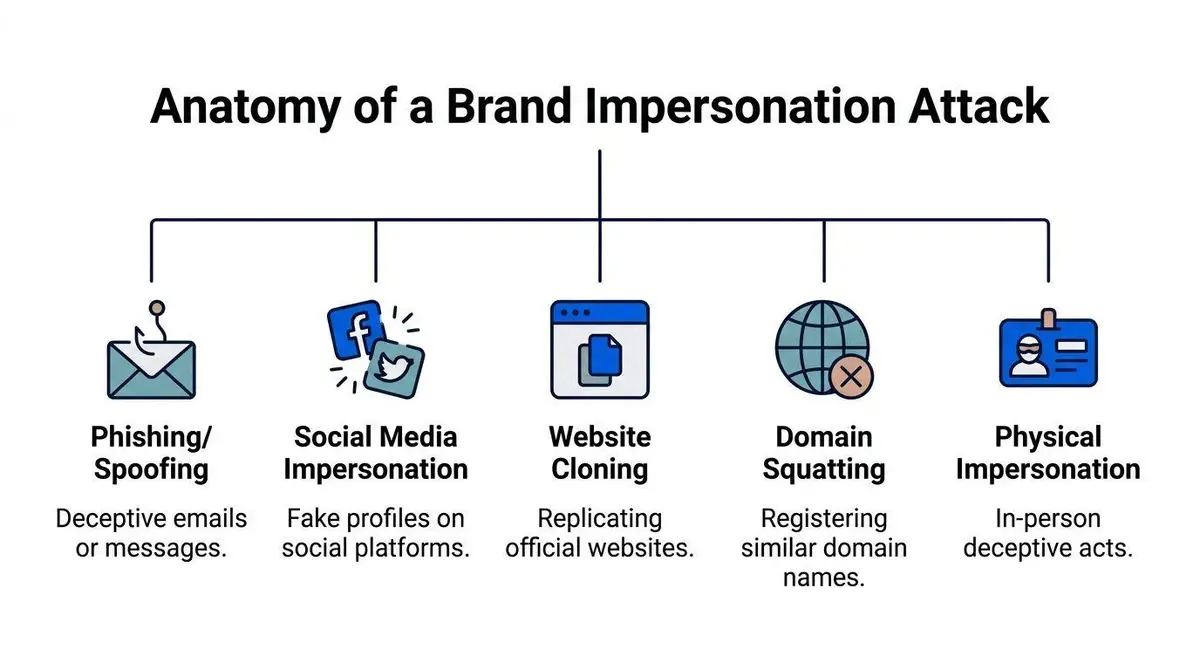
The fastest way to control an impersonation incident is to classify it correctly. Different forms of abuse require different evidence, different reporting channels, and different takedown strategies. If you misclassify the attack, you waste the first critical hours.
Brand impersonation is a sophisticated phishing cyber-attack where malicious actors engineer messages or counterfeit digital entities that mask themselves as a legitimate brand. The attack relies on the established trust and reputation of the impersonated organization to deceive customers, employees, and partners, as defined by Darktrace’s brand impersonation glossary.
Email spoofing and phishing
This is the version most executives recognize. An attacker sends messages that appear to come from your domain, a close variant of it, or a display name that mirrors a real employee. The purpose is usually straightforward. Steal credentials, reroute payments, or push a malware link.
The business mistake is assuming the email itself is the whole operation. Often it’s only the front door. The message pushes the recipient toward a cloned login page, a fake invoice workflow, or a callback number controlled by the attacker.
A strong defense starts with SPF, DKIM, and DMARC. These controls help receiving systems verify whether a sender is authorized. For visible trust in the inbox, BIMI combined with Verified Mark Certificates adds another layer by displaying a verified brand logo for supported email environments. Those are not cosmetic upgrades. They reduce ambiguity where ambiguity is expensive.
Social media impersonation
Many B2B companies are exposed without realizing it. Attackers create fake executive accounts, sham support profiles, or lookalike brand pages on LinkedIn, X, Instagram, and other platforms. They approach customers, prospects, investors, and journalists under your identity.
This threat works because the medium feels informal. People lower their guard on social platforms. The attacker uses that relaxed posture to request a private conversation, redirect the victim to a fake site, or spread misinformation under your name. Firms trying to tighten their executive visibility and platform posture can learn from Advisor Momentum’s social media expertise, particularly where personal brand presentation intersects with institutional trust.
Website cloning and counterfeit digital assets
A cloned website is more dangerous than a bad fake email because it gives the victim a place to continue believing the deception. The page looks legitimate. The form works. The branding matches. Search ads, social messages, or email links drive traffic into that environment.
Counterfeit assets also include fake marketplace listings, rogue support pages, unauthorized reseller storefronts, and impersonating mobile experiences. The legal and procedural route for each differs sharply. That matters later, when speed determines loss.
Domain squatting and AI-assisted impersonation
Some attackers register lookalike domains that differ by a single character, added word, or altered suffix. Others use trusted websites to host phishing links, which makes detection more difficult for security teams. Nearly 51% of all browser-based phishing attempts involved some form of brand impersonation, and 75% of those phishing links were hosted on good, trusted websites, according to Security Magazine’s coverage of browser-based phishing analysis.
The AI layer makes all of this easier to scale. As summarized by Cyble’s analysis of 2025 brand impersonation threats, Americans lost over $12.5 billion to fraud in 2025, and 300,487 phishing-related complaints were logged as criminals increasingly used AI, automation, and stolen personal data to deploy kits that clone websites and generate convincing content. For an executive team, the implication is simple. Visual polish is no longer evidence of legitimacy.
Assessing the Financial and Reputational Damage
Leaders usually see the first loss and miss the larger one. The fake invoice, diverted payment, or stolen credential gets attention because it’s visible. The longer-term injury is the collapse in confidence around your communications, your executives, and your customer channels.

Direct loss is only the first line item
The immediate damage usually falls into one of three buckets. Money goes to the wrong account. Sales go to a counterfeit seller. Credentials are harvested and used to deepen the intrusion.
That’s the beginning, not the end. Once victims associate your brand with fraud, every legitimate message you send faces more skepticism. Support costs rise because customers need reassurance before they act. Sales cycles slow because procurement teams want extra verification. Internal staff start second-guessing normal requests.
Social media is now a board-level exposure
Many companies still invest heavily in email security while treating social platforms as a marketing problem. That’s a category error. Brand impersonation on social media is “booming,” and 70% of impostors on social media target B2B customers directly, according to BitSight’s analysis of the rise of brand impersonation phishing. If your executives are visible on LinkedIn, your attackers don’t need to break into your network to damage your pipeline. They can impersonate leadership and intercept trust in public.
A fake executive profile doesn’t need to fool everyone. It only needs to fool one customer, one journalist, one investor, or one employee at the wrong moment.
The reputational damage spreads in four directions
A useful way to evaluate exposure is to look at four separate consequences:
- Revenue loss. Funds are diverted, transactions are abandoned, or customers choose not to proceed because they no longer trust your channels.
- Brand erosion. The market starts associating your name with confusion, complaints, and poor control of your digital footprint.
- Legal and compliance pressure. If the impersonation campaign leads to compromised personal data or misrepresented communications, counsel and regulators may need to get involved.
- Operational drag. Your finance, legal, communications, IT, and customer service teams divert time into incident handling instead of running the business.
Why the reputational effect lasts longer than the fraud
A payment scam can be reversed or written off. Distrust is slower to repair. Once clients start asking, “How do I know this message is really from you?” your company has entered a higher-friction operating environment.
That’s why a weak response is expensive. Silence looks evasive. An overbroad public statement creates more panic. The right move is controlled verification, precise communications, and rapid removal of the fraudulent assets.
Proactive Monitoring and Threat Detection
Most companies monitor impersonation passively. They wait for a customer complaint, a press inquiry, or a takedown notice from a platform. That isn’t a strategy. It’s delayed discovery.
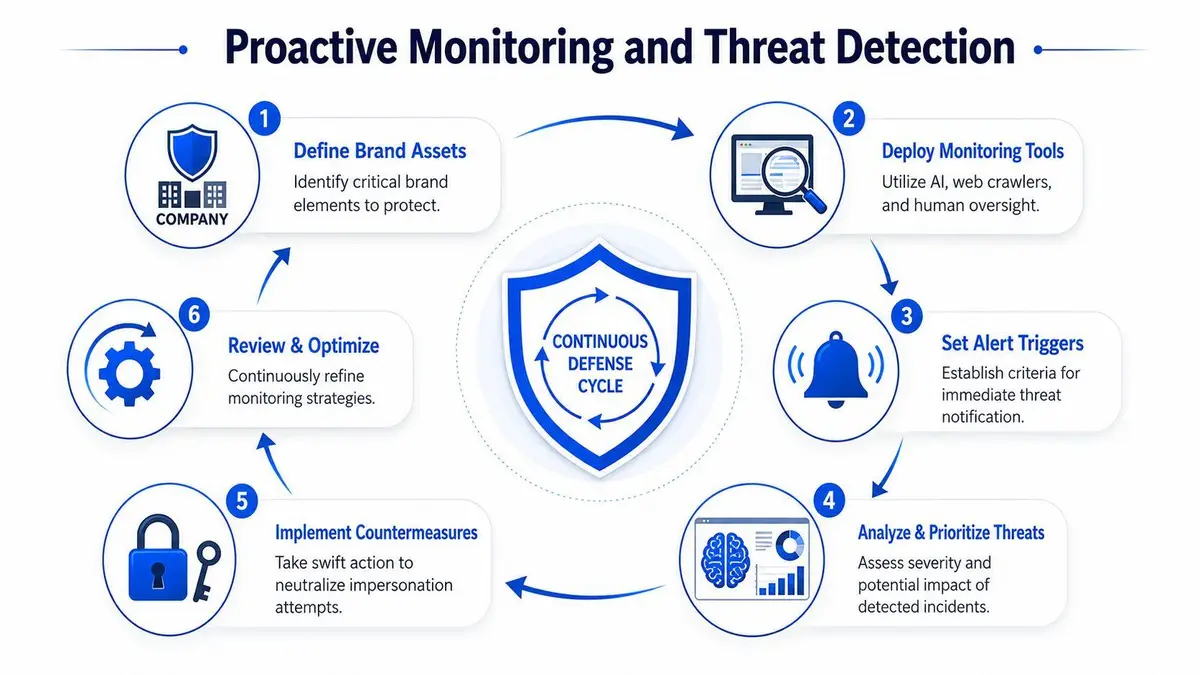
If you want a workable answer to what is brand impersonation in practical terms, here it is. It’s a live operational risk that demands continuous detection across email, domains, websites, search, marketplaces, and social channels.
Preemptive defense is the only serious posture
The most effective programs don’t wait for a cloned site to start collecting credentials. They aim to identify and disrupt abuse as users encounter it. That aligns with Gartner’s identification of preemptive cybersecurity as a top strategic technology trend for 2026, defined by deny, deceive, and disrupt, as discussed in Memcyco’s analysis of preemptive cybersecurity and brand impersonation protection.
That framework matters because reactive takedowns come after exposure. Preemptive monitoring shortens the window in which the attacker can monetize your brand.
A practical reference point for broader protective measures is this guide to online brand protection services, especially if your organization is trying to unify legal, technical, and reputational controls.
What a mature monitoring program includes
A capable monitoring program has several moving parts, and they should operate continuously rather than as one-off audits.
- Email authentication controls. Enforce SPF, DKIM, and DMARC. Add BIMI and Verified Mark Certificates where appropriate so recipients have a visible trust signal.
- Domain surveillance. Watch for lookalike registrations, brand-plus-keyword domains, and suspicious redirects that can support phishing or counterfeit activity.
- Social identity monitoring. Track unauthorized use of executive names, company logos, and support branding across major platforms.
- Web and marketplace review. Search for cloned sites, fake storefronts, unauthorized seller pages, and copied marketing assets.
- Threat triage. Not every fake profile deserves the same response speed. A dormant parody account is different from a payment-diversion page impersonating your finance team.
Passive monitoring tells you what happened. Preemptive monitoring gives you a chance to stop what’s happening.
The video below gives a useful visual frame for how these attacks present in practice.
Why standard IT ownership often fails
IT teams are good at internal controls. Brand impersonation defense also requires platform fluency, trademark awareness, evidence preservation, and fast external escalation. That mix rarely sits inside one department.
The companies that handle this well build a defined response path across security, legal, communications, and executive leadership. They know who validates a fake account, who preserves screenshots, who contacts the affected platform, who decides on customer notice, and who owns post-incident remediation. Without that structure, every hour gets spent debating process while the attacker keeps operating.
The Takedown Arsenal Legal and Platform Remedies
The wrong takedown method wastes time. A fake LinkedIn executive account is not handled the same way as a spoofed email campaign. A cloned website hosted through a foreign provider is not removed the same way as a counterfeit marketplace listing. The remedy must match the abuse.
Different abuse types require different procedural paths
Most generic guidance falls short here. It says “report the account” or “send a takedown notice” as if all impersonation works the same way. It doesn’t.
Fake marketplace sellers require evidence of trademark infringement and platform-specific requests, whereas phishing demands DMARC/SPF verification and email provider takedowns. There can be a 24 to 48 hour execution disparity between variants, and social media fake accounts can often be removed faster than cloned websites, according to Doppel’s explanation of brand impersonation reporting pathways. That difference should drive your response plan.
If counterfeit product listings are part of the problem, the tactics used to secure listings and deter counterfeiters are relevant because marketplace enforcement turns heavily on proof of trademark ownership and platform process, not on phishing logic.
For a deeper legal framing around online impersonation claims and remedies, this strategic guide to legal options for online impersonation of a business is useful.
Brand impersonation takedown methods compared
| Takedown Method | Target | Typical Speed | Primary Use Case |
|---|---|---|---|
| Platform-native impersonation report | Fake social profiles, sham support accounts, executive impersonation pages | Often faster than cloned website actions | Clear account impersonation on social platforms |
| Marketplace IP complaint | Fake sellers, counterfeit listings, unauthorized storefronts | Depends on platform review | Trademark misuse and unauthorized commercial listings |
| Email provider and sender-authentication complaint | Spoofed email campaigns, phishing messages | Varies by provider and evidence quality | Sender abuse, spoofing, and phishing distribution |
| Hosting provider abuse report | Cloned websites, fake portals, scam landing pages | Slower than social account removals in many cases | Fraudulent websites hosted by third parties |
| Cease-and-desist letter | Identifiable operators or intermediaries | Depends on service and compliance | Early legal pressure where the party can be reached |
| UDRP or court-directed domain remedy | Domain disputes, entrenched cloned sites, persistent abuse | Slower, more formal process | Domain control and higher-resistance cases |
Choose the remedy by objective, not by habit
A board-level mistake is insisting on a legal letter for every incident. Sometimes that’s necessary. Often it’s not the fastest first move.
Use a simple decision test:
- Is the asset on a controlled platform? Use the platform’s impersonation or IP process first.
- Is the attack email-led? Focus on authentication evidence, provider escalation, and inbox protection.
- Is the asset a standalone website? Preserve evidence, notify the host and registrar where appropriate, and prepare for a longer enforcement path.
- Is there commercial misuse of your mark? Build the trademark record and file the correct marketplace or infringement complaint.
The best takedown strategy is rarely the most aggressive on paper. It’s the one that removes the harmful asset fastest while preserving your position for the next step.
What executives should insist on from counsel and responders
You want a response team that can answer four questions immediately. What exactly is being impersonated. Where is it hosted or published. What evidence will the platform or provider require. What can be removed fastest today while the longer remedies are prepared.
That sequence keeps urgency tied to results. It stops the common drift into abstract legal analysis while the fraudulent asset stays live.
An Executive’s Incident Response Checklist
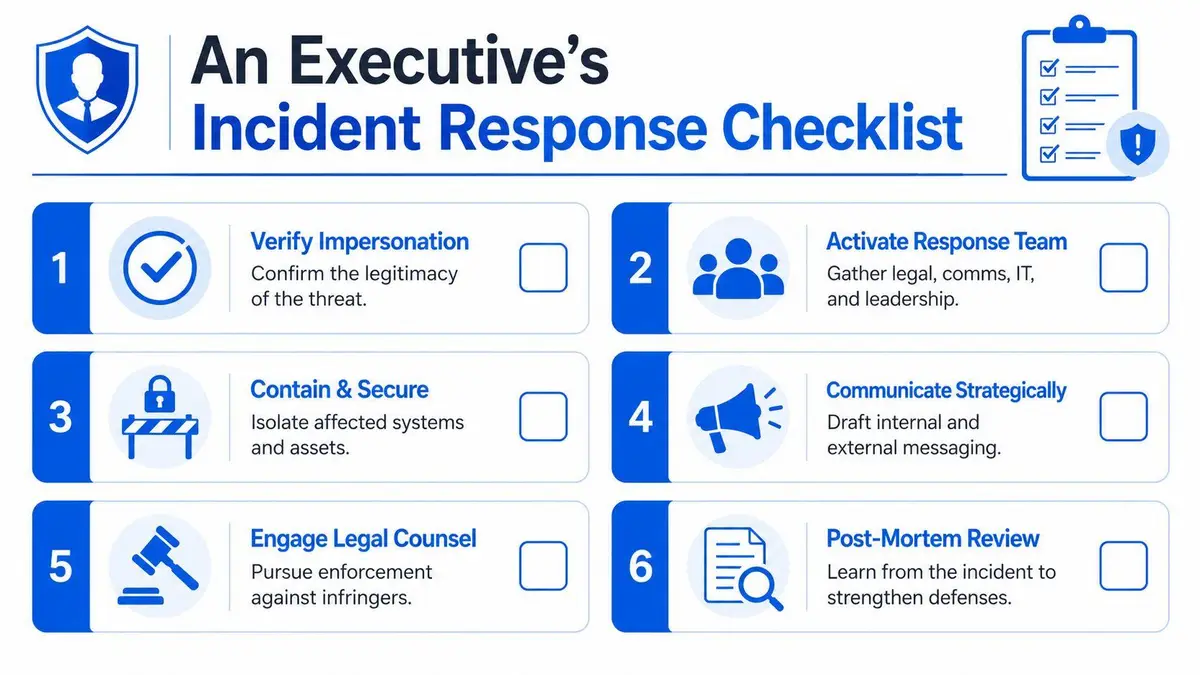
When impersonation is confirmed, your job is to impose order. Don’t chase every screenshot. Don’t argue with the attacker. Don’t let five departments issue five different instructions. Run a disciplined timeline.
The first hour
Start by confirming the impersonation and freezing the evidence. Capture the fake asset, associated profiles, URLs, messages, payment instructions, timestamps, and any recipient reports. Preserve headers, screenshots, and copies before anyone starts filing complaints or notifying platforms.
Then activate a compact response group. You need legal, communications, security, and one executive decision-maker. Keep the group small enough to move.
Do not contact the attacker directly. That often triggers deletion, migration, or escalation before you’ve secured the record.
The first 24 hours
Scope the incident. Identify what was impersonated, who saw it, whether credentials or payments were submitted, and whether any internal system was compromised. Separate confirmed facts from assumptions.
Use a triage frame:
- High urgency. Active phishing pages, payment diversion, fake executive outreach to customers, or broad public-facing scams.
- Medium urgency. Dormant fake accounts, low-traffic cloned pages, or impersonation with no current victim activity.
- Strategic watch. Suspicious domains, placeholder accounts, or early-stage abuse with no clear activation.
At the same time, draft controlled communications. Internal teams need verification instructions. Affected customers may need direct notice. Public statements should be narrow, factual, and operationally useful.
Say only what you can verify, and give recipients one clear method to confirm legitimate communications from your company.
Days one through three
Execute the takedown path that matches the abuse type. Social account impersonation should move through platform channels immediately. Email abuse requires provider and authentication-led escalation. Cloned websites often need host complaints, registrar review, and legal follow-up in parallel.
Secure adjacent assets while the takedown process runs. Review your legitimate domains, executive profiles, and customer-facing pages for consistency. Strengthen authentication controls. If criminals are imitating your support team or payment workflows, publish a short verification protocol for customers and partners.
Recovery and hardening
Once the fraudulent assets are removed or contained, conduct a post-incident review that answers specific questions. How did the attacker choose the target? Which public assets made imitation easy? Where did reporting or internal coordination slow down? Which stakeholders needed better verification guidance?
Turn the lessons into policy. Tighten executive profile governance. Standardize customer verification language. Clarify who owns social, web, email, and marketplace escalation. Register and protect key brand names and marks so you’re not improvising rights evidence under pressure.
The companies that recover well don’t just end the incident. They reduce the odds of the next one succeeding.
If your company, executives, or family office are dealing with a live impersonation attack, ContentRemoval.com provides confidential assessment, takedown strategy, and rapid reputation protection across websites, search results, social platforms, and fraudulent digital assets. When the issue involves legal exposure, executive targeting, or reputational harm that can’t wait, their team can move quickly and discreetly.
Frequently asked questions
How do I get a fake LinkedIn profile of my CEO taken down?
Use the platform’s native impersonation reporting process first, with evidence that the account represents a real executive without authority. The article notes social account impersonation typically moves faster than cloned website removals, so start there while longer remedies are prepared.
What is the first thing to do when brand impersonation is discovered?
Confirm the impersonation and freeze the evidence: capture the fake asset, associated profiles, URLs, messages, timestamps and any recipient reports before anyone files a complaint. Then activate a small response group with legal, communications, security and one executive decision-maker, and do not contact the attacker directly.
Why can’t the IT department handle brand impersonation alone?
IT teams are built for internal controls. Impersonation defense also needs platform fluency, trademark awareness, evidence preservation and fast external escalation across social, hosting, email and marketplace channels. The companies that respond well define ownership across security, legal, communications and leadership in advance.