
Libel is a published false statement of fact that harms a reputation. A claim requires four elements: a verifiably false assertion of fact rather than opinion, publication to at least one third party, fault by the publisher, and identifiable harm. Public figures must prove actual malice, meaning the publisher knew the statement was false or recklessly disregarded the truth.
Key facts
- Truth is an absolute defense; substantially true statements are not libel however damaging.
- After New York Times v. Sullivan, public figures win roughly one in ten libel suits.
- Criminal defamation laws remain active in over 80% of countries surveyed by UNESCO in several regions.
- The statute of limitations is usually one to two years from first publication under the single publication rule.
Where ContentRemoval.com comes in. Because litigation is slow, public and rarely won by public figures, ContentRemoval.com focuses on removing the libelous article, post or review from the source, de-indexing it from search and stopping its spread across social platforms. Executives and their counsel usually make contact after confirming the statement is false and before deciding whether to sue. A free 15-minute Exposure Scan maps what is removable, and the report is theirs to keep. Get a Free, Confidential Exposure Scan or read how our defamation removal work is done.
Libel is a published false statement of fact that harms a reputation. To successfully mount a legal challenge against it, you cannot merely point to a statement that is malicious or untrue. The law requires proof of four distinct elements.
The Four Pillars of a Libel Claim
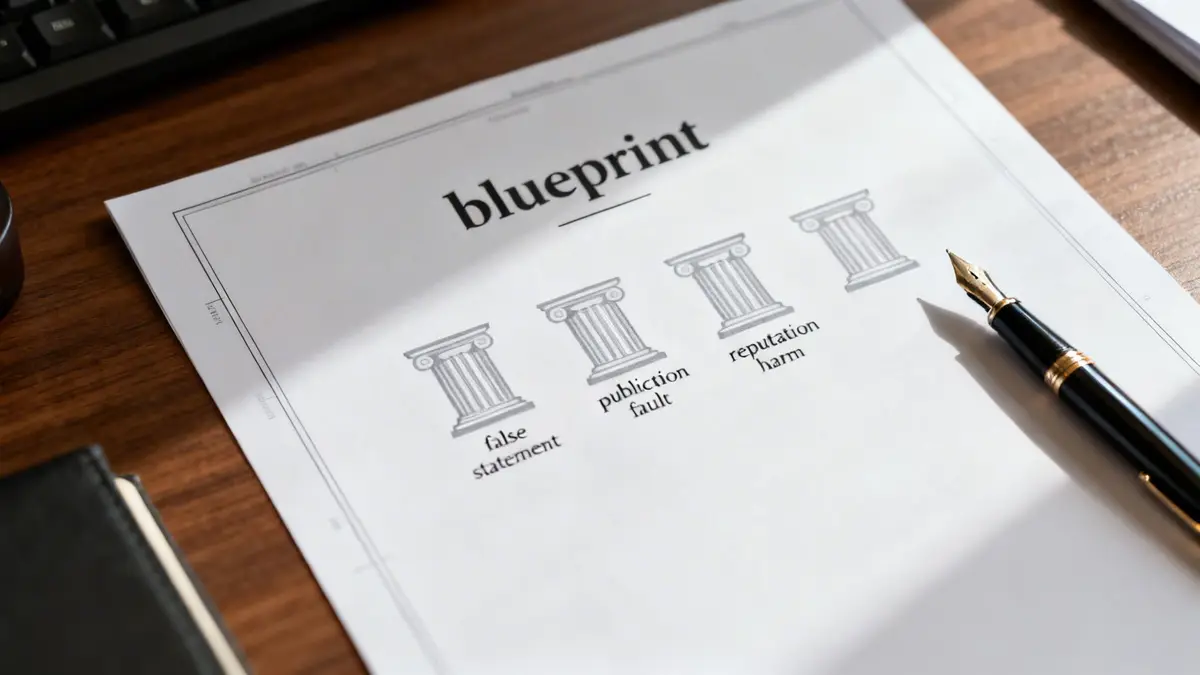
A successful libel claim rests on four essential legal pillars. If any one of them is missing or structurally unsound, the entire case collapses. For any high-profile individual facing a reputational crisis, viewing the attack through this legal lens is the first, most critical step in formulating a strategic response.
It is insufficient for a statement to feel damaging. You must be able to prove each of these pillars with evidence. This is particularly true when a viral post, a misleading news article, or a fabricated review threatens your career or enterprise.
1. A False Statement of Fact
The bedrock of any libel claim is falsity. The statement must be a verifiably false assertion of fact. If the content published about you is substantially true, no matter how damaging, it is not libel. Truth serves as an absolute defense.
Equally important, the statement must be an assertion of fact, not an opinion. There is a significant legal distinction between “I believe this CEO is an ineffective leader” (opinion) and “This CEO embezzled funds from the company” (a statement of fact that can be proven true or false). The line can blur. A comment such as, “In my opinion, he is a crook,” may be interpreted as implying a factual basis, potentially converting a protected opinion into an actionable false statement.
2. Publication to a Third Party
A false statement becomes libelous only once it is “published,” meaning it has been communicated to at least one other person. A private message containing false allegations, seen only by the recipient, does not harm a reputation in the eyes of others and therefore does not meet this standard.
In the digital sphere, this element is almost always met. A single social media post, blog entry, or online video is instantly published to a potentially global audience. The permanence and rapid dissemination of digital content make online libel uniquely destructive.
3. Fault on the Part of the Publisher
The third pillar is proving that the publisher was at fault. The legal standard for fault depends entirely on the status of the plaintiff. For a private citizen, the standard is typically negligence. This means the publisher failed to exercise reasonable care in verifying the statement’s truthfulness.
For public figures (a category that includes most executives, celebrities, and prominent individuals) the bar is set substantially higher. You must prove “actual malice,” a specific legal standard. This requires showing the publisher either knew the statement was false or acted with reckless disregard for its truth.
A statement made carelessly is not the same as a statement made with malice. For a private individual, proving a reporter failed to check sources may be sufficient. For a well-known CEO, you must prove the reporter knew the sources were unreliable and published the material anyway.
4. Identifiable Harm to Reputation
Finally, you must demonstrate that the false statement caused tangible harm to your reputation. This is the “damages” pillar. It is not enough to be personally offended; you must connect the defamatory statement to a negative outcome.
Harm may be financial, such as a lost contract, a rescinded job offer, or a decline in your company’s stock value. It can also be non-economic, including public humiliation, severe mental anguish, or ostracism from your professional community. Documenting this fallout is crucial, as it forms the basis for any legal remedy you might seek.
The Four Essential Elements of a Libel Claim
| Element | Description for High-Profile Individuals |
|---|---|
| 1. False Statement of Fact | The statement must be a provably false assertion of fact, not a protected opinion. For instance, “He’s a bad negotiator” is an opinion, while “He bribed the official” is a statement of fact. |
| 2. Publication to a Third Party | The false statement was communicated to at least one other person, whether through a tweet, a news article, a blog post, or an online review. This is almost always met in online attacks. |
| 3. Fault (Actual Malice) | For a public figure, you must prove the publisher acted with “actual malice”: they either knew the information was false or published with reckless disregard for the truth. This is far harder to prove than simple negligence. |
| 4. Identifiable Harm | The statement caused concrete damage to your reputation. This can include documented financial losses (lost income, canceled contracts) or severe non-economic harm (public humiliation, ostracism). Simply being offended or embarrassed is not enough. |
If you cannot substantiate all four of these elements with compelling evidence, a libel claim will not succeed in court. This framework is the starting point for developing any effective strategy to combat reputational attacks.
The Uphill Battle for Public Figures
While the foundational elements of a libel claim apply universally, the element of fault creates a dramatically different legal landscape depending on the plaintiff’s public standing. For an executive, founder, or other prominent person, this is not a legal footnote; it is the central reason that challenging a false media report or online smear campaign is an arduous undertaking.
A private citizen typically only needs to demonstrate that the publisher was negligent. This standard addresses basic carelessness. For instance, a local blogger who publishes an unverified, anonymous tip has failed to exercise reasonable care.
For public figures, the standard is exponentially higher. This shift stems from the landmark 1964 Supreme Court case, New York Times Co. v. Sullivan, which fundamentally reshaped American libel law. The court reasoned that to maintain a robust public debate, individuals who voluntarily enter the public sphere must accept a higher burden of proof when they sue for defamation.
The “Actual Malice” Hurdle
If you are a public figure, you cannot win a libel suit simply by proving a story was false and damaging. You must prove the publisher acted with “actual malice.”
This legal term is one of the most frequently misinterpreted concepts in defamation law. It bears no relation to the common meaning of malice, such as spite, ill will, or a personal vendetta.
Actual malice is a specific legal test. It means you must prove the person publishing the statement either knew it was false or acted with “reckless disregard” for whether it was true or not.
Proving a publisher’s state of mind is exceptionally difficult. You must show more than just sloppy reporting, overt bias, or a failure to investigate all facts. You must produce evidence demonstrating they had serious doubts about the story’s veracity and published it anyway.
This is precisely why high-profile libel suits are so rarely won by plaintiffs. Following the Sullivan decision, the success rate for public figures suing for libel fell to approximately one in ten. This statistic underscores how heavily the law favors free expression, often at the expense of executives, celebrities, and other individuals in the public crosshairs.
Who Qualifies as a Public Figure?
Courts generally recognize two types of public figures. Determining your classification is the first step in assessing your legal options and is essential for anyone needing to protect the personal information of high-profile individuals.
All-Purpose Public Figures:
- These are individuals who have achieved such widespread fame or notoriety that they are considered public figures for all purposes. This includes A-list celebrities, senior politicians, and CEOs of major global corporations. Their lives are, to a significant extent, matters of public interest.
Limited-Purpose Public Figures:
- This is a more common category for many leaders and experts. It includes individuals who have voluntarily thrust themselves into the center of a specific public controversy. A tech founder who becomes a vocal advocate for AI regulation, for example, becomes a public figure on that topic. A false statement about their personal life might still be judged by the lower negligence standard, but any commentary about their work in AI now faces the high bar of actual malice.
For most executives, board members, and prominent entrepreneurs, the conclusion is clear: your professional role almost certainly makes you a public figure, at least concerning matters related to your work. This reality renders formal litigation a slow, expensive, and often ineffective tool for reputation repair, which is why strategy often shifts toward faster, more direct remedies like professional content removal.
Libel, Slander, and Defamation: A Strategic Distinction
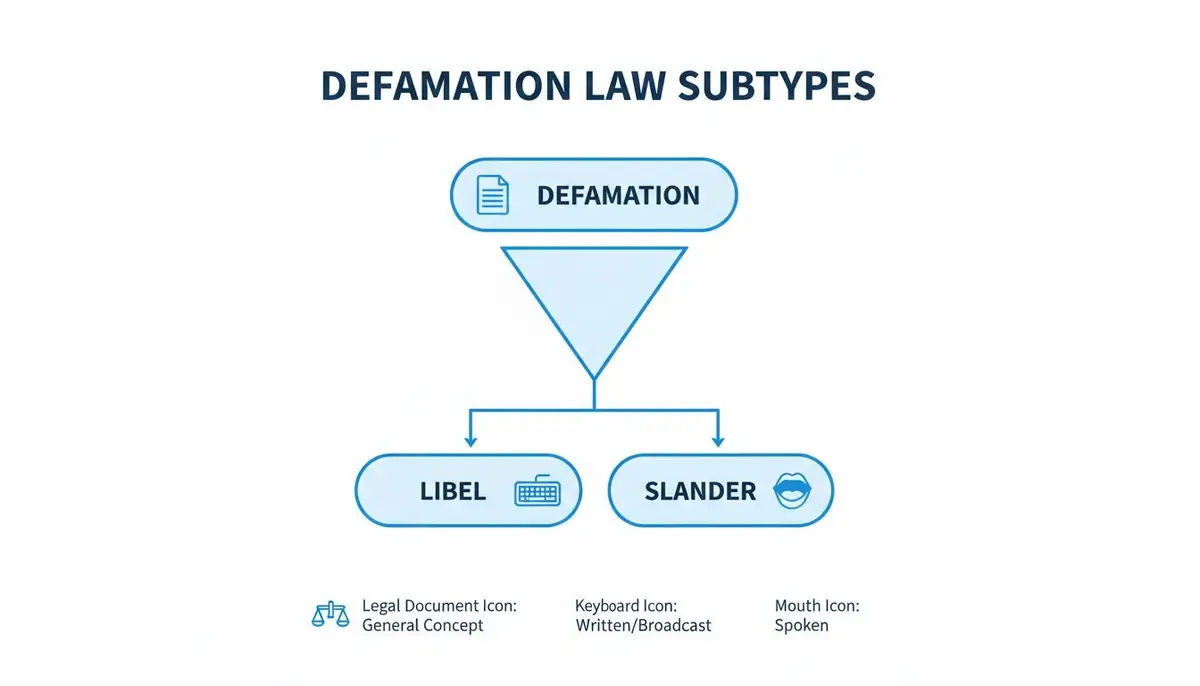
When your reputation is at risk, precise terminology is a matter of strategy, not semantics. The terms defamation, libel, and slander are often used interchangeably, but their legal distinctions are critical. Understanding them is the first step in mounting an effective defense.
Defamation is the umbrella legal term for any false statement that harms a person’s reputation. It is the area of law that encompasses two specific torts: libel and slander.
The primary distinction is permanence. The medium of the false statement determines its classification and, more importantly, its potential for damage.
Slander is defamation in a transient form, typically spoken. It is a false statement made orally, such as a rumor shared in a meeting or a false accusation made in a conversation. While damaging, its impact is limited to those who heard it, and its power fades over time.
Libel, conversely, is defamation fixed in a tangible medium. For any high-profile individual, this is where the most significant modern threat lies. Historically, this meant print media like newspapers or books. Today, it encompasses nearly all digital content:
- A malicious blog post.
- A defamatory social media comment or fake review.
- A news article containing falsehoods.
- A recorded podcast or video.
The moment a false statement is written, recorded, or published online, it becomes libel. This act of fixation transforms a fleeting insult into a permanent digital asset, one that search engines index, users share, and which can inflict damage for years.
For an executive, this distinction is paramount. An unsubstantiated claim made at a private dinner is slander. If another guest records that claim and posts it online, it instantly becomes libel. The false statement now has an independent and enduring existence.
The threat of online libel is its scale and persistence. A slanderous remark may be forgotten, but a libelous article can occupy the first page of Google search results for a decade, perpetually discovered by investors, partners, recruiters, and family. A strategy that relies solely on future litigation is often a losing one. The immediate objective must be the removal of the damaging content before it can proliferate. The permanent nature of online libel makes rapid, surgical removal the only effective solution. To explore this subject further, see our analysis of defamation in our comprehensive guide.
Navigating Global Libel and Jurisdictional Dangers
For an executive with global business interests, a defamatory statement published online is not a singular problem but a multiplicity of potential legal threats across different jurisdictions. An attack originating on a server in one country can be read in every other, creating a complex web of liability that a domestic-only strategy cannot address. Your legal standing in the United States, for example, offers little protection when a lawsuit is filed against you in London or Sydney.
This has led to the rise of “libel tourism,” a tactic where a plaintiff files a lawsuit in a country with claimant-friendly laws. While the U.S. offers robust free speech protections, jurisdictions like the United Kingdom and Australia often place the burden of proof on the defendant to prove their statements were true. This inverts the American standard. A single online post can trigger legal battles on foreign soil, forcing you to defend your reputation in unfamiliar and often hostile courtrooms.
The Specter of Criminal Libel
Beyond civil damages, a more severe threat looms in much of the world: criminal libel. While largely archaic in the U.S., many nations still treat defamation not as a private dispute but as a crime punishable by fines and imprisonment.
The prevalence of these laws is startling. A UNESCO report found that criminal defamation laws remain active in 39 of 47 African countries, 38 of 44 in Asia and the Pacific, and 20 of 25 in Western Europe and North America. Over 80% of countries in these regions still criminalize libel, making the potential penalties far more severe than a financial judgment.
The permanent, “fixed” nature of libel is what gives it this dangerous international reach. Spoken slander fades, but a web page is perpetual. This permanence is precisely why a blog post considered libelous in one country can trigger criminal charges in another, regardless of where the content originated.
Why a Domestic Legal Strategy Is Not Enough
This global patchwork of laws renders a purely U.S.-centric legal strategy dangerously insufficient. A victory in an American court does nothing to prevent a foreign government from initiating a criminal investigation or a foreign court from issuing a judgment against you.
Because the attack is digital, it exists everywhere at once. A blog post hosted on a U.S. server is simultaneously “published” in Germany, Japan, and Brazil the moment it goes live. This has immediate, practical consequences:
- Enforcement of Foreign Judgments: A plaintiff who wins a libel case abroad can seek to enforce that judgment against your assets in that country or others.
- Travel and Business Risks: An outstanding criminal complaint or civil judgment can create serious impediments to international travel, jeopardizing business operations.
- Reputational Contagion: The mere existence of a foreign lawsuit, even a baseless one, can generate negative headlines and amplify the attack you are trying to suppress.
The internet has no borders, and neither does libel law. Assuming you are safe because the defamatory statement was made in a speech-protective jurisdiction is a critical and costly mistake. The true battlefield is global.
This complex, multi-jurisdictional minefield demonstrates why traditional litigation is often too slow and cumbersome to be effective. The primary goal must be to neutralize the threat at its source through rapid and decisive content removal. Engaging a global removal partner who understands these international nuances is essential for de-escalating cross-border threats before they spiral into a series of expensive and damaging legal battles around the world.
Recognizing Defenses and Anti-SLAPP Laws
Knowing you have been libeled is one matter; proving it in court against a determined defendant is another. The publisher has a powerful arsenal of legal defenses. A realistic strategy requires anticipating and countering each one.
The three most common defenses are truth, privilege, and opinion.
The most potent defense is truth. If the “sting” of the statement is substantially true, the case is over. The burden is on you to prove falsity, but the defendant need only prove truth to have the claim dismissed.
Next is privilege. This defense grants legal immunity for statements made in specific contexts. Absolute privilege protects statements made during judicial or legislative proceedings. More common is qualified privilege, which protects statements made in good faith on a matter of shared interest, such as a candid but negative reference for a former employee.
Finally, there is opinion. A statement of pure opinion is protected by the First Amendment. A business analyst may call a corporate strategy “reckless” without fear of a libel suit. This defense falters only when an opinion implies a false assertion of fact. “In my opinion, he’s a criminal” suggests knowledge of actual criminal acts and may cross the line into defamation.
The real fight in many libel cases is not over truth or falsity, but whether a statement is a protected opinion or a defamatory assertion of fact. This is a gray area where cases are won and lost.
The Weaponization of Libel and Anti-SLAPP Statutes
The legal system itself can be weaponized. Strategic Lawsuits Against Public Participation (SLAPPs) are meritless libel suits filed not to win but to silence critics through the sheer cost of litigation.
To combat this abuse, many jurisdictions have enacted anti-SLAPP statutes. These laws allow a defendant to file a special motion to dismiss the lawsuit at its outset. If a judge determines the suit targets protected speech on a public matter, the burden shifts to the plaintiff to prove a high probability of success. If they fail, the case is dismissed, and they are often ordered to pay the defendant’s legal fees.
This is a global issue. The rise of SLAPPs has spurred protective legislation worldwide. In 2022 alone, Europe saw 161 such retaliatory lawsuits. While the U.S. pioneered anti-SLAPP laws, similar statutes exist in Australia and Canada, and other nations are following suit. Global trends, including a 2023 proposal in Bulgaria to decriminalize defamation, are detailed in a comprehensive report from Media Defence.
For a high-profile individual under attack, this legal reality is a double-edged sword. While anti-SLAPP laws protect legitimate speech, they also underscore the slow, public, and uncertain nature of litigation when you are the plaintiff. This reality reinforces the core strategic principle: the primary goal should not be to win in court, but to remove the defamatory content quickly and quietly.
Your Strategic Response to a Libelous Attack

Discovering you are the target of a libelous attack prompts an immediate impulse to retaliate publicly. This is almost always the wrong move. An emotional response can amplify the very falsehood you wish to suppress and provide the attacker with new ammunition. The correct response is a quiet, calculated, and strategic counter-move executed behind the scenes.
Prioritize Removal Over Litigation
The primary objective should never be a protracted court battle. Litigation is expensive, slow, and the outcome is never guaranteed. Even with a legal victory years later, the defamatory content has likely remained online, inflicting continuous reputational damage.
The real win is the complete and permanent removal of the content from the internet. This means excising it from the source website, de-indexing it from search engines, and ensuring its erasure from social media. Speed is paramount.
A libelous article is a digital asset working against you 24/7. The longer it remains visible, the more credibility it gains and the deeper it becomes embedded in your online footprint. Your first and only priority should be to neutralize this threat as quickly as possible.
Engage a Specialist Firm for Confidential Assessment
Your first action should be to engage a specialist firm with a proven record of removing such content. This is not a task for a standard PR agency or general counsel. You require a team that integrates legal expertise with deep technical knowledge.
The process begins with a confidential assessment:
- Confirming Libel: A specialist analyzes the material to confirm it meets the legal definition of libel and identifies vulnerabilities that can be leveraged for removal.
- Assessing Damage: The firm maps the content’s spread, its search engine ranking, and its real-world impact on your personal and business interests.
- Identifying the Attacker: An investigation seeks to determine the party responsible for the post, whether named or anonymous, which is critical for formulating the removal strategy.
Following this groundwork, a specialized firm can execute a targeted takedown campaign. This may involve leveraging platform terms of service violations, filing copyright claims, or communicating directly with web hosts and site owners. In many libel cases, the first official step is a formal demand letter; guidance on structuring one can be found in this sample attorney demand letter.
By focusing on swift, surgical removal instead of a public lawsuit, you regain control of the narrative quietly. This approach halts the damage and restores your digital reputation without the high costs and public drama of litigation. When facing this situation, it is vital to know how to deal with online defamation correctly with an experienced team.
Libel FAQs: Your Questions Answered
When you’re the target of a false attack, you need clear, immediate answers. Here are some of the most common questions from clients in this position.
Can an Opinion Be Libelous?
The answer is nuanced. While pure opinion is constitutionally protected, that protection is not absolute. The line is crossed when an “opinion” implies a false statement of fact. For example, “I don’t agree with John Doe’s business strategy” is an opinion. However, “In my opinion, John Doe is a thief” is different, as a reasonable person would infer a factual basis for the claim. Courts assess how an average reader would interpret the statement. If it is perceived as asserting a fact, it can be libelous.
How Long Do I Have to File a Libel Lawsuit?
The time limit, or statute of limitations, for filing a libel suit is short. In most jurisdictions, you have only one to two years from the date of first publication. For online content, courts typically apply a “single publication rule,” meaning the clock starts the day the material is first posted, not each time it is viewed. This narrow window makes litigation an impractical first response and underscores the need for a faster solution.
Am I Responsible for Libelous Third-Party Comments?
In the United States, generally no. Section 230 of the Communications Decency Act shields website operators and individuals from liability for content posted by third parties. If someone posts a defamatory comment on your blog or social media profile, you are typically not held responsible. However, this immunity can be lost if you materially contribute to or edit the comment in a way that amplifies the defamation. This protection is a U.S. law; equivalent immunity is weaker or non-existent in many other countries, creating risk for those with an international presence.
When under a libelous attack, your first move must be strategic and decisive. The goal is not a protracted public fight, but the swift and permanent removal of the damaging content. ContentRemoval.com specializes in discreetly and effectively removing defamatory material for high-profile individuals and executives.
To begin a confidential assessment and develop your action plan, visit us online to learn more.
Frequently asked questions
Is it libel if someone says something false about me in a private message?
Not unless a third party sees it. Publication requires communication to at least one other person, so a message only you receive is an insult rather than libel. The moment it is forwarded, posted or read to someone else, that element is met.
Why is it so hard for a CEO or celebrity to win a libel case?
Public figures must prove actual malice: that the publisher knew the statement was false or seriously doubted it and published anyway. Sloppy reporting or bias is not enough, which is why plaintiffs in this category succeed only about one time in ten.
Can I be held liable for libelous comments someone else posts on my page?
In the United States, generally no. Section 230 shields site operators and individuals from liability for third-party content, unless you materially contribute to or edit the comment in a way that amplifies the defamation. Equivalent protection is weaker or absent in many other countries.