
Yes, you can sue for defamation, but only if you can prove a false statement of fact, publication to a third party, identification, fault and actual harm. Executives and public figures must also prove actual malice under New York Times v. Sullivan. Because litigation is slow and public, professional content removal is often the faster first move.
Key facts
- Section 230 shields platforms like X and Facebook from liability, so the suit must target the author.
- Public figures must show knowledge of falsity or reckless disregard for the truth by clear and convincing evidence.
- Statutes of limitation generally run one to three years from first publication under the single publication rule.
- Europe’s CASE coalition has tracked over 1,300 abusive SLAPP lawsuits since 2010.
Where ContentRemoval.com comes in. ContentRemoval.com is the removal track this guide describes as the dual-track alternative to litigation: securing takedowns from site administrators, hosts and search engines in days or weeks while counsel decides whether a lawsuit is worth its cost and exposure. Executives, founders and their lawyers usually make contact together, often when an anonymous poster makes a John Doe suit look slow. A free 15-minute Exposure Scan maps what is removable, and the report is yours to keep. Get a Free, Confidential Exposure Scan or read how our defamation removal work is done.
Yes, you can sue for defamation, but the critical question is not whether you can, but whether you should. A lawsuit is not a simple remedy for a false statement; it is a serious strategic commitment. For executives, founders, and high-net-worth individuals, a defamation suit demands a dispassionate calculation of risk versus reward. Success requires concrete, provable evidence that satisfies a high legal threshold, making a clear-headed strategy essential from the outset.
Your Guide to a Defamation Lawsuit
When false statements threaten your personal or corporate reputation, the instinct is to respond with overwhelming force. A defamation lawsuit often appears to be the most decisive instrument. However, initiating litigation is a significant strategic decision with consequences that extend far beyond the courtroom. It requires a substantial investment of time, capital, and focus.
For any public-facing professional, a lawsuit becomes an indelible part of your public narrative, potentially defining your reputation as much as the original defamatory content. The legal system is structured to protect free speech, which places the burden of proof squarely on the plaintiff. Your case must be constructed on an unassailable foundation of evidence.
This guide provides a framework for analyzing the critical elements required before considering legal action.
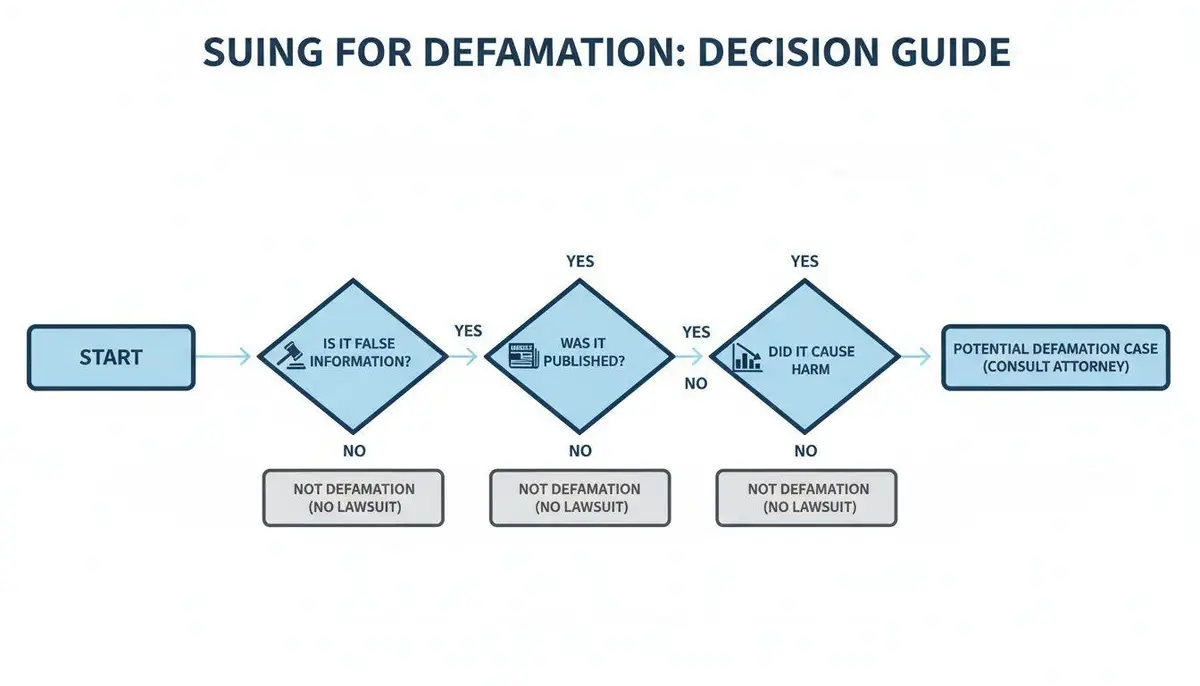
As the decision path illustrates, a negative answer at any stage can terminate a potential lawsuit. Each element (the false statement, its publication, and the resulting damage) is a non-negotiable component of a viable claim.
Assessing Your Legal Standing
The initial step is a frank, objective assessment of your position. Success in litigation depends not on the injury to your reputation, but on what you can prove.
This preliminary analysis serves two functions:
- It acts as a pragmatic filter, preventing the misallocation of resources into a case with a low probability of success.
- It establishes the discipline required for meticulous evidence preservation from the moment an attack is identified.
Before engaging in a full legal process, this framework allows for a quick evaluation of the core elements of a potential claim. Consider it a preliminary diagnostic to determine if the basic components for a meritorious case are present.
Initial Assessment for a Defamation Claim
| Element | What You Must Prove |
|---|---|
| A False Statement of Fact | The statement was presented as a verifiable fact, not an opinion, and is demonstrably false. |
| Publication to a Third Party | The statement was communicated to at least one other person or entity (e.g., posted online, spoken, printed). |
| Identification | The statement must clearly refer to you or your business, even without explicit naming. |
| Harm to Your Reputation | You must provide evidence of actual damages, such as financial loss, professional setbacks, or social ostracism. |
| Fault | You must prove the publisher acted with, at minimum, negligence in verifying the statement’s truth. |
If you can substantiate each of these points with solid evidence, a strong foundation for litigation may exist. If any element is weak or absent, a lawsuit is likely to be a prolonged, costly, and ultimately unsuccessful venture.
A critical distinction that derails many claims is the difference between a damaging opinion and a defamatory fact. If an analyst calls your corporate strategy “foolish,” it is protected opinion. If, however, they claim you “committed tax fraud to fund the new venture,” they are asserting a fact. If that assertion is false, it becomes potentially actionable. Understanding this distinction is paramount.
Litigation is one of several tools in a reputation defense arsenal. In many scenarios, faster and more discreet options like professional content removal can neutralize defamatory material without the expense and public exposure of a court battle. The purpose of this guide is to provide a clear, strategic understanding of all available options, beginning with the foundational question: is a lawsuit the right strategic move?
The Elements of a Successful Defamation Claim

Prevailing in a defamation lawsuit requires more than pointing to an insulting or harmful comment. It requires the methodical construction of a case, proving several distinct legal elements to the court. If any single element is missing, the entire claim collapses.
The burden of proof for each element rests with your legal team. A failure to prove even one creates an opportunity for the defendant to seek summary dismissal of your case.
A False Statement of Fact
The bedrock of any defamation case is a false statement of fact. This is a critical distinction that terminates many potential lawsuits. Statements of opinion, regardless of how offensive, are generally protected by free speech principles and are not legally actionable.
For example, a commentator describing your business strategy as “a total train wreck” is expressing an opinion. It is harsh, but not defamatory. In contrast, an article stating that you “embezzled $1.5 million from the company” makes a specific, factual claim. To prevail, your legal team must prove that claim is false, using evidence such as audited financial records or sworn testimony.
The truth of the statement is an absolute defense. If the damaging claim is substantially true, the defamation action will fail.
Publication to a Third Party
A provably false statement is insufficient on its own. The statement must have been “published,” a legal term meaning it was communicated to at least one person other than you.
Publication can range from a viral social media post seen by millions to a private email sent to a business partner or a word-of-mouth rumor shared with a potential investor. The scale of the publication directly influences the quantum of damages, but the legal requirement is met the moment a third party receives the communication. A single text message can satisfy the publication element as readily as a front-page article.
A crucial legal reality is the immunity granted to online platforms. Section 230 of the Communications Decency Act shields “interactive computer services” like X (formerly Twitter), Facebook, and review sites from liability for content posted by users. Your lawsuit must target the individual or entity that authored the statement.
This immunity means that identifying the original author is a vital, and often challenging, initial step, particularly when dealing with anonymous online assailants. For a more detailed analysis, our guide on what constitutes online defamation provides further detail for executives and founders.
Fault and the Public Figure Hurdle
Next, you must prove the publisher acted with a requisite level of fault. The legal standard for fault changes dramatically based on a single determination: are you a private individual or a public figure? This distinction can be outcome-determinative.
- For Private Individuals: The plaintiff generally must prove negligence. This means showing the defendant failed to exercise reasonable care in verifying the truth of the statement before publishing it. This is a lower evidentiary bar.
- For Public Figures: The burden is significantly higher. You must prove actual malice.
“Actual malice” is a legal term of art; it is not about personal animosity or ill will. It requires you to prove the publisher disseminated the falsehood either knowing it was false or with a “reckless disregard” for the truth. This necessitates presenting evidence of the publisher’s state of mind, a formidable challenge explored in the next section.
Overcoming the Public Figure Hurdle
If you are an executive, founder, or hold any position of public prominence, the law deliberately makes it difficult to win a defamation claim. You face a steeper climb than a private citizen due to a legal standard known as actual malice. This is not mere legal jargon; it is a formidable barrier erected to protect robust public debate.
First, actual malice is unrelated to the publisher’s personal feelings toward you. Animus is irrelevant in the court’s analysis. The sole focus is on what the publisher knew, or deliberately chose to ignore, at the moment of publication.
To succeed, you must prove, by clear and convincing evidence, one of two conditions:
- Knowledge of Falsity: The defendant published the statement with actual knowledge that it was false.
- Reckless Disregard for the Truth: The publisher entertained serious doubts about the statement’s accuracy but proceeded with publication anyway.
The second condition, reckless disregard, is where the contest is usually fought in high-profile defamation cases. The standard is exceptionally difficult to meet.
What Does Reckless Disregard Actually Mean?
“Reckless disregard” is a far more demanding standard than mere negligence or poor journalistic practice. You cannot win by showing the publisher was sloppy, made an error, or failed to cross-reference sources.
To prove reckless disregard, you must demonstrate that the publisher had serious, subjective doubts about the truth of the story but proceeded with a high degree of awareness of its probable falsity. It is a subjective standard, focusing on the internal state of mind of that specific publisher, not what a “reasonable” journalist would have done.
This requires your legal team to prove the publisher’s state of mind. The discovery process can be invasive and prolonged, involving forensic examination of internal communications (emails, text messages, reporter’s notes, and drafts) in search of evidence showing they knew they were publishing a probable falsehood.
The difference this standard makes is profound. A private person needs only to prove carelessness. A public figure must prove a state of mind bordering on intentional falsehood.
The speed and reach of the internet have amplified this challenge. A surge in defamation suits fueled by social media, where falsehoods go viral instantaneously, complicates matters. As detailed in a 2025 report on the rise of defamation claims, platform algorithms often promote the most inflammatory content. High-stakes cases like Noel Clarke v Guardian News and Media, which concluded with a 224-page judgment against the claimant, illustrate the difficulty of this fight.
Why Is the Bar So High for Public Figures?
The actual malice standard originates from the landmark 1964 Supreme Court case, New York Times Co. v. Sullivan. The Court reasoned that public discourse requires “breathing space.” If journalists and citizens feared financial ruin for making an honest mistake while reporting on powerful figures, a “chilling effect” would stifle scrutiny and weaken public accountability.
The court made two key assumptions about public figures:
- You possess greater access to media channels and can use your platform to counteract false statements.
- You have voluntarily sought a position of influence, and with that influence comes a commensurate level of public scrutiny.
Therefore, before filing suit, the first strategic question is whether a court will classify you as a public figure. If the answer is yes, you must prepare for an expensive, invasive, and uphill battle to prove actual malice.
Proving Damages and Anticipating Defenses

A false statement does not automatically entitle you to a large monetary award. To succeed in a defamation suit, you must prove to the court that the statement caused real, quantifiable harm. This is not a theoretical exercise; it requires a disciplined approach to documenting the consequences of the reputational attack.
Simultaneously, you must anticipate the defendant’s counter-arguments. A competent defendant will deploy a range of established legal defenses to dismantle your case. Understanding these potential defenses is essential for assessing the viability of your claim.
Quantifying the Harm to Your Reputation
Courts categorize damages into several types. Building a strong case means gathering specific proof for each category.
- Special Damages: These are the direct, out-of-pocket financial losses that can be proven with documentary evidence. This includes lost contracts, canceled investment rounds, or a discernible decline in revenue directly attributable to the defamatory statement. The key is causation and documentation. You must establish a clear evidentiary line from the false statement to the financial loss.
- General Damages: This category addresses non-economic harm: damage to your good name, professional standing, and personal well-being. It encompasses the humiliation, anxiety, and social ostracism resulting from a public smear. While difficult to price, evidence such as therapy records or testimony from colleagues about the impact on your reputation can help substantiate the claim.
- Punitive Damages: These are the largest but rarest form of damages. Punitive damages are not compensatory; they are designed to punish the defendant for egregious conduct and to deter similar behavior. They are typically awarded only where the plaintiff can prove the defendant acted with actual malice or a flagrant disregard for the truth.
To prove special damages, a general assertion like, “I lost a deal because of that post,” is insufficient. You must build a case file. This includes emails where the client expresses concern, text message chains showing a withdrawal, and witnesses prepared to testify that they disengaged specifically because of the false information. Every piece of documentation is critical.
Anticipating Common Defamation Defenses
Your opponent will seek any available angle to have the case dismissed. Before filing a lawsuit, you must adopt an adversarial mindset and stress-test your own case against these common defenses.
Truth as an Absolute Shield
The most powerful defense in defamation is truth. It is an absolute shield. If the defendant can demonstrate that the “gist” or “sting” of the statement was substantially true, your case will fail, regardless of the reputational harm or the defendant’s malicious intent.
For example, if a report accuses a company of overlooking safety protocols and the publisher can produce internal reports substantiating this claim, the lawsuit is over. The truth of the statement negates the claim for defamation.
The Opinion and Fair Comment Defense
Individuals are permitted to express opinions, even harsh ones, under the protection of the First Amendment. A common defense strategy is to argue that the statement was not a factual assertion but a protected opinion. The line can be indistinct, but it often hinges on whether the statement is capable of being proven true or false.
This defense is not limitless. Prefacing a false statement with “In my opinion…” does not grant a license to defame. If an opinion implies a false underlying fact, it can still be actionable. “In my opinion, John is a bad accountant” is distinct from, “In my a opinion, John is a thief who steals from his clients.” The latter implies a factual, criminal act and crosses the line into defamation.
The Shield of Privilege
The law immunizes certain statements from defamation claims based on the context of their delivery. This is known as privilege. Absolute privilege provides complete immunity for statements made in official proceedings, such as a courtroom or legislative session.
More common in commercial disputes is qualified privilege, which protects statements made when there is a social or professional duty to communicate information. Examples include a manager’s performance review or a report of suspected wrongdoing to an appropriate authority. This defense is not absolute; it can be overcome by proving the defendant acted with malice or shared the information with individuals who had no legitimate need to know.
When your case involves digital evidence like altered videos or screenshots, establishing their authenticity is non-negotiable. Using a proper chain of custody template ensures that your evidence meets the court’s standards for admissibility.
Navigating Modern Threats in Defamation
The fundamental principles of defamation law persist, but the threat landscape has evolved dramatically. Attacks are no longer limited to individual actors spreading rumors; they are sophisticated, blending aggressive legal tactics with powerful technology to inflict maximum reputational damage.
Deciding whether a lawsuit is the appropriate response requires understanding these new weapons. Two significant threats that complicate a traditional legal response are retaliatory lawsuits designed to silence victims and the rise of AI-generated slander.
The Rise of SLAPPs and Reputational Warfare
A SLAPP, or Strategic Lawsuit Against Public Participation, is a pernicious legal tactic. It is a lawsuit filed not to win on the merits, but to intimidate and financially exhaust an opponent into silence.
While often used by corporations to muzzle journalists, this strategy can be weaponized against anyone who speaks out or defends their name. The plaintiff knows their case may be weak, but that is not the point. The objective is to bleed you dry through exorbitant legal fees and protracted court proceedings, making the cost of defense so prohibitive that you are forced to capitulate. Countering this form of reputational warfare requires a strategy that addresses both the legal battle and the public damage the lawsuit itself is designed to create.
The New Frontier of AI-Generated Defamation
A more alarming development is the explosion of AI-generated defamation. Deepfake technology and large language models (LLMs) can create hyper-realistic but entirely fabricated content. This includes forged news articles detailing non-existent scandals or audio clips that perfectly mimic your voice making reprehensible statements.
This represents a new frontier in character assassination. AI systems can generate and disseminate false narratives at a scale and speed previously unimaginable. We have encountered cases where AI fabricates official-looking court documents or criminal records to destroy a target’s reputation. For a brand or public figure, this content can go viral in hours, causing devastating and widespread harm.
The core problem with AI defamation is one of volume and velocity. A single adversary can generate thousands of unique defamatory posts across hundreds of platforms in minutes. By the time a traditional cease and desist letter is drafted, the damage is already done and has likely multiplied.
Litigation alone is too slow to combat this type of automated assault. When facing a digital wildfire, the first priority must be rapid containment. This requires blending legal action with a swift, technical response.
To monitor for such threats, many now rely on reputation management software platforms. When an attack occurs, a strategic guide to reporting defamatory websites provides the immediate takedown protocols required while a broader legal strategy is developed.
Strategic Alternatives to Litigation

When you are under reputational attack, the instinct to sue is powerful. While a lawsuit is the ultimate weapon for seeking legal vindication and damages, it is not always the most effective tool for immediate problem resolution. The primary objective is to stop the damage, to get the defamatory content removed before it metastasizes.
Litigation is a slow, public, and frequently adversarial process. Therefore, even if you can sue, the more important question is whether you should. Filing a lawsuit subordinates your timeline to that of the court, which can easily extend for years. Throughout that time, the harmful content often remains online, eroding your reputation with every view.
The Content Removal Advantage
A more direct and often superior strategy is professional content removal. This approach operates outside the judicial system to resolve the problem at its source with speed and discretion. The goal is not to win a legal argument, but to achieve a tangible result: the permanent deletion of the damaging content.
This method bypasses the delays and public scrutiny of litigation. Instead of filing motions and conducting depositions, a specialized firm leverages established protocols and relationships with website administrators, hosting providers, and search engines to secure rapid takedowns.
Consider the strategic difference: a lawsuit is a prolonged siege intended to secure damages and a court order. Professional removal is a surgical strike designed to neutralize the threat quickly and quietly. The problem can often be resolved in days or weeks, not years.
This is particularly true when targeted by an anonymous attacker. While a “John Doe” lawsuit can be filed to unmask the perpetrator, it is a lengthy and uncertain process. A content removal specialist can often have the content taken down long before a court compels a platform to disclose a user’s identity, frequently rendering the lawsuit unnecessary. We address this scenario in our guide on what to do when a website won’t remove your information.
Countering Abusive Legal Tactics
Litigation carries the risk of retaliatory legal attacks. These SLAPPs (Strategic Lawsuits Against Public Participation) are designed to financially drain and intimidate you into submission. Europe’s CASE coalition has tracked over 1,300 such abusive lawsuits since 2010.
A professional removal strategy circumvents this entire battlefield. By focusing on technical and procedural channels for takedowns, you achieve your primary objective without being dragged into a costly and public war of attrition. For any individual or entity whose reputation is their primary asset, discretion is paramount. A quiet, swift removal protects your privacy and denies adversaries the public platform that a lawsuit provides.
Frequently Asked Questions About Defamation
When you are the target of a reputational attack, you are confronted with urgent questions. Here are direct answers to the most common concerns we address for executives and other high-profile individuals considering a defamation lawsuit.
How Long Do I Have To Sue For Defamation?
Your right to sue is governed by a strict deadline known as the statute of limitations, which varies by jurisdiction. Generally, you have between one to three years to file a lawsuit, commencing from the date the defamatory statement was first published.
For online content, most courts apply the “single publication rule.” This means the clock starts ticking the moment the content is first posted, not each time it is viewed. If you miss this deadline, your right to sue may be permanently extinguished. Immediate consultation with a specialist is therefore critical to preserve all legal options.
Delay is the enemy of a successful defamation claim. Evidence degrades, witness memories fade, and the legal deadline to act is absolute. Swift action is imperative.
Can I Sue An Anonymous Online Poster For Defamation?
Yes, you can initiate legal action against an anonymous party. The process begins with filing a “John Doe” lawsuit against the unknown defendant. This legal maneuver allows your counsel to issue subpoenas to the website, platform, or internet service provider hosting the defamatory content to compel disclosure of the user’s identity.
This disclosure is not automatic. Courts must balance your right to seek redress against the poster’s First Amendment right to anonymous speech. Before ordering the “unmasking” of a defendant, a judge will require you to demonstrate that your defamation claim is meritorious. This adds a layer of complexity and time to the process, making experienced counsel essential.
Is It Better To Remove The Content Or Sue?
The answer depends on your primary objective. If your goal is the fast and discreet elimination of the damaging content, then professional content removal is almost always the superior initial action. It is a strategy optimized for speed and confidentiality, designed to contain the immediate threat without the public spectacle of litigation.
A lawsuit is a long-term strategy. It is the appropriate tool if you seek financial compensation for proven damages and require a formal court judgment vindicating your name. However, it is a multi-year process that will amplify public awareness of the dispute.
Often, the most effective approach is a dual-track strategy: engage a rapid removal service to contain the crisis immediately, while simultaneously preparing a legal case to pursue long-term justice if necessary.
When your reputation is at stake, you require a solution that is as swift as it is definitive. ContentRemoval.com specializes in the fast, discreet, and permanent removal of defamatory online content, operating with the precision and confidentiality required by high-profile individuals and their advisors. If you are facing a reputational threat, schedule a confidential assessment to understand your immediate action plan.