
A concierge reputation management service is a discreet, incident-led operation for executives, public figures and family offices facing defamation, impersonation, leaked media, doxxing or dark web exposure. It preserves evidence, then combines source removal, search de-indexing, platform escalation, privacy cleanup and continuous monitoring through a single point of contact, with restricted communications and clear escalation authority.
Key facts
- Standard ORM handles reviews and sentiment; concierge work handles defamation, impersonation, NCII, doxxing and dark web circulation.
- The engagement runs from confidential assessment to evidence and containment, outcome-based strategy, parallel action and stabilization.
- Impersonation takedowns often need identity verification packets, cross-platform account mapping and staff advisories.
- No provider can credibly promise total erasure from hidden forums; monitoring and recurrence prevention are the realistic aim.
Where ContentRemoval.com comes in. This is the model ContentRemoval.com operates for private clients: one point of contact, a narrow circle, and removal, de-indexing, privacy cleanup and monitoring handled as a single matter. Contact typically comes through a family office, a chief of staff or counsel, rarely from the principal directly. A free, confidential 15-minute Exposure Scan maps what can be removed and what should happen first, and the report is yours to keep. Get a Free, Confidential Exposure Scan or read how our reputation management work is done.
A reputational crisis rarely arrives with courtesy. It appears as a text from a board member asking why a fake profile is soliciting money in your name, a call from counsel about a leaked document now indexed by search engines, or a message from a spouse who has found manipulated images circulating in private channels and moving into public view.
At that point, individuals often discover that the usual advisers each hold only part of the answer. A PR firm can shape messaging, but it can’t force a platform takedown. A litigation team can prepare claims, but it often isn’t built for same-day platform escalation, search de-indexing, or dark web surveillance. A standard agency may know how to polish search results, but that isn’t the same as neutralizing an extortion attempt, an impersonation campaign, or non-consensual intimate imagery.
That gap is where a concierge reputation management service matters. Not as a branding exercise. As a discreet operational capability for people whose name, family, company, and assets are exposed to asymmetric digital threats.
When Digital Threats Demand Elite Intervention
The typical client doesn’t come looking for this service because of a mediocre review. They come because something has changed quickly and unpleasantly.
An executive preparing for a financing round learns that a fabricated misconduct post is now ranking for their name. A public figure finds a deepfake clip spreading through private groups before it hits search results. A family office notices that home addresses, relatives’ names, and travel patterns are being assembled across data broker sites and reposted by anonymous accounts. The problem isn’t only visibility. It’s speed, replication, and impact.
Why the usual response breaks down
In the first hours of a digital attack, delay creates structure. Screenshots become reposts. Reposts become indexed pages. Indexed pages become talking points for journalists, employees, counterparties, or hostile litigants. By the time a conventional team has agreed who owns the issue, the issue has spread across multiple surfaces.
That’s one reason the broader concierge category has grown. The global concierge services market was valued at $647.3 million in 2022 and is projected to reach $1.1 billion by 2032, according to Allied Market Research’s concierge services market analysis. The demand isn’t abstract. High-net-worth individuals, executives, and celebrities increasingly pay for specialized intervention that saves time and reduces risk.
A digital attack is rarely one problem. It’s usually three at once: legal exposure, search visibility, and private escalation behind the scenes.
A proper concierge response recognizes that from the start. It treats the incident as a live matter requiring evidence preservation, jurisdiction analysis, platform action, search suppression, and client-protection protocols around home, family, staff, and travel.
What elite intervention looks like in practice
The first move isn’t public argument. It’s control.
That means securing evidence before the attacker deletes or edits it, identifying where the harmful material originates, distinguishing removable content from suppressible content, and deciding which channels can be pressured immediately. Some matters belong in a DMCA or privacy notice. Others require platform impersonation reports, direct publisher communication, or coordinated legal and technical escalation.
A concierge reputation management service works best when it behaves less like marketing support and more like a crisis cell. One point of contact. Restricted communications. Clear authority lines. Fast action on the highest-risk surfaces first.
Short-term calm often depends on that structure. Long-term recovery almost always does.
Beyond Reviews What a Concierge Service Truly Provides
Many people hear “reputation management” and think of review requests, templated responses, and polished search snippets. That’s a narrow slice of the field, and for high-stakes clients it’s often the least important slice.
Standard ORM is useful when the issue is ordinary customer sentiment. It can help a hotel group answer complaints, improve ratings, or increase positive visibility. But severe reputational harm doesn’t behave like a customer service problem. It behaves like contamination. It spreads, mutates, and moves across systems that weren’t designed to protect you.

The difference between polish and containment
If you want a useful analogy, standard ORM is housekeeping. A concierge reputation management service is hazardous-material response with legal authority and digital forensics attached.
That distinction matters because much of the market still talks about “concierge” as if it means attentive service around reviews. Yet analysis published by My Review Concierge shows existing concierge content largely centers on review management while missing more serious threats such as defamation and leaked data. The same analysis notes that 68% of executives worry about personal data leaks impacting their reputation, which is exactly why review-focused tactics are often inadequate.
For ordinary service businesses, review management can be central. In adjacent luxury sectors, that’s part of the customer experience conversation. If you’re comparing that world, this guide to luxury travel concierge services gives a good sense of what premium clients expect from white-glove support. Reputation protection at the high end borrows the same discretion and responsiveness, but the operating model is closer to risk management than hospitality.
Threats that sit outside standard ORM
A real concierge service deals with matters that don’t yield to cheerful responses or generic SEO work.
- Defamation and false allegations: The problem isn’t just that harmful claims exist. It’s that they may be copied, syndicated, and attached to your name in search.
- Impersonation: Fake profiles can solicit funds, approach employees, manipulate media contacts, or create evidentiary confusion.
- NCII and leaked media: These cases require speed, chain-of-custody discipline, and often jurisdiction-specific privacy arguments.
- Doxxing and data exposure: Home addresses, family details, identity documents, and travel patterns create physical risk, not just embarrassment.
- Dark web circulation: Once material enters hidden forums or broker ecosystems, the response has to include monitoring and recurrence prevention.
Practical rule: If the threat could affect your safety, your deal flow, your family, or a court record, treat it as a containment problem first and a branding problem second.
That is why privacy work often sits alongside reputation work. A client facing persistent exposure doesn’t just need bad content removed. They often need their broader digital footprint reduced so the next attack has less material to exploit. That includes personal data cleanup, broker-site removal, and address shielding through services such as online privacy protection for exposed individuals and families.
What clients are actually buying
They aren’t buying “better optics.” They’re buying judgment under pressure.
They need a team that knows when to push for source removal, when to seek de-indexing, when to preserve a record for litigation, and when silence is more effective than rebuttal. They need advisers who understand that the wrong move can authenticate a smear, expand coverage, or alert the attacker that a takedown is underway.
A concierge reputation management service earns its value by making those calls well.
The Core Arsenal of Digital Protection
The tools that matter in serious cases are specific. They aren’t interchangeable, and they don’t all produce the same kind of result. Good operators choose the remedy that fits the surface, the jurisdiction, and the client’s real objective.
Legal removals and search de-indexing
Source removal and search de-indexing solve related but different problems.
Source removal aims to get the content off the originating site or platform. That may involve copyright claims, privacy arguments, terms-of-service enforcement, impersonation complaints, or direct legal correspondence. De-indexing accepts that the source may remain live for a period, but seeks to remove its prominence from search results so counterparties, journalists, recruiters, and hostile observers don’t encounter it when searching your name.
The strongest firms combine both. According to Clevertone’s online reputation management analysis, advanced concierge services use proprietary de-indexing and continuous AI monitoring to achieve 80-95% harmful content suppression rates, often within 24-48 hours, while scanning over 500 sites and the dark web daily. The same analysis notes that unmitigated negative search results can drive a 70% erosion in trust. For a high-net-worth client, that’s not a vanity problem. It’s a business and personal security problem.
Impersonation takedowns
Impersonation cases move fast because platforms understand the risk. The challenge is proving identity, documenting harm, and filing in the way each platform expects.
A fake account pretending to be a founder, spouse, or principal can trigger wire fraud attempts, media manipulation, stalking, and investor confusion. The practical work usually includes evidence capture, account mapping across platforms, identity verification packets, and coordinated notice filing so the attacker doesn’t shift channels while one report is pending.
Some matters also require notifying banks, assistants, estate staff, investor relations teams, or household personnel. A takedown that ignores the human perimeter isn’t complete.
NCII and leaked media removal
These are among the most time-sensitive matters a concierge team handles.
The first priority is preserving evidence without increasing distribution. The second is immediate removal action using the best available route for the content type and platform. Depending on the facts, that can include privacy complaints, copyright-based claims, platform-specific intimate image processes, and search-level interventions to limit discoverability while source action proceeds.
A common mistake is allowing too many intermediaries into the matter. Every added participant increases the chance of accidental redistribution, poor evidence handling, or inconsistent statements to platforms. High-functioning teams keep the circle narrow and work from a single verified evidence set.
Dark web remediation and exposure mapping
Public search results are only one layer of risk. Data often circulates in closed or semi-closed environments first.
Dark web remediation isn’t magic. No one can credibly promise total erasure from every hidden forum. What a competent service can do is identify where material is circulating, determine whether it is old, active, or repackaged, assess whether credentials or identity artifacts are involved, and reduce the likelihood of wider dissemination through notice, monitoring, and strategic disruption.
This matters for executives, family offices, and public figures because leaks often precede phishing, extortion, and physical targeting. If someone has passport imagery, private contact data, or children’s details, you are not dealing with “online chatter.” You are dealing with operational risk.
Continuous AI monitoring
Monitoring is not glamorous, but it separates one-off cleanup from durable protection.
A serious monitoring layer watches for reuploads, syndication, mirrored domains, fresh search indexing, impersonation accounts, and resurfacing on image boards, forums, and broker networks. The purpose is twofold. Catch recurrence early, and build a factual record that supports faster repeat takedowns.
For clients who need that protection over time, reputation monitoring for ongoing risk detection is often more valuable than another round of suppression work months later.
The most expensive reputation matter is the one you “solve” once and then have to solve again in a slightly different form.
Where automation helps and where it fails
Automation has a place, especially in triage. It can flag risky keywords, classify sentiment, identify duplicate uploads, and sort urgency. It can also reduce lag between discovery and action.
What it cannot do reliably is make the legal and strategic distinctions that serious cases demand. A leaked board document, a fabricated accusation, an impersonation network, and a non-consensual image set may all appear under the broad label of “reputation issue,” but they require very different handling.
That is why the best concierge work looks surgical. The toolkit is broad, but the application is selective.
The Engagement Workflow From Crisis to Resolution
Clients under pressure don’t need mystery. They need a process that restores order quickly and keeps information compartmentalized.
The work usually begins with a confidential assessment. That isn’t a sales call in the usual sense. It’s an intake designed to establish what exists, where it exists, who may be behind it, and which surfaces create the highest immediate risk. In serious matters, the answer is rarely “all of it at once.” It’s usually one or two nodes that drive most of the harm.
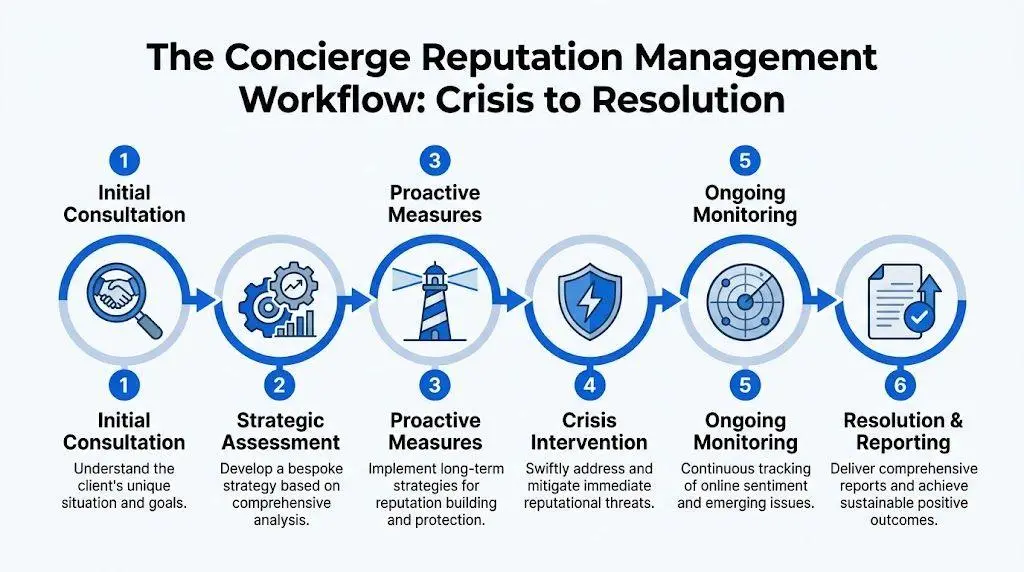
The first phase is evidence and containment
At the start, a disciplined team collects screenshots, URLs, account identifiers, timestamps, publisher details, and any known relationships between the attacker and the client. They also decide what not to do. That usually includes avoiding direct engagement with the attacker, avoiding emotionally reactive public statements, and limiting internal circulation to people who need to know.
A single point of contact matters here. Without one, versions drift. Staff forward links. Family members respond independently. Counsel, PR, and security teams begin operating from different assumptions.
Early confusion helps the attacker. Early structure helps the client.
Strategy is built around outcomes, not activity
Once the evidence is assembled, the next question is what success means.
In one matter, the right objective is source removal. In another, it’s urgent de-indexing while preserving claims for litigation. In another, it’s isolating the client from repeat exposure by reducing personal data trails and locking down the pathways an attacker is using. The strategy should define the desired result for each asset or URL, the legal basis if one exists, the technical route, and who approves escalations.
A proper service level arrangement also belongs here. Not because clients want paperwork for its own sake, but because speed, reporting cadence, confidentiality protocols, and escalation thresholds should be explicit from the outset.
Action starts with the highest-leverage surfaces
Rapid action often unfolds in parallel.
Some notices go to platforms. Some go to publishers. Search interventions may begin while source communications are pending. Impersonation reports may be coordinated with staff advisories and account verification work. If data exposure is part of the matter, privacy cleanup begins at the same time because reducing the public footprint lowers future vulnerability.
This middle phase feels busiest to the client, but the best teams keep it calm. They report in plain language. They separate confirmed removals from pending actions. They distinguish between what has been neutralized, what has been hidden from common discovery, and what still requires pressure.
Resolution doesn’t end with the takedown
The final stage is stabilization.
That may include search suppression for residual references, watchlists for reuploads, monitoring of broker sites and hidden forums, and periodic reports that show what has stayed down, what has resurfaced, and what preventive measures remain active. In family and executive matters, the post-crisis phase often includes advice on staff protocols, household exposure points, and public-record risks.
A good engagement ends when control is restored. A wise one continues until recurrence risk is materially lower.
Calculating the ROI of Reputational Security
The cost question is understandable, but it is usually framed too narrowly. Clients ask what intervention costs when they should also ask what inaction is already costing.
A damaged reputation doesn’t only affect vanity metrics or search aesthetics. It reaches transactions, hiring, partnerships, media posture, family privacy, and internal confidence. For businesses serving affluent clients, that exposure is particularly direct.

According to reputation management statistics compiled by Electro IQ, 86% of people hesitate to engage with businesses that have negative online reviews, and businesses with positive online reputations generate 6.9 times more leads. Those figures come from the service-provider context, but the commercial lesson is broader. Reputation affects willingness to proceed.
Where the return actually shows up
In practice, the return on a concierge reputation management service appears in avoided friction.
- Deals keep moving: Investors, acquirers, and counterparties don’t get forced into preventable diligence concerns.
- Key relationships hold: Clients, board members, and referral sources aren’t left to interpret harmful material on their own.
- Recruitment stays viable: Senior candidates and their advisers don’t infer instability from visible allegations or chaos.
- Family exposure narrows: The matter doesn’t spill from reputation into residential, schooling, or travel risk.
These gains often don’t appear as a neat line item. They appear because a problem never matures into a wider event.
What drives fees
Pricing typically follows the shape of the threat.
A contained matter with a few removable assets is different from a multi-jurisdiction attack involving search indexing, impersonation, intimate imagery, broker-site exposure, and hidden-forum reposting. Costs also change depending on whether the assignment is urgent project work, a longer suppression campaign, or an ongoing protective retainer with monitoring and recurrence response.
The rational way to evaluate spend is to compare it to the value of the asset under pressure. That asset may be your name in the market, a financing event, your ability to hold a board seat, your company’s customer trust, or your family’s safety margin.
A short discussion of the business side of reputation risk is worth watching:
When to hire immediately
There are a few trigger events that justify immediate specialist involvement.
- Active impersonation: Someone is contacting others while pretending to be you or a family member.
- Leaked sensitive material: Documents, images, or videos are already moving across platforms.
- Search contamination: Harmful results are now appearing for your name, company, or close relatives.
- Coordinated harassment: Multiple accounts or sites are repeating the same allegations or disclosures.
- Data exposure with real-world implications: Addresses, school information, travel details, or identity records are circulating.
When one of those conditions is present, waiting for the issue to “settle down” is usually a costly experiment.
Vetting Your Reputation Management Partner
The market is crowded with firms that speak confidently about protection and deliver little more than review software, outsourced legal letters, or generic SEO. A high-stakes client needs a sharper filter.
The first question is simple. Can the firm handle removal, de-indexing, privacy, impersonation, and recurrence monitoring as one integrated matter, or will it hand pieces to different vendors? Fragmentation slows response and weakens confidentiality.
Signals that a firm is built for serious matters
Look for evidence of operating capability, not marketing polish.
- In-house legal fluency: A credible provider should understand platform policies, privacy rights, copyright-based removals, and evidence preservation without treating every issue as a future lawsuit.
- Technical workflow beyond SEO: If the toolset sounds limited to publishing positive content and answering reviews, it is too narrow for severe threats.
- Clear reporting: You should know which URLs are under action, which have been removed, which are de-indexed, and which remain under review.
- Discretion in client handling: Sensitive matters require compartmentalized communication and a disciplined chain of approval.
- Experience with exposed principals: Executives, founders, public figures, and family offices present different risk patterns than local retail businesses.
A useful market overview appears in this executive guide to reputation management companies, especially if you’re comparing providers with very different operating models.
Service Provider Comparison
| Dimension | Concierge Reputation Service | Standard ORM Agency | Traditional PR Firm |
|---|---|---|---|
| Primary mission | Neutralize digital threats and restore control | Improve online sentiment and visibility | Shape public narrative and media perception |
| Typical triggers | Defamation, leaks, impersonation, NCII, doxxing | Bad reviews, low ratings, weak branded search | Press scrutiny, public controversy, stakeholder messaging |
| Speed of action | Fast, incident-led response with direct takedown focus | Often campaign-paced | Fast on messaging, slower on technical removal |
| Core tools | Legal notices, de-indexing, platform escalation, monitoring, privacy work | Review management, content publishing, search optimization | Media relations, statements, briefing strategy |
| Discretion level | High, with restricted communications | Moderate | Variable, often more outward-facing |
| Result type | Removal, suppression, exposure reduction, recurrence control | Reputation polishing and visibility improvement | Narrative mitigation and public positioning |
| Fit for HNWI crisis | Strong if the team handles legal and technical action directly | Limited | Useful as a complement, not a standalone solution |
Questions worth asking before you sign
The right questions are practical.
Ask who performs takedown work. Ask whether the firm preserves evidence before acting. Ask how it handles cross-border requests. Ask what happens when content is removed from one surface and reappears elsewhere. Ask how often you’ll receive status reports, and who has authority to approve escalations on your behalf.
If a provider can’t explain the difference between source removal and search de-indexing in plain language, keep looking.
The best partner won’t promise fantasy. It will give you a realistic map of what can be removed, what can be suppressed, what should be preserved, and what requires ongoing surveillance.
Frequently Asked Questions and Next Steps
Can harmful content be removed permanently
Sometimes yes, sometimes no. Source removal is the strongest outcome because the material leaves the originating site or platform. De-indexing is weaker but often still valuable because it reduces ordinary discoverability. In serious matters, the practical objective is layered control. Remove what can be removed, hide what can be hidden, and monitor aggressively for recurrence.
What if the attacker is in another country
Cross-jurisdiction matters are common. The key is to match the remedy to the platform, the host, the content type, and the client’s domicile. Platform rules may offer one path, privacy law another, and search intervention a third. The mistake is assuming the whole matter must wait for a single court process.
Should I respond publicly
Usually not at the start. Public rebuttal can harden the attacker, spread the material further, and create admissions or inconsistencies that complicate later action. Preserve evidence first. Contain second. Speak publicly only if there is a strategic reason and the message has been cleared by the people handling removal and legal exposure.
Are AI tools enough to manage this
No. AI-driven systems can process thousands of reviews daily, which is useful in retail or hospitality settings, but The Reputation Lab’s discussion of review automation highlights a limit that matters here: automated systems lack the precision required for high-stakes attacks that demand legal and technical intervention. A leaked image set, an impersonation ring, and a defamatory campaign can’t be solved by sentiment analysis.
What should I do in the first hour after discovery
Keep it simple and disciplined.
- Preserve evidence: Capture screenshots, URLs, usernames, timestamps, and any direct messages.
- Don’t engage the attacker: Direct confrontation often escalates distribution or tips them off.
- Limit internal sharing: Send material only to the small group handling response.
- Protect adjacent accounts: Review account security and alert key staff if impersonation or phishing is involved.
- Bring in specialists quickly: Early action creates more options than late cleanup.
A high-stakes reputational problem can still be controlled if the response is early, quiet, and properly coordinated.
If your name, company, or family is under digital pressure, the next step is a confidential assessment with ContentRemoval.com. Bring the URLs, screenshots, and any known timeline. You’ll get a clear view of what can be removed, what can be suppressed, and what should happen first.