
To get a website taken down you need a valid legal ground and the right enforcement channel: a DMCA notice to the host for copyright, complaints to the hosting provider or registrar for policy breaches, search engine de-indexing to cut visibility, a court order for defamation or privacy torts, or law enforcement for criminal content. Most campaigns combine several.
Key facts
- Providers typically answer valid DMCA notices within 24 to 72 hours; a counter-notice opens a 10 to 14 day window.
- Shared hosts often act in 1 to 5 business days; registrars take roughly 5 to 15.
- Court-ordered takedowns usually take several months and may include a temporary restraining order.
- Offshore hosts in Iceland, Switzerland, Russia, the Netherlands or Panama complicate cross-border enforcement.
Where ContentRemoval.com comes in. ContentRemoval.com runs the multi-channel campaign this guide describes, coordinating host and registrar complaints, DMCA notices, de-indexing requests, legal demand letters and payment or ad network notices, then watching for mirror sites once the original comes down. Business owners, their lawyers and the marketing agencies who first spot the site usually make contact. A free 15-minute Exposure Scan maps what is removable, and the report is theirs to keep. Get a Free, Confidential Exposure Scan or read how our content removal work is done.
When harmful, defamatory, or infringing content threatens your reputation or violates your rights, understanding how to get a website taken down becomes critical. Whether you’re dealing with copyright violations, privacy breaches, explicit media, or false accusations published online, multiple legal and technical pathways exist to remove problematic websites or content from the internet. This comprehensive guide examines the legitimate methods for pursuing takedown actions, the legal frameworks that govern content removal, and the practical steps required to protect your digital reputation in 2026.
Understanding Website Takedown Mechanisms
Getting a website taken down requires following established legal procedures and understanding which enforcement mechanisms apply to your specific situation. The approach varies significantly based on the type of violation, the hosting jurisdiction, and the platform’s willingness to cooperate.
Primary Takedown Pathways
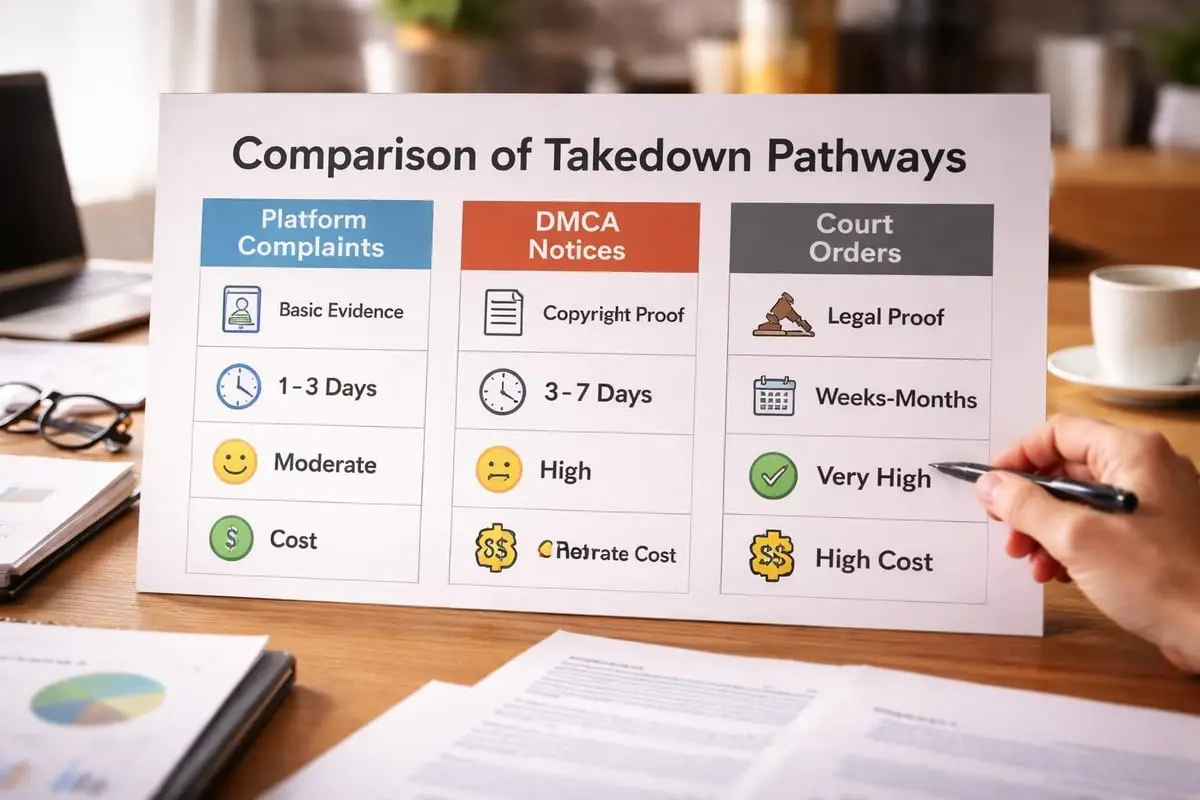
Multiple channels exist for pursuing website removal, each with distinct requirements and timelines:
- Platform-level complaints submitted directly to hosting providers or website operators
- DMCA takedown notices for copyright infringement claims
- Search engine de-indexing requests to remove content from search results
- Court orders obtained through civil litigation
- Law enforcement action for criminal violations
- Domain seizures in cases involving serious legal violations
The most appropriate pathway depends on your specific circumstances, the severity of the violation, and the resources available for pursuing removal. Many situations benefit from a multi-channel approach that combines direct platform requests with legal escalation strategies.
Legal Grounds for Content Removal
Valid legal justification forms the foundation of any successful takedown request. Courts and platforms recognize several categories of violations that warrant content removal:
| Legal Ground | Description | Common Examples |
|---|---|---|
| Copyright Infringement | Unauthorized use of protected works | Pirated content, stolen articles, copied images |
| Defamation | False statements damaging reputation | Fake reviews, fabricated allegations, misleading claims |
| Privacy Violations | Unauthorized disclosure of private information | Doxxing, leaked documents, personal data exposure |
| Terms of Service Violations | Breach of platform usage policies | Spam, harassment, prohibited content |
| Criminal Activity | Content facilitating illegal acts | Fraud schemes, illegal marketplaces, explicit material |
Each legal ground requires specific evidence and follows distinct procedural requirements. Understanding how to get a website taken down legally involves documenting the violation thoroughly and selecting the appropriate enforcement mechanism.
DMCA Takedown Process for Copyright Claims
The Digital Millennium Copyright Act provides a streamlined framework for removing copyright-infringing content from websites. This mechanism has become one of the most commonly used tools for getting content removed quickly without court intervention.
How DMCA Takedown Notices Work
When someone uses your copyrighted material without permission, you can submit a DMCA takedown notice to the hosting provider or platform. The DMCA Takedown process requires specific information to be valid and enforceable.
A proper DMCA notice must include:
- Identification of the copyrighted work you own
- Location of the infringing material (specific URLs)
- Statement of good faith belief that use is unauthorized
- Statement that the information provided is accurate
- Your physical or electronic signature
- Your contact information
Service providers typically have 24-72 hours to respond to valid DMCA notices. Under safe harbor provisions, platforms must remove or disable access to the allegedly infringing content to maintain their legal protections. This creates strong incentives for rapid compliance.
Limitations and Counter-Notices
The DMCA system includes important limitations that affect takedown effectiveness. If the person who posted content believes your claim is invalid, they can file a counter-notice disputing the infringement allegation. This triggers a 10-14 day window during which you must file a lawsuit or the content may be restored.
Additionally, DMCA protection only applies to copyright violations. It cannot be used for defamatory content, privacy violations, or other non-copyright issues. Research on DMCA effectiveness has highlighted challenges in applying this framework to certain content types, particularly non-consensual intimate media that may not involve traditional copyright claims.
For comprehensive removal of harmful content beyond copyright issues, specialized content removal services employ multiple legal strategies tailored to the specific violation type and jurisdiction.
Obtaining Court Orders for Website Removal
When direct platform requests fail or the situation involves serious legal violations, obtaining a court order to get a website taken down becomes necessary. This pathway provides the strongest legal enforcement mechanism but requires more time, resources, and legal expertise.
Grounds for Court-Ordered Takedowns
Courts will consider ordering website removal when the content causes demonstrable harm and meets specific legal standards. The most common bases for court-ordered takedowns include:
- Defamation claims where false statements cause reputational damage
- Copyright infringement involving substantial commercial harm
- Trade secret theft or intellectual property violations
- Harassment or stalking facilitated through online content
- Privacy torts including public disclosure of private facts
Obtaining a court order to remove a website requires filing a lawsuit, presenting evidence of harm, and demonstrating that removal is the appropriate remedy. This process typically takes several months and involves significant legal costs.
Evidence Requirements and Litigation Process
Successful court-ordered takedowns depend on comprehensive evidence documentation. You must preserve screenshots, URLs, archive copies, and metadata proving the content’s existence and impact. Many cases also require expert witnesses to establish damages or technical aspects of publication.
The litigation process follows these general stages:
- Pre-litigation investigation to identify responsible parties and gather evidence
- Filing the complaint with detailed allegations and requested relief
- Service of process on defendants, which can be challenging for anonymous or foreign operators
- Discovery phase to obtain additional evidence and testimony
- Motion practice or trial to obtain judgment
- Enforcement of judgment including injunctions requiring takedown
Courts may issue temporary restraining orders or preliminary injunctions requiring immediate takedown while litigation proceeds. These emergency measures apply when plaintiffs demonstrate irreparable harm and likelihood of success.
Platform-Specific Removal Procedures
Most major platforms maintain their own content reporting and removal systems independent of legal processes. Understanding platform-specific procedures can often achieve faster results than formal legal action.
Social Media and User-Generated Content Platforms
Facebook, Instagram, Twitter, YouTube, and similar platforms have established reporting systems for various content violations. Each platform defines prohibited content in its terms of service and community guidelines.
Common reporting categories include:
- Harassment and bullying
- Hate speech or violent threats
- Sexually explicit content
- Intellectual property violations
- Impersonation or identity theft
- Privacy violations or doxxing
Response times vary significantly across platforms and violation types. Some reports receive automated review within hours, while complex cases may take weeks. Platforms increasingly use AI systems to flag and remove certain content types automatically, though human review remains necessary for nuanced situations.
Website Hosting Providers and Domain Registrars
When dealing with independent websites rather than platform content, targeting the hosting provider or domain registrar offers an alternative removal pathway. Most hosting companies have acceptable use policies prohibiting illegal content, harassment, phishing, and malware distribution.
| Provider Type | Typical Response Time | Removal Authority |
|---|---|---|
| Shared Hosting | 1-5 business days | Can suspend account for AUP violations |
| Dedicated Servers | 3-10 business days | More limited authority over content |
| Domain Registrars | 5-15 business days | Can suspend domain for illegal activity |
| CDN Services | 1-3 business days | Can remove cached content and block access |
Complaints to hosting providers should clearly identify the specific policy violations, provide evidence, and explain the harm caused. Many providers require formal legal documentation for serious allegations like defamation or harassment.
Search Engine De-Indexing Requests
Even when a website cannot be completely removed, eliminating it from search results significantly reduces its visibility and impact. Search engine de-indexing represents a practical middle ground between full takedown and leaving harmful content accessible.
Google’s Content Removal Policies
Google maintains several distinct pathways for removing content from search results, each with specific eligibility requirements. These include removals for legal violations, privacy concerns, and outdated information.
Google will consider removing search results for:
- Copyright infringement through DMCA notices
- Personal information including financial data, ID numbers, and doxxing content
- Non-consensual intimate images under revenge porn policies
- Court orders requiring de-indexing
- Defamatory content in certain jurisdictions with strong legal protections
- Right to be forgotten requests in applicable regions
The process for removing search results varies by removal type but generally requires submitting detailed forms with supporting evidence. Response times range from days to several weeks depending on review complexity.
Bing, Yahoo, and Alternative Search Engines
While Google dominates search traffic, comprehensive reputation protection requires addressing other search engines. Bing and Yahoo maintain similar but not identical removal policies. Some violations that qualify for Google removal may not meet other platforms’ standards.
Alternative and specialized search engines present additional challenges. Many smaller search engines lack formal removal procedures, requiring direct legal action or technical interventions. Building a comprehensive de-indexing strategy often involves working across multiple platforms simultaneously.
Understanding the broader context of online privacy protection helps frame de-indexing as one component of a comprehensive digital reputation strategy.
Government Seizures and Law Enforcement Actions
In cases involving serious criminal activity, government authorities may seize entire websites or domains. These actions represent the most severe form of website takedown and typically occur without prior warning to site operators.
High-Profile Domain Seizures
Law enforcement agencies have increasingly targeted websites facilitating copyright infringement, fraud, illegal marketplaces, and other criminal activity. The seizure of Megaupload in 2012 demonstrated the government’s willingness to take down major internet platforms when criminal violations are alleged.
Domain seizures typically involve:
- Federal warrants authorizing seizure of domain names
- Coordination with domain registrars to transfer control to authorities
- Seizure notices replacing original content
- Asset forfeiture proceedings that may permanently transfer ownership
These actions provide powerful deterrence but require cooperation from multiple authorities and jurisdictions. For individuals seeking removal of harmful content, reporting to law enforcement may trigger investigations but rarely produces immediate takedown results.
Reporting Criminal Content to Authorities
When website content involves criminal activity such as fraud, extortion, child exploitation, or credible threats, reporting to appropriate law enforcement agencies becomes both a legal obligation and practical necessity. Different violation types require reporting to specific agencies:
- FBI Internet Crime Complaint Center (IC3) for cybercrime and fraud
- National Center for Missing & Exploited Children for child exploitation material
- Local police for harassment, stalking, and threats
- Federal Trade Commission for consumer fraud and deceptive practices
- State attorneys general for violations of state consumer protection laws
Law enforcement action follows its own timeline independent of civil remedies. Criminal investigations may take months or years, though urgent threats sometimes receive expedited attention.
Technical Considerations and Website Downtime
Understanding technical factors that cause websites to become unavailable helps distinguish intentional takedown actions from operational issues. This knowledge proves valuable when assessing whether removal efforts succeeded or temporary technical problems occurred.
Common Causes of Legitimate Downtime
Not every instance of an unavailable website results from takedown action. Common causes of website downtime include server failures, expired domains, traffic overload, and maintenance periods. Distinguishing intentional removals from technical issues requires monitoring over time.
Temporary downtime may result from:
- Server crashes or hardware failures
- DNS propagation delays after configuration changes
- DDoS attacks overwhelming server capacity
- Expired SSL certificates or domain renewals
- Software updates or database maintenance
- Hosting account suspensions for non-payment
Permanent takedowns typically involve explicit notice pages, domain seizure banners, or complete DNS removal. When monitoring whether a website taken down remains offline, check multiple times over several days to confirm the removal is permanent rather than temporary.
Archival Evidence and Documentation
Before pursuing takedown action, creating comprehensive archives of harmful content provides essential evidence. Websites change constantly, and operators may delete content once they become aware of legal action. Proper documentation includes:
- Full-page screenshots with visible URLs and timestamps
- Web archive snapshots using services like the Wayback Machine
- Video recordings of navigation through the site
- HTML source code preservation
- Metadata extraction including publication dates and author information
This evidence proves invaluable in legal proceedings, platform complaints, and enforcement of court orders. Professional documentation may require notarized affidavits or forensic certification for court admissibility.
Responding to Takedown Demands
Understanding takedown procedures includes knowing how to respond when your own content faces removal demands. Whether legitimate or abusive, takedown requests require careful evaluation before compliance or resistance.
Evaluating Takedown Request Validity
Not all takedown demands have legal merit. Legal considerations for responding to takedown demands emphasize assessing the request’s legal basis before removing content. Invalid or abusive takedown attempts may aim to silence legitimate criticism or competition.
Questions to evaluate include:
- Does the complainant own the rights they claim?
- Is the content actually infringing or protected as fair use?
- Does the request cite specific legal violations with supporting evidence?
- Is the complainant attempting to suppress protected speech?
- What are the consequences of non-compliance versus removal?
Consulting legal counsel before responding to serious takedown demands protects against both legitimate liability and improper censorship. Many takedown requests contain procedural defects that invalidate the demand.
Safe Harbor Protections for Platforms
Online platforms hosting user-generated content benefit from safe harbor provisions that limit liability for third-party content. Understanding how the DMCA affects websites includes recognizing that platforms must implement reasonable takedown procedures to maintain these protections.
Platforms typically remove reported content quickly to preserve safe harbor status, even when validity remains uncertain. This creates asymmetry favoring complainants in many disputes. Understanding these dynamics helps both those seeking takedowns and those defending against potentially invalid claims.
International Jurisdiction and Cross-Border Enforcement
Getting a website taken down becomes significantly more complex when content originates from foreign jurisdictions. International enforcement requires navigating multiple legal systems with varying standards for protected speech, privacy rights, and content regulation.
Jurisdiction Shopping and Forum Selection
Content that violates laws in one country may enjoy legal protection in another. Website operators sometimes deliberately choose hosting jurisdictions with lax enforcement or strong free speech protections to shield controversial content.
Common offshore hosting jurisdictions include:
- Iceland with strong press freedom protections
- Switzerland with strict privacy laws and limited cooperation
- Russia often resistant to Western legal demands
- Netherlands balancing freedom and enforcement
- Panama offering privacy-focused hosting services
Pursuing takedowns across borders may require engaging local counsel, using mutual legal assistance treaties, or relying on platform policies that apply globally regardless of hosting location. Many situations benefit from targeting the hosting platform or payment processors rather than the content creator directly.
Regional Regulatory Frameworks
Different regions have developed distinct regulatory approaches to online content. The European Union’s General Data Protection Regulation (GDPR) provides stronger personal data removal rights than U.S. law. The “right to be forgotten” recognized in EU jurisdictions enables removal of outdated or irrelevant personal information from search results.
Asian jurisdictions vary widely, with some countries maintaining strict content controls while others adopt more permissive approaches. Understanding these regional differences proves essential for international takedown strategies.
The consequences of domain seizures extend beyond the immediate takedown, affecting users, alternative services, and broader internet infrastructure in ways that vary by jurisdiction.
Emerging Legislation and Future Takedown Mechanisms
Content removal law continues evolving as legislators address new challenges including deepfakes, non-consensual intimate imagery, and platform accountability. Recent and proposed legislation will significantly impact takedown procedures in coming years.
The Take It Down Act and Similar Proposals
Recent legislative proposals aim to strengthen removal mechanisms for specific content types. Analysis of the Take It Down Act examines provisions requiring platforms to remove non-consensual intimate images within specified timeframes, creating stronger enforcement mechanisms than existing frameworks.
Key provisions in emerging legislation include:
- Accelerated timelines requiring removal within 24-48 hours
- Enhanced verification procedures to prevent abuse
- Expanded platform obligations beyond traditional safe harbor frameworks
- Stronger penalties for non-compliance
- Victim support mechanisms including reporting assistance
These developments suggest an evolving regulatory landscape with stronger takedown rights for certain content categories, particularly privacy violations and intimate imagery.
Platform Accountability and Transparency Requirements
Growing pressure on platforms to address harmful content has produced new transparency requirements. Several jurisdictions now mandate regular reporting on takedown requests, response times, and removal decisions.
Anticipated developments include:
- Standardized takedown request formats across platforms
- Public databases of removal requests and outcomes
- Appeals processes for disputed removals
- Independent oversight of content moderation decisions
- Faster response requirements for high-priority violations
These changes will likely make website takedown processes more transparent and potentially more efficient, though implementation challenges remain significant.
Strategic Considerations for Removal Success
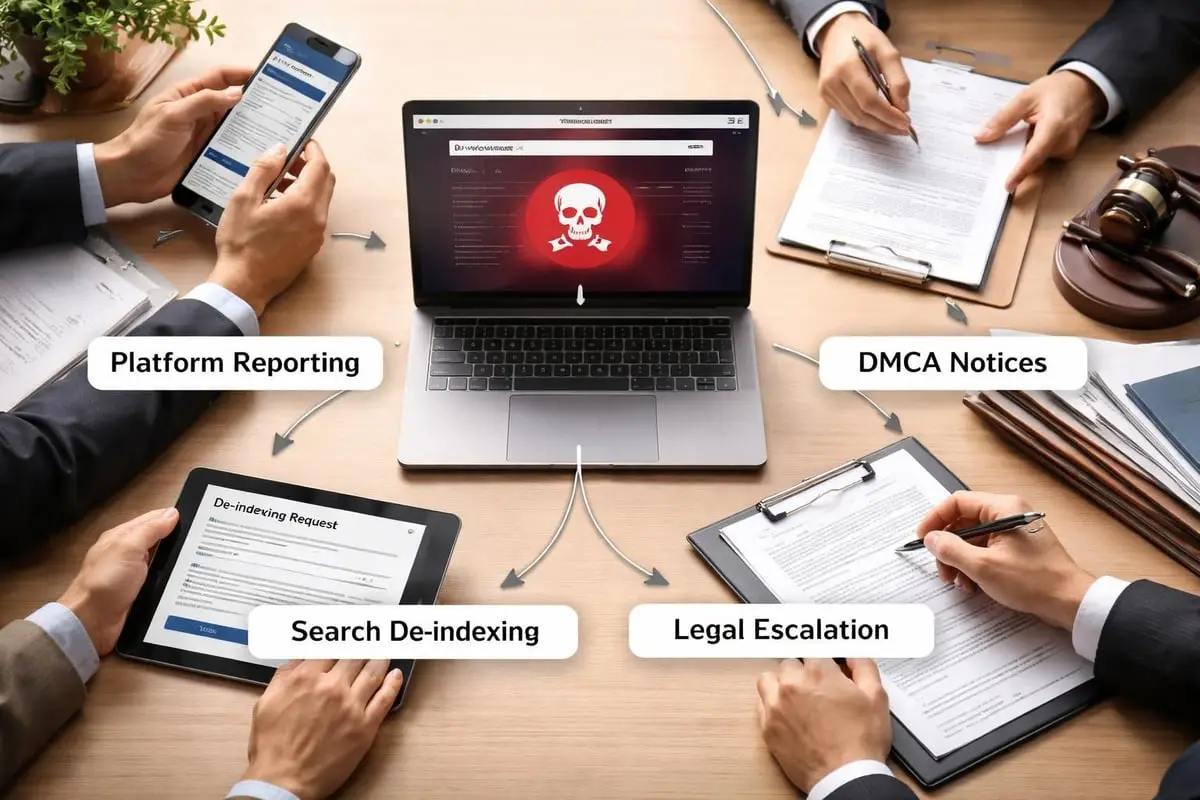
Successfully getting a website taken down requires strategic planning beyond simply submitting complaints. Effective removal campaigns coordinate multiple approaches and maintain persistent pressure across relevant channels.
Multi-Channel Escalation Strategies
The most successful takedown efforts rarely rely on a single approach. Instead, they combine simultaneous actions across multiple channels, creating redundant pressure points that increase likelihood of success.
An effective multi-channel strategy includes:
- Direct platform complaints to hosting providers and domain registrars
- DMCA notices when copyright elements exist
- Search engine de-indexing to reduce visibility during removal efforts
- Legal demand letters establishing formal notice and potential liability
- Payment processor notifications for sites monetizing through standard services
- Advertising network complaints to defund sites through ad revenue removal
This coordinated approach addresses technical, legal, and financial pressure points simultaneously. Even if one pathway fails, others may succeed or create sufficient pressure to achieve voluntary removal.
Documentation and Persistence
Website takedown efforts frequently require multiple attempts and sustained pressure over weeks or months. Maintaining detailed documentation of all communications, requests, and responses proves essential for escalation and legal proceedings.
Critical documentation includes:
- Timestamps and reference numbers for all complaints submitted
- Correspondence records with platforms, hosts, and legal parties
- Evidence of non-compliance when removal requests are ignored
- Impact documentation showing ongoing harm from content
- Cost records for potential damages claims
Persistence often determines success. Many initial complaints receive automated rejections or insufficient review. Following up with additional evidence, legal citations, or escalation to supervisors frequently produces different outcomes.
For complex situations involving multiple platforms, defamatory content, or international enforcement, professional assistance from specialists in reputation management provides expertise in navigating technical and legal challenges while coordinating multi-channel strategies for maximum effectiveness.
Cost Considerations and Resource Requirements
Understanding the financial and time investments required for different takedown approaches helps set realistic expectations and choose appropriate strategies. Costs vary dramatically based on the chosen pathway and case complexity.
DIY Approaches Versus Professional Assistance
Individual website owners can handle straightforward platform complaints and DMCA notices without legal assistance. Template forms and automated systems make simple copyright claims accessible to non-lawyers. However, more complex situations involving international enforcement, defamation claims, or persistent violations typically require professional expertise.
| Approach | Typical Cost Range | Timeframe | Success Rate |
|---|---|---|---|
| Platform Self-Service | $0 | 1-2 weeks | 40-60% |
| DMCA Notice Service | $50-$500 | 3-10 days | 70-85% |
| Legal Demand Letter | $500-$2,000 | 2-4 weeks | 60-75% |
| Full Legal Representation | $5,000-$50,000+ | 2-12 months | 80-95% |
| Specialized Removal Services | $3,000-$25,000 | 1-6 months | 85-95% |
Cost-benefit analysis should consider the value of removing content versus the investment required. High-stakes situations involving business reputation or personal safety justify greater investment than minor complaints.
Hidden Costs and Ongoing Monitoring
Beyond direct removal costs, website takedown efforts incur indirect expenses including time investment, opportunity costs, and ongoing monitoring requirements. Content may reappear on different platforms or new domains, requiring sustained vigilance.
Comprehensive approaches include:
- Monitoring services to detect content reappearance ($100-$1,000/month)
- Preventive measures to discourage future violations
- Regular search result audits to catch new instances
- Relationship management with platforms for expedited future removal
These ongoing costs form part of broader digital footprint cleanup strategies that extend beyond single takedown incidents.
Special Cases and Complex Scenarios
Certain website takedown situations present unique challenges requiring specialized approaches. Understanding these special cases helps identify when standard procedures prove insufficient.
Cryptocurrency and Anonymous Platforms
Websites operating on blockchain infrastructure or through decentralized networks resist traditional takedown mechanisms. Cryptocurrency-based platforms may lack identifiable operators, use censorship-resistant hosting, and operate beyond conventional legal jurisdiction.
Alternative strategies for these scenarios include:
- Targeting gateway services that connect decentralized platforms to regular internet users
- Payment channel disruption through cryptocurrency exchanges and processors
- Search engine de-indexing to reduce discoverability
- Public awareness campaigns warning users about fraudulent platforms
- Law enforcement coordination for criminal violations
These approaches acknowledge that complete removal may prove impossible while focusing on harm reduction and access limitation.
Mirror Sites and Content Replication
Successfully removing a website often leads operators to create mirror sites duplicating the same content under different domains. This game of whack-a-mole frustrates many removal efforts and requires adaptive strategies.
Addressing persistent operators involves:
- Identifying the underlying party through technical investigation
- Broadening legal actions to include pattern of behavior
- Preemptive registration of likely mirror domains
- Monitoring systems to detect new instances quickly
- Platform cooperation to prevent account recreation
Persistent violators may ultimately require litigation targeting the individual or organization rather than specific domains.
Government and Quasi-Government Websites
Content on official government websites or quasi-governmental platforms presents unique removal challenges. Government speech enjoys broad protections, and sovereign immunity limits legal remedies against government entities.
Options for addressing government-hosted content include:
- Freedom of Information Act requests for correction of inaccurate records
- Administrative appeals through agency procedures
- Legislative advocacy for policy changes
- Constitutional challenges when rights violations occur
- Public pressure campaigns through media and advocacy organizations
These pathways require patience and often political rather than purely legal strategies. Success rates vary significantly based on the specific agency and content type.
Successfully getting a website taken down requires understanding the legal frameworks, technical procedures, and strategic approaches that match your specific situation. Whether pursuing DMCA notices, platform complaints, court orders, or multi-channel campaigns, documentation, persistence, and appropriate escalation determine outcomes. When facing harmful, defamatory, or privacy-violating content that threatens your reputation or safety, Content Removal provides expert guidance through complex takedown processes, coordinating legal strategies and technical interventions to permanently remove damaging content from the internet while protecting your long-term digital reputation.
Frequently asked questions
Can I get a website taken down for defamation without going to court?
Sometimes. Hosting providers and registrars have acceptable use policies, and a documented complaint or legal demand letter can prompt action, though many providers want formal legal documentation for defamation. Where they refuse, search engine de-indexing reduces visibility while a court order is pursued.
How long does a DMCA takedown take?
Providers typically respond within 24 to 72 hours to a valid notice because removing the content preserves their safe harbor protection. If the poster files a counter-notice, you have 10 to 14 days to file a lawsuit or the content may be restored.
What if the website is hosted in another country?
Content lawful in one country may be actionable in another, so cross-border cases often need local counsel, mutual legal assistance treaties or platform policies that apply globally. Targeting the hosting platform, CDN or payment processor is frequently more productive than pursuing the operator directly.