
Viral content damage control is a speed, evidence, legal, platform and search visibility problem all at once, not a communications problem. The playbook runs in order: first-hour triage that freezes scheduled posts, secures accounts and preserves evidence; takedowns matched to copyright, impersonation, harassment, NCII or defamation; SEO suppression for what stays live; and continuous monitoring against reuploads.
Key facts
- False news spreads six times faster than truth, and arousing negative posts spread up to 12% more.
- Map originators, accelerants, legitimizers and search contaminators instead of replying to the crowd.
- Use copyright when it fits; forcing a defamation theory can harden a publisher’s position.
- In about half of cases negative viral impact fades within a week, but algorithm changes can revive it.
Where ContentRemoval.com comes in. ContentRemoval.com coordinates source removals, de-indexing, suppression support and monitoring from one evidence set and one priority list, so legal, technical and search work run in parallel rather than in sequence. CEOs, founders and the counsel advising them usually make contact within the first day, often after a first report has stalled. A free 15-minute Exposure Scan maps what is removable and what must be suppressed, and the report is theirs to keep. Get a Free, Confidential Exposure Scan or read how our content removal work is done.
Your phone is lit before you’re fully awake. The group chat has gone silent, which is worse than noise. Your assistant has three missed calls. Someone has forwarded a screenshot from X, a clipped video from TikTok, and a search result already indexing the story under your name. By the time you sit up, the incident is no longer an incident. It’s a narrative.
That’s when individuals often make their worst mistake. They treat a viral crisis as a communications problem. It isn’t. It’s a speed, evidence, legal, platform, and search visibility problem happening all at once.
If you’re a CEO, founder, public figure, or counsel advising one, generic PR advice won’t save you. Posting a polished statement while the underlying content remains live, mirrored, indexed, and reuploaded is how reputational damage hardens into digital history. Effective viral content damage control requires one integrated system: immediate triage, platform and legal takedowns, search suppression, and continuous monitoring after the first wave appears to cool.
The Moment of Impact When a Crisis Goes Viral
A crisis goes viral because outrage is structurally advantaged online. The content that wins distribution is usually the content that produces the strongest reaction, not the content that is most accurate.
Stanford researchers found that highly arousing negative news posts spread most virally, up to 12% more than balanced sources, and the same analysis notes MIT findings that false news spreads six times quicker than truth. That combination creates a brutally short response window before a narrative hardens across feeds, screenshots, reposts, and search results, as reported by Stanford HAI on negative news and doom-scrolling.
That asymmetry explains why calm explanations usually underperform the original accusation. It also explains why waiting for “the facts to settle” is usually a losing move. Platforms reward velocity. Audiences reward emotional certainty. Search engines record both.
Why the usual instinct fails
The first instinct is often to post something immediately. Sometimes that’s necessary. Often it’s reckless. A rushed statement can confirm the wrong frame, create discoverable admissions, inflame comments, and give publishers a fresh hook for a second article.
The second instinct is to report the content and hope the platform handles it. That approach is passive, fragmented, and too slow for a high-stakes event. By the time standard reporting queues move, the content may already be embedded in blogs, mirrored on secondary accounts, clipped into short-form video, and attached to your name in search.
Viral outrage doesn’t need proof to spread. It only needs friction, timing, and a platform willing to distribute it.
What the battlefield actually looks like
In the first hours, you’re not dealing with one piece of content. You’re dealing with a cluster:
- The source asset such as the original post, video, article, or thread
- Amplifiers including large accounts, journalists, aggregators, and hostile commentators
- Search surfaces where your name, company, and related terms begin to associate with the event
- Derivative copies such as stitched videos, screenshots, quote posts, and reposted articles
Once you see the crisis that way, the objective becomes clear. You are not trying to “win the conversation.” You are trying to interrupt distribution, preserve evidence, remove what can be removed, suppress what can’t, and prevent the second wave.
That’s the only rational posture when the internet has decided to feed on your name.
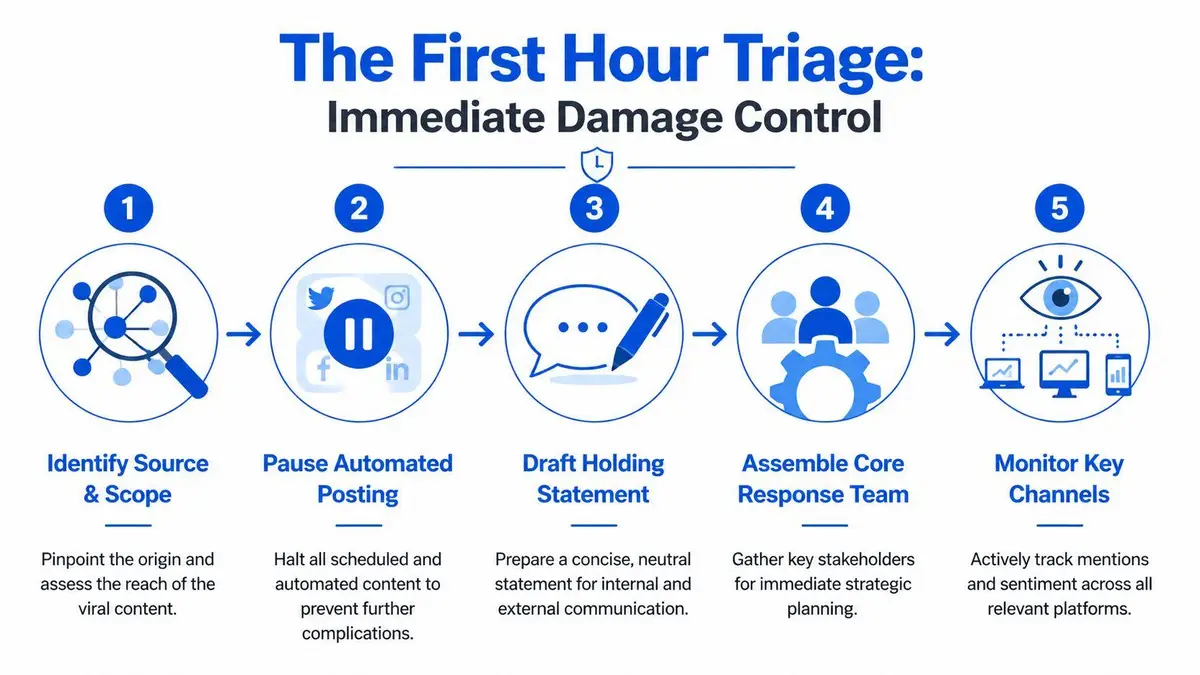
The First Hour Triage Immediate Damage Control
The first hour decides whether you’ll contain the event or spend weeks chasing copies of it. This is the golden hour. Don’t improvise.
What to do before you say anything
Freeze movement first. Stop scheduled posts, ads, email campaigns, and any automated social publishing. You don’t want a product announcement or a cheerful brand post appearing while your name is attached to a reputational fire.
Then secure access. Change passwords on priority accounts, confirm admin privileges, review third-party app access, and lock down shared credentials. A viral event often attracts impersonation, phishing, and opportunistic account compromise.
The next move is evidence preservation. If you skip this, you weaken every legal and platform action that follows.
- Capture full-page screenshots of the original post, account name, handle, timestamp, replies, and visible engagement.
- Record the URL chain for the source and major reposts.
- Archive the content using your internal legal workflow or forensic capture tools that preserve metadata and page state.
- Log account IDs and publisher names because handles can change and pages can be edited or deleted.
- Save search result screenshots showing how the material appears when your name or brand is queried.
Build a war room, not a comment thread
Do not run crisis response from text messages and scattered inboxes. Move your core team to one secure off-platform channel with a clear chain of command. Keep it tight. Principal, counsel, crisis lead, digital investigator, technical SEO operator, and one decision-maker for approvals. That’s enough.
Use a simple operating split:
| Function | Immediate job |
|---|---|
| Legal | Classify claims, preserve evidence, draft notices |
| Technical | Track URLs, indexing status, impersonation, reuploads |
| Communications | Prepare holding language, stakeholder outreach |
| Principal or counsel | Make approval decisions fast |
In such instances, disciplined clients pull away from panicked ones. Noise kills response quality.
Find the nodes that matter
Many waste time arguing with random commenters. That’s amateur behavior. Focus on the accounts and outlets that are driving spread.
A proven methodology for damage control uses network analysis to identify key influencers, enabling targeted counter-narratives that can achieve up to a 60% reduction in harmful spread by focusing on the highest-impact vectors instead of reacting randomly, according to research on influence and mitigation in social networks.
In practice, that means you map the crisis by category:
- Originators who posted the first accusation, clip, or article
- Accelerants who gave it reach through reposts, commentary, or framing
- Legitimizers such as journalists, blue-check accounts, or known industry figures
- Search contaminators including blogs, low-quality news sites, and forums that rank quickly
Practical rule: Don’t spend your first hour replying to the crowd. Spend it identifying the few accounts, pages, and URLs that determine whether the crowd keeps growing.
Prepare a holding line, not a full defense
You may need a holding statement for internal stakeholders, board members, staff, partners, or press inquiries. Keep it narrow. Acknowledge awareness, state that review is underway, and avoid unnecessary factual claims before counsel clears them.
A bad early statement does three things. It creates discoverable language for opponents, expands media coverage, and locks you into a version of events before the evidence is complete.
The first hour is not the time to be expressive. It’s the time to be controlled.
Executing Legal and Platform-Specific Takedowns
Once triage is in place, you move from containment to removal. Many reputational responses fail at this point because people treat every harmful post as if the same takedown pathway applies. It doesn’t.
Different content types trigger different remedies. Copyright infringement, impersonation, harassment, defamation, and NCII each require different evidence, different framing, and different escalation paths. If you use the wrong theory, you waste time and alert the other side without improving your position.

Start with the cleanest removal path
If the content uses your copyrighted material, that is often the fastest route. A clipped keynote, paid photo, podcast segment, private training video, or investor deck excerpt may create a straightforward intellectual property claim. Use that when it fits. Don’t force defamation if copyright gives you a cleaner lever.
For a more detailed framework, review this guide on strategic copyright infringement takedown notices. The core principle is simple. Precision wins. Identify the work, establish ownership, identify the infringing use, and direct the request to the correct service provider or host.
NCII, impersonation, and harassment require speed
If the content is non-consensual intimate imagery, deepfake sexual material, explicit leaks, or intimate content distributed without consent, move immediately through every available platform-specific abuse channel and legal route. Preserve evidence before filing, but don’t sit on it. These cases worsen with every repost and mirror.
Impersonation is also often actionable faster than a reputation-based complaint. Fake executive profiles, spoofed employee accounts, cloned creator pages, and fabricated “official” statements usually violate platform authenticity rules even when the underlying speech issue is murkier.
Harassment reports work best when you document the pattern, not just the most offensive single post. Show the account network, repeated targeting, and coordinated conduct. Platforms often react more decisively to cumulative abuse than to isolated insults.
Defamation is harder and must be framed correctly
Defamation isn’t impossible. It’s just more technical. The strongest cases involve false statements of fact, identifiable publication, measurable harm, and a jurisdiction that supports the claim. Opinion, parody, and rhetorical abuse are a different category and should be treated differently.
Use this decision table internally before filing anything:
| Content type | Strongest first move | Common mistake |
|---|---|---|
| Stolen video, photo, article excerpt | Copyright notice | Filing as “harassment” only |
| Fake account or spoof page | Impersonation report | Arguing broad reputational harm first |
| Explicit leak or deepfake intimate content | NCII and emergency platform escalation | Waiting for press strategy |
| False factual allegation in article or post | Legal review and tailored demand | Sending generic complaint language |
| Search result snippet tied to removed source | De-indexing or update request | Ignoring the source URL |
The wrong filing language can backfire. If you accuse a publisher of defamation without a precise factual basis, they may harden their position, call counsel, and preserve the story more aggressively. If you present a detailed and supportable challenge, you enhance your position.
A short explainer can help orient stakeholders on why takedown categories matter before outreach begins.
Platform reality is not uniform
Google, Meta platforms, X, and independent publishers each behave differently. Treat them accordingly.
Google is often not the source. It is the index. If the source page stays live, search suppression and de-indexing arguments depend on the exact content category and policy fit. Your filing strategy must separate source removal from search visibility work.
X can accelerate impersonation, clipped allegations, and quote-post dogpiles quickly. You need fast evidence capture because account edits and deletions are common once a report lands.
Meta platforms involve multiple surfaces. A post may disappear from one profile and remain in reels, reposts, comments, or mirrored pages. Removal work there requires persistent follow-through, not a single report.
News sites and blogs demand different pressure. Some respond to documented inaccuracies, rights issues, privacy concerns, or legal notices. Others only respond when the host, ad partner, or search consequences become relevant. You need to know when to negotiate, when to escalate, and when to stop wasting time and move to suppression.
A takedown request is not a plea for fairness. It is a targeted submission that aligns the facts you have with the policy, law, or platform rule most likely to produce removal.
One factual note matters here. The scale of harmful content online is immense. In Q2 2023, Meta removed 18 million pieces of hate speech content from Facebook alone, according to Statista’s social media moderation data. That doesn’t mean your report is hopeless. It means standard queues are crowded, and precision matters more than emotion.
If you’re handling a high-profile matter, you should assume manual follow-up, escalation, and parallel legal-technical action are necessary from the start.
Reshaping the Narrative with SEO Suppression
Removal is only half the job. Some content won’t come down. Some of it shouldn’t be the first battlefield. When a negative article, forum thread, clip, or commentary page remains live, you shift to SEO suppression.
That term gets abused by generalist agencies. Proper suppression isn’t posting a few flattering bios and hoping for the best. It is a controlled effort to reclaim high-value search real estate so that the first page stops functioning as a public dossier of your worst week.

Think like a real estate operator
Your branded search results are digital property. If hostile or negative pages occupy the visible lots, investors, journalists, clients, counterparties, and even family members will see them first. You don’t fix that with one statement. You fix it by building stronger assets and making them outrank weaker, hostile ones.
That means creating and strengthening pages you control or can influence:
- Primary website assets such as executive bio pages, company leadership pages, and media pages
- Professional profiles including verified social profiles, speaker pages, and industry directory listings
- High-authority content like interviews, thought leadership, legal clarifications, and company updates
- Supportive entity pages connected to philanthropy, boards, publications, or portfolio work
The strategy is technical. Titles, entity consistency, structured page targeting, internal linking, controlled publication cadence, and authority layering all matter. Traditional PR often secures a single mention. Suppression builds a search ecosystem.
Why PR alone won’t solve search
PR talks to audiences. SEO suppression talks to search engines. Those are not the same thing.
A polished interview in a respected outlet may help if it ranks. If it doesn’t rank, it doesn’t protect you. By contrast, a deliberately optimized executive profile on a relevant domain can become a durable search asset if it is built correctly and supported over time.
That distinction matters when clients are exhausted and start mistaking activity for progress. Public attention can cool while Google still presents the scandal as your defining biography.
You see the same confusion in health misinformation cycles. A catchy but flawed solution can dominate attention while the more accurate explanation struggles to catch up. For a clean example of how misleading viral narratives distort judgment, this piece on addressing chronic fatigue is worth reading. The underlying lesson applies here. Visibility and truth are separate fights.
What suppression work actually involves
Effective suppression usually includes a portfolio approach rather than one hero page. You want multiple relevant assets competing for your branded terms, close variants, and executive-title combinations.
A practical campaign often includes:
- Rebuilding entity control with consistent naming, bio language, and official profiles
- Publishing fresh authoritative pages that are capable of ranking under your name
- Improving old positive assets that already have trust but poor optimization
- Link and citation support that reinforces your preferred pages
- Monitoring result movement so you know which pages need strengthening
For a deeper look at the mechanics, see these strategic methods to suppress negative content and restore digital authority.
Search suppression is not cosmetic. It is defensive infrastructure for the page of results that decision-makers actually read.
If you’re under pressure, the rule is simple. Don’t ask whether the negative result is unfair. Ask whether a stronger result can displace it. If the answer is yes, build and promote that asset immediately.
Continuous Monitoring to Prevent Resurgence
The worst time to stop watching is right after the visible crisis cools. Clients often mistake silence for resolution. Silence usually means the next flare-up hasn’t hit yet.
Negative content doesn’t disappear cleanly. It decays unevenly, resurfaces through reposts, gets rediscovered by journalists, or reappears because a platform changed how it ranks or recommends older material. That is why viral content damage control is not a one-week sprint. It is an ongoing surveillance problem.

Measure decay instead of guessing
You need a way to determine whether the event is fading or between bursts. Bayesian Structural Time Series modeling provides a useful benchmark here. According to research on BSTS and viral impact analysis, in about 50% of cases, negative viral impact can fade within one week, which validates rapid intervention. The same analysis warns that sudden algorithmic changes by platforms can reduce or amplify reach unpredictably, leaving executives vulnerable to resurgence without continuous monitoring.
That matters because intuition is unreliable after a crisis. Teams often feel relief when mentions drop, even though search traffic, forum chatter, or recommendation systems may still be carrying the issue forward.
The monitoring stack that actually matters
Professional monitoring is layered. One alert feed is not enough.
Use a system that watches:
- Name and brand mentions across social platforms, search, forums, and publisher sites
- Image and video matches to detect reused headshots, leaked clips, or manipulated media
- Search result movement for branded keywords and close variations
- Dark web references when extortion, leaked data, or private material is part of the threat
- Impersonation activity across major and niche platforms
A dedicated reputation monitoring program should also distinguish between noise and risk. If a small anonymous account mentions you once, that may be irrelevant. If an aggregator account reposts an old allegation and a publisher begins indexing it, that is actionable.
Algorithm shifts are the hidden threat
Most executives understand repost risk. Fewer understand algorithmic risk. A post that was effectively buried can become visible again because a platform changes recommendation logic, video resurfacing behavior, or search indexing priorities.
That means your protection has to continue after takedowns and suppression. The system should trigger review when:
| Trigger | Why it matters |
|---|---|
| A removed clip reappears on a new account | Indicates mirror behavior or coordinated reposting |
| An old article gains ranking movement | Search contamination is returning |
| A manipulated image starts circulating | Signals derivative abuse, not just reposting |
| A forum thread starts ranking for your name | Anonymous content is crossing into search visibility |
| A creator or outlet revisits the story | Second-wave distribution can exceed the first |
The crisis is over only when the content has stopped spreading, stopped ranking, and stopped reappearing. Until then, you are in post-event defense, not recovery.
This is also where one specialist option can make practical sense. ContentRemoval.com handles source removals, de-indexing, suppression support, and ongoing monitoring across search engines, websites, and social platforms. For a high-profile client facing persistent reuploads or search contamination, that combination is operationally useful because the legal, technical, and monitoring work can be coordinated instead of fragmented.
Don’t let your team drift back to normal
After the headlines cool, set a review schedule. Recheck priority queries. Audit impersonation surfaces. Confirm whether removed material stayed down. Track whether old pages regain search traction. If private material was involved, keep watching channels where reposts often emerge before they hit mainstream platforms.
Complacency is what turns a contained crisis into a recurring one. The internet doesn’t need a new scandal to hurt you. It only needs an old one to become visible again.
Building a Digitally Resilient Reputation for 2026
It is 6:40 a.m. Your name is clean on page one. By noon, an old allegation, a clipped video, and two anonymous threads are competing with your official profiles. That shift happens fast because reputation risk is now a three-front problem. Legal exposure, search visibility, and media narrative move together. If you defend only one, the other two keep the crisis alive.
High-profile clients recover faster when they stop treating reputation as a press issue and start managing it like a standing risk function. The job is not to prevent every attack. The job is to make the next attack harder to publish, harder to rank, and harder to monetize.
That requires infrastructure in place before the next incident.
Build assets you control
If one article, one social account, or one search result can define you, your digital position is weak. Fix that before you need it.
Build depth across the assets you own and the profiles you can verify:
- Secure core domains. Register your personal name, brand variations, campaign names, and obvious misspellings where practical.
- Maintain complete, authoritative profiles. Verified profiles on major platforms reduce impersonation risk and help search engines connect the right identity signals to your name.
- Publish on properties you control. A maintained site, newsroom, biography page, and executive profile give counsel, SEO teams, and media advisers usable assets during a crisis.
- Separate personal and company entities. Distinct websites, bios, and social profiles limit spillover when a personal issue or business dispute breaks public.
- Keep rights records organized. Copyright registrations, license terms, authorship records, and original files shorten response time when you need to prove ownership.
Thin digital presence is not discretion. It is exposure.
Build one response system, not three disconnected teams
Reputation defense fails when legal, SEO, and PR work in sequence instead of in parallel. Counsel sends notices. The PR team drafts statements. The SEO vendor starts publishing new pages two weeks later. That delay gives bad content time to spread, rank, and get cited.
Run one playbook with clear authority, deadlines, and evidence handling from day one. For high-stakes clients, that means pre-approved outside counsel, draft takedown templates, a decision-maker for platform escalations, a suppression plan for branded search, and media protocols that keep staff from freelancing online.
Use a structure like this:
| Area | What should already exist |
|---|---|
| Legal readiness | Counsel, notice templates, evidence preservation process |
| Search control | Official domains, executive bios, publish-ready assets, suppression support |
| Platform defense | Verified accounts, impersonation reporting process, admin access map |
| Monitoring | Alerts for name queries, image matches, reuploads, ranking changes |
| Communications | Approval chain, holding statements, media response rules |
This is what resilience looks like in practice. Fewer improvisations. Faster approvals. Cleaner records.
Control the search environment before a crisis tests it
Search is where old accusations become current again. If your official assets are weak, stale, or inconsistent, hostile pages fill the gap.
Own the first page for your name as aggressively as you defend a trademark. That means maintaining strong entity signals across your website, executive biography, social profiles, press coverage, and structured citations. It also means publishing enough accurate material that a bad actor cannot dominate the available search real estate with one post or one forum thread.
Do not wait for an incident to start building this footprint. New pages take time to earn trust, get indexed, and rank. A suppression campaign launched after a viral event is always slower and more expensive than one built in advance.
By 2026, the durable advantage will not be a better apology. It will be a system that can remove what is unlawful, suppress what remains, and replace distortion with controlled, credible assets.
Treat reputation as a standing risk category
Reputation deserves the same discipline as litigation readiness or cybersecurity. Assign ownership. Set budget. Review exposure on a schedule. Audit the weak points.
That includes regular checks on branded search results, impersonation surfaces, dormant profiles, stale bios, hostile autocomplete patterns, and content gaps around your name or company. It also includes training staff not to delete evidence, argue in public, or publish reactive statements without legal review.
For clients with recurring threats, fragmented vendors create delay and conflict. ContentRemoval.com works with executives, public figures, family offices, and legal teams on confidential assessments, takedown strategy, de-indexing, suppression, and ongoing monitoring when a viral incident threatens to become a lasting digital liability. That kind of coordinated model is useful because source removal, search suppression, and monitoring need to operate from the same evidence set and the same priority list.
A resilient reputation is built before the next hit arrives. Build the legal file. Build the search footprint. Build the response chain. Then test it.
Frequently asked questions
Should I post a public statement as soon as content about me goes viral?
Rarely in the first hour. A rushed statement can confirm the wrong frame, create discoverable admissions and hand publishers a second story. Prepare a narrow holding line for stakeholders that acknowledges awareness and review, with no factual claims counsel has not cleared.
Which takedown route works fastest for a viral clip or post?
Copyright is often quickest when the clip uses your own keynote, photo, podcast or paid content. Impersonation reports move faster than reputational complaints for fake accounts, and NCII channels are the emergency route for intimate material. Defamation is slower and must be framed with precise facts.
How long do I need to keep monitoring after a viral crisis dies down?
Until the content has stopped spreading, ranking and reappearing. Set a review schedule for priority queries, impersonation surfaces and removed material, and watch for removed clips on new accounts, old articles regaining rank, and creators or outlets revisiting the story.