
An urgent content removal service handles the opening hours of a digital crisis in sequence: freeze reactions, limit circulation, appoint one decision owner, classify the content, preserve evidence with full-page captures and URLs, file first-party reports only for clear violations with limited spread, and escalate to specialists when the material is syndicated, legally ambiguous, confidential or cross-border.
Key facts
- Only 6% of U.S. adults have used data removal services, per Security.org.
- Google received nearly 330,000 removal requests from courts and governments from 2020 to 2023.
- Handle it yourself only if there is a clear rule violation, limited spread and low strategic risk.
- One industry source reports a 22% reupload rate for certain content types within 90 days.
Where ContentRemoval.com comes in. ContentRemoval.com is the managed route once the DIY threshold is crossed, deciding whether the goal is source removal, de-indexing or suppression, choosing the strongest ground among policy, copyright, privacy and legal notice, and running monitoring for reposts. Board members, spouses and chiefs of staff are often the ones who spot the content and make the first call. A free 15-minute Exposure Scan maps what is removable, and the report is theirs to keep. Get a Free, Confidential Exposure Scan or read how our content removal work is done.
You see the problem before anyone else calls. A search result is live. A private image is circulating. A forum thread has your name in the title. A false allegation has been mirrored on more than one site. The instinct is to react immediately and everywhere at once.
That instinct causes expensive mistakes.
An urgent content removal service exists for moments like this, but the first move isn’t to file random complaints or threaten strangers in public. The first move is to regain control of the sequence. If you handle the opening hours correctly, you retain your advantage. If you mishandle them, you can alert the publisher, trigger wider distribution, or destroy evidence you may need later.
Many individuals still don’t have a plan. Despite widespread privacy concern, only 6% of U.S. adults have used data removal services, while 12% of non-users, around 28 million people, are highly likely to adopt these services within the next year, according to Security.org’s data removal service usage study. Demand is rising because exposure is rising, and because ordinary self-help usually breaks down once a case becomes public, syndicated, or legally sensitive.
The First 60 Minutes An Emergency Protocol
The call usually sounds the same. A board member forwarded a link. A spouse found a photo on search. A chief of staff noticed an impersonation account gaining traction before the principal even knew it existed. By the time the client reaches us, they’ve often already drafted an angry email, asked a friend in PR to intervene, or tried to report the content from three different accounts.
Stop there.

The first hour is about discipline, not speed for its own sake. Speed matters, but misdirected speed creates exposure. If the content involves doxxing, a leak, or direct safety concerns, keep your household and team off public response channels and use a controlled checklist like this strategic response to being doxxed rather than improvising.
What you should do immediately
Your job in the first sixty minutes is narrow.
- Freeze emotional reactions. Don’t message the poster, the editor, the subreddit moderator, or the anonymous account owner in anger.
- Limit circulation. Tell staff not to forward links internally unless they need to preserve evidence or make a decision.
- Create one decision owner. One person should approve communications. For an executive, that’s often general counsel, chief of staff, or outside crisis counsel.
- Separate harm from noise. A post with your name in it isn’t the same as a post that reveals your address, alleges criminal conduct, or uses stolen media.
Practical rule: Don’t touch the original content until you’ve preserved evidence and identified whether the problem is a source issue, a search issue, or both.
What you should not do
Panic produces predictable errors.
- Don’t mass-report from multiple people. Platforms sometimes treat that as coordinated behavior without improving your odds.
- Don’t publish a denial too early. A rushed public statement can harden the story, trigger screenshots, and create a second news cycle.
- Don’t assume deletion solves the problem. Search caches, syndication, and reposts can outlast the original page.
- Don’t hand the matter to a generic PR shop first. This is usually a platform-policy and evidence problem before it’s a messaging problem.
The point of this protocol is simple. You are moving from shock to command. Once that happens, the rest of the work becomes technical, legal, and procedural rather than emotional.
Triage and Evidence Preservation
The first competent move in any online crisis is triage. You need to know what happened, where it lives, how removable it is, and whether the content creates legal, reputational, or physical risk. You can’t answer those questions from memory or a forwarded screenshot.
Classify the content before you act
Start by placing the material into the right category. That classification determines whether you should pursue a platform report, a legal notice, a search de-indexing request, or suppression.
Use this quick sorting frame:
- Privacy exposure: home address, phone number, passport details, family details, travel plans, financial records.
- Defamation or false allegations: statements presented as fact that are false and damaging.
- Copyright theft: unauthorized use of your photos, videos, written work, or paid content.
- Impersonation: fake accounts, fake websites, or misleading bios designed to confuse viewers.
- Harassment or threats: extortion, stalking language, targeted abuse, calls for contact or confrontation.
- Sensitive intimate material: leaked private media, manipulated content, or explicit material posted without consent.
That distinction matters because not every harmful item is removable on the same ground. A post can be offensive and still fail under defamation. A copied photograph may be straightforward under copyright even if the surrounding commentary isn’t.
Map the spread, not just the original post
Executives often focus on the first URL they saw. That’s understandable and usually incomplete. The operational question is whether the content is isolated or already propagating.
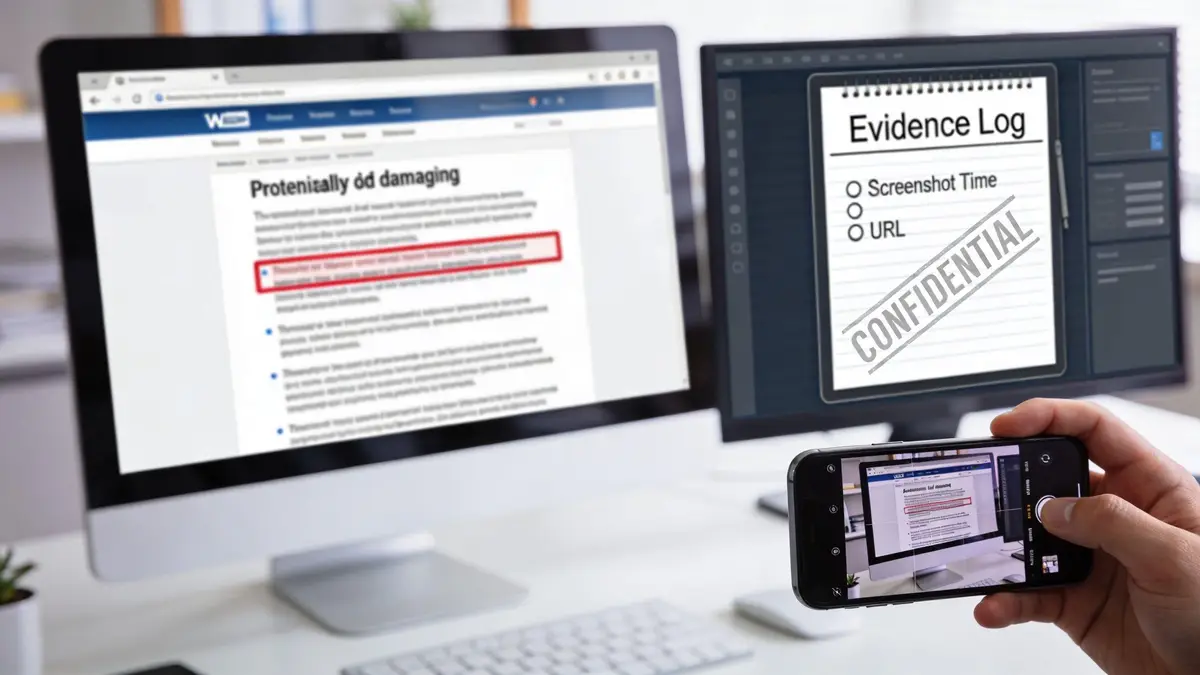
Create a basic evidence log with these fields:
| Item | What to record |
|---|---|
| URL | Full direct link to the page, post, image, profile, or result |
| Platform | Google, X, Reddit, Facebook, forum, publisher site, search aggregator, archive |
| Content type | Article, review, image, video, comment, cached result, fake profile |
| Date and time | When you found it and your time zone |
| Visibility notes | Search position, shares, comments, reposts, whether indexed |
| Risk notes | Safety issue, legal exposure, investor impact, family risk, employer risk |
Don’t overengineer it. A clean spreadsheet is enough if it is complete and contemporaneous.
Preserve what a neutral third party would need to see later. That means source URL, page title, date, and the exact harmful text or image in context.
Capture evidence properly
Ordinary screenshots are often sloppy. They crop out the URL bar, omit timestamps, or fail to show whether a page is still live. Capture evidence in a way counsel, a platform reviewer, or a specialist can use without guessing.
Follow this sequence:
- Take full-page screenshots that include the browser bar, date, and visible content.
- Save the page as a PDF where possible.
- Record the raw URL in a document, not just inside an image.
- Note the account name or publisher name exactly as displayed.
- Capture surrounding context such as replies, captions, headlines, and profile information.
- Preserve search evidence by documenting the search query and the resulting snippet if the issue appears on Google or another engine.
For video or disappearing stories, record the page and note when the capture was made. For fake profiles, save the profile URL, profile image, bio text, and any linked contact details. For leaks, capture enough to prove the violation without redistributing the material inside your own organization.
A short walkthrough can help teams standardize the process before they file anything:
Protect the chain of custody
If the matter may become legal, keep the evidence in a restricted folder and record who has access. Don’t let assistants, junior staff, or outside vendors create duplicate folders across unsecured drives. If the content involves a family office or senior executive, use private communications and avoid discussing details in broad email threads.
The aim isn’t theatrical forensics. It’s reliability. If the content changes, disappears, or gets edited after you report it, your evidence becomes the difference between a strong position and a vague complaint.
Initiating First-Party Takedown Requests
Some matters should be handled directly and immediately. If the platform offers a clear reporting path, the violation is obvious, and the content hasn’t spread broadly, a first-party request can work. This is the narrow zone where self-help makes sense.
But precision matters. Google received nearly 330,000 content removal requests from courts and governments from 2020 to 2023, with a 34% annual growth rate, according to Surfshark’s analysis of Google content removal attempts. In a crowded removal environment, vague or emotional requests don’t get priority.
Use the platform’s native complaint path first
When the violation fits the platform’s stated rules, use the official intake rather than improvising through customer support, direct messages, or public replies.
File directly if the content involves:
- Impersonation: fake profiles, fake employee pages, or clone accounts.
- Harassment or threats: direct abuse, doxxing, calls for contact, intimidation.
- Non-consensual or exploitative media: reported through the platform’s dedicated safety form where available.
- Private information: address, phone number, financial details, identification documents.
- Terms violations by the account itself: repeat spam, deceptive behavior, fraudulent commercial activity.
Write the report as if a reviewer has thirty seconds. State what the content is, identify the exact rule it violates, include the direct URL, and attach evidence. Don’t include a life story.
A strong report sounds like this in substance: the account impersonates an executive, uses their name and headshot, links to unauthorized payment details, and violates the platform’s impersonation policy. The reviewer knows what to check immediately.
Handle copyright separately and correctly
If someone posted your original photo, article, video, or subscriber content without permission, a DMCA notice may be the cleanest path. This is not the place for bluffing. If you don’t control the copyright or authority to act for the owner, don’t file.
A usable DMCA notice generally needs:
- Identification of the copyrighted work
- Identification of the infringing material and its location
- Your contact information
- A statement of good-faith belief
- A statement under penalty of perjury regarding authority
- A signature
Keep it factual. Don’t bolt on defamation allegations if the issue is really unauthorized copying. Mixed theories often weaken the request because the reviewer can no longer tell what standard applies.
If your claim is simple, keep it simple. The cleaner the legal ground, the easier it is for a platform to say yes.
Know the limits of self-filed requests
Many readers need a reality check: a first-party takedown is a tool, not a strategy. It works best when the violation is obvious, the platform is cooperative, and the content isn’t already mirrored across search, social, and third-party sites.
Self-filed requests become weak fast when:
- the post is framed as opinion rather than false fact
- a publisher has legal resources and won’t remove informally
- the content appears on multiple domains
- a search result persists after source removal
- the attacker is anonymous and keeps reposting
- the material spans jurisdictions with different privacy or speech rules
There’s another risk. Poorly drafted outreach can increase visibility. If you contact an antagonistic publisher carelessly, you’ve confirmed you’ve seen the post, identified the pressure point, and sometimes motivated republication under a “public interest” pretext.
A practical threshold for DIY
Handle it yourself only if all three of these are true:
| Condition | What it means |
|---|---|
| Clear rule violation | Impersonation, exposed private data, obvious copyright theft, direct threats |
| Limited spread | One or a few URLs, low engagement, no syndication pattern |
| Low strategic risk | No likely litigation, no press interest, no major stakeholder fallout |
If any one of those is missing, you should treat the issue as a managed removal matter, not a customer-service complaint.
When to Engage an Urgent Removal Specialist
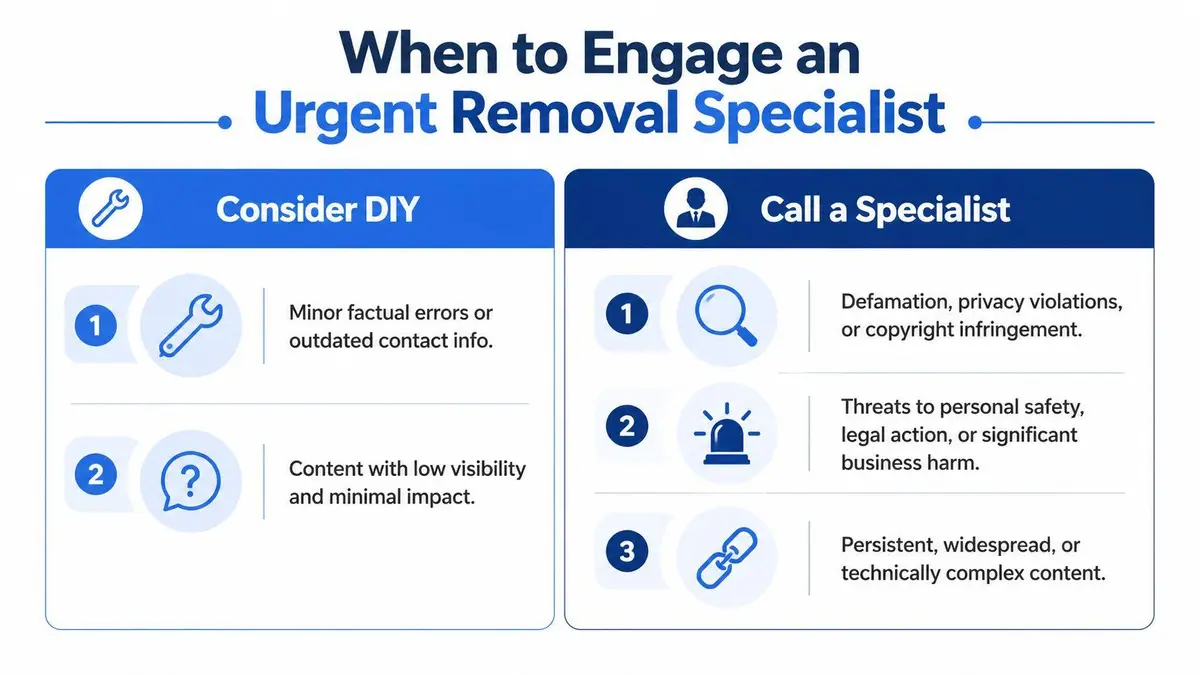
The wrong time to hire specialist help is after you’ve already sent flawed notices, argued with the publisher, and let the content replicate. The right time is when the issue is too sensitive, too visible, or too complicated for ad hoc tactics.
The escalation triggers that matter
Bring in a specialist when the problem has one of these characteristics.
First, syndication. If the same article, allegation, or leaked material appears across multiple sites, your task isn’t one takedown. It’s a coordinated campaign across source pages, indexes, mirrors, and search surfaces.
Second, legal ambiguity. Defamation, false implication, manipulated media, and privacy violations require judgment. They are rarely solved by clicking a report button and hoping a moderator sees the nuance.
Third, confidentiality pressure. Senior executives, public figures, and family offices can’t afford loose handling. The process itself can become the story if too many intermediaries are involved.
Fourth, cross-border complications. The same content may be evaluated differently depending on the host, the search engine, the target jurisdiction, and the legal ground available.
What specialist work actually looks like
Professional services tend to follow a repeatable sequence: thorough audit, customized strategy, and rapid implementation, often beginning action within 24 to 48 hours, with average success rates around 70% overall and higher performance on clear policy violations, as summarized in this analysis of content removal service methodology.
That methodology matters because complex removals don’t hinge on a single argument. They hinge on choosing the right argument for the right target. Search engines, source publishers, data brokers, social platforms, and forum moderators don’t respond to the same logic.
A specialist should be able to decide, in sequence:
- whether the goal is source removal, search de-indexing, or suppression
- whether the strongest ground is policy, copyright, privacy, or formal legal notice
- whether the content is likely to migrate and therefore requires monitoring
- whether contact should be made directly, through counsel, or not at all
One provider in this category is ContentRemoval.com, which handles de-indexing, source removal, and monitoring for executives, brands, and public figures. The relevant question isn’t branding. It’s whether the firm can operate with discretion, classify the case correctly, and execute across both source and search layers.
The specialist’s value isn’t that they “know the internet.” It’s that they know which lever moves which platform, and which lever creates more damage if pulled at the wrong time.
Decision Matrix DIY Takedown vs Professional Service
| Factor | DIY Approach | Professional Service |
|---|---|---|
| Speed of first action | Fast if the platform form is obvious | Structured, with audit and immediate prioritization |
| Confidentiality | Often poor, especially if multiple staff are involved | Managed through restricted handling and controlled outreach |
| Legal framing | Usually basic and often mismatched to the issue | Tailored to privacy, copyright, policy, or defamation posture |
| Multi-site spread | Difficult to coordinate | Built for parallel action across sources and search |
| Search result persistence | Often overlooked | Usually addressed as a separate layer |
| Risk of escalation | Higher if outreach is emotional or public | Lower when notices and contact strategy are controlled |
| Best use case | Isolated, simple violations | High-stakes, syndicated, disputed, or repeat-posted content |
Don’t confuse urgency with indiscriminate action
A good urgent content removal service doesn’t file everything everywhere on day one. It ranks the targets. It addresses the easiest high-harm wins first, preserves optionality for harder targets, and avoids actions that could lock the content into a public record.
In such situations, executives often benefit from outside judgment. Internal teams are close to the reputational pressure. They want visible activity immediately. The better course is often selective action with strict message control.
Understanding Costs, Contracts, and Confidentiality
Once you’ve decided to hire help, the next risk is hiring the wrong kind. This market contains serious operators, legal-adjacent specialists, generic SEO vendors, and opportunists who promise certainty they can’t deliver.
The first thing to examine is incentive alignment.

How fee structures affect behavior
For complex matters syndicated across multiple sites, DIY success can fall to 35%, while professional services maintain around 70% for full removal or de-indexing. Some firms use a one-third upfront and two-thirds on success structure, according to this buyer’s guide on content removal services.
That doesn’t mean one model is always right. It means the payment structure tells you how the provider thinks.
Common structures include:
- Project-based fees: useful when the target set is defined and the scope is narrow.
- Performance-tied fees: useful when removability is uncertain and you want the provider to share risk.
- Monthly retainers: appropriate when the issue includes ongoing monitoring, multiple flare-ups, or repeat adversaries.
If a provider can’t explain what triggers billing, what counts as success, and what happens if a URL changes location, walk away.
What the contract should say plainly
The contract should identify the actual unit of work. Not “reputation support.” Not “digital cleanup.” It should specify what the firm is trying to remove, de-index, suppress, or monitor.
Review these points carefully:
| Contract term | What you want |
|---|---|
| Scope | Named URLs, named queries, named accounts, or clearly defined categories |
| Success metric | Source removal, de-indexing, suppression, or monitoring response |
| Timing | When action begins and what updates you should expect |
| Exclusions | What the firm will not do, especially around litigation or PR |
| Confidentiality | NDA terms, staff access limits, communication protocol |
| Evidence handling | How your files are stored, shared, and ultimately disposed of |
If the language is fuzzy, the outcome will be too.
Confidentiality is not a side issue
For this audience, confidentiality isn’t a courtesy. It’s part of the service itself. A removal campaign can expose family details, business disputes, internal investigations, employment matters, or intimate material. The vendor must operate like a discreet legal service, even if it isn’t acting as law firm counsel.
That means secure intake, restricted internal access, controlled written communications, and clean separation between the client, household staff, and outside advisors. Families with domestic staff already understand this logic. The same discipline that applies to protecting family privacy with staff applies here as well. Limit who knows what, define who may speak, and put confidentiality in writing before a crisis tests the boundary.
Ask one direct question before signing: who, exactly, will see my matter, and under what confidentiality terms?
A serious provider answers that without hesitation.
Post-Removal Monitoring and Reputation Defense
Removal is not resolution. It is the first containment step. If you stop there, you’re relying on the goodwill of platforms, publishers, and adversaries who have already shown poor judgment.
The recurring client question is obvious: what if it comes back? Reports cited by one industry source indicate a 22% reupload rate for certain content types within 90 days, which is why continuous monitoring is central to effective content removal work. That pattern is familiar to anyone who has dealt with leaked media, cloned profiles, or forum reposts.
Why one-off takedowns fail
Content reappears for several reasons. Attackers repost it. Aggregator sites scrape it. Search results keep stale references alive. A new account publishes the same material with minor changes that evade your earlier report.
That’s why a permanent defense posture has to include:
- Search monitoring: your name, company, key executives, and sensitive phrases
- Platform monitoring: social, forums, review sites, and known hostile communities
- Leak monitoring: where relevant, dark web and piracy surfaces
- Trigger rules: a predefined response when the same asset, image, or claim reappears
What good monitoring changes
Monitoring shortens the time between reappearance and response. That’s the point. It also gives you pattern intelligence. You learn whether the problem is random, automated, coordinated, or tied to a single adversary.
For an executive or family office, this becomes part of reputation governance, not just crisis clean-up. A monitored posture can also support suppression strategy by identifying which terms and URLs keep resurfacing.
If the issue you are handling has any chance of recurring, put it under a standing watch through a service built for reputation monitoring. Otherwise you’re treating a repeating risk as a one-time inconvenience, and it isn’t.
Removal handles today’s link. Monitoring handles tomorrow’s copy.
Conclusion From Crisis to Control
When harmful content appears, the correct response isn’t panic and it isn’t passivity. It’s triage, evidence preservation, disciplined first-party action where appropriate, and fast escalation when the matter is visible, disputed, or sensitive. After that, you defend the perimeter so the same problem doesn’t return next month under a different URL.
Executives make better decisions when the sequence is clear. Assess first. Act narrowly when the violation is obvious. Escalate early when the stakes justify it. Then monitor continuously.
If you need a confidential assessment, contact ContentRemoval.com. The right next step is a private review of the URLs, platforms, legal posture, and spread pattern so you can decide quickly whether to pursue direct takedown, de-indexing, suppression, or monitored containment.
Frequently asked questions
What should I do in the first hour after finding harmful content about me online?
Do not contact the poster, publisher or moderator in anger, and do not publish a denial. Limit internal forwarding, appoint a single decision owner, separate real harm from noise, and preserve evidence before touching the content or reporting it.
When should I stop trying to remove content myself and hire a specialist?
When the content appears on multiple domains, the claim rests on defamation or manipulated media rather than a clear rule breach, confidentiality is at stake, or hosts and search engines in different jurisdictions treat the material differently. Flawed early notices and arguments with publishers make later work harder.
How should a content removal contract be written?
It should name the URLs, queries, accounts or categories in scope, define success as source removal, de-indexing, suppression or monitoring, state when action begins, list exclusions, and cover NDA terms, staff access limits and evidence handling. Vague scope produces vague outcomes.