
Removing content before it goes viral means detecting abnormal spread early, classifying the post correctly as impersonation, harassment, copyright misuse, non-consensual intimate imagery or defamation, and filing one precise report under the strongest category while preserving evidence. Search de-indexing runs in parallel, public confrontation is avoided, and monitoring catches re-uploads before the material hardens into screenshots and search results.
Key facts
- Generic abuse reports on Meta, TikTok, X, LinkedIn, Reddit and Snapchat often land in slower queues.
- DMCA is usually the fastest route when the post uses photos, video or documents you own.
- NCII should be treated as an emergency with dedicated platform channels, not a standard reputation issue.
- Defamation needs a false statement of fact, not opinion, and is slower and more evidence-heavy.
Where ContentRemoval.com comes in. ContentRemoval.com takes urgent cases where a false allegation, leaked image, impersonation page or intimate content is starting to spread, filing under the strongest category on the source platform, working search exposure at the same time, and watching for re-uploads afterward. Contact often comes from the person’s chief of staff, agent or lawyer while the post is still climbing. A free 15-minute Exposure Scan maps what is removable, and the report is yours to keep. Get a Free, Confidential Exposure Scan or read how our content removal work is done.
A post about you, your company, or your private life has just gone live. It might be false, stolen, manipulated, defamatory, or catastrophic in context. You refresh once, then twice, and the engagement curve starts climbing. At that moment, you are not dealing with a communications problem. You are dealing with a containment problem.
Most clients wait too long because they misread the early stage. They assume virality is random, that legal review can wait until morning, or that reporting the post once will be enough. That thinking loses cases. Harmful content spreads in cascades, and the first response window is brutally short.
If you’re trying to remove content before going viral, the only useful posture is immediate control. That means spotting breakout signals early, classifying the threat fast, choosing the right removal path without hesitation, and suppressing re-uploads before the content hardens into search results, screenshots, reposts, and commentary.
The Critical Hours Before Virality
You find the content at the worst possible time. Late at night. Before a board meeting. During a financing process. On the eve of a product launch. Your first instinct is often emotional. Call the poster. Threaten a lawsuit. Draft a statement. Those moves feel active, but they often waste the only hours that matter.
The practical question is simpler. Can you stop distribution before the platforms and the crowd do what they always do, which is amplify first and review later?
That is why the opening window matters more than the cleanup phase. In Q2 2023, Meta removed 18 million pieces of hate speech content and 1.8 million pieces of violent and graphic content, according to Statista’s social media moderation data. Those figures show scale. They do not show prevention. Platforms remove vast amounts of harmful material, but they still operate reactively. By the time a moderation system catches up, the damage may already exist in feeds, screenshots, embeds, and search results.
Reactive response fails for one reason
PR teams work on narrative. General counsel works on risk. Neither function is designed for minute-by-minute spread interruption. If the content involves a compromising image, a false allegation, leaked documents, impersonation, or a viral negative visual, you need a takedown sequence, not a press strategy. That is the difference between preserving a reputation and managing a public incident.
For a focused look at visual crises specifically, see this guide on viral negative photo removal.
Practical rule: If harmful content is gaining engagement and you are still debating whether to respond, you are already behind.
What matters in the first response window
Three things decide whether this turns into a contained incident or a long-term reputation event:
- Speed of detection: You need to know whether the post is merely visible or beginning to break out.
- Correct classification: Impersonation, harassment, copyright misuse, non-consensual intimate imagery, and defamation do not travel through the same removal channels.
- Silent execution: Public confrontation often feeds the cycle. Quiet removal usually works better.
Executives often underestimate the compounding effect of delay. One repost becomes ten. Ten become screenshots. Screenshots become “commentary.” Commentary becomes indexed search material. Once that chain starts, every later action gets slower, more expensive, and less complete.
The right mindset
Do not ask whether the content is fair. Ask whether it is removable. Do not ask whether you can win the argument. Ask whether you can interrupt the spread. The early hours are not for debate. They are for control.
The Pre-Viral Detection and Triage Framework
The difference between panic and command is having a system. Professionals don’t wait for a post to become obviously viral. They watch for statistical abnormality, then act before the broader audience notices what’s happening.
Start with anomaly detection
A harmful post rarely announces itself as a crisis. It starts as an outlier. Shares rise faster than the account’s norm. Comments arrive from outside the usual audience. The post gets picked up by adjacent accounts. Search demand starts to form around names, brands, or allegations.
Professionals use z-scores to detect that kind of abnormal movement. According to this PMC-cited methodology on early virality detection, teams can detect 95% of potential viral threats within 1 to 2 hours by calculating z-scores for shares and interactions, and a z-score greater than 3 on Facebook is a critical flag. The same framework then uses a Hawkes process model to forecast whether the content is likely to exceed 10x its baseline engagement within 24 hours.
You do not need to be a data scientist to understand the implication. If the content is moving far outside normal behavior, you don’t wait for certainty. You escalate.
Triage by reach and harm
Detection without triage creates noise. Every unpleasant post is not a crisis. Every critical comment is not a takedown case. The decision has to be grounded in two factors: current spread and likely damage.
Use a simple executive matrix:
| Current reach | Potential harm | Response level |
|---|---|---|
| Low | Low | Monitor quietly |
| Low | High | Immediate takedown prep |
| Rising | Medium | Platform action now |
| Rising fast | High | Full emergency response |
A low-reach post with severe legal exposure can be more dangerous than a moderately visible complaint. A leaked image, impersonation page, fabricated accusation, or stolen internal document should trigger action even before broad distribution begins.
Classify the content correctly
Misclassification kills speed. If your team files a generic abuse report when the better route is impersonation, copyright, or NCII, you lose time and often lose priority in the queue.
Use these distinctions:
- Impersonation: Fake profiles, false executive accounts, cloned creator pages.
- Harassment or bullying: Coordinated attacks, threats, abusive targeting.
- Copyright misuse: Stolen photos, videos, internal decks, branded assets, leaked media you own.
- NCII: Intimate content shared without consent, real or manipulated.
- Defamation: False statements presented as fact that create measurable reputational harm.
These categories are not interchangeable. Platforms process them differently, and legal remedies depend on precision.
If the content can be removed under a stronger category, never lead with a weaker one.
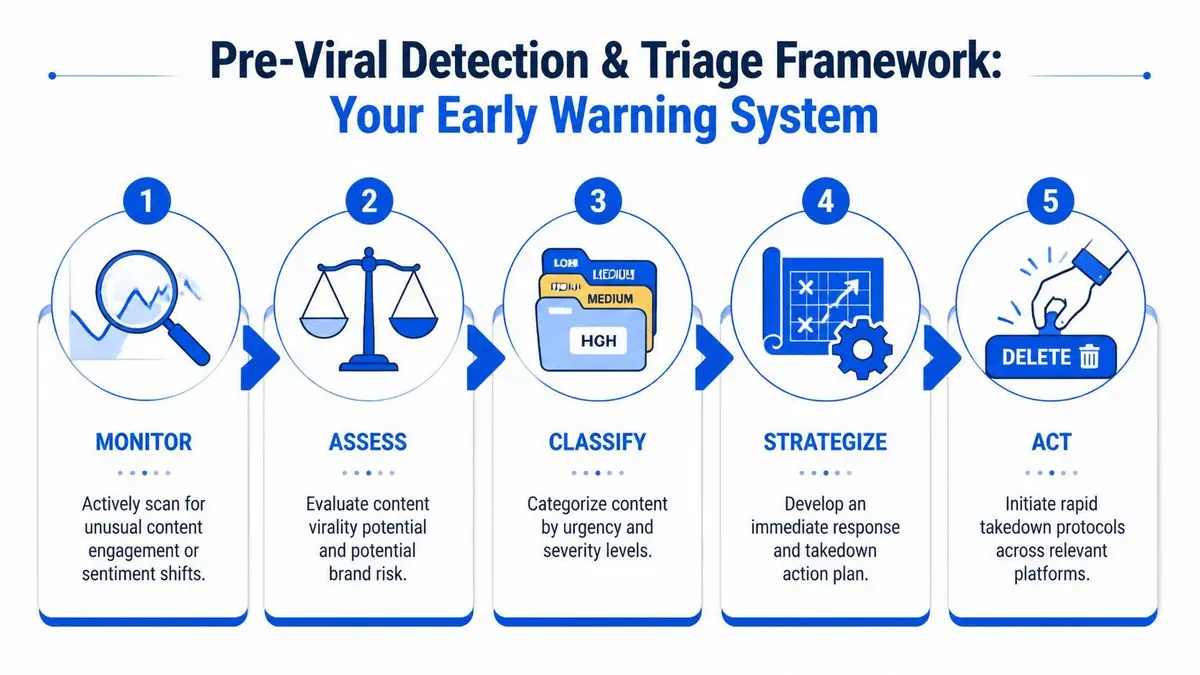
Build a five-step internal response
When an executive office or family office has no protocol, the first hour disappears into confusion. Build a compact flow and make one person responsible for triggering it.
- Monitor the signal
Capture URLs, usernames, timestamps, screenshots, and current engagement. Preserve evidence before reporting or requesting deletion. - Assess spread behavior
Ask one question: is the post behaving normally for that account, or is it escaping the creator’s usual audience? - Classify the violation
Pick the strongest legitimate removal basis. Accuracy matters more than creativity. - Strategize the route
Decide whether the fastest path is platform-native reporting, legal notice, search de-indexing, direct host contact, or a combination. - Act without discussion drift
Assign owners and move. Delay usually comes from internal over-consultation, not technical limits.
What executives get wrong
Senior people often delegate too broadly. Marketing sees a brand issue. Legal sees a documentation issue. Security sees a monitoring issue. Nobody owns the incident as a live distribution threat. That gap is where harmful content escapes containment.
The correct move is central command. One decision-maker. One evidence folder. One takedown strategy. One monitoring stream.
Executing an Immediate Multi-Platform Takedown
The first line of defense is usually the platform itself. That sounds obvious, but platform tools are often used badly. They file vague reports, omit evidence, choose the wrong violation type, and wait passively for a reply. That is not a takedown strategy. It is a delay mechanism.

Sequence matters more than volume
Do not blast ten inconsistent reports from ten different people. File one accurate report under the strongest available policy basis, preserve proof, then layer in the next channel. Disorder creates contradictions. Contradictions slow review.
Start with the source platform. Then move to search visibility. Then monitor for mirrors and re-uploads. If the content also appears in search snippets, cached pages, or copied posts, treat each surface as a separate exposure point.
Social platforms reward precision
On Meta, TikTok, X, LinkedIn, Reddit, and Snapchat, generic “this is harmful” reporting often disappears into a slower queue. Specific categories tend to perform better because they map to existing moderation workflows. If the content is a fake account, report impersonation. If it uses your photo or video, use the platform’s copyright process. If it contains intimate imagery or sexual exploitation, use the platform’s dedicated NCII or sexual content route. If it targets a person with abuse, use harassment with direct evidence.
The filing itself has to read like a case note, not a complaint. Include the exact URL, the username, timestamps, a short factual description, and the clearest supporting evidence. Cut emotion. Moderators need category clarity.
For a platform-specific example, this guide on how to remove a Twitter post for executives shows why category selection and evidence quality matter on X.
Search needs its own response
People forget that a post can keep harming you even after platform engagement cools down. Search extends the life of the incident. That is why de-indexing and legal removal tools must run in parallel where appropriate.
According to this benchmarked de-indexing protocol, Google’s legal removal tool for defamation or NCII achieves an 82% success rate within 3 to 5 days, and proprietary monitoring can catch and prevent 95% of reuploads. The key condition is timing. The source notes that success depends on acting before the content becomes algorithmically entrenched.
That last point matters. Once harmful material is repeatedly linked, mirrored, reposted, and discussed, search suppression becomes harder because the ecosystem around the original content has grown.
A workable takedown order
This is the order I recommend when speed matters:
- Secure evidence first: Save the live URL, profile URL, visible metrics, screenshots, and any related comments or reposts.
- File the strongest native report: Use impersonation, copyright, harassment, NCII, or another precise category instead of generic abuse.
- Escalate search exposure: If the content is already appearing in search, prepare a Google removal or legal request immediately.
- Map copies and embeds: Look for reposts, quote posts, mirrored files, forum threads, and indexed pages.
- Watch for second-wave spread: Harm often shifts platforms after the first removal request lands.
A loud public response during this phase is usually a mistake. It alerts the original poster, attracts spectators, and can encourage copycat uploads.
Quiet removal beats visible outrage. Attention is fuel.
Use video evidence and internal workflow discipline
If your team has never handled a takedown under pressure, train them before they need it. Review the mechanics of reporting paths, evidence packaging, and escalation logic. This short explainer is useful for that purpose:
What to include in every filing
A good submission answers the moderator’s unspoken questions fast. Who is affected? What policy is implicated? Where is the content? Why is this report accurate? What evidence supports urgency?
Use this minimum standard:
- Identity match: If impersonation is involved, show the legitimate account or official identity reference.
- Ownership proof: If copyright is involved, identify the original work and your ownership or rights.
- Context proof: If defamation or harassment is involved, attach the exact statement and the surrounding context.
- Direct URLs: Do not rely on screenshots alone if the form accepts URLs.
- Consistency: Every report, legal notice, and internal memo should describe the issue the same way.
The objective isn’t to “raise concern.” The objective is to make removal the easiest correct outcome.
Deploying Legal Instruments for Rapid Removal
Platform reporting is fast when it works. When it doesn’t, legal instruments force the issue. The common mistake is reaching for the wrong one. They threaten defamation when copyright would move faster. They send an angry email when an NCII pathway would trigger immediate review. They overcomplicate a case that should have been framed cleanly from the start.
The legal route has to match the content.
The three instruments that matter most
DMCA is usually the fastest option when the content includes material you own. That can include photos, videos, written material, internal presentations, paywalled content, branded assets, or recorded footage. If the file was taken from you and posted without permission, copyright can be a direct path to removal.
Defamation is powerful but slower and more fact-sensitive. You need a false statement presented as fact, not mere opinion or insult. You also need to think jurisdictionally. Where is the poster? Where is the host? Where is the damage occurring? If the statement is plainly false and damaging, defamation should be prepared carefully, not theatrically.
NCII often provides the strongest urgent-removal route when the content involves intimate imagery shared without consent, including manipulated intimate content. Platforms tend to have dedicated reporting channels, and hosts may move faster because the legal and policy risk is clearer.
Comparison of Legal Removal Instruments
| Instrument | Best Use Case | Typical Speed | Key Requirement |
|---|---|---|---|
| DMCA | Stolen photos, videos, documents, or other protected original content | Often fast where hosting and ownership are clear | Proof of ownership or rights in the original work |
| Defamation | False factual statements causing reputational damage | Slower and more evidence-heavy | A false statement of fact and supporting proof |
| NCII | Intimate imagery shared without consent, including manipulated content | Often urgent where platforms have dedicated processes | Clear identification of the content and lack of consent |
DMCA when you need immediate leverage
DMCA works best when the ownership chain is clean. If you shot the image, commissioned the video under proper assignment, or own the document outright, use that advantage. Do not lead with a sprawling grievance letter when a concise copyright notice can force review faster.
The problem is that many executives fail to preserve ownership proof in a usable form. Their assistant has the original file. Their agency holds the source edit. Their company owns the content but cannot quickly document chain of title. In a crisis, disorganization kills otherwise valid claims.
Defamation when the content is false, not just hostile
Defamation should be used with discipline. Not every harmful statement qualifies. Accusing someone publicly of criminal conduct, fraud, professional misconduct, or serious dishonesty may support rapid legal action if false. But legal force depends on evidence, not outrage.
If you go this route, build a clean record:
- Capture the exact wording: Small changes in wording can change the legal analysis.
- Show falsity clearly: Contradict the allegation with documents, correspondence, or objective records.
- Document damage pathways: Investor concern, client loss, employment exposure, or reputational harm all matter.
- Identify the right target: Sometimes the host matters more than the poster. Sometimes the reverse is true.
For broader context on jurisdiction, hosts, and strategic removal pathways, review this guide to online content removal laws for executives.
Legal pressure works best when it is precise, documented, and sent to the right party. Sloppy threats are ignored.
NCII is a priority case, not a standard reputation issue
Treat non-consensual intimate imagery as an emergency. Do not fold it into a generic reputation response. The filing path, evidence handling, and escalation should reflect the urgency and sensitivity of the content.
Keep the circle tight. Preserve evidence discreetly. Use dedicated platform forms where available. If hosts, search engines, or mirrors are involved, run those channels in parallel. This category rewards speed and punishes hesitation.
Choose the instrument by objective
If your objective is fast source removal, DMCA or NCII may outperform a defamation theory. If your objective is record correction and legal accountability, defamation may be necessary even if it takes more work. If your objective is reduced visibility while source removal is pursued, pair legal action with de-indexing and monitoring.
The right legal response is not the loudest one. It is the one that removes the material fastest while preserving your position if the matter escalates.
Mitigating Fallout and Preventing Re-Emergence
A takedown is not the end of the job. It is the first clean hit. After that, you need containment. Harmful content often returns through secondary accounts, mirrored domains, forum threads, search cache, image boards, or private channels that later leak back into the open.
That is why experienced operators avoid public victory laps. The goal is not to win attention. The goal is to reduce oxygen.

Quiet mitigation beats public confrontation
The worst instinct after removal is to publish a dramatic rebuttal that sends new people searching for the original material. You may feel compelled to defend yourself publicly. Sometimes that is necessary. Often it is destructive.
The better model is quiet suppression. Remove the source. Watch for replicas. Limit indexing. Control the spread surfaces. If public communication is unavoidable, keep it narrow, factual, and boring. Boring statements don’t travel.
Early intervention loses force over time
The evidence on engagement suppression supports this approach. A Yale study found that flagging misinformation immediately reduces reposts by 46.1% and views by 13.5%, according to Yale’s report on Community Notes and engagement reduction. The same study found that the effect diminishes over the full lifespan of the content because early engagement dominates.
That is the point often missed. A strong intervention late in the cycle does less than a modest intervention early. Once attention has formed, it is harder to unwind.
The internet remembers what it sees first. Your job is to stop it seeing the worst material at scale.
Monitoring is not optional
Once a bad actor sees that you can remove content, they may repost it with minor edits, new captions, cropped images, different handles, or mirrored pages. Monitoring has to look for sameness, not just exact copies.
A practical follow-up system should include:
- Search monitoring: Watch branded terms, personal names, executive names, and obvious allegation phrases.
- Platform monitoring: Track known accounts, repost patterns, quote-post behavior, and clone profiles.
- Media matching: Look for cropped, compressed, or lightly edited versions of removed images and video.
- Dark web and fringe channels: If the material is sensitive, assume it may move to less cooperative environments.
Manage internal fallout too
A reputational incident creates secondary risk inside the organization. Employees talk. Partners speculate. Screenshots circulate on private chats. If leadership stays silent internally, rumor fills the gap.
Use a narrow internal briefing. Tell essential stakeholders what the issue is, who is handling it, and what not to do. Do not encourage staff to engage online. Do not let multiple executives freelance public responses. One chain of command. One approved factual line if needed. No improvisation.
The standard after removal
The right question after a takedown is not “Did it come down?” It is “Can it come back, and who is watching for that?” If nobody owns that answer, the incident is not closed.
Establishing a Permanent Rapid Response Capability
If you are high-profile, wealthy, visible, controversial, or successful enough to attract opportunists, this will not be the last digital attack you face. Treating each incident as a one-off is amateur work. You need standing capability.
Build a small, hard-edged response structure
Do not create a committee. Committees waste the opening window. Create a compact response cell with one senior owner, one legal contact, one technical or security contact, and one external specialist already vetted. Give them authority to preserve evidence, classify incidents, and trigger takedown action immediately.
The internal playbook should fit on a few pages. It should identify who captures evidence, who decides the removal basis, who files platform reports, who handles legal notices, and who monitors recurrence. If your organization cannot answer those questions in real time, it is not prepared.
Prepare before the next incident, not during it
Pre-vet your vendors. Pre-assemble proof of identity and ownership. Keep official account records, copyright evidence, and key corporate documents accessible. Confirm who can approve legal action after hours. Make sure assistants, chiefs of staff, and communications leads know not to freelance responses.
Readiness is not a policy document. It is the ability to move in minutes without confusion.
Retained expertise changes the outcome
The worst time to look for specialist help is during a live spread event. By then, every onboarding delay costs reach, search persistence, and influence. High-risk individuals and organizations should already know who they will call when a false allegation, leak, impersonation page, or intimate image appears.
That is not paranoia. It is normal risk management for people with visibility, capital, and reputation worth protecting.
If you need to remove content before going viral, ContentRemoval.com handles urgent cases involving defamation, impersonation, leaked images and video, NCII, search de-indexing, and re-upload monitoring with strict confidentiality. Start with a confidential assessment and get a direct action plan before the next hour is lost.
Frequently asked questions
How do I know if a post about me is about to go viral?
Watch for outliers rather than raw numbers: shares rising faster than the account’s norm, comments arriving from outside its usual audience, adjacent accounts picking it up and search demand forming around the name or allegation. If the post is moving far outside normal behavior, escalate without waiting for certainty.
Should I respond publicly to a viral post about me?
Usually not. A loud response alerts the original poster, attracts spectators and can encourage copycat uploads. Quiet removal, limited indexing and a narrow, factual statement only if communication is unavoidable tend to reduce the oxygen the content needs.
Which report should I file to get harmful content removed fastest?
The strongest legitimate category that fits. A fake account is impersonation, your own photo or video is a copyright claim, intimate imagery uses the dedicated NCII route and targeted abuse is harassment with direct evidence. File one accurate report with URLs, usernames, timestamps and proof rather than several inconsistent ones.