

Tax lien removal means more than paying the IRS. It means choosing the right remedy, release, withdrawal or discharge, obtaining the IRS document that changes the public record, then forcing county records, background-check databases and search results to catch up. A release confirms the debt is satisfied; a withdrawal removes the Notice of Federal Tax Lien as if never filed.
Key facts
- Tax liens no longer appear on the three consumer credit bureau reports, but they persist in public-record databases.
- The IRS generally issues a lien release within 30 days of full payment; withdrawal requests use Form 12277.
- Balances of $25,000 or less may qualify for withdrawal after three Direct Debit Installment Agreement payments.
- Discharge under Form 14135 frees a specific property for sale or refinance without resolving the whole liability.
Where ContentRemoval.com comes in. Once the IRS has issued the release or withdrawal, ContentRemoval.com takes on the part tax resolution leaves behind: stale lien entries in people-search and risk-screening databases, scraped public-record pages and indexed search results that still show the filing. Executives, founders and their tax counsel or family office staff usually make contact during a refinance, sale or board vetting. A free 15-minute Exposure Scan maps what still appears and what is removable, and the report is theirs to keep. Get a Free, Confidential Exposure Scan or read how our content removal work is done.
You open the mail, see that a Notice of Federal Tax Lien has been filed, and the first instinct is usually the wrong one. Many individuals focus on the tax bill. Astute clients focus on the exposure.
A federal tax lien changes how banks, counterparties, investors, buyers, and private databases evaluate you. It can stall a refinancing, complicate a liquidity event, unsettle a board, and create a search-result problem that lingers long after the IRS matter is technically resolved. Tax lien removal, handled correctly, isn’t just tax compliance. It’s title clearance, transaction protection, and reputation defense.
That distinction matters more now than it did a decade ago. The modern tax lien problem is less about the standard consumer credit file and more about public visibility, commercial underwriting, and digital persistence. If your objective is a clean exit from the problem, paying the IRS is only part of the work. The rest is choosing the right remedy, getting the right IRS paperwork, and then forcing the public and online record to catch up.
The Modern Threat of a Federal Tax Lien
A federal tax lien is a public filing tied to a private failure. That is why it hits executives and high-net-worth individuals differently. The tax issue may be manageable. The public signal is what creates secondary damage.
The old concern was credit scoring. That changed after the National Consumer Assistance Plan. The Consumer Financial Protection Bureau reported that the new standards led to the removal of all civil judgments and eventually all tax liens from the credit reports of the three nationwide credit bureaus, shifting the actual impact of tax liens toward public records instead of standard credit reporting, as described in the CFPB’s retrospective on removing public records.
That sounds like good news until you see how deals operate. Commercial lenders, private banks, family offices, title companies, compliance teams, journalists, and business partners often look beyond a consumer credit file. They check filings. They order searches. They review public-record databases that don’t care whether the big three bureaus stopped displaying the lien.
Why the threat changed, not disappeared
For a private individual with no pending transaction, a tax lien is serious. For someone selling a company, raising debt, refinancing real estate, or joining a board, it can be disruptive in a different way.
The lien can raise three immediate questions:
- Can title or collateral be cleared: If real estate, securities-backed lending, or business assets are involved, the issue becomes transactional.
- Will the public filing remain visible: Even a resolved lien can continue to appear in databases and search results.
- What narrative will third parties infer: People rarely distinguish between an active tax dispute, a paid lien, and a withdrawn notice unless you force the record to become clear.
A satisfied tax problem and a repaired reputation are not the same outcome.
What tax lien removal should actually mean
Clients often use “tax lien removal” to mean one thing. In practice, it can mean several very different end states. You might need a release because the debt has been paid. You might need a withdrawal because the public notice itself is the problem. You might need a discharge because a specific property has to close now.
The strategic mistake is treating every lien as if the only question is how to pay it. The better question is narrower and tougher: what result has to be achieved, on what timeline, and in which records?
Initial Triage and Lien Verification
The first job is not payment. It is verification.
A surprising amount of damage comes from acting on an assumption that the filing is accurate in every respect. Before money moves or forms are filed, confirm that the lien is valid, the assessed liability is correct, the filing matches the taxpayer, and the underlying compliance history is complete.

What to verify before choosing a remedy
Start with the notice itself and the IRS account behind it. The practical workflow described by practitioners is to verify the lien is valid and the underlying filing is correct before selecting a resolution path, as discussed in this federal tax lien removal guide.
Review the filing with a forensic mindset:
- Taxpayer identity: Confirm the lien is filed against the correct legal name and, where relevant, the correct entity.
- Tax periods involved: Match each period to filed returns and prior IRS notices.
- Assessment accuracy: Make sure the underlying balance reflects payments, credits, and adjustments already made.
- Recording details: Check where the notice was filed and whether it touches personal property, business assets, or real estate in ways that affect current transactions.
- Current compliance posture: If returns are missing, many relief options become harder or impossible.
Where sophisticated taxpayers get tripped up
Executives often delegate payroll, estimated payments, and compliance workflows. That creates a specific risk. The tax may be real, but the balance may still be wrong because deposits weren’t credited correctly, a payroll service failed, or an accountant assumed another advisor had handled a filing.
I’ve seen the same pattern repeatedly. The client thinks the problem is nonpayment. The actual problem is mixed: part unpaid liability, part procedural breakdown, part bad recordkeeping.
Practical rule: Never request relief on a lien you haven’t fully reconstructed from the underlying account.
That means collecting the account transcripts, reconciling the tax periods, and identifying whether the immediate objective is to challenge part of the debt, satisfy it, or manage its effect on a pending transaction.
Build a parallel reputation file from day one
At the same time, preserve every document that proves the filing status and later resolution. That includes notices, proof of payment, installment-agreement confirmation, IRS correspondence, and recorded release or withdrawal documents. You will need that file later when you start clearing public databases and search results.
For readers dealing with the broader visibility issue, this guide on removing your name from public records online is useful because the tax process and the record-clearing process should run in parallel, not one after the other.
Choosing Your Resolution Path
The right path depends on what must happen first. Clear title. Remove the public filing. Reduce the liability. Stop collection pressure. Those are different objectives, and they don’t point to the same remedy.
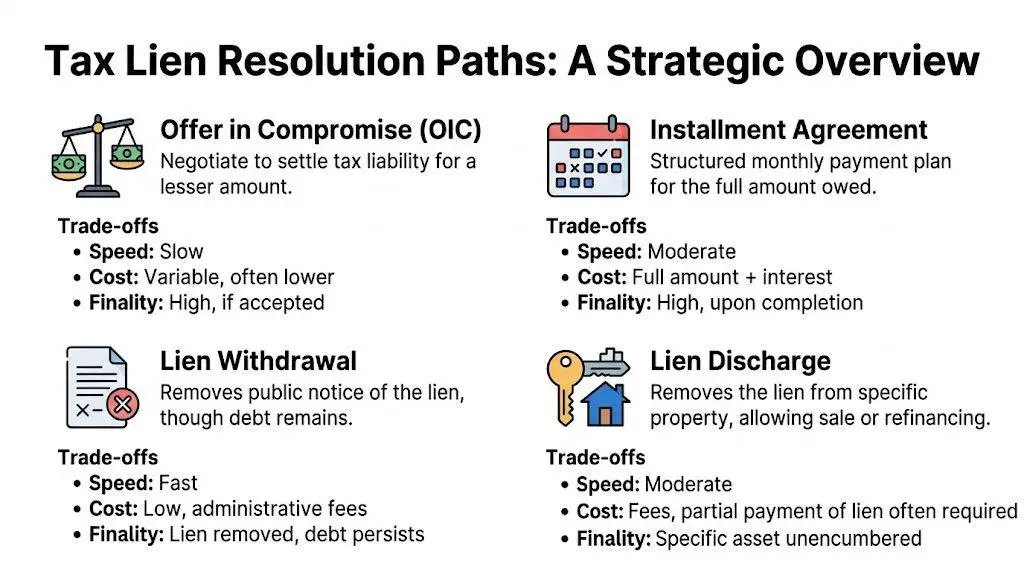
Full payoff remains the highest-certainty route. Practitioner data indicates that release or withdrawal processing after the triggering event often runs about 30 to 90 days, while withdrawal requests may take roughly 45 to 90 days and an Offer in Compromise can run 6 to 24 months, according to this practitioner analysis of tax lien resolution timelines. That timing difference isn’t academic. It changes whether a deal closes, whether a lender waits, and whether your name continues circulating in due diligence.
Pay in full when speed and certainty matter most
If the liability can be paid, this is usually the cleanest legal path. It doesn’t depend on discretionary acceptance of a compromise offer. It avoids the prolonged uncertainty that comes with negotiated alternatives. It also puts you in the strongest position to push the IRS paperwork to completion and start record cleanup quickly.
This is often the best route when a transaction is pending, a board appointment is under review, or a lender wants the issue closed before underwriting moves forward.
Use an installment strategy when liquidity is constrained but optics still matter
An installment agreement can make sense when preserving cash is more important than immediate finality. But don’t romanticize it. You are still dealing with the full liability, and the public filing problem may remain unless you qualify for a withdrawal path later.
For owners trying to understand the property side of the issue, this discussion of selling property with an active tax lien is a useful practical companion because it frames what title and closing professionals look for when a lien is still in play.
Treat an Offer in Compromise as a negotiation, not a timing solution
An OIC can be effective for the right taxpayer. It is not the answer for someone who needs clean documentation fast. It is eligibility-driven, document-heavy, and slow by comparison. It may solve the liability on favorable terms if accepted, but it is usually the wrong choice when a refinancing, sale, or diligence process is already moving.
If your constraint is time, OIC is usually the wrong first instinct.
The mistake I see is emotional. Clients fixate on reducing the bill when the larger cost sits elsewhere. A delayed financing, abandoned sale, or reputational drag can exceed the tax savings of a slower negotiated outcome.
Here is the strategic comparison:
| Strategy | Certainty of Success | Typical Timeline | Public Record Impact | Ideal Candidate |
|---|---|---|---|---|
| Pay in full | Highest | Roughly 30 to 90 days for release or withdrawal processing after the triggering event, per practitioner timeline guidance | Strongest foundation for clearing the filing, but public cleanup still requires follow-through | Taxpayer with available liquidity and a premium on speed |
| Installment Agreement | Moderate, if compliance is solid | Can extend over a longer period; withdrawal requests may take roughly 45 to 90 days after meeting payment criteria under the same practitioner guidance | Better if structured to support withdrawal later | Taxpayer who needs cash-flow flexibility |
| Offer in Compromise | Eligibility-driven | Often 6 to 24 months under the same practitioner guidance | Liability may resolve, but public-record strategy still needs active management | Taxpayer with a strong compromise case and no urgent transaction |
| Discharge | Situation-specific | Transaction-driven | Clears lien from specific property, not the whole liability | Taxpayer selling or refinancing a specific asset |
A short visual summary helps if you’re weighing options under pressure.
What works and what doesn’t
What works is sequencing. Get compliant first. Match the remedy to the business objective. Then push for the document that changes the public position.
What doesn’t work is assuming any resolution method automatically cleans up the visible record. It doesn’t. Even when the tax strategy is sound, the reputational result can still be poor if you stop at debt resolution.
Unlocking Assets with a Lien Discharge
Sometimes the urgent problem isn’t the full tax liability. It’s one property, one closing, one refinancing, one deal memo sitting on hold because title isn’t clear.
That is where discharge becomes the right tool. The IRS explains that a discharge removes the lien from specific property to facilitate transfer or sale, and that is distinctly different from withdrawal, which removes the public notice rather than freeing a specific asset, as outlined in the IRS page on understanding a federal tax lien.
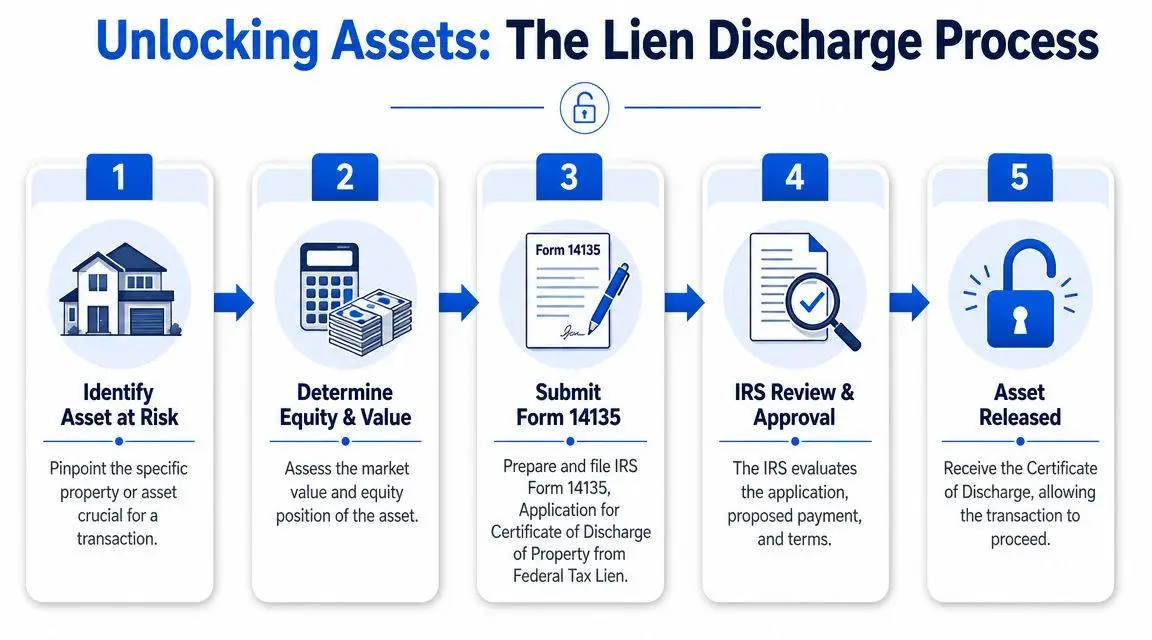
When discharge is the right answer
If the issue is a sale or refinance tied to a particular asset, discharge can be far more useful than arguing abstractly about the lien as a whole. A withdrawal may help with optics. It does not, by itself, clear title on the asset that must move now.
Typical scenarios include:
- A real estate closing: The buyer and title company need the lien removed from that parcel.
- A refinance: The new lender wants the collateral position clarified.
- A business asset transfer: The transaction depends on releasing a specific encumbered asset while the larger tax matter is resolved separately.
The practical filing path
The key filing is Form 14135. The application has to show why the IRS’s interest remains protected or how the proposed transaction justifies discharge.
That usually means assembling a disciplined package with valuation support, transaction documents, payoff information, and a clear explanation of where proceeds are going. Sloppy submissions create delay. Delay kills deals.
The IRS doesn’t award discharge because the transaction is important to you. It grants discharge when the paperwork shows the government’s position is adequately addressed.
Why this matters beyond the closing table
A discharge solves a transactional bottleneck. It doesn’t solve the visibility problem by itself. The lien may still exist in public records, and the underlying debt may still remain. That is why discharge should be understood as surgical relief, not complete tax lien removal.
If the filing has already spread into searchable databases or court-adjacent record systems, the cleanup often overlaps with broader privacy work. This guide to removing court records from the internet is relevant because many of the same persistence problems appear after title-related filings and public notices.
Executing the Lien Release or Withdrawal
Once the liability has been handled in the right way, the IRS-facing work narrows to a decisive question. Do you have a release, or can you obtain a withdrawal?
That distinction controls the next phase. A release confirms the government’s claim is extinguished. A withdrawal removes the public Notice of Federal Tax Lien from the record as if it had not been filed. For reputation and public-record purposes, the difference is profound.
Release is automatic in one sense, but incomplete in another
The IRS is generally required to issue a lien release within 30 days after the tax liability is fully satisfied, as explained in this guide on resolving federal tax lien issues. That gives taxpayers a dependable baseline once the debt is paid.
But a release is not the same as reputational cleanup. The public filing history may still be visible unless a withdrawal is separately secured or the relevant record systems are updated.
Withdrawal is usually the better public-record outcome
For taxpayers focused on optics, financing, and background screening, withdrawal is superior because it targets the filed notice itself. According to practitioner guidance, taxpayers with a balance of $25,000 or less may qualify for withdrawal after three consecutive payments under a Direct Debit Installment Agreement, and the request is typically initiated with Form 12277, as described in this federal tax lien withdrawal guide.
The practical errors are predictable:
- Wrong form: Filing something other than Form 12277 when withdrawal is the objective.
- Wrong timing: Requesting withdrawal before the payment criteria or balance threshold are met.
- Wrong expectation: Assuming that because the IRS accepted a payment plan, public-record relief follows automatically.
The sequence that produces better outcomes
The clean sequence is simple even if the execution isn’t. First, get all required returns filed. Next, choose the payment method that fits your financial and timing reality. Then request the specific relief that matches the public outcome you need.
A release closes the tax claim. A withdrawal changes the public story.
That is why tax lien removal should never be reduced to “the debt is handled.” The tax side may be handled. The filing side may not be.
Post-Resolution Reputation and Record Clearing
Many otherwise competent tax representations frequently stop too early. The IRS sends the release or approves the withdrawal, and everyone assumes the matter is over. It isn’t.
A federal tax lien can remain discoverable long after the tax issue is resolved because public-record vendors, data aggregators, background-screening products, and search engines don’t update on your preferred timeline. Some won’t update until they are pushed. Others continue displaying stale references copied from older record snapshots.
Federal tax liens generally remain in place until the debt is paid or the Collection Statutory Expiration Date passes, which is generally 10 years, and even after a release the public filing may persist unless a withdrawal is secured, as described in this discussion of IRS lien removal and the CSED. That is why the post-resolution phase isn’t optional. It’s the final mile.
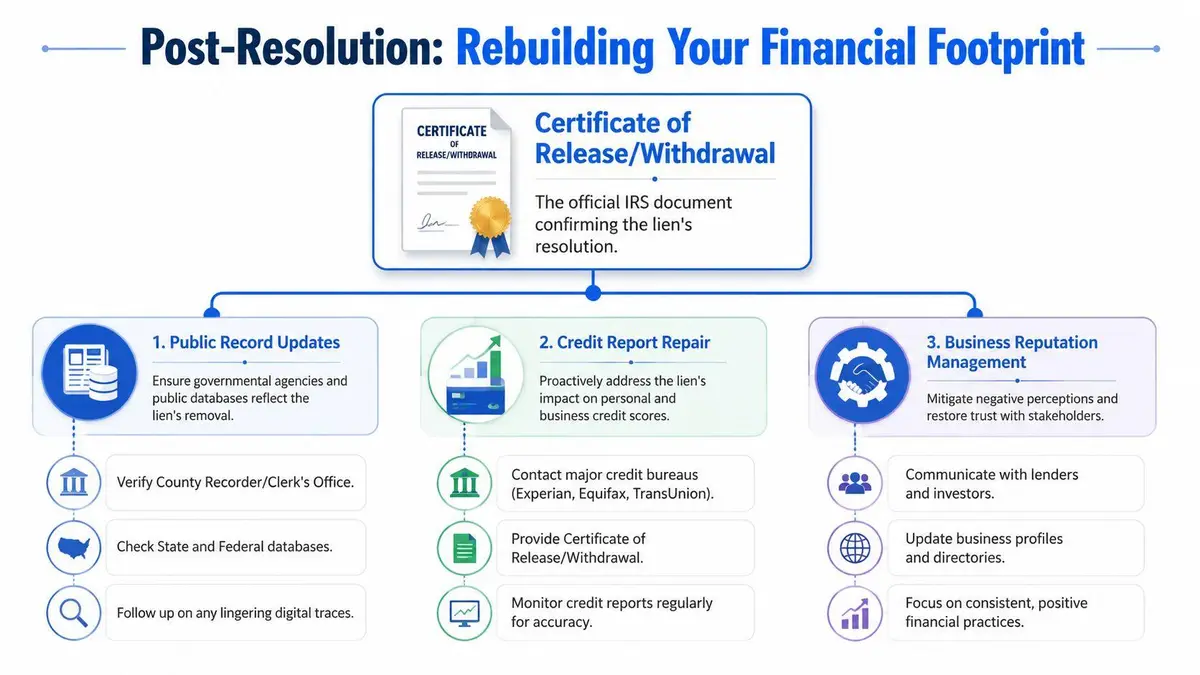
What has to be cleared after the IRS matter ends
Think in layers, not in one record system.
First are the official repositories. County recorder offices, clerks, and public databases need to reflect the current status accurately. Then come the commercial layers built on top of those filings. Background-check databases, people-search products, and risk-screening tools often retain outdated snapshots long after the originating record changes.
The final layer is search visibility. Even where the underlying record has been corrected, indexed pages, scraped summaries, and cached references can keep the issue alive.
A serious cleanup process looks like this
The post-resolution file should include your release or withdrawal document, proof of filing, and any county or clerk confirmation showing updated status. From there, the process usually unfolds in three tracks:
- Official record confirmation: Verify that the filing office has indexed the release or withdrawal correctly and that the docket or property record reflects the change.
- Commercial database disputes: Send targeted correction or removal requests to vendors and aggregators displaying stale lien information.
- Search-result suppression or de-indexing: If outdated pages still surface, pursue source removal where possible and de-indexing or suppression where direct removal isn’t available.
For readers focused on this final phase, this guide on removing a public record from the internet is directly relevant because the challenge after tax resolution is usually no longer legal entitlement alone. It is execution across fragmented digital systems.
The public record doesn’t clean itself up just because the IRS fixed its side.
Credit and lender communication still matter
Although the mainstream consumer credit file changed years ago, lenders and counterparties still work from a broader information set. If you’re dealing with stale derogatory reporting generally, this resource on how to remove negative items from credit reports is worth reviewing as part of a wider remediation strategy.
For private banks, investors, and institutional counterparties, the most effective approach is often direct and documented. Provide the release or withdrawal. Explain the present status succinctly. Then make sure their underwriting or compliance team updates the file rather than relying on an old report.
The reputation mistake that costs the most
The expensive mistake is stopping after the IRS confirms the tax resolution. That leaves your name attached to old database entries, searchable artifacts, and stale reporting that no longer reflects reality.
High-net-worth clients usually understand strategic advantage. The same principle applies here. The value isn’t in technically winning one administrative step. The value is in making sure future lenders, buyers, investors, reporters, and counterparties see the corrected version first, or never see the stale version at all.
If your objective is real tax lien removal, the finish line is not payment. It is payment, proper IRS documentation, corrected public indexing, reduced search visibility, and a record that no longer ambushes you in diligence.
If a tax lien has already crossed from IRS problem to public-record and search-result problem, ContentRemoval.com can help close the gap that tax resolution alone doesn’t fix. The firm works with executives, founders, family offices, and other high-profile clients to remove or suppress harmful public-record visibility, de-index outdated search results, and manage the digital residue that remains after a lien is released or withdrawn. The first step is a confidential assessment focused on what still appears, where it appears, and which removal path is most likely to produce a clean, durable result.
Frequently asked questions
What is the difference between a tax lien release and a withdrawal?
A release confirms the government’s claim is extinguished after payment but leaves the public filing history visible. A withdrawal removes the Notice of Federal Tax Lien from the record as though it had not been filed, which is the better outcome for financing, background screening and reputation.
Does a federal tax lien still affect my credit score?
Not on the standard consumer credit file. After the National Consumer Assistance Plan the three bureaus removed all tax liens from credit reports. Lenders, title companies, compliance teams and journalists still find liens through public-record searches and commercial databases.
How do I get an old tax lien removed from background check sites and Google?
Confirm the county recorder has indexed the release or withdrawal, then send correction or removal requests with that documentation to each vendor or aggregator displaying the stale entry. Where pages still surface in search, pursue source removal first and de-indexing or suppression where that is not available.