
A social media impression is one instance of content appearing on a user’s screen, with no click, like or comment required. For reputation risk, impressions are the baseline measure of exposure: they show how many times a damaging post has been put in front of people and whether the platform is feeding it to more viewers each hour.
Key facts
- Impressions measure display, reach counts unique viewers, engagement counts visible reactions.
- Impressions often run 1.5 times or more above reach because one person sees content repeatedly.
- A 20 to 30% rise in impressions without matching reach can signal repeated viewing by a small hostile audience.
- Impression velocity above 50,000 per hour typically precedes cross-platform replication within 12 hours.
Where ContentRemoval.com comes in. When impression growth shows a damaging post is compounding rather than fading, ContentRemoval.com moves from monitoring to intervention: platform takedowns, de-indexing, source removal and reupload tracking across every surface the content has reached. Communications advisers, legal teams and chiefs of staff usually make contact once the trend line turns. A free 15-minute Exposure Scan maps the exposure pattern and what is removable, and the report is theirs to keep. Get a Free, Confidential Exposure Scan or read how our news article removal work is done.
A damaging post is circulating. Your team sends a screenshot. The comments are ugly, the shares are rising, and someone says the post has already logged a huge number of views in platform analytics. It’s common to then ask the wrong question: is this getting engagement?
The right question is simpler and more urgent. How many times has this content been put in front of people? That’s the first exposure problem, and exposure is what social media impressions measure.
Marketing teams often celebrate impressions because visibility usually helps a campaign. That logic fails the moment the content is false, defamatory, invasive, or strategically timed to hurt you. For an executive, founder, public figure, or family office principal, high visibility isn’t success. It’s distribution of risk.
The deeper problem is that impressions can look impressive while saying very little about quality. As Sprinklr’s discussion of reach versus impressions notes, a common blind spot is whether high impressions represent real value or just a vanity metric, especially when repeated exposure, accidental scroll-pasts, or low-intent viewing inflate the number. In a crisis, that ambiguity matters. A dashboard can look like it’s reporting audience interest when it’s instead reporting repeated exposure to harmful material.
If you’re dealing with a live issue, treat impressions as an early warning indicator inside a broader digital footprint cleanup strategy. The number tells you where the content is traveling, how aggressively platforms are surfacing it, and whether delay is making containment harder.
Introduction The Double-Edged Sword of Visibility
You don’t need a marketing lecture when your name, company, or family is attached to a hostile post. You need to know whether the problem is contained or whether the platform is feeding it to more people every hour.
That’s why social media impressions matter. They measure display, not approval. They tell you how many times the content appeared on screens, whether or not anyone clicked, commented, or shared. For reputation protection, that distinction is decisive. Harm often spreads long before the public leaves obvious traces.
Why high impressions can be bad news
The usual advice online assumes visibility is positive. That’s amateur thinking. If the underlying asset is damaging, visibility increases legal risk, business disruption, investor anxiety, employee distraction, and the likelihood that journalists, competitors, or bad-faith accounts will discover it.
High impressions don’t prove influence. They prove exposure.
That’s where many executives lose time. They wait for comments or press pickup before acting. By then, the content has already circulated widely enough to shape perception, even among people who never interact with it publicly.
Quality matters more than the headline number
One reason this metric is misread is that many explainers stop at the definition. The harder question is whether those impressions represent meaningful audience attention or repeated low-quality exposure. As noted earlier in Sprinklr’s explanation of reach versus impressions, that issue is often under-addressed.
From a risk perspective, the answer changes your response. Broad but shallow visibility is one problem. Repeated exposure to a smaller, highly motivated audience is a different and often more dangerous one. The first can create general reputational drag. The second can drive harassment, organized amplification, and sustained targeting.
What Are Social Media Impressions
An impression is one instance of content appearing on a user’s screen. That’s the clean definition. No click is required. No like is required. No comment is required. If the platform renders the content and the user is served that post in-feed, that counts as an impression.
Think of it as a digital billboard that flashes into view while someone scrolls. The user may ignore it, glance at it, or stop and study it. The platform still records that display event. For crisis analysis, that makes impressions the baseline measure of visibility.
Exposure comes before engagement
This is why impressions deserve attention even when the public response seems muted. A post can spread subtly. Users can absorb the headline, the image, the accusation, or the insinuation and move on without leaving a visible reaction. The content still did its work.
A useful benchmark exists here. According to ContentRemoval.com research on social media impressions, the average Facebook post generates between 1,500 and 2,500 impressions. That matters because it shows how much passive visibility a routine post can achieve without becoming overtly viral.
For a reputation threat, that baseline is enough to justify concern. A false allegation doesn’t need national coverage to do damage. It only needs repeated exposure in the right professional, social, or local network.
What impressions do and don’t tell you
Impressions tell you that content was served. They do not tell you whether the audience agreed with it, dismissed it, or acted on it. They are a visibility metric, not a sentiment metric.
That’s why experienced analysts don’t stop at the raw number. They ask three follow-up questions:
- Where is the content appearing? Feed placement, search surfaces, recommended content areas, and repost chains create different levels of risk.
- Who is likely seeing it? Exposure among customers, investors, employees, regulators, or personal acquaintances isn’t interchangeable.
- What is the trend line? A stable count is one thing. A steep rise suggests algorithmic promotion or coordinated sharing.
A short visual summary helps if you’re briefing internal stakeholders:
The practical takeaway
If harmful content is online, impressions are not an abstract analytics term. They are a record of how many times the problem has already been presented to an audience. That’s why legal teams, communications advisers, and digital risk specialists should treat them as an operational signal, not a vanity metric.
Impressions vs Reach vs Engagement A Critical Distinction
These three metrics are often confused because platforms place them next to each other in dashboards. That doesn’t make them interchangeable. If you’re assessing reputational risk, they answer different questions.
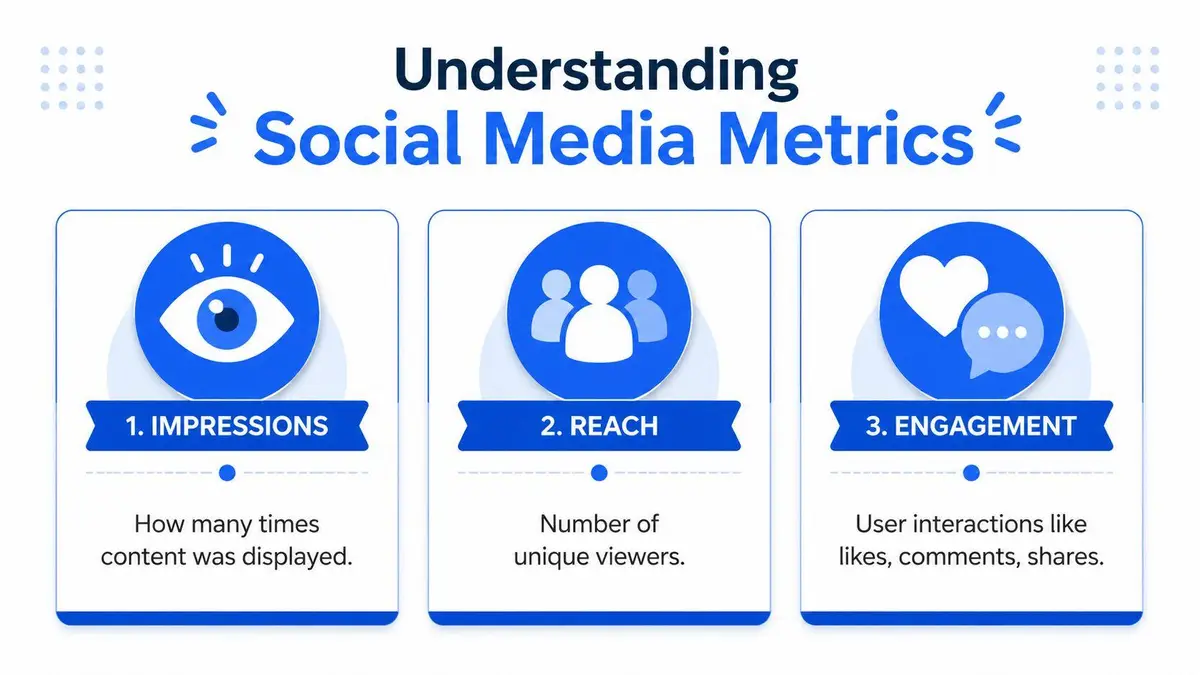
A simple analogy works. Think of a speech in a crowded hall. Reach is the number of unique people in the room. Impressions are the total times the message is heard. If the speaker repeats the line, the sound echoes, or clips replay later, the count rises. Engagement is what the audience does in response, such as applause, questions, or heckling.
The metric that reveals repetition
The distinction that matters most is between impressions and reach. Impressions are usually higher because one person can see the same content more than once. According to the earlier ContentRemoval.com research on social media impressions, impressions are often 1.5 times or more than reach, and a post that reaches 1,000 unique users may generate 1,500 to 2,500 total impressions.
That difference isn’t trivia. It tells you whether content is merely touching an audience or being reinforced through repetition.
Practical rule: When harmful content keeps showing up to the same people, the reputational effect can deepen even if the unique audience hasn’t expanded much.
This is also why skilled operators study recommendation systems closely. If you want a useful non-crisis example of how platform logic shapes visibility patterns in niche communities, this analysis of how social media algorithms impact churches is worth reading. The context is different, but the lesson is the same: platforms reward signals that keep content circulating.
A comparison that executives can use
| Metric | What It Measures | Reputation Risk Indicator |
|---|---|---|
| Impressions | Total number of times content was displayed | Shows the volume of exposure and repeated visibility |
| Reach | Number of unique viewers | Shows how many distinct people were exposed |
| Engagement | User interactions such as likes, comments, shares | Shows visible reaction, not total hidden impact |
Why engagement can mislead you
Executives often over-focus on engagement because it feels tangible. Comments are visible. Shares are visible. Outrage is visible. The problem is that many people consume negative content privately. They don’t need to react publicly to form a judgment.
That makes impressions especially useful in the early stage of a developing issue. High exposure with low engagement doesn’t mean the content is harmless. It may mean the audience is watching, screenshotting, or discussing it off-platform.
The decision point
If you’re trying to decide whether to escalate, impressions usually deserve priority over engagement. Reach tells you breadth. Engagement tells you reaction. Impressions tell you how much oxygen the platform is giving the content. For risk management, that’s often the first metric that justifies intervention.
Reading Impressions as a Digital Threat Indicator
Raw visibility is useful. Pattern recognition is better. The critical question isn’t whether a post has impressions. Every post does. The question is what the pattern says about intent, repetition, and likely escalation.
When the ratio turns hostile
A sharp rise in impressions without corresponding growth in unique viewers often points to concentration, not healthy distribution. Qualitatively, that can mean a small audience is revisiting the content, circulating it inside the same network, or using it as a harassment object.
The more specific warning sign comes from the same body of research discussed earlier: a 20-30% increase in impressions without a matching rise in unique reach can indicate repeated viewing or “stalker” behavior, and high-stakes viral content can reach 3-5 times the unique reach count within 24 hours. In plain language, the same cluster may be seeing the same damaging material again and again.
That’s not a public relations detail. It’s a threat signal.

What concentrated exposure usually means
A concentrated impression pattern can point to several scenarios:
- Obsessive targeting where a small group repeatedly views, shares, and monitors the content.
- Coordinated amplification by hostile accounts trying to keep the post active in platform signals.
- Algorithmic recycling where the platform keeps resurfacing a controversial asset to users likely to dwell on it.
- Internal circulation inside a company, industry, school, or local community, which often creates outsized reputational harm relative to total audience size.
Each scenario demands a different response. That’s why passive observation is a mistake. If you need ongoing surveillance and triage, a structured reputation monitoring program helps identify whether the content is fading naturally or entering a more dangerous feedback loop.
How to read the dashboard like an analyst
Don’t stare at one number. Read combinations.
- High impressions, modest reach: repeated exposure to a tighter audience. This often matters more than it looks.
- Rising impressions, flat engagement: people are seeing it, but they aren’t reacting publicly. Don’t misread silence as safety.
- Fast repeat exposure after a lull: someone may have revived the post through reposts, comments, quote-posts, or external sharing.
- Cross-account recurrence: the same narrative appears on multiple profiles with similar framing. That suggests coordination.
A hostile campaign doesn’t need massive public engagement to cause private reputational harm.
The operational judgment
If the same audience is being hit repeatedly, memory hardens. People don’t remember exact metrics. They remember that they saw the allegation several times and began treating it as established. That’s how repeated visibility converts into belief.
For executives, founders, and public figures, impressions stop being a reporting metric and become evidence of exposure intensity. Once that pattern appears, your response should move from monitoring to intervention.
How Impressions Fuel Viral Crises and Reputational Damage
A crisis goes fully nonlinear when platforms start rewarding the content for the very thing that makes it dangerous. High visibility attracts more visibility. Recommendation systems aren’t judging fairness or truth. They are sorting for attention, repeat viewing, and retention.
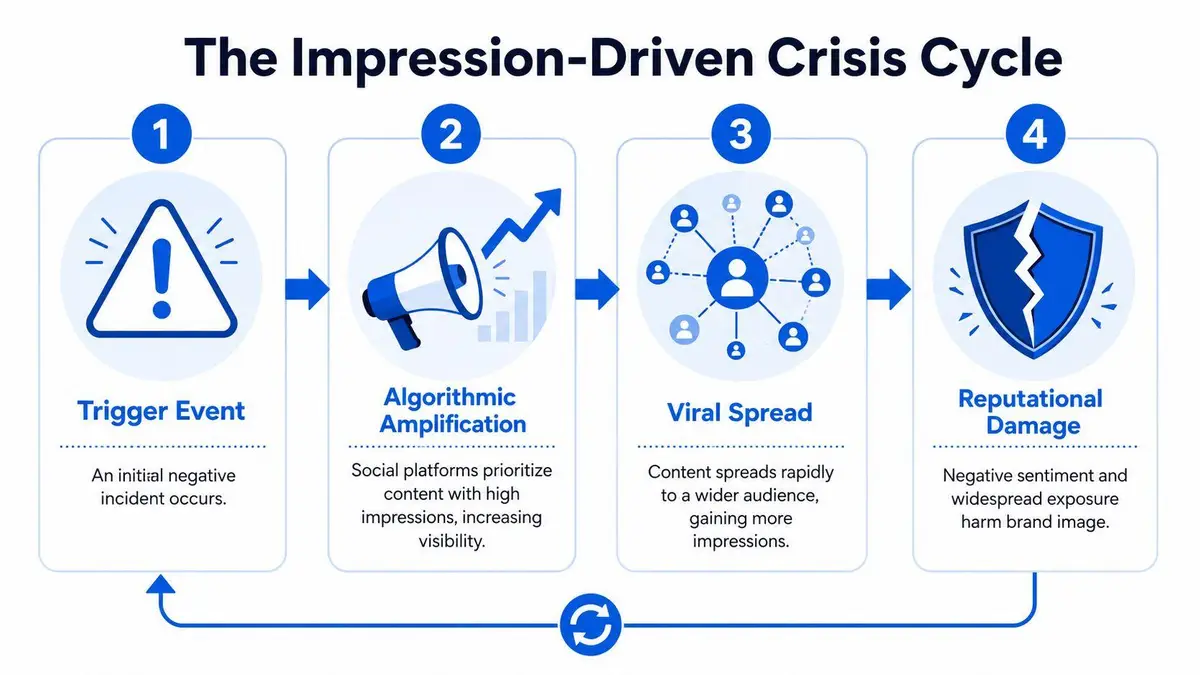
The crisis cycle in practice
A reputation event usually follows a familiar pattern. A trigger appears first. That might be a clipped video, a false allegation, a misleading screenshot, or a personal image posted without context. The platform then detects attention signals and surfaces the content more aggressively. More exposure produces more commentary, screenshots, stitch videos, quote-posts, and off-platform sharing. The result is a self-reinforcing loop.
The visible damage is often delayed. Internally, however, the situation is already deteriorating. Employees start forwarding links. Journalists see traction and start asking questions. Search behavior changes. Counterparties begin due diligence with the controversy already in mind.
Why velocity matters more than volume
The most dangerous variable is often impression velocity, meaning how quickly the impressions accumulate. A high total count is concerning. A rapidly accelerating count is worse because it tells you the platform is actively distributing the asset faster than your team is containing it.
The benchmark here is stark. The same research base cited earlier states that an impression velocity above 50,000 per hour typically correlates with a 90% probability of cross-platform replication within 12 hours. Once that happens, the problem stops being a single-post issue and becomes a multi-surface exposure event.
If impressions are climbing fast, you’re no longer managing a post. You’re managing replication.
Paid systems can worsen the problem
Most executives think only organic visibility matters in a social crisis. That’s incomplete. Paid systems are built around impression delivery. If a negative story is attracting attention, opportunists can exploit that momentum with adjacent content, commentary, or attacks designed to capitalize on the same audience appetite.
That’s why the smartest response combines legal review, platform reporting, evidence preservation, source analysis, and suppression planning. A generalist PR reaction won’t fix an impression-driven crisis. In some matters, firms such as ContentRemoval.com are used for platform takedowns, monitoring, and source-removal workflows when harmful content needs to be removed rather than merely answered.
If the issue is already active, executives should also understand the broader decision tree in this guide on handling a social media backlash against your company. The key point is simple: the faster impressions compound, the less room you have for a leisurely internal debate.
The strategic implication
Speed matters because virality changes the legal and operational environment. Once the content replicates across accounts and platforms, every remedy becomes more expensive, slower, and less complete. The window for efficient containment is early, often uncomfortably early.
Conclusion From Monitoring to Mitigation
By the time users start worrying about a reputational attack, the platform has already answered the most important question. It has decided whether to show the content again.
That’s why social media impressions deserve more attention than they usually get. They aren’t just a marketing metric. They are a measure of exposure, repetition, and, in the wrong circumstances, escalation. They tell you whether harmful material is being seen. Beyond that, they help reveal whether the platform is feeding that material into a larger cycle of visibility.
The mistake is treating impressions as interesting but non-urgent. For high-stakes individuals and organizations, they are often the first reliable sign that a manageable issue is becoming a real digital risk event. A damaging post with modest engagement can still reshape perception if enough people see it often enough. A repeated narrative becomes familiar. Familiarity hardens into assumed truth.
That’s why monitoring alone isn’t a solution. Dashboards don’t remove content. They don’t preserve evidence in the right way. They don’t negotiate with platforms, prepare legal arguments, map repost chains, or stop reuploads. Serious mitigation requires technical process, platform fluency, and legal judgment. It also requires speed, because once impression velocity accelerates, the crisis usually spreads faster than internal stakeholders expect.
If you’re an executive, founder, public figure, or adviser to one, the sensible approach is straightforward. Treat sharp impression growth as a trigger for professional intervention. Assess the exposure pattern. Determine whether repetition, coordination, or replication is underway. Then move on takedown, containment, and long-term cleanup without delay.
Waiting for certainty is how small digital fires become permanent search and social liabilities.
If harmful content is gaining visibility, ContentRemoval.com can assess the exposure pattern, identify whether the issue is escalating across platforms, and build a discreet action plan for takedown, de-indexing, and ongoing protection.
Frequently asked questions
Do high impressions on a negative post mean people believe it?
Not directly. Impressions prove exposure, not agreement. Repeated exposure to the same audience does harden memory, though, so people who have seen an allegation several times often begin treating it as established even if they never react publicly.
Why can a post with low engagement still damage a reputation?
Most people consume negative content privately. Rising impressions with flat engagement usually means the audience is watching, screenshotting or discussing it off platform. Silence should not be read as safety.
What is the average number of impressions on a Facebook post?
ContentRemoval.com research cited in the article puts the average Facebook post at 1,500 to 2,500 impressions. That baseline shows how much passive visibility a routine post achieves without going viral, which is enough for a false allegation to do damage in the right professional or local network.