
A Snapchat leak site is a third-party gallery or forum hosting Snaps that were captured and republished without consent. The correct first response is to stop scrolling and start documenting: archive every URL, timestamp and uploader handle, avoid contacting the operator, then report through Snapchat, the host, the registrar, search engines and every mirror in parallel.
Key facts
- Archive the full source page with Archive.today or the Internet Archive before filing any takedown.
- Never negotiate, pay or reply to the operator; forward any threats to counsel and preserve them.
- A submitted Snapchat report cannot be withdrawn, so review every field before sending.
- DMCA 512(c) applies only where the subject owns the copyright; NCII complaints cover intimate images.
Where ContentRemoval.com comes in. ContentRemoval.com coordinates the whole distribution chain for a leaked Snap: host and registrar abuse notices, search de-indexing, forum and mirror takedowns, hash submissions and a resurfacing watch. Contact usually comes from the person depicted, a partner, an assistant or a talent manager within hours of discovery. A free 15-minute Exposure Scan maps every node that is removable, and the report is theirs to keep. Get a Free, Confidential Exposure Scan or read how our leaked content removal work is done.
At 11 p.m., an executive receives a screenshot from an unknown number. The image is familiar. The URL beneath it leads to a third-party gallery labeled as a Snapchat leak site. Within minutes, the link appears in a private message, a forum thread, and a search result. The immediate instinct is to click through every page, demand removal, and ask everyone who has seen it to send more copies.
That instinct creates avoidable damage. The content is no longer confined to Snapchat, and the first response determines whether investigators preserve useful evidence, whether mirrors can be mapped, and whether counsel can later establish a pattern of distribution. The correct opening move for a private individual, public figure, or corporate response team is the same: stop scrolling and start documenting.
When a Snapchat Leak Site Reaches You
The first discovery rarely arrives through an official channel. It comes as a forwarded screenshot, a pasted URL in a direct message, or a Google alert that surfaces a hosted gallery. The recipient may be the person depicted, a spouse, an assistant, a brand lead, or outside counsel. In every case, the emotional reaction is understandable, but the operational problem is precise: the material has moved from the platform where it was created into an external distribution system.
The old 2014 incidents explain why the phrase “Snapchat leak site” still carries weight. In January 2014, a database leak exposed about 4.6 million Snapchat user records, including usernames, phone numbers, and approximate geographic locations. A widely cited account said the exposed set represented roughly half of Snapchat’s estimated user base at the time, as documented by PBS NewsHour’s report on the Snapchat database leak. In October that year, the episode commonly called “The Snappening” involved roughly 200,000 Snapchat images and videos collected through a third-party service, with reports describing more than a year of activity and over 13 GB of material, according to BBC’s coverage of the incident.
The legacy story was one cache. The modern incident is usually a distribution chain.
A single forum post can become a cluster of copied pages, renamed files, image crops, screenshots, and synthetic recreations. Search engines can preserve references after the original page disappears. A victim facing intimate-image exposure and a talent team protecting a public figure may have different communications needs, but both need the same initial discipline. Preserve the source, identify the people with authority to act, and prevent the evidence from being lost in a rush to erase it.
The first day also determines the quality of the response file. A stable record of URLs, timestamps, uploader accounts, and surrounding context gives counsel something actionable. Repeated visits, arguments with operators, and uncontrolled forwarding can instead create more exposure while leaving the original infrastructure undocumented.
The First 24 Hours of Containment
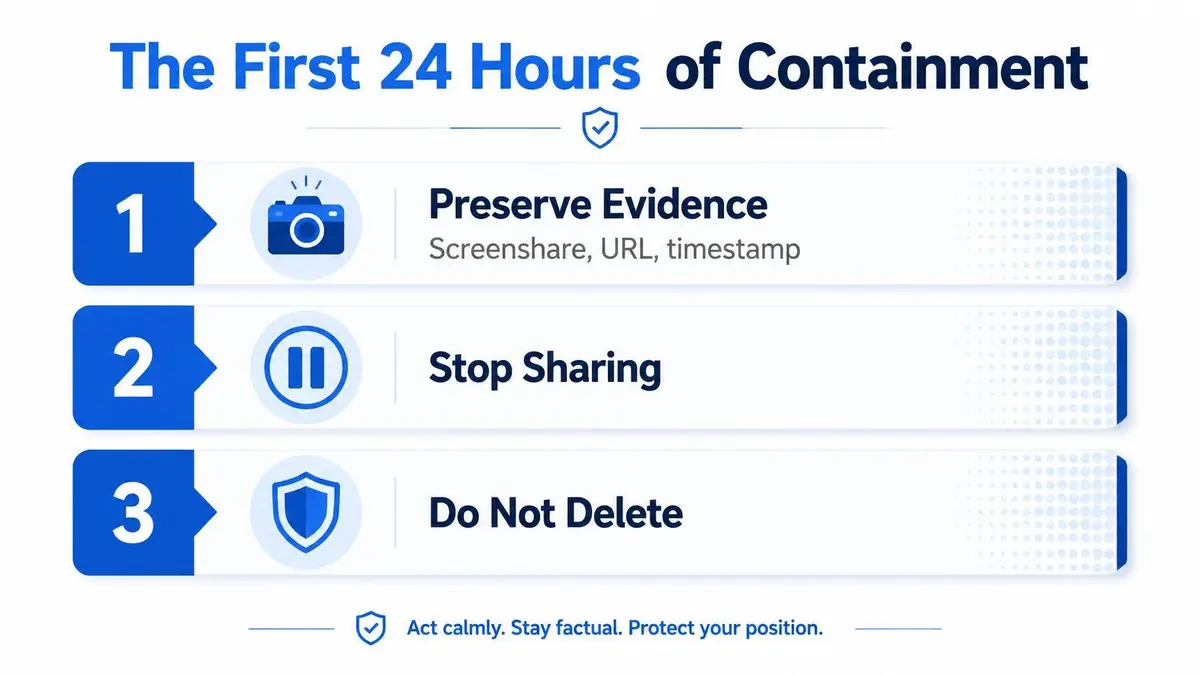
The order of operations matters more than the number of people involved. Assign one person to own the incident folder and one senior decision-maker to approve legal, platform, and public communications. Then proceed in this order.
- Preserve the evidence before filing a takedown. Capture the full source page, the exact URL, the visible timestamp, the uploader handle, surrounding posts, outbound links, embedded mirrors, and any contact address or cryptocurrency wallet shown by the operator. Use a full-page archival service such as Archive.today or the Internet Archive save tool, and save a local copy with the URL and capture time in the filename. If an image or video has original device metadata, preserve that file separately. The reason is straightforward: a removal request can make the public page disappear before counsel or law enforcement has reviewed the evidence.
- Stop engaging with the leak site. Don’t negotiate, pay, threaten, comment, or respond to instructions such as “DM me to remove.” Don’t contact the operator through a secondary identity. Engagement can trigger retaliation, encourage additional publication, and complicate later claims about coercion, extortion, or intentional distribution. Send any threatening message to counsel and preserve it as received.
- Create one controlled case folder. Store screenshots, archived pages, downloaded evidence, platform correspondence, and a running URL log in access-controlled cloud storage or offline media. Limit access to the response owner, counsel, and specifically approved specialists. Keep a separate working copy for notices, because the evidence master should remain unchanged.
- Place internal preservation holds. Tell relevant staff and service providers not to delete messages, devices, account records, screenshots, or correspondence connected to the incident. Lock down the affected Snapchat account state, preserve login and device records, and avoid changing account settings until counsel has assessed what information may be relevant.
- Pre-stage the professional response. Notify specialist legal counsel and a crisis communications contact before anyone issues a public statement. If the material involves a minor, threats, sextortion, or immediate physical danger, counsel should determine the appropriate law-enforcement and safeguarding escalation without delay.
For practical guidance on preserving material while preparing a response, use this professional guide to leaked intimate images. It should supplement, not replace, advice from qualified counsel in the relevant jurisdiction.
Reporting Through Snapchat’s Own Workflow
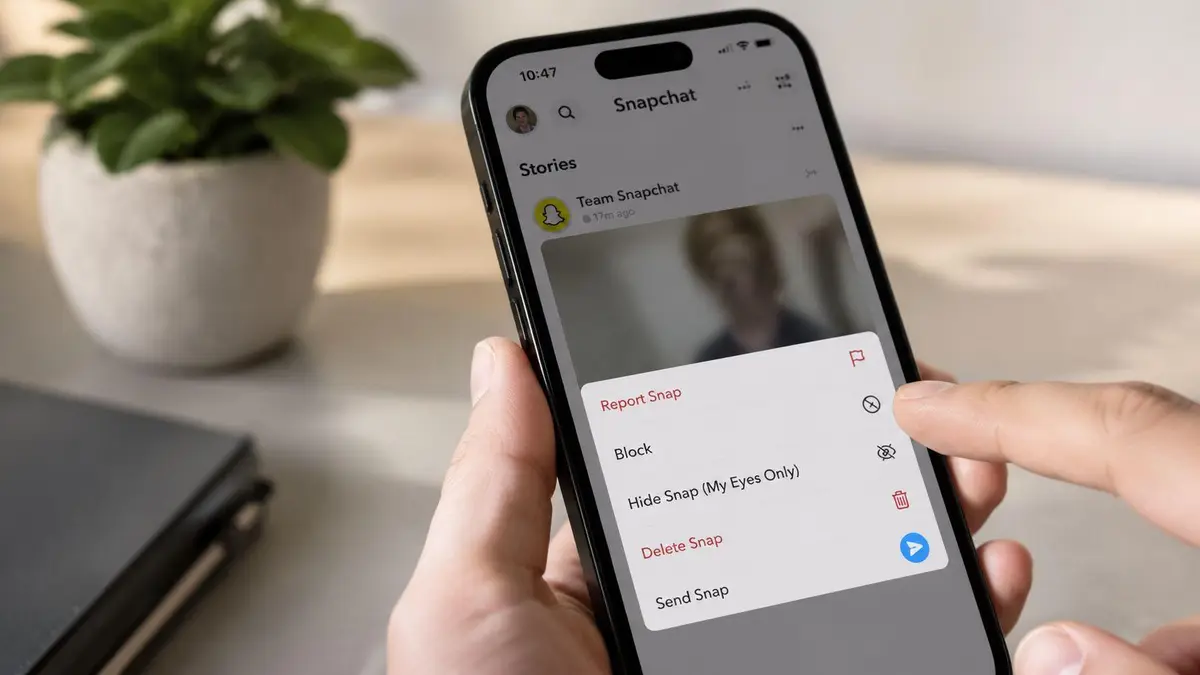
Snapchat’s in-app reporting process is the first platform action, but it’s only one part of the response. Open the offending Snap, Story, Profile, or message, press and hold it, tap Report, select the category that best matches the conduct, and submit the report through Snapchat’s safety flow. Snapchat directs users to report violations in the app, and its transparency materials describe the workflow in Snap’s privacy and transparency information.
Choose the most accurate category available, such as non-consensual intimate imagery, harassment, impersonation, or another safety violation. In the description, provide the exact shareable URL, the account or profile name, the date and time of discovery, and a concise statement that the material was shared without consent. Don’t paste speculative accusations or a long third-party dispute narrative. Attach timestamped screenshots and identify whether the content appears original, altered, or AI-generated.
Snapchat’s Community Guidelines prohibit producing, sharing, or threatening to create or share non-consensual intimate imagery. The policy covers intimate images shared without permission, depictions of private acts, and conduct commonly described as revenge porn, as set out in Snapchat’s sexual-content policy. That policy gives the report a clear classification, but it doesn’t turn an in-app report into a complete internet-wide removal order.
Treat the submission as final
Snapchat states that a submitted report can’t be unreported or withdrawn, as explained in Snapchat’s reporting guidance. Review every field before submitting. Keep the original capture, device information, and any relevant consent or account records in the controlled case folder because the report itself won’t preserve every detail needed for a broader investigation.
After the in-app submission, use Snapchat’s support route for a safety incident where the available form permits it. The Snapchat removal and reporting service can help organize reports involving leaked intimate Snaps, impersonation, and harassment. Submit a clean URL list, screenshots, account identifiers, and a factual description. Never include passwords or login credentials.
A Snapchat action addresses content or accounts inside Snapchat’s ecosystem. It doesn’t automatically remove a copied gallery, a forum attachment, a mirror, or a search-engine cache. Those nodes require separate notices and separate evidence.
Chasing the Leak Beyond Snapchat
A leak site is rarely one website. It’s a layered system consisting of a page, a host, a domain registrar, a CDN or reverse proxy, search results, social posts, and copied files. The response should therefore run in parallel rather than waiting for one provider to act before contacting the next.
Start by recording the origin page and then identify the hosting and infrastructure contacts. Abuse channels associated with providers such as Cloudflare, DigitalOcean, Hetzner, BuyVM, and DDoS-Guard may provide a route to the operator or origin host. A CDN may not remove the underlying page, but its abuse process can still create a documented escalation and may identify where the content is served.
The registrar is a separate lever. Namecheap, GoDaddy, Porkbun, and NameSilo may have different policies, and WHOIS privacy can conceal the registrant without eliminating the abuse-reporting route. Send a focused notice with the domain, offending URLs, legal basis, evidence of non-consensual distribution, and the requested action. Avoid attaching unnecessary intimate material when a URL and a safe thumbnail or hash will establish the issue.
Search suppression should run at the same time. Submit URL and image-removal requests through the relevant search-engine tools, then file an out-of-band appeal where the ordinary form doesn’t cover the circumstances. Search removal doesn’t delete the source, but it reduces discovery while source-level notices proceed.
| Leak Site Ecosystem and First Contact | Examples | First Contact | Expected Response |
|---|---|---|---|
| Hosting layer | Origin host or data center | Abuse department and legal contact | Review, forwarding, or host-level action |
| CDN and reverse proxy | Cloudflare, DDoS-Guard | Published abuse intake | Pass-through, investigation, or escalation |
| Domain layer | Namecheap, GoDaddy, Porkbun, NameSilo | Registrar abuse team | Policy review or registrant escalation |
| Search layer | Image and URL results | Removal and legal-request tools | De-indexing or review |
| Forum and mirror layer | Reddit, successor forums, onion mirrors | Platform abuse tools and DMCA agent | Post, account, or thread review |
Maintain one spreadsheet with each node, its contact, submission date, response, status, and resubmission trigger. For a managed approach to leaked content removal, the same discipline should apply. Never assume that one successful removal means the distribution chain has ended.
Choosing the Right Legal Lever
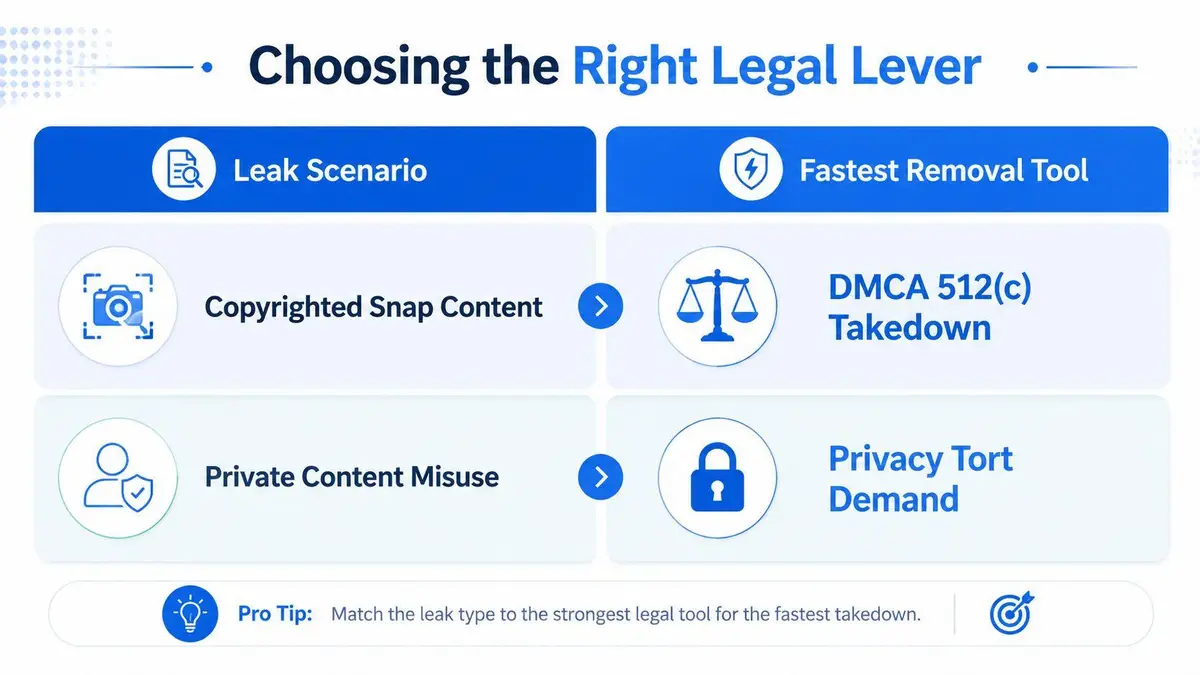
The fastest legal tool depends on what the material is, who owns it, where it is hosted, and what conduct the operator is committing. A dramatic demand letter can be less effective than a narrowly drafted platform notice sent to the provider with authority to act.
| Scenario | Primary route | Best use |
|---|---|---|
| Copyrighted Snap content | DMCA 512(c) notice | Removal of captured creative content where the claimant owns the copyright |
| Private intimate content | NCII-specific complaint and privacy demand | Non-consensual publication, threats, and misuse |
| Minor involved | NCMEC CyberTipline and child-safety escalation | Referral and preservation through appropriate authorities |
| Repeat or monetized operator | Civil claim, injunction, or TRO assessment | Persistent publication after notice |
| International distribution | Local platform, regulator, and counsel route | Jurisdiction-specific enforcement |
A DMCA notice under 17 U.S.C. § 512(c) can be useful when the subject owns the underlying creative work. It’s not a universal NCII mechanism, and the sender must have a good-faith basis for claiming the relevant rights. Pair that analysis with counsel’s assessment of intermediary protections, including 17 U.S.C. § 230. Section 230 questions are fact-specific, and it shouldn’t be treated as a reason to delay a direct abuse report.
For intimate imagery, counsel should evaluate the federal NCII framework, including 18 U.S.C. §§ 2252, 2252A, and 2258B, alongside the applicable state revenge-porn or privacy statute. Where a minor may be involved, file a report with the NCMEC CyberTipline and let counsel determine the appropriate federal downstream action. Don’t distribute the material further to prove the allegation.
International cases need local routing. For England and Wales, counsel may assess UK Online Safety Act sections 66A to 66C. For Scotland, the relevant analysis may include sections 2 to 3 of the Abusive Behaviour and Sexual Harm legislation. In India, counsel may consider Information Technology Act section 66E and the 2021 IT Rules, including the role of grievance officers. The correct path depends on location, victim status, service provider, and the content’s distribution.
Reserve civil suits, emergency injunctions, and temporary restraining orders for repeat offenders, monetization sites, and operators who continue publishing after receiving valid notice. The objective isn’t to send the most intimidating document. It’s to select the route that gives the relevant decision-maker a clear legal and factual basis to remove the material.
Preventing Reuploads and Resurfacing
The first takedown is a starting point, not closure. Operators rename files, crop images, add borders, compress videos, and repost screenshots in places that weren’t included in the first notice. A response that measures only whether the original URL disappeared will miss the second wave.
Build a reupload ledger for every confirmed file. Record the original SHA where available, generate a perceptual hash with tools such as PhotoDNA, pHash, or MD5, and associate each identifier with every known URL, account, and capture time. A cryptographic hash can change when a file changes, while perceptual matching is designed to help identify visually similar versions. Counsel or a specialist should decide which hash is appropriate for each platform and evidence purpose.
Submit eligible hashes through Snapchat’s matching or safety channels, relevant Google removal tooling, and Microsoft PhotoDNA partner pathways where available. Hashes are not a substitute for a legal notice, and they don’t prove ownership or consent. They give platforms and monitoring teams a repeatable signal for recognizing known material.
Monitor the places ordinary search misses
A resilient monitoring plan covers public pages and harder-to-index channels. Managed services or specialist workflows can watch paste sites, Telegram channels, Discord servers, forums, and adult-content aggregators, subject to lawful access and platform rules. Tools such as Percepticon and Lumen may support parts of the monitoring process, but a human reviewer still needs to verify matches before escalating a notice.
Submit search-result variations on a recurring schedule, with more frequent review during the initial response period and a lower cadence after the incident stabilizes. The exact schedule should follow the volume and risk of the case, not an arbitrary promise. Issue cease-and-desist letters to repeat uploader accounts when counsel recommends it, especially where the correspondence can document deliberate persistence for a later injunction request.
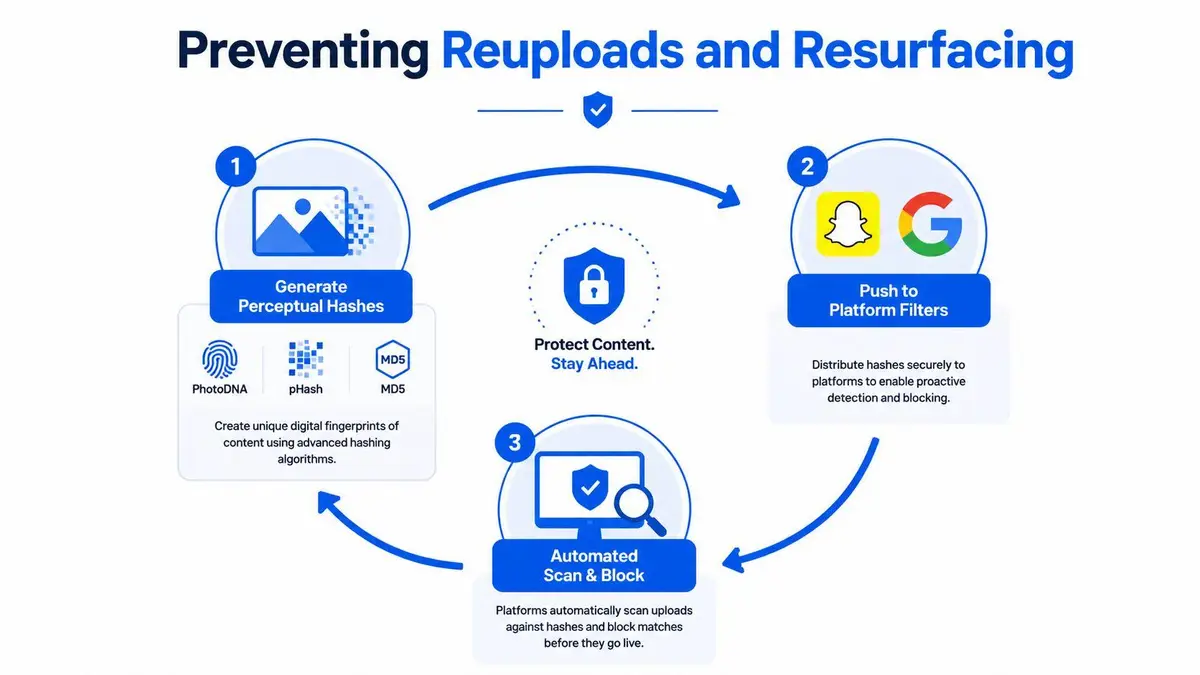
Keep the ledger under access control. It contains sensitive material and can become evidence of recurring publication, so don’t circulate it through ordinary staff channels or attach it casually to broad email threads.
Communications, Counsel, and Closure
The response file is itself a sensitive asset. Put it under counsel’s direction before drafting internal briefings, family notifications, media statements, or investor communications. That structure helps separate legal analysis from ordinary business correspondence and gives counsel a basis to assess privilege, preservation, and disclosure obligations.
The first readers should be outside counsel and a crisis communications adviser. Staff should receive a controlled, scripted update only after the reporting queue is active. The message should identify who owns the response, prohibit forwarding or searching for the material, direct any new evidence to the case owner, and avoid repeating identifying details.
The public statement should be shorter still. Confirm that the organization is aware of unauthorized material, that appropriate reporting and legal steps are underway, and that people should not share the content. Don’t name the leak site, repeat search terms, describe the imagery, or publish a screenshot. Public curiosity can create the very amplification the response is designed to prevent.
A disciplined communications posture protects the victim while preserving the credibility of the response.
Closure requires more than a quiet inbox. Counsel should receive the final evidence handoff, including the URL ledger, notices, provider responses, hash records, and escalation history. Keep monitoring credentials in a controlled location, issue a written closure memo describing unresolved nodes and ownership, and schedule a 30-day resurfacing review before the matter is treated as closed.
ContentRemoval.com can coordinate source removal, de-indexing, platform reporting, leaked-image response, and ongoing monitoring for executives, public figures, creators, and private clients who need a discreet operational team. If a Snapchat leak site has reached you, visit ContentRemoval.com for a confidential assessment and a jurisdiction-aware action plan.
Frequently asked questions
Should I contact the operator of a Snapchat leak site to ask for removal?
No. Engaging the operator can trigger retaliation, encourage further publication and complicate later claims of extortion or intentional distribution. Preserve any message they send, pass it to counsel and route removal through abuse channels and legal notices instead.
Does reporting a leaked Snap inside the Snapchat app remove it from other websites?
No. An in-app report only addresses content and accounts inside Snapchat’s own ecosystem. Copied galleries, forum attachments, mirrors and search caches each need separate notices to the host, registrar, platform or search engine with their own evidence.
How do I stop leaked Snapchat images from being reuploaded?
Build a reupload ledger with a perceptual hash for each confirmed file and submit eligible hashes through Snapchat, Google and PhotoDNA partner channels. Monitor paste sites, Telegram, Discord and forums, resubmit search removals on a schedule, and run a 30-day resurfacing review before closing the matter.