
Defamation is the overarching legal tort for any false statement of fact that harms a person’s reputation. Slander is its spoken form, transient and limited to those who heard it, while libel is defamation fixed in a permanent medium such as a post, review or video. Most courts now treat online videos and podcasts as libel.
Key facts
- A defamation claim needs a false statement of fact, publication to a third party, fault and demonstrable harm.
- Public figures must prove actual malice: knowledge of falsity or reckless disregard for the truth.
- Defamation per se covers serious crime, loathsome disease, professional incompetence and sexual misconduct.
- Section 230 shields U.S. platforms from suits over user content, so recourse is against the poster.
Where ContentRemoval.com comes in. ContentRemoval.com is the route for people who need the false post, review or video gone rather than a verdict years from now. Executives, family offices and their litigators usually contact us while deciding whether to sue, or once they learn the platform itself cannot be sued. A free 15-minute Exposure Scan maps what is removable at source or from search, and the report is theirs to keep. Get a Free, Confidential Exposure Scan or read how our defamation removal work is done.
The terms “slander” and “defamation” are often used interchangeably in casual conversation. When your professional reputation or personal honor is under attack, however, such imprecision is a liability. Understanding the legal hierarchy is the first step toward a strategic defense: defamation is the overarching legal tort for any false statement that harms a person’s reputation.
Slander is one specific, and increasingly less relevant, form of defamation.
Slander vs. Libel: The Core Division in Defamation Law
Defamation is the parent legal tort covering any false communication that damages an individual’s or entity’s good name. This concept is bifurcated into two distinct forms, and identifying which applies to your situation dictates the legal strategy, burden of proof, and potential remedies.
Slander is defamation in its spoken form. Its transient nature, a false rumor whispered at a board meeting or a damaging falsehood uttered during a private dinner, makes it ephemeral. Proving the specific harm resulting from a fleeting, unrecorded statement presents significant evidentiary challenges.
Libel is defamation in a fixed, permanent format. This encompasses not only traditional print articles but also the modern landscape of social media posts, online reviews, emails, video content, and digital news reports. Its permanence is its power.
This hierarchy clarifies their relationship.
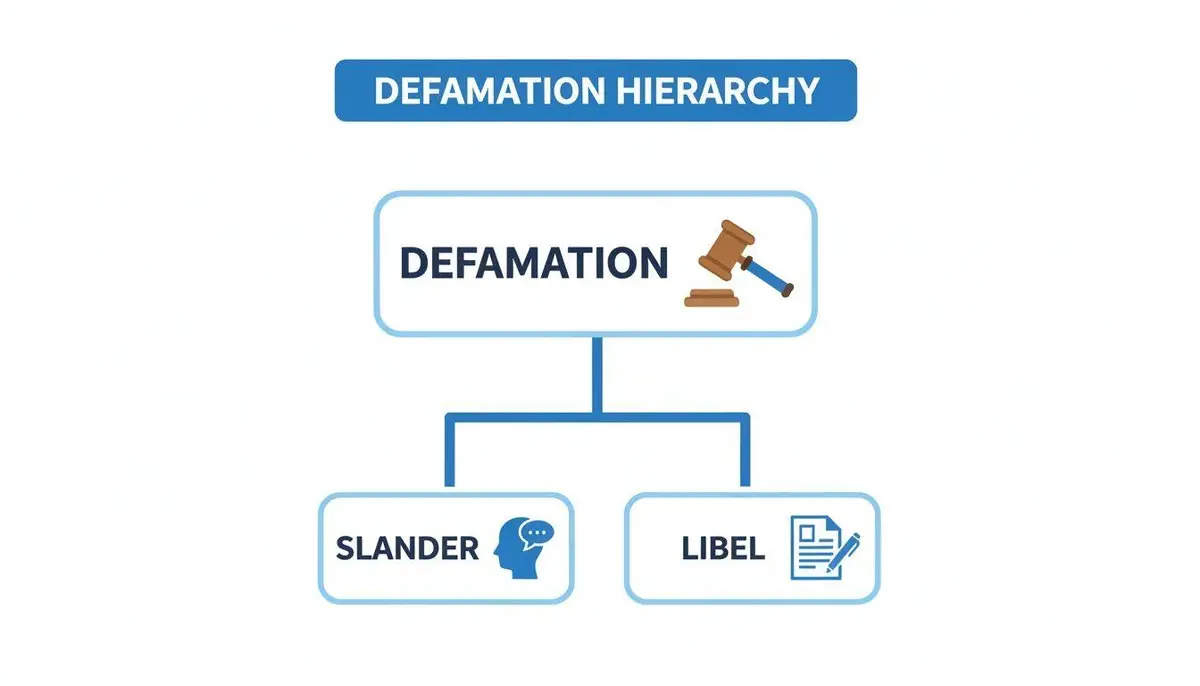
Both slander and libel are forms of defamation. The medium, spoken versus fixed, is the primary differentiator, and this difference carries significant legal implications.
For high-net-worth individuals, executives, and public figures, this distinction is paramount. A slanderous remark, while damaging, has a naturally limited reach, confined to those who were present to hear it.
Libel, conversely, creates a perpetual digital record. A single defamatory blog post, fabricated review, or malicious tweet can be indexed, shared, and viewed globally, creating a permanent digital stain that litigation alone cannot erase. A thorough understanding of these unique challenges is central to forming a defense, as detailed in our guide to online defamation.
This table codifies the core differences between slander and libel.
Defamation At a Glance: Slander vs. Libel
| Attribute | Slander (Spoken) | Libel (Written or Published) |
|---|---|---|
| Form | Spoken statements, gestures. | Written text, images, videos, broadcasts. |
| Permanence | Transient, impermanent. | Fixed, permanent record. |
| Burden of Proof | Often requires proof of specific financial loss (“special damages”). | Harm is often presumed (“per se”) due to its lasting nature. |
| Reach | Limited to the immediate audience. | Potentially global and perpetual. |
| Modern Example | A false accusation of insider trading made during a live, unrecorded conference call. | A defamatory post on X, a negative Google review, or a doctored image online. |
The table illuminates the fundamental legal distinctions. The permanence of libel not only simplifies the evidentiary burden but also amplifies the potential for damage exponentially, which is why the law treats it with greater severity.
The Decisive Factor of Permanence
Permanence is the most critical factor. A 2026 case involving the online forum Tattle Life demonstrated this principle. Anonymous online posts, a clear instance of libel, led to a court order unmasking the publisher and freezing their assets, valued at over £1.8 million.
Such a powerful outcome underscores why written or published defamation carries more legal weight. The evidence is preserved in a fixed format, accessible to a global audience, and courts recognize the immense harm this can cause. You can review this and other landmark rulings in the Top 10 Defamation Cases of 2025 on inforrm.org.
The Four Elements of a Defamation Claim
Successfully prosecuting a defamation claim, whether for libel or slander, requires more than a sense of injury. It is a precise legal challenge. A viable claim must satisfy four essential elements.

These elements function as the pillars of a legal case; if even one cannot be established, the entire claim collapses. A proper case requires proving the following.
1. A False Statement of Fact
The foundation of any defamation claim is a false statement. This is non-negotiable. Critically, the statement must be presented as an assertion of fact, not an expression of opinion. Opinions are protected speech; false statements of fact are not.
For instance, “I don’t believe John Doe is an effective CEO” is an opinion. However, “John Doe was fired from his last company for embezzlement” is a factual claim. If that claim is false, the first element is met.
2. Publication to a Third Party
The false statement must be communicated, or “published”, to at least one other person. Reputation exists in the minds of others, so a private insult communicated only to the target is not defamation.
An offensive email sent exclusively to you may be insulting, but it does not constitute defamation. The moment that email is forwarded to a business partner, posted online, or read aloud to a colleague, it has been legally “published.”
In the context of online attacks, this element is almost invariably satisfied. A single social media post, blog comment, or negative business review constitutes publication to a potentially vast audience.
3. Fault by the Defendant
The plaintiff must also prove the defendant was at fault in making the statement. The legal standard for “fault” is determined by the status of the plaintiff: a private individual or a public figure.
For private figures, the standard is typically negligence. This requires showing the defendant was careless and failed to exercise reasonable diligence in verifying the statement’s truthfulness before publication.
For public figures (including executives, celebrities, or politicians) the standard is significantly higher: actual malice. This requires proving the defendant either knew the statement was false or acted with a reckless disregard for the truth.
Proving a defendant’s state of mind, that they knowingly lied or entertained serious doubts about the truth, is a formidable obstacle. This standard is designed to protect public debate, but it makes it exceptionally difficult for prominent individuals to combat reputationally damaging falsehoods.
4. Demonstrable Harm or Damages
Finally, the plaintiff must demonstrate that the false statement caused actual, provable harm to their reputation. This constitutes the “damages” element of the claim. Such harm can manifest as direct financial injury, like a lost job, client, or business revenue. It also includes non-economic harm, such as public humiliation, mental anguish, and damage to personal and professional relationships. Our guide on what constitutes online defamation provides a deeper analysis of how damages are assessed.
In specific cases, such as libel or “slander per se” (spoken falsehoods so damaging that harm is assumed), the court may presume damages. These situations typically involve false accusations of serious criminal activity, professional incompetence, or affliction with a “loathsome disease.” For most other claims, tangible injury must be demonstrated.
How Jurisdiction Shapes Your Legal Strategy
In defamation law, where a statement is published can be as consequential as what was said. For executives, public figures, and individuals with a global profile, understanding how geography dictates legal strategy is not a minor detail. It can determine the outcome of a case. Defamation laws vary dramatically between jurisdictions, creating a complex web of risks and tactical opportunities.

The United States, for example, offers robust First Amendment protections for speech, epitomized by the “actual malice” standard for public figures. To prevail, a plaintiff must prove the defendant knew their statement was false or demonstrated a reckless disregard for the truth. This incredibly high bar, designed to foster open debate, often leaves prominent individuals vulnerable to sophisticated attacks that inflict immense damage while remaining just shy of provable malice.
Contrasting US and International Defamation Law
The American standard stands in stark contrast to the laws in many other developed nations. A global perspective reveals why online libel often poses a greater threat than a fleeting slanderous comment and why truth is not always an absolute defense. This legal divergence is why many international executives and high-profile individuals find themselves navigating complex reputational crises.
In jurisdictions like South Korea and Germany, the law places a higher value on personal honor and privacy over absolute freedom of speech. There, even a factually true statement can be deemed defamatory if it is judged to have needlessly harmed a person’s dignity or social standing. This legal philosophy was a key factor in cases like Donald Trump’s 2026 lawsuits against media outlets over reports on alleged ties to a sex trafficker. A comprehensive analysis of defamation laws worldwide from silblawfirm.com offers deeper insight into these nuances.
This difference in legal philosophy has given rise to the controversial strategy of “libel tourism.”
Libel tourism is the practice of filing a defamation lawsuit in a jurisdiction selected specifically for its plaintiff-friendly laws, even if the connection to that location is tenuous. If a defamatory article is accessible online in the United Kingdom, a plaintiff might sue there to leverage its historically more protective libel laws rather than contend with the more challenging US legal system.
For any individual or entity with a global footprint, this creates a complex, multi-front battle. A single false story published online can generate legal exposure in dozens of countries simultaneously, each with its own statute of limitations, standard of proof, and legal traditions.
The Borderless Nature of Online Defamation
The internet has effectively erased traditional borders, making the question of jurisdiction exceptionally complex. An attack from a blogger in Eastern Europe can inflict tangible financial harm on an executive in New York, a brand in Australia, and investors in London, all at once. The operative question is no longer just “What was said?” but “Where was it seen, and where can we most effectively launch a counter-attack?”
Navigating this patchwork of international law without specialized expertise is a formula for failure. It requires a sophisticated, cross-border strategy to defend your reputation. One must identify the source of the attack, understand the relevant legal frameworks, and make a strategic determination on the optimal venue for action. This is where specialized expertise becomes indispensable, moving beyond theoretical legal options to execute a direct and effective response.
Calculating Damages and Securing Remedies
When a false statement harms your reputation, the legal system offers a path to seek redress. A successful defamation suit is not merely about securing an apology; it involves quantifying the real-world harm suffered and obtaining remedies that can restore your good name and penalize the defendant. Understanding the types of damages available is critical to the financial and strategic outcome of any case.
Courts do not assign damages arbitrarily. In defamation law, damages are categorized to address different aspects of the injury. The ultimate goal is to make the plaintiff “whole” by compensating for both tangible financial losses and the personal, emotional toll.
Quantifying the Financial Impact
The most straightforward damages to prove are special damages. These represent the direct, calculable financial losses directly traceable to the defamatory statement. Claiming them requires concrete evidence.
This is not a matter of speculation; documentation is required to show:
- Lost clients or canceled business contracts.
- A rescinded job offer or a termination of employment.
- A clear, measurable decline in company revenue.
For example, if a fabricated online review claiming professional fraud directly causes a client to cancel a $50,000 project, that amount constitutes a clear basis for special damages. However, proving this direct causal link can be challenging, particularly with spoken slander or even some forms of libel.
General damages are intended to compensate for intangible harm, the kind of injury that does not produce an invoice. This covers public humiliation, mental anguish, and loss of standing in the community. As there is no price tag on a damaged reputation, a jury determines this amount based on the severity of the falsehood, the extent of its publication, and the plaintiff’s prior standing. A malicious lie about a respected physician that goes viral will naturally result in higher general damages than a private insult.
The most powerful deterrent in a defamation case is punitive damages. These are not meant to compensate the plaintiff. They are designed solely to punish the defendant for egregious or malicious conduct and to serve as a stark warning to others.
The Power of Defamation Per Se
Certain false statements are so inherently damaging that the law presumes harm, relieving the plaintiff of the burden of proving specific financial losses. This powerful legal doctrine is known as defamation per se.
A statement is considered defamation per se if it falsely imputes that an individual has:
- Committed a serious crime.
- Carries a “loathsome” disease.
- Is incompetent or unethical in their profession.
- Engaged in serious sexual misconduct.
When a falsehood falls into one of these categories, a common occurrence in online attacks, the court presumes reputational damage. This significantly lowers the plaintiff’s burden of proof and shifts the case’s focus from whether harm occurred to how much compensation is warranted. This provides a major strategic advantage, particularly in libel cases where the permanent nature of the content amplifies the harm.
Recent case law demonstrates the high stakes involved. In Australia, a court awarded $160,000 in Michelmore v Brown after defamatory emails attacked a lawyer’s professional integrity. In Canada, the CATIE case involved a website’s malicious accusations of ‘grooming’ against staff, triggering major litigation. You can explore more about the trends in recent defamation cases to understand the current legal climate.
Beyond Monetary Awards: Injunctions and Retractions
A successful outcome is not always measured in dollars. Courts possess other powerful remedies. An injunction is a court order compelling the defendant to cease repeating the falsehood. For anyone facing an ongoing smear campaign, an injunction can provide a critical lifeline by silencing the source of the attack.
In some jurisdictions, a court can also order the defendant to publish a formal retraction or correction. While a retraction cannot fully undo the harm, it is a crucial step toward clearing one’s name and setting the record straight. For many clients, securing these non-monetary remedies is as vital as any financial award.
Key Defenses Against Defamation Claims
Being named in a defamation lawsuit, whether for slander or the more persistent threat of libel, does not mean liability is inevitable. The law provides several robust defenses that can entirely shield a defendant from liability. Understanding these is the first step in building a counter-strategy with your legal and reputation management counsel.
The most potent defense is truth. If the statement at issue is factually correct, it cannot be defamatory. This is an absolute defense, but the burden of proof rests on the defendant to substantiate its accuracy. The core “sting” of the statement must be true, not just peripheral details.
The Shield of Privilege
Beyond truth, the law recognizes situations where open communication is so vital that it outweighs the risk to an individual’s reputation. This protection is known as legal privilege and exists in two forms.
Absolute privilege provides complete immunity from defamation claims. It applies to statements made in specific, high-stakes contexts, regardless of whether the statement was false or made with malicious intent. The purpose is to allow individuals in certain official capacities to speak without fear of litigation.
This total immunity is reserved for statements made:
- In official court proceedings (by judges, lawyers, and witnesses).
- During legislative debates.
- In high-level government communications.
For example, a witness testifying under oath cannot be sued for defamation for their testimony, even if it is later found to be inaccurate. The integrity of the judicial process is prioritized over potential reputational harm.
When Privilege Is Conditional
A more common but less absolute protection is qualified privilege. Also known as a common interest privilege, this defense covers statements made in good faith between parties who share a legitimate interest or duty. Unlike absolute privilege, it is defeasible. If the plaintiff can prove the defendant acted with actual malice, knowing the statement was false or acting with reckless disregard for its truth, the privilege is nullified.
This defense is frequently invoked in professional settings. A former employer providing a negative reference to a prospective employer is a classic example. As both parties have a legitimate interest in the candidate’s professional history, the communication is typically protected.
This protection is not a license for malice. If the same employer provided a damaging reference out of personal spite or without verifying the facts, the privilege would be lost. The same applies to reporting suspected criminal activity to the police; the report is privileged unless motivated by malice. Proving or disproving malicious intent often determines the outcome of such cases.
Finally, the defense of opinion protects statements that cannot be definitively proven true or false. Describing a CEO as “incompetent” is generally considered a protected opinion. However, stating that “The CEO embezzled company funds” is a factual claim that, if false, is defamatory. The line can be ambiguous, especially when an opinion implies a false underlying fact. Courts will scrutinize the specific language and context to determine if a reasonable person would interpret the statement as an assertion of fact.
Proactive Removal Beyond Litigation
While understanding the legal distinctions between slander and libel is essential, relying solely on litigation to resolve a reputation attack is often a strategic error. The judicial process is slow, the proceedings are public, and the costs can be prohibitive. For executives, high-profile individuals, or family offices confronting an immediate online threat, waiting months or years for a court resolution is not a viable strategy.
This is where a direct and proactive removal strategy offers a superior alternative. Instead of engaging in protracted legal theory, this approach focuses on decisive action. The objective is speed, discretion, and a guaranteed outcome, assurances the traditional legal path can seldom provide. When a fabricated review, defamatory article, or impersonator’s social media profile appears, the damage occurs in real time. The primary goal is to neutralize that threat before it metastasizes.
The Mechanics of Rapid Intervention
A proactive strategy bypasses the public spectacle of a lawsuit by addressing the problem at its source. It is a multi-pronged approach capable of achieving content removal within 24 to 48 hours: a velocity the legal system cannot match.
The methodology includes:
- Source Removal: This is the ideal resolution. It involves direct engagement with website administrators, publishers, or platform moderators to secure the permanent deletion of the defamatory material. We deploy proprietary methods and leverage established relationships to ensure the content is permanently eradicated.
- De-indexing from Search Engines: In cases where the publisher is uncooperative, the next line of defense is de-indexing the content from search engines like Google. Although the defamatory post may technically persist on the original webpage, it becomes functionally invisible to the public, as it no longer appears in search results. This effectively severs its connection to its audience. You can learn more about how we remove defamatory content using these advanced techniques.
This dual-pronged approach addresses both the visibility and the existence of the harmful content. For crises involving social media impersonations, fabricated business reviews, or maliciously altered articles, this immediate intervention is critical. It contains the problem before it can spiral out of control, protecting personal reputation, brand equity, and shareholder confidence.
The core principle is surgical precision. Instead of a protracted legal battle that can attract more unwanted attention, this method acts quietly and decisively behind the scenes to erase the problem. It is about control and containment, not public conflict.
Ultimately, the courts provide a mechanism for seeking financial damages after the harm has been inflicted. A proactive removal strategy, in contrast, prevents that damage from occurring in the first place. A robust defense also includes preventative measures, like implementing a clear liability release form to mitigate potential claims before they materialize. When the stakes are high, the optimal solution is the one that resolves the issue swiftly and completely, allowing you to move forward without the shadow of a public legal conflict.
Frequently Asked Questions

When under attack, you require immediate, precise answers. These are the most frequent questions from clients facing reputational damage, with the direct information needed to determine your next course of action.
Can Truth Ever Be Considered Defamatory?
In the United States, the answer is an unequivocal no. Truth is an absolute defense to a defamation claim. If a statement is factually accurate, it is not legally defamatory, regardless of its negative impact on one’s reputation.
This is not a universal legal principle. Other jurisdictions, including Germany and South Korea, have laws where even a true statement can be unlawful if it is deemed an unnecessary violation of personal privacy or honor. This is a critical distinction for any individual with an international profile, as the legality of a statement may depend entirely on the jurisdiction where it was published.
Is an Online Video Considered Slander or Libel?
This question highlights the intersection of law and technology. Slander is spoken defamation; libel is fixed in a permanent medium. So where does a video fall?
Most courts now classify online videos, podcasts, and other digital recordings as libel. The determinative factor is permanence. Because the content is recorded and can be repeatedly disseminated, it functions like a published text, not a transient conversation. This classification often benefits the plaintiff, as libel claims may have a lower burden of proof and, in some cases, presumed damages.
What Is the Statute of Limitations for a Defamation Claim?
A strict deadline governs all defamation claims. The statute of limitations, the time frame within which a lawsuit must be filed, varies by state but is typically one to three years from the date of the initial publication.
This deadline is almost always absolute. Most jurisdictions adhere to the “single publication rule,” meaning the clock starts when the content first appears online, not each time it is viewed or shared. Missing this window will likely result in the forfeiture of your right to sue, which underscores the necessity of taking swift action.
Can I Sue an Online Platform for Defamatory User Comments?
In the U.S., this is almost always a futile effort. Section 230 of the Communications Decency Act grants broad immunity to internet platforms like X, Facebook, and Google for content posted by third-party users.
The law treats these platforms as neutral intermediaries, not as publishers. You cannot sue the owner of a bulletin board for a defamatory note someone pinned to it. Your legal recourse is against the individual who created the content, not the platform that hosted it. This is precisely why direct content removal strategies are often more effective than attempting to litigate against a technology corporation.
When your reputation is on the line, time is the one asset you cannot recover. Litigation is slow, public, and its outcome is never certain. ContentRemoval.com provides a faster, more discreet solution by removing harmful content at its source. If you require a threat to be neutralized with speed and finality, contact us.
Take control of your online reputation with ContentRemoval.com