
Reputation management cost in the UK depends on severity, speed and finality. Third-party surveys put standard management at £500 to £2,000 per month, personalized high-stakes work at £1,620 to £20,000 per month, and crisis campaigns involving deepfakes at £5,000 to £12,000 or more. Fee structures are project fees, monthly retainers or performance-linked arrangements, each suited to a different problem.
Key facts
- Essex Magazine’s 2026 analysis reports standard management at £500 to £2,000 per month and enterprise work above £5,000.
- Google de-indexing via right-to-be-forgotten filings succeeds in roughly 45% of EU and UK cases, per the same source.
- AI-related cleanup adds 20 to 50% premiums to standard monthly retainers according to 2026 UK reporting.
- Cost drivers are jurisdiction, platform mix, the number of mirrors and reposts, and evidence preservation needs.
Where ContentRemoval.com comes in. ContentRemoval.com works with UK executives, founders, family offices and public figures on defamation, leaks, impersonation and damaging search results, with the scope quoted in writing only after the content and platforms have been reviewed. Contact often comes through the client’s solicitor, chief of staff or private office. A free 15-minute Exposure Scan maps what is removable and by which route, and the report is yours to keep. Get a Free, Confidential Exposure Scan or read how our reputation management work is done.
The call usually comes after a search, not after a strategy meeting. A chief executive types their own name into Google before a board dinner and finds a false allegation, an old court document, a copied article stripped of context, or a convincing impersonation profile ranking where investors, journalists, and counterparties will see it first. The next question is never abstract. It is always practical. How bad is this, how fast can it be contained, and what will it cost in the UK?
That is the right framing. Reputation management cost UK is not a marketing line item in high-stakes matters. It sits closer to legal spend, risk management, and asset protection. If the issue touches financing, deal flow, regulatory confidence, family privacy, or personal safety, delay is usually more expensive than the invoice.
Most clients don’t need a lecture on online visibility. They need someone to explain why one matter is a contained project and another becomes a multi-month engagement involving takedowns, de-indexing, suppression, monitoring, and evidence preservation. That pricing gap is real. It exists because the work is different.
The True Cost of a Digital Crisis
For serious clients, that’s why I treat reputation protection as part of the same advisory perimeter as legal counsel and private wealth management. The underlying asset is substantial. According to the 2025 UK Reputation Valuation Report, reputation accounts for 29% of the total market value of the FTSE 350, equivalent to £730 billion, with a year-on-year rise of £11 billion. If listed companies assign that level of value to reputation, private clients should stop treating online damage as a minor PR irritation.
The essential cost starts with three variables. Severity. Speed. Finality. A malicious review cluster against a founder demands one response. A leak of private images or a fabricated executive profile requires another. A false allegation picked up by search engines, social platforms, and aggregator sites becomes a different class of problem again.
Practical rule: If the issue can affect a transaction, appointment, lender relationship, or family security, you are already beyond DIY territory.
That is also why clients often misjudge the difference between removal and management. Removal aims to take material down at source or de-index it. Management is broader. It deals with what remains visible, what might reappear, and what must outrank it if removal is incomplete. If you want a more focused explanation of the removal side of the ledger, this professional pricing guide for content removal matters is a useful starting point.
What clients usually get wrong
The first mistake is assuming all negative content can be erased. It can’t. Some material can be removed quickly. Some can be de-indexed. Some must be displaced with better content and stronger digital assets. Good advisers tell you which category you are in before they discuss fees.
The second mistake is fixating on the monthly number without asking what failure costs. In a high-net-worth or executive context, a bad result can affect who returns your call, who extends credit, who invites you onto a cap table, and who decides you are too complicated to back.
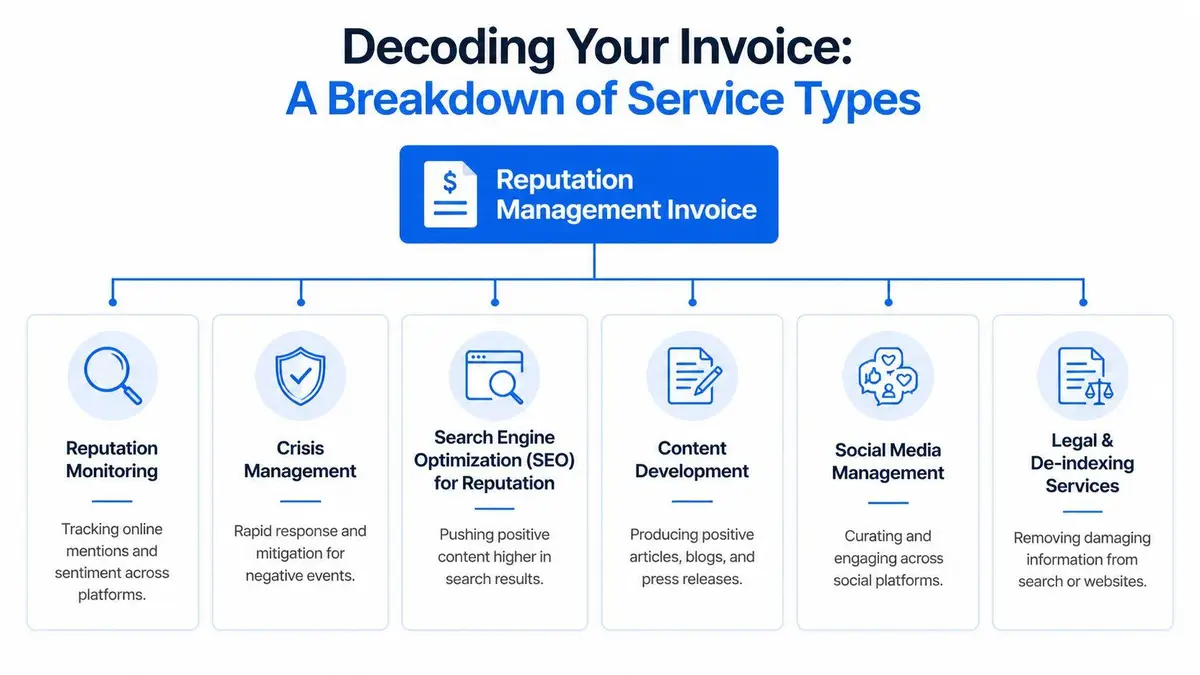
Decoding Your Invoice A Breakdown of Service Types
Most reputation invoices look opaque because firms collapse very different workstreams into a single “ORM” label. That’s unhelpful. You should know exactly what you are paying for and why one matter needs monitoring while another needs legal escalation, technical de-indexing, and search result replacement.
Monitoring is intelligence, not resolution
Monitoring is the earliest layer. It tracks where your name, company, images, or copied content appear across search, review platforms, social channels, and sometimes dark web references. In a low-stakes engagement, monitoring may be most of the service. In a serious matter, it is solely the detection layer that tells the team what to attack first.
Many low-cost providers often stop at this point. They will send alerts and reports. They will not remove the article, challenge the profile, or suppress the result. Monitoring without an intervention plan is surveillance, not protection.
Takedowns and de-indexing are specialised work
When harmful material breaches platform rules, privacy rules, or applicable law, a capable firm will attempt source removal or search de-indexing. Those are different processes. Removing from the source usually has the cleanest outcome. De-indexing may reduce visibility even if the source stays live.
This work involves evidence capture, platform-specific submissions, legal framing, escalation paths, and follow-up. It also requires judgement. An aggressive complaint sent to the wrong publisher can harden their position and worsen discoverability.
Suppression and SEO exist because some content won’t disappear
If material cannot be removed, the search page must be rebuilt around it. That usually means creating and strengthening accurate, positive, and authoritative content that can rank above harmful or misleading results. This is not generic “content marketing.” It is a reputational displacement exercise tied to specific search terms, named entities, and platform authority.
A serious provider should explain the relationship between owned assets, third-party profiles, structured content, citation signals, and search result composition. If they cannot explain that clearly, they are guessing.
Crisis handling now includes AI contamination
The premium tier of invoices has expanded because the problem set has changed. According to the 2026 UK reporting on online reputation firms, AI-related cleanup adds 20-50% premiums to standard monthly retainers, with executive or crisis campaigns involving deepfakes or AI hallucinations reaching £5,000-£12,000+ per month, and 65% of high-net-worth clients facing AI-sourced defamation. That premium is rational. AI-generated falsehoods can spread across multiple surfaces at once and reappear in altered forms.
A modern invoice should show whether you are paying for detection, removal, suppression, legal escalation, or reappearance control. If those lines are blurred, expect disappointment.
What each line item is meant to achieve
- Monitoring and alerting identifies harmful content quickly and preserves evidence before edits or deletions complicate the record.
- Platform enforcement targets breaches of terms, impersonation rules, privacy violations, and abusive content standards.
- Search suppression reduces the practical visibility of stubborn material that remains online.
- Content development creates the assets needed to occupy branded search results with accurate information.
- Legal coordination frames claims properly when publishers, hosts, or search engines require a rights-based argument.
- Crisis response manages velocity. This matters when copied posts, leaks, or fake accounts are multiplying.
If you are comparing providers, ask for the invoice to be mapped to outcomes. One factual option in this category is ContentRemoval.com’s content removal services, which are structured around source removal, de-indexing, impersonation takedowns, leak response, and ongoing monitoring rather than a single generic ORM label.
Structuring Your Investment Retainer vs Project Fees
A chief executive wakes up to a forged social profile, a hostile article copied onto three domains, and investors forwarding screenshots before the market opens. In that situation, the fee model is not an administrative detail. It determines whether your team can act at speed or spend the first 24 hours arguing about scope.

For high-stakes matters, you are usually choosing between three commercial structures. A fixed project fee, a monthly retainer, or a performance-linked arrangement. Each can work. Each can also become expensive if it is attached to the wrong problem.
When a project fee is the right tool
Use a project fee for a contained objective with a clear endpoint. A single defamatory page. One impersonation profile. A defined leak on a specific platform. One round of search de-indexing submissions tied to named URLs.
This model gives budget certainty, which is useful if the board wants approval before action starts. It also forces the provider to define deliverables in black and white.
The weakness is obvious. Digital harm rarely stays put.
A false story gets mirrored. An image leak is reposted. An impersonation account reappears under a variant handle. If your contract treats each recurrence as a fresh instruction, the headline price will look modest and the final spend will not. For that reason, project terms should state how copied content, reposts, and near-identical republications are billed.
When a retainer earns its place
Retainers suit clients with continuing exposure. That includes listed company directors, family offices, private investors in disputed transactions, regulated professionals, and public figures dealing with coordinated attacks or recurring leaks.
You are not only paying for labour. You are buying readiness.
A serious retainer should cover standing monitoring, rapid triage, preserved evidence, platform escalation, legal coordination, and a response window that reflects the client’s risk profile. If those elements are absent, the retainer is little more than a monthly convenience fee for the provider.
Ask for these terms in writing:
- response times for new incidents
- named workstreams included each month
- escalation rules for after-hours crises
- reporting format and frequency
- treatment of repeat attacks and mirror sites
- what falls outside scope and triggers extra fees
Without that detail, “ongoing management” means nothing.
Performance fees require stricter drafting than clients expect
Performance pricing appeals to discerning clients because it appears to shift risk onto the firm. Sometimes it does. Often it just hides the argument until later.
The definition of success must be exact. Source removal is different from de-indexing. De-indexing is different from reducing a result from page one to page two. Suppression across a cluster of search terms is different again. If the contract does not define the target, the measurement method, and the review date, expect a billing dispute.
Use this model for narrow and measurable tasks. Avoid it for broad reputation repair, where legal pressure, platform action, search work, and content placement all move on different timelines. If you are assessing that model, this guide to performance-based content removal for executives is useful because it frames the right commercial question. What exact result triggers payment?
| Fee model | Best fit | Main advantage | Main risk |
|---|---|---|---|
| Project fee | Defined incident with a clear endpoint | Budget certainty and fixed scope | Extra charges if the content spreads or reappears |
| Monthly retainer | Recurring exposure or high-profile vulnerability | Faster action, continuity, and standing coverage | Waste if the scope, service levels, and exclusions are vague |
| Success-based fee | Narrow, measurable objective | Better alignment on a specific result | Disputes over definitions, timing, and attribution |
One question cuts through the sales pitch. What exactly will you do next month if nothing new appears? A credible firm will answer with specific monitoring, prevention, reporting, and contingency work. If the answer is fuzzy, the pricing model is wrong for a serious case.
Why Your Case May Cost More Unpacking Cost Variables
Clients are often told their matter is “complex” without anyone defining the word. That is not good enough. Complexity has identifiable drivers, and each one affects price.

According to Essex Magazine’s 2026 UK analysis of ORM pricing, standard management sits at £500-£2,000 per month, while enterprise solutions involving multi-jurisdictional takedowns can exceed £5,000 per month. The same source notes that Google de-indexing via right-to-be-forgotten filings has a success rate of approximately 45% in the EU/UK. That single figure should cure anyone of the illusion that search removal is automatic.
Jurisdiction changes the labour
A defamatory post published in the UK against a UK resident is one thing. A false article hosted abroad, copied onto mirror sites, and amplified through foreign social accounts is another. The legal framing, notices, escalation path, and practical influence all become harder.
Cross-border matters also create sequencing problems. You may need one approach for the source, another for search, and another for platforms hosting screenshots or commentary. That means more drafting, more review, and more technical follow-up.
Platform difficulty is not uniform
Some platforms have established impersonation and privacy workflows. Others are inconsistent, slow, or procedurally awkward. Search engines, social networks, forums, publisher sites, archive services, and review platforms each require different submissions and supporting evidence.
A news site with an editorial process is not the same as a throwaway forum. A fake profile on a major platform is not the same as a defamatory blog with offshore hosting and no meaningful contact details. If your quote is higher, platform mix is often the reason.
Velocity and duplication push fees upward
One harmful item is cheaper than ten variants. A fake article copied onto multiple domains, clipped into short videos, quoted on social media, and discussed on forums becomes a campaign rather than a post. The work expands because the team must track origin, mirrors, screenshots, and reuploads.
That is also why some firms charge more for continuous monitoring after the initial incident. If the content is likely to reappear, you are paying for recurrence control, not just first-wave cleanup.
A short explainer on how search visibility and suppression interact is useful here:
The hidden variables clients overlook
- Identity verification requirements can slow takedowns where platforms demand proof of authority or proof of harm.
- Evidence preservation matters if litigation is possible. The team may need to capture pages, timestamps, account details, and publication history before pressing for removal.
- Stakeholder sensitivity affects workflow. Matters involving boards, family offices, public listings, or personal security need tighter reporting and narrower internal circulation.
- Desired finality changes scope. Temporary suppression is cheaper than a strategy designed to reduce reappearance risk over the long term.
The most expensive cases are not always the most public. They are often the matters that mix privacy, legal nuance, and multiple platforms at once.
Budgeting for Results Sample Case Scenarios
Clients under pressure don’t need abstract ranges. They need planning assumptions. The examples below are not promises. They are realistic budgeting frames for high-stakes UK matters where the objective is containment, reduced visibility, and durable control.
The broad premium market supports that framing. According to Igniyte’s UK fee overview, personalised ORM services for high-stakes clients typically range from £1,620 to £20,000 per month, often with a one-off setup fee of £1,620-£1,735 +VAT. The same source states that enterprise-level interventions for severe issues can start at £5,000-£20,000+ per month, with an aim of significant negative result suppression within 90 days.
Three scenarios clients actually recognise
A chief executive targeted by a coordinated review and disinformation campaign usually needs a blended response. The immediate objective is to stop the spread, challenge false profiles and reviews, preserve evidence, and stabilise branded search results. This is not just a review management issue. It is an attack on commercial credibility.
A public figure facing unauthorised intimate image distribution or related leak material has a different risk profile. Speed matters more than optics. The first phase is emergency containment, source removal requests, platform escalation, and search de-indexing where available. After that comes recurrence monitoring and, if necessary, suppression of commentary pages that keep the issue visible.
A family office trying to reduce the prominence of sensitive historic legal documents usually has a more technical and strategic matter. The content may be lawful, old, and difficult to remove at source. The work often focuses on de-indexing arguments where appropriate, search result restructuring, and controlled publication of accurate alternative material that outranks legacy references.
Sample Reputation Management Case Budgets (UK, 2026)
| Scenario | Primary Objective | Typical Strategy | Estimated Budget Range (First 90 Days) | Expected Timeline for Initial Impact |
|---|---|---|---|---|
| CEO facing coordinated false reviews and disinformation | Stop active reputational harm and restore search credibility | Review challenges, impersonation takedowns, search suppression, crisis monitoring, response planning | £5,000-£20,000+ per month, with possible £1,620-£1,735 +VAT setup depending on provider structure | Initial impact often begins within the first 90 days |
| Public figure dealing with leaked private images or intimate material | Urgent containment and reduction of visibility | Source removal requests, platform escalation, de-indexing submissions, recurrence monitoring, limited suppression work | £5,000-£20,000+ per month, with setup fees often in the £1,620-£1,735 +VAT range where charged | Initial impact often begins within the first 90 days |
| Family office reducing visibility of historic legal records | Lower discoverability of legacy material in branded search | De-indexing strategy where available, legal review, search result displacement, controlled content development | £1,620-£20,000 per month depending on complexity and whether the matter remains strategic or becomes adversarial | Initial impact often begins within the first 90 days |
How to read these budgets properly
The first mistake is to read the lower end of a range as the likely fee for a serious matter. It usually isn’t. Lower price points tend to apply where the issue is narrower, the platform is more cooperative, and the client’s search footprint is less crowded.
The second mistake is assuming the first ninety days solve the whole problem. They often don’t. They usually establish momentum. In search-based matters, that means the harmful result is challenged, displaced, or reduced in prominence. In privacy and impersonation matters, it means the first wave is contained and reappearance risk is being managed.
My recommendation on budgeting
If you are exposed to a live, high-visibility issue, budget for competence rather than hope. Cheap retainers are often just reporting subscriptions dressed up as strategy. For executives, founders, family offices, and public figures, the sensible question is not “What is the cheapest UK reputation management package?” It is “What budget gives me a realistic path to control?”
If the matter affects your name, company, or household directly, treat the first quarter as the decision period. Either fund a serious intervention early or accept that the online record may harden around the damage.
Choosing Your Partner A Checklist for Vetting a Firm
A polished website tells you almost nothing. The right partner is the one that can explain process, limits, and risk without slipping into sales theatre.

Questions that reveal whether a firm is serious
Start with methodology. Ask how they handle your specific platform mix. A firm that knows search suppression but not publisher negotiation, or social takedowns but not de-indexing, will expose that gap quickly when pressed.
Then ask about case control. Who does the work, who reviews legal risk, and who is accountable for escalation decisions? If the answer is vague, the operation is probably fragmented.
Use questions like these:
- Platform process: “How do you approach removal on this exact platform or publisher type?”
- Cross-border handling: “What changes when the host, publisher, or search result sits outside the UK?”
- Privilege and confidentiality: “How do you protect sensitive facts during intake, evidence sharing, and escalation?”
- Failure analysis: “Tell me about a matter you could not fully remove and what you did instead.”
- Reporting discipline: “What will I receive weekly or monthly, and what decisions will I be asked to make?”
Red flags that should end the conversation
Some warnings are obvious. Others are subtle.
- Absolute guarantees: Any firm promising it can remove anything from Google or erase all negative content is not being candid.
- Opaque pricing: If they cannot separate monitoring, removal attempts, suppression, and legal coordination, you cannot assess value.
- No discussion of downside: Serious practitioners discuss failed applications, stubborn publishers, and recurrence risk.
- Overreliance on PR language: If every answer comes back to “brand storytelling” when your issue is impersonation, defamation, or leaked material, you are speaking to the wrong provider.
- No chain of custody for evidence: In legal or privacy matters, sloppy evidence handling can damage later options.
Hire the firm that is willing to tell you what probably won’t work. That answer is usually more valuable than the pitch.
What the contract should state clearly
The engagement letter should identify scope, exclusions, response times, escalation rules, reporting cadence, confidentiality handling, and what happens if harmful content migrates to new locations. If there is a success element, define success in operational terms, not marketing language.
Also insist on clarity around third-party costs. If specialist counsel, platform ads, external publishing, or investigative work might be needed, that should be addressed before the engagement begins. Surprises are avoidable.
Beyond Cost The Long-Term Value of a Protected Reputation
A client facing a leak, a false allegation, or an executive impersonation campaign should judge spend against exposure, not against a generic monthly marketing budget. In serious matters, the financial question is simple. What does inaction cost if the wrong result sits on page one during a financing, board appointment, acquisition, dispute, or family office diligence process?
The answer is usually far larger than the invoice.
Protected reputation has balance-sheet value, even if it does not appear as a separate asset line. It preserves deal confidence, reduces avoidable questions from banks and counterparties, protects private family information from becoming a recurring point of public access, and limits the risk that a hostile or misleading publication becomes the default reference attached to your name.
That matters most in high-stakes cases because the harm rarely ends with the first post. One leak gets copied. One impersonation profile spawns others. One defamatory page is cited in forums, summaries, and AI-generated snippets. Recovery therefore buys more than removal or suppression in the moment. It reduces future remediation costs.
The long-term value also sits in preparedness. A well-run reputation programme leaves behind assets and controls that lower the cost of the next incident. Accurate search-visible profiles, stronger third-party references, documented escalation routes, monitoring, and evidence discipline all improve response speed when pressure returns. In practical terms, that means less money spent rebuilding from zero.
Private clients and boards often make the same mistake. They treat premium reputation work as a discretionary clean-up exercise. In reality, for defamation, leaked material, and identity misuse, it is a form of risk containment with direct commercial consequences.
The right view of reputation management cost UK is not whether the fee feels high in isolation. The right view is whether the spend protects access, privacy, negotiating position, and enterprise value at the point they are most exposed.
Executive-Level Reputation FAQs
How quickly should I act after discovering harmful content
Immediately. Delay gives search engines time to index, users time to screenshot, and secondary accounts time to copy the material. Even if full removal takes time, early evidence capture and first-wave escalation can materially improve your position.
Should I contact the publisher or platform myself
Usually not until someone has assessed the consequences. Direct contact can alert the wrong party, trigger edits that complicate evidence, or provoke wider publication. In sensitive matters, sequence matters as much as substance.
Is removal better than suppression
If genuine removal is available, it is usually the cleaner result. But removal is not always possible. The practical answer is often a combined strategy. Remove what you can, de-index what you cannot remove, and suppress what remains visible. Clients get into trouble when they insist on one method for every problem.
Can my company handle this internally through PR or legal
Sometimes, but internal teams usually cover only part of the map. PR can manage messaging. Lawyers can frame claims. Neither function always runs platform enforcement, search de-indexing, technical suppression, or recurrence monitoring as an integrated operation. High-stakes matters often need all of those at once.
Why do providers ask so many questions before quoting
Because a serious quote depends on facts. Platform mix, jurisdiction, publication history, screenshots, indexing status, search prominence, and reupload risk all affect scope. A fast quote without that analysis is often just a sales number.
Are cheaper monthly packages ever worth buying
For local review monitoring, sometimes yes. For defamation, impersonation, leaks, or executive targeting, usually no. The lower-cost package often covers observation and basic responses, not the intensive work that changes outcomes.
What should I prepare before the first consultation
Bring screenshots, URLs, dates, search terms, account names, and a short chronology of how you discovered the issue. Also identify what matters most to you. Privacy, speed, legal positioning, public visibility, or long-term search cleanup. The strategy changes depending on that priority.
Can a firm promise confidentiality
It can promise contractual confidentiality and disciplined handling. That matters. But you should still ask how materials are stored, who sees them, and whether outside counsel or third-party vendors are involved. Discretion should be operational, not just promised.
If you’re dealing with defamation, leaks, impersonation, false reviews, or damaging search results in the UK, ContentRemoval.com offers confidential assessments for executives, founders, family offices, and public figures. A useful first step is a private review of the content, the platforms involved, the likely removal routes, and the budget required to contain the issue properly.
Frequently asked questions
How much does it cost to remove a negative article from Google in the UK?
There is no single figure. Third-party surveys cited in the article place standard management at £500 to £2,000 per month and complex multi-jurisdictional matters above £5,000 per month, with right-to-be-forgotten de-indexing succeeding in roughly 45% of EU and UK cases. Severity, platform, jurisdiction and reupload risk all move the price.
Should I pay a retainer or a fixed project fee for reputation management?
Use a project fee for a contained matter with a clear endpoint, such as one defamatory page or one impersonation profile. A retainer suits continuing exposure, such as listed company directors, family offices and public figures facing recurring attacks. Whichever you choose, get response times, workstreams, escalation rules and treatment of mirror sites in writing.
Why does a reputation firm ask so many questions before quoting?
Because a serious quote depends on facts: platform mix, jurisdiction, publication history, indexing status, search prominence and reupload risk. A fast quote without that analysis is usually a sales number. Bring screenshots, URLs, dates, search terms and a short chronology to the first consultation.