

To remove negative content about an executive, start with a confidential threat assessment that classifies each item as defamation, doxxing, impersonation, copyright misuse or out-of-context news. Illegal content is pursued through defamation claims, DMCA notices and court orders; policy breaches are reported as precise platform violations. Content that cannot be removed is de-indexed or suppressed, and stakeholders are briefed privately.
Key facts
- A clear impersonation profile on a major platform is often resolved within 24 to 72 hours.
- Google de-indexes for doxxing, non-consensual intimate imagery, copyright infringement and court-ordered removals.
- Source removal can take 24 hours to 6 months; suppression campaigns run 3 to 12 months.
- A public rebuttal legitimizes the accusation and creates a permanent search result tied to your name.
Where ContentRemoval.com comes in. ContentRemoval.com handles executive matters from assessment through removal, de-indexing, suppression and monitoring, working alongside general counsel and communications so the legal and search tracks move together and the board can be briefed with facts. The first call usually comes from a chief of staff, the company’s counsel or a PR agency acting for the executive. A free 15-minute Exposure Scan maps what is removable, and the report is yours to keep. Get a Free, Confidential Exposure Scan or read how our content removal work is done.
When negative content concerning an executive surfaces online, it is not a public relations issue. It is a direct assault on corporate value and personal credibility. Whether a defamatory article, a false review, or leaked proprietary data, the resulting damage can be swift and severe.
An effective response is not a simple takedown request. It is a strategic campaign combining legal action against unlawful content with sophisticated SEO to neutralize material that, while damaging, may be legally permissible. The process begins not with a public statement, but with a quiet, precise assessment of the threat.
Starting with a Confidential Threat Assessment
When an executive’s reputation is under attack, it directly threatens corporate stability, market perception, and shareholder value. The natural impulse is to react immediately and publicly. Resist it.
The most effective initial action is a discreet internal assessment to understand the precise nature of the threat. This is not crisis management; it is digital forensics. This involves analyzing the negative content, tracing its origins, and mapping its potential blast radius. This foundational work is essential for constructing an effective strategy for removal and defense.
Know Your Enemy: Categorizing the Threat
Not all negative content is equivalent. The nature of the attack dictates the strategy. The first order of business is to accurately categorize each piece of damaging information.
Our analysis typically identifies several common attack vectors:
- Libel and Defamation: This is the most clear-cut category, involving demonstrably false statements of fact that cause material harm. Examples include fabricated news articles, malicious blog posts, or manufactured accusations on social media.
- Privacy Violations and Doxxing: This involves the malicious publication of private information, such as a home address, family details, or personal financial records. It constitutes a direct security risk and a clear violation of most platform terms of service.
- Impersonation: An adversary creates a fraudulent social media profile or email account in an executive’s name to spread disinformation or commit fraud, thereby undermining the executive’s credibility. For a detailed analysis of how our specialists address such issues, consult an online privacy consultant.
- Misleading or Out-of-Context News: This is a more nuanced threat. A factually accurate but dated news story can be re-circulated to create a skewed, damaging narrative that adversely affects current business interests.
Once the content is categorized, prioritization can begin. Certain items demand immediate legal action, while others require a more subtle approach, such as suppression or de-indexing. This disciplined focus prevents the misallocation of resources on ineffective tactics.
To visualize this process, we employ a threat matrix to classify the problem and identify the optimal solution.
Threat Matrix for Negative Executive Content
This table categorizes common types of negative content by their typical impact level and the primary removal strategy, helping executives prioritize their response.
| Content Type | Impact Level | Primary Removal Vector |
|---|---|---|
| Defamatory News Article | High | Legal Takedown (Defamation) |
| Fake Social Media Profile | High | Platform Takedown (Impersonation) |
| Doxxing on a Forum | Severe | Platform Takedown (Privacy Violation) |
| Negative Employee Review | Medium | SEO Suppression / Response |
| Out-of-Context Old News | Medium | SEO Suppression / De-indexing |
| Copyright Infringement | Medium | Legal Takedown (DMCA) |
This framework transforms a chaotic situation into a clear, prioritized action plan.
The Real-World Cost of an Online Attack
The consequences of a digital smear campaign are not abstract; they have a real, measurable, and often brutal financial impact. The data tells a stark story.
A 2026 Harvard Business Review study found that 85% of executives believe negative online content had a direct, adverse impact on their professional careers. Furthermore, 62% observed measurable declines in investor confidence immediately following a viral smear campaign.
In major US and European markets, where over 70% of Fortune 500 board decisions are estimated to be influenced by an executive’s public image, a single damaging article can depress a stock price by up to 15% within 48 hours.
The goal of a threat assessment is to shift from an emotional reaction to an analytical one. A reputation attack must be treated with the same seriousness as a financial or operational crisis, because that is precisely what it is.
This analytical approach separates a successful reputation defense from a panicked and counterproductive public relations scramble. It enables the construction of a targeted action plan based on evidence, not anxiety. Once the specific nature of each threat is understood, the correct tools can be deployed to neutralize it.
Taking Action: A Practitioner’s Guide to Legal and Platform Removals
Once the threat is assessed, the strategy shifts from defense to offense. Securing the removal of negative content about an executive is not a matter of polite requests. It is a tactical operation requiring precise knowledge of which levers, legal or platform-based, will compel removal.
Successful execution depends on pairing the correct tool with the specific problem. A poorly drafted DMCA notice or a weak defamation claim can be rejected and, worse, alert the attacker, escalating the situation.
Choosing Your Battleground: Illegal vs. Policy Violation
The primary strategic decision is to determine whether the content is illegal or merely a violation of a website’s terms of service. This distinction will shape the entire takedown strategy.
This decision tree illustrates the analytical process used to determine the optimal path forward.
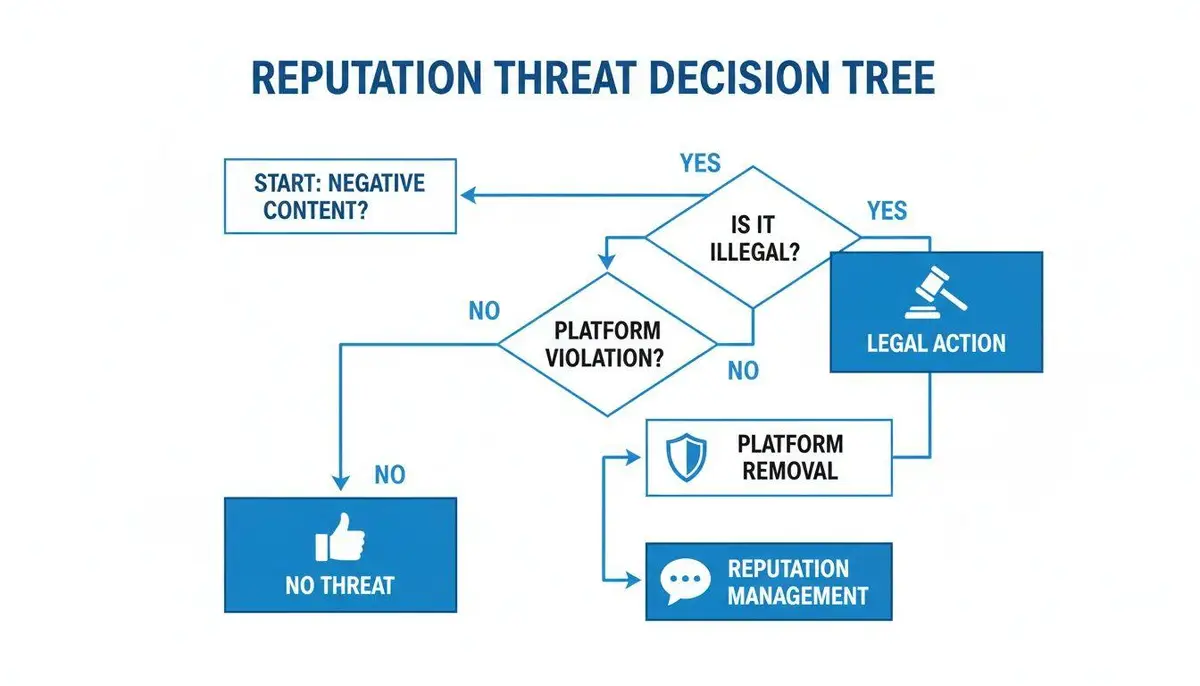
Content that violates the law opens a direct legal path. Content that breaks a platform’s rules requires a different approach, one that uses the platform’s own policies against the publisher. Selecting the correct route is critical.
Wielding the Legal Hammer
When dealing with illegal content, several powerful legal instruments are available. These are not requests but legally backed demands that compel action from publishers and hosting providers.
- Defamation Claims: This is the primary tool for content that is provably false and has caused tangible harm. Meticulous documentation is paramount. An airtight case must demonstrate that the statements are false and have directly harmed the executive’s career or business. A well-constructed claim sent to a platform’s legal department often results in swift removal.
- Court Orders: A court order is the ultimate weapon. While obtaining one is a significant undertaking, its power is absolute. Once a judge orders content to be removed, platforms are legally obligated to comply. This is the most effective means of dealing with malicious or intransigent attackers.
- Digital Millennium Copyright Act (DMCA): The DMCA is essential when an executive’s intellectual property is stolen and published online. This can include copyrighted photos, videos, or internal documents. A properly filed DMCA notice creates a legal obligation for the hosting provider to remove the infringing material.
Privacy laws also provide strong grounds for removal, particularly for executives with a global presence. In Europe, GDPR’s “Right to be Forgotten” has resulted in over 450,000 URLs being de-indexed since 2018. A significant 35% of these requests involve executives, with an estimated success rate of 80% in restoring professional standing.
For threats against an executive’s family, such as the publication of Non-Consensual Intimate Imagery (NCII), the response is even more decisive. Specialized platform APIs enable a success rate of over 90% for NCII takedowns, preventing catastrophic personal and financial harm.
Using a Platform’s Own Rules Against Them
In some cases, the most efficient resolution does not involve legal counsel. Much of the content targeting executives, while not strictly illegal, is a flagrant violation of a platform’s terms of service.
The objective is to shift from complaining to reporting. Frame the takedown request not as a personal grievance but as a clear-cut policy violation. This changes the dynamic: you are no longer a victim seeking assistance but an agent helping the platform enforce its own rules.
A fraudulent profile on LinkedIn or X (formerly Twitter) is a textbook impersonation violation. The publication of an executive’s home address on a forum is a direct breach of doxxing and privacy policies on virtually every legitimate site.
Success in these instances depends on filing a report that is sharp, specific, and points directly to the rule being broken. Vague, emotional complaints are invariably lost in moderation queues. An experienced firm understands how to craft these reports to align with each platform’s unique review process, ensuring they are escalated and addressed quickly. Further information on this approach can be found in our guide to legal content removal strategies.
By skillfully combining legal force with precise policy enforcement, a coordinated online attack can be systematically dismantled, restoring control over an executive’s digital presence.
When a hostile publisher refuses to remove a damaging story, either due to intransigence or because the content is protected by free speech laws, the battle is not over. It simply moves to a new battlefield: the search engine results page (SERP).
At this juncture, two primary options exist. The first is to compel search engines like Google to “de-index” the URL, effectively removing it from search results. The second, more common strategy is to bury the negative content with an overwhelming volume of positive, authoritative material. This combined approach is how control over an executive’s online narrative is reclaimed.

Going Straight to Google: The De-Indexing Route
De-indexing is the process of petitioning a search engine to blacklist a specific URL. The page remains on the original website but becomes invisible to anyone using a search engine. This is not a universal solution; a request to remove content simply because it is unfavorable will be denied.
A solid legal or policy-based justification is required. Our experience indicates that these requests gain traction only when the content clearly violates a search engine’s terms of service.
Google, for example, has specific policies against:
- Privacy Violations & Doxxing: Publishing private contact details or financial information without consent.
- Non-Consensual Intimate Imagery (NCII): Any explicit material posted without the subject’s permission.
- Copyright Infringement: Proven theft of intellectual property, typically supported by a DMCA notice.
- Court-Ordered Removals: When a court has legally mandated the removal of a URL.
Success requires submitting a formal request through the search engine’s legal portal with meticulous documentation. An airtight case demonstrating a clear violation must be presented. Vague complaints are immediately dismissed.
If You Can’t Remove It, Bury It: The Art of Suppression
What if the content is merely negative: an unfavorable review, a critical news story, or an out-of-context opinion piece? Such content often does not violate a specific policy, making de-indexing unavailable. This is where suppression becomes the primary strategy.
Suppression is an aggressive form of search engine optimization (SEO) where the goal is obscurity, not removal. The process involves creating and promoting a portfolio of positive, authoritative content (new articles, interviews, professional profiles, and other digital assets) designed to outrank the negative item. It is a resource-intensive but highly effective strategy.
You are not attempting to erase the negative story. You are constructing a firewall of positive content that pushes it so far down the search results that it becomes irrelevant. You are defining your digital identity on your own terms.
The data is conclusive. We have managed cases where harmful content dominated 75% of an executive’s first-page results. After a successful suppression campaign, positive assets accounted for 92% of that prime digital real estate.
This is a global issue. In the UK, the Information Commissioner’s Office handled over 15,000 de-indexing complaints in 2025 alone. A staggering 52% originated from business leaders, with 82% resulting in compliance and an average reputation rebound of 35% in media sentiment scores. The use of data to drive policy and enforcement is a growing trend, as seen in various government contexts; you can explore reporting on data-driven policy changes on abcnews.com.
Comparing Removal Versus Suppression Strategies
When deciding on a path forward, a side-by-side comparison of strategies is instructive. Each has a different goal, timeline, and degree of permanence.
| Strategy | Primary Goal | Typical Timeline | Permanence |
|---|---|---|---|
| Source Removal | Eradicate the content from the internet permanently. | 24 hours to 6+ months | High (if successful) |
| De-Indexing | Make the content undiscoverable via search. | 2 weeks to 3 months | High (can be reversed) |
| Suppression (SEO) | Push negative results off the first page. | 3 to 12+ months | Moderate (requires ongoing effort) |
An expert reputation management firm will not default to a single strategy. It will evaluate the specifics of the situation and deploy the right tactics in the correct sequence. While source removal is always the ideal outcome, the ability to remove negative search results through de-indexing and suppression is what truly secures an executive’s digital footprint. It ensures the first online impression is a strong and accurate reflection of their career and character.
Managing the Fallout and Building Your Defenses
Removing damaging links must occur in concert with a sophisticated crisis communications plan. Winning the technical battle while losing the trust of key stakeholders is a pyrrhic victory.
A reputation attack creates an information vacuum. If you do not fill it with a controlled narrative, your critics will. This is not about issuing a generic press release; it is a surgical operation to manage perceptions among investors, the board, key clients, and the leadership team.
The Critical Choice: Speak Up or Stay Silent?
The first and most important decision is whether to make any public statement. A rushed or poorly worded statement can amplify the negative story, granting it a wider audience. In most cases we handle, the optimal course is strategic silence with the public, coupled with direct, private communication to key stakeholders.
A public rebuttal is a high-risk gamble that rarely succeeds. It often:
- Amplifies the negative story: Your response legitimizes the original accusation and elevates its importance.
- Alerts your adversary: Publicly engaging demonstrates your strategy and can provoke further attacks.
- Creates a permanent link: Your official statement now appears in search results, forever connecting your name to the controversy.
A superior approach is to manage the narrative privately. A confidential briefing for the board or key investors allows for a calm explanation of the situation, a review of the takedown process, and a reaffirmation of the executive’s value to the company. This can preempt internal panic.
The gut reaction is to fight back: publicly and loudly. That is almost always a mistake. Real control comes from containing the damage, not broadcasting the fight. The objective is to eliminate the noise, not become the loudest voice in the room.
This ensures that individuals whose opinions affect the business feel informed and confident, preventing the kind of speculation that can depress stock prices or trigger a vote of no confidence.
Building Your Digital Fortress for the Long Haul
While immediate communications focus on damage control, a long-term strategy must center on proactive defense. We term this building a “digital fortress”, a powerful portfolio of positive, professional, and authoritative online assets that you own and control. This is the foundation of lasting reputation security.
The concept is to establish such a strong and positive digital footprint that future attacks fail to gain traction in search results. This is not vanity; it is a strategic inoculation against future crises.
A resilient digital fortress is built upon several key pillars:
- A Polished Professional Hub: This begins with a fully optimized LinkedIn profile, featuring recent activity, strong endorsements, and a clear narrative of professional expertise.
- Owned Digital Real Estate: A personal website or professional blog is non-negotiable. It serves as the definitive source for your narrative, thought leadership, and career achievements.
- Credible Third-Party Endorsements: Actively seek and secure positive media coverage, guest interviews, and features in respected industry publications.
- A Consistent Content Engine: Regularly publish high-value content such as articles, white papers, or videos from speaking engagements that solidify your authority in your field.
Creating these assets accomplishes two objectives simultaneously. First, it solidifies the positive, accurate narrative you want to project. Second, it functions as a powerful suppression tool, pushing down any new negative content that may arise. A firm grasp of executive reputation management is essential for integrating these proactive and reactive strategies.
When you control the majority of your first-page search results, you define your own digital identity. This is what makes a reputation resilient, transforming a one-time cleanup into a permanent solution.
Shifting from Defense to Offense: Ongoing Monitoring and Prevention
Removing negative content is a significant tactical victory, but it does not win the war. Adversaries are often persistent and will attempt to re-upload removed articles, create new defamatory posts, or find new angles of attack. A one-time cleanup is merely a temporary fix.
The strategic objective is to shift from a reactive, defensive posture to a proactive one. This requires establishing a permanent, intelligent monitoring system that functions as a 24/7 online intelligence-gathering operation. This is not about setting a few Google Alerts; it is about building a comprehensive system to protect your reputation for the long term.

Building Your Early-Warning System
Effective monitoring requires casting a wide net. A system must be in place to constantly scan for any mention of your name, your company, and other key phrases across all corners of the web.
The scanning protocol must be exhaustive, covering:
- The Surface Web: This includes public-facing sites such as news outlets, blogs, forums, and review platforms.
- Social Media: Real-time tracking of mentions, tags, and impersonation attempts on platforms from LinkedIn and X to smaller, niche networks is critical.
- The Dark Web: Specialized tools are required to crawl hidden forums and marketplaces where credentials are sold, data leaks are discussed, or coordinated attacks are planned.
This system serves as a digital smoke detector. The objective is to identify a threat the moment it materializes, providing an opportunity to act before a negative story is indexed by Google or goes viral on social media.
Fine-Tuning Alerts for a Rapid Response
A monitoring tool that generates a high volume of irrelevant mentions is counterproductive. The system must be fine-tuned to flag only what truly matters. This is achieved by establishing specific rules that trigger alerts based on criteria such as negative sentiment, the use of certain keywords in proximity to your name, or mentions on known high-risk websites.
When a genuine threat is flagged, speed is paramount. A Rapid Response Protocol is non-negotiable. This is a pre-approved action plan, developed with legal counsel and key stakeholders, that dictates the exact steps to be taken the moment an alert is received, no new meetings or approvals are required.
A Rapid Response Protocol transforms hours of panicked decision-making into minutes of decisive action. When a re-uploaded defamatory article is detected at 2 a.m., the protocol empowers your team to immediately execute the pre-vetted takedown procedure, neutralizing the threat before it gains a foothold.
This protocol ensures the response is swift, coordinated, and legally sound every time. It eliminates the analysis paralysis that can cripple a team during a surprise attack and dramatically shortens the lifespan of damaging content. This systematic approach is how reputation management is transformed from a series of frantic cleanups into a state of continuous control and security.
When a reputation is under fire, executives and their teams require immediate, high-stakes answers, not vague possibilities. The following are the most common questions we address, based on years of experience in digital reputation management.
Executive Content Removal FAQ
How Long Does It Take to Remove Negative Content About an Executive?
There is no universal timeline; the duration depends on the nature of the content and its location. A clear-cut policy violation, such as an impersonation profile on a major social platform, can often be resolved within 24 to 72 hours after a meticulously documented report is filed.
More complex situations require more time. A de-indexing request to a search engine for a privacy breach typically takes several weeks for review and action. Pursuing a court order for defamation is a significant legal undertaking that can extend over several months. A realistic timeline can only be provided after a full assessment of the specific legal and platform-based options for each piece of harmful content.
What Are the Costs of Executive Content Removal?
The cost is commensurate with the scope of work required. A simple, one-off removal of a single link may be handled for a fixed fee.
However, a comprehensive reputation attack necessitates a full-scale campaign, which is a significant investment. A typical engagement may involve legal action in multiple jurisdictions, removal of content from dozens of sites, an aggressive search engine suppression strategy, and ongoing monitoring. Top-tier firms work on a retainer or project basis, with fees reflecting the specialized legal and technical expertise required to operate discreetly and deliver a decisive result.
An investment in professional content removal is not a “cost.” It is a critical measure to protect market capitalization, investor confidence, and an executive’s career. The financial and reputational damage from unchecked negative content will almost always exceed the cost of a strategic removal campaign.
Can a Negative News Article Be Removed?
Securing the removal of a factually accurate article from a legitimate news organization is nearly impossible due to robust press freedom protections. In such cases, the strategy shifts from removal to suppression. The objective becomes burying the negative article by creating and promoting a flood of positive, authoritative content that pushes it deep into search results, rendering it effectively invisible.
If the article contains demonstrable factual errors, we can pursue a correction or a full retraction. If the piece is published on a disreputable blog or fringe site, the probability of securing a source removal or de-indexing by search engines is much higher.
Can Removed Content Reappear?
Yes, and this occurs frequently. The originator of the attack will often attempt to re-upload the same material on the original platform or new ones. This is precisely why a one-time removal project is insufficient.
An effective strategy must include continuous, long-term monitoring to detect re-uploads the moment they appear. We utilize proprietary technology to constantly scan the web for this exact issue. With a rapid-response plan in place, re-uploaded content can be removed almost immediately, often before it is re-indexed by search engines, neutralizing the threat before it can cause further damage.
Managing an executive’s digital footprint is a complex, time-sensitive challenge. At ContentRemoval.com, we bring the certainty and speed needed to protect high-value careers and corporate stability. If you’re facing a reputation threat, contact us for a confidential assessment.
Frequently asked questions
Should an executive respond publicly to a smear campaign?
Usually not. A public rebuttal amplifies the story, shows the adversary your strategy and creates an official statement that ranks alongside the accusation for years. The article recommends strategic public silence paired with private briefings for the board, investors and key clients.
What is the difference between illegal content and a platform policy violation?
Illegal content, such as provable defamation, stolen copyrighted material or doxxing, opens a legal route: a defamation claim, a DMCA notice or a court order. Content that breaks a platform’s rules without being illegal, such as a fake profile, is removed by filing a sharp report that names the specific policy breached.
What is a rapid response protocol for executive reputation?
A pre-approved action plan agreed with legal counsel and key stakeholders that sets out exactly what happens when monitoring flags a threat, with no new meetings needed. It lets the team file a pre-vetted takedown the moment a re-uploaded article appears, often before it is re-indexed.