
To remove your info online, audit where it appears, delete or lock down accounts you control, opt out of data brokers such as Whitepages, Spokeo, BeenVerified and TruthFinder, then submit search engine removal requests for cached or sensitive results. California residents can use the DROP platform for a single deletion request, and quarterly checks stop new exposure building up.
Key facts
- California’s DROP platform, effective January 1, 2026, sends one deletion request to all registered brokers.
- Download your data archives before deleting social accounts, because deletion is permanent.
- Google’s outdated content requests typically process in 1 to 3 days; personal information in 3 to 7.
- A full DIY removal usually takes 20 to 40 hours, then 2 to 4 hours each quarter.
Where ContentRemoval.com comes in. ContentRemoval.com takes on the parts of an online cleanup that subscription tools cannot reach: news articles, defamatory posts, explicit content, court records and clusters of negative search results, alongside the broker opt-outs and monitoring. People usually reach us directly, or through an assistant or lawyer when a job, deal or safety concern is behind the request. A free 15-minute Exposure Scan maps where you are exposed and what is removable, and the report is yours to keep. Get a Free, Confidential Exposure Scan or read how our personal data removal work is done.
Your personal information is scattered across hundreds of websites, data brokers, and platforms right now. From previous addresses and phone numbers to financial records and social media activity, the digital footprint you’ve accumulated creates genuine privacy risks, security vulnerabilities, and professional liabilities. The good news is that in 2026, individuals have more tools and legal rights than ever before to systematically remove my info online and reclaim control over their digital presence.
Understanding Where Your Information Lives Online
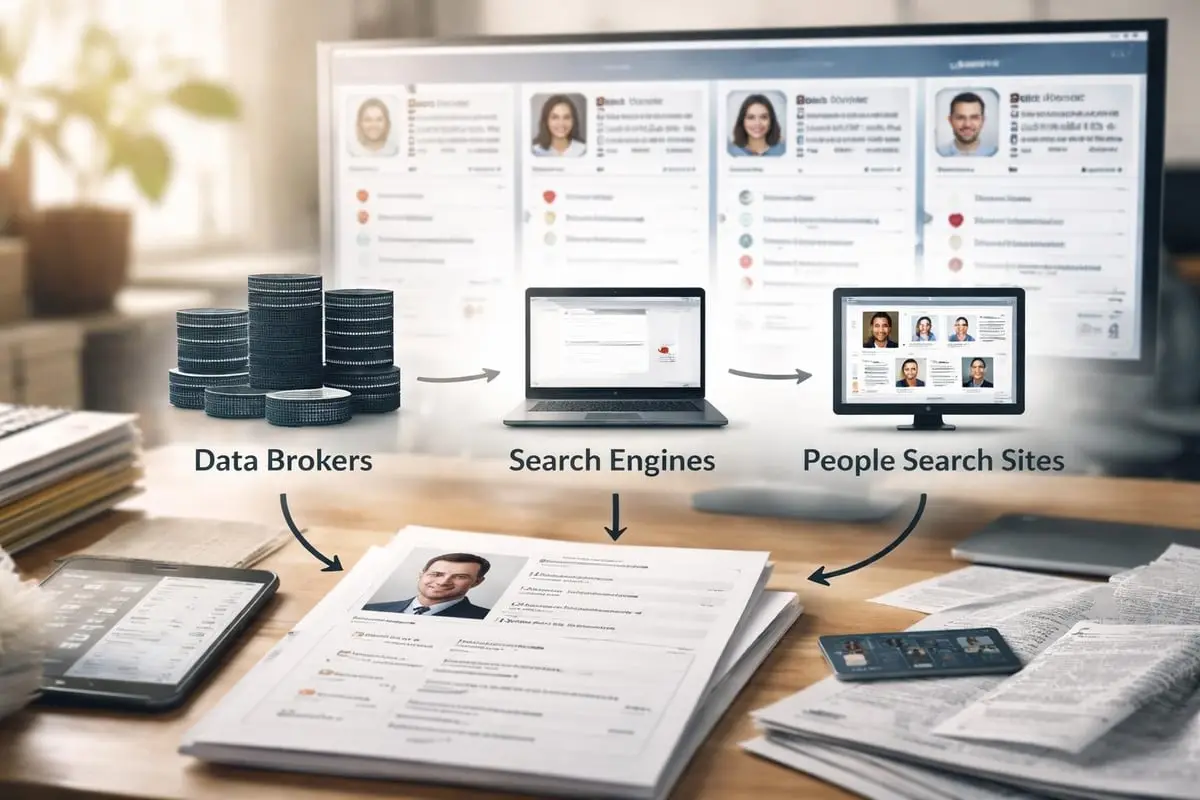
Before you can effectively remove my info online, you need to understand the ecosystem that collects, stores, and redistributes your personal data. Your information exists in three primary categories of locations, each requiring different removal approaches.
Data broker databases represent the largest concentration of personal information. These companies aggregate public records, purchase data from other sources, and scrape publicly available information to create comprehensive profiles. They sell this information to marketers, employers, background check services, and anyone willing to pay.
Primary Data Sources
The information pipeline begins with these fundamental sources:
- Public records: Court documents, property records, voter registrations, marriage certificates, business filings
- Commercial transactions: Purchase histories, loyalty programs, credit applications, warranty registrations
- Online activity: Social media profiles, forum posts, blog comments, review sites, professional networks
- Previous employment: Company directories, press releases, conference attendance, professional associations
Social media platforms maintain extensive archives of your posts, photos, comments, and interactions. Even deleted content often persists in backups, cached versions, and third-party archives. Search engines index this content, making it discoverable years after publication.
People search sites specifically target personal information aggregation. Sites like Whitepages, Spokeo, BeenVerified, and dozens of competitors compile detailed profiles linking your name to addresses, relatives, phone numbers, and background information. These platforms update continuously, requiring ongoing monitoring.
Legal Rights and Privacy Regulations in 2026
Your ability to remove my info online depends significantly on where you live and which laws apply to your situation. The privacy landscape has evolved dramatically, giving residents of certain jurisdictions powerful removal rights.
California’s DELETE Act and DROP Platform
California residents gained substantial new capabilities in 2026 through the Delete Request and Opt-out Platform (DROP) Act, which became effective January 1, 2026. This legislation creates a centralized platform where residents submit a single request to delete personal information from all registered data brokers simultaneously.
The DROP platform addresses the most frustrating aspect of previous removal efforts: the need to contact hundreds of data brokers individually. Now California residents access a state-operated portal, authenticate their identity, and submit one comprehensive deletion request that legally binds all registered data brokers.
| Privacy Law | Jurisdiction | Key Rights | Effective Date |
|---|---|---|---|
| CCPA/CPRA | California | Deletion, opt-out, access | 2020/2023 |
| DROP Act | California | Centralized deletion platform | January 2026 |
| GDPR | European Union | Right to erasure, portability | 2018 |
| Virginia CDPA | Virginia | Deletion, correction, opt-out | 2023 |
The Right to Be Forgotten, established through European GDPR regulations, allows individuals to request removal of personal information from search results under specific circumstances. This legal concept has influenced similar legislation worldwide, though implementation varies by jurisdiction.
When Legal Rights Don’t Apply
Not everyone benefits equally from privacy laws. If you live outside California, the EU, or other jurisdictions with strong privacy protections, you’ll rely primarily on voluntary compliance, platform-specific policies, and direct negotiation. Many data brokers offer opt-out mechanisms voluntarily, though enforcement and permanence vary significantly.
Step-by-Step Process to Remove My Info Online
Successfully removing personal information requires systematic execution across multiple fronts. This comprehensive approach addresses immediate exposure while preventing future data accumulation.
Phase One: Inventory and Assessment
Begin with a thorough audit of your current digital footprint. Search your full name, previous names, phone numbers, email addresses, and usernames across multiple search engines. Document every result containing personal information, categorizing by priority and sensitivity.
High-priority targets include:
- Results containing financial information, social security numbers, or identity documentation
- Photos or content you didn’t authorize for publication
- Outdated information that misrepresents your current situation
- Addresses or contact information creating safety risks
- Professional content that damages career prospects
Use privacy-focused search tools and incognito browsing to see results unaffected by your personal search history. Search image repositories separately, as visual content often persists in locations that don’t appear in standard web searches.
Phase Two: Direct Platform Removal
Start with platforms where you have direct control. Delete old social media accounts, deactivate unused email addresses, and close dormant online profiles. Removing yourself from major platforms requires following specific procedures for each service.
Social media deletion checklist:
- Download your data archives before deletion (permanent loss otherwise)
- Remove tags in other people’s posts where possible
- Delete posts individually if platform doesn’t offer bulk deletion
- Deactivate first, then return after waiting period to permanently delete
- Clear connected third-party applications and services
For accounts you can’t delete entirely due to ongoing professional or personal needs, minimize information exposure. Remove birth dates, locations, phone numbers, email addresses, and relationship details. Adjust privacy settings to maximum restriction, limiting visibility to confirmed connections only.

Phase Three: Data Broker Opt-Outs
The most time-intensive aspect of efforts to remove my info online involves systematically opting out of data broker sites. This process typically requires visiting each broker’s opt-out page, searching for your profile, and following their specific removal procedure.
Common data brokers requiring individual opt-out:
- Whitepages and associated properties
- Spokeo
- BeenVerified
- Intelius
- PeopleFinders
- MyLife
- TruthFinder
- Instant Checkmate
Each broker implements different verification requirements. Some accept simple form submissions, while others require email confirmation, identity documentation, or phone verification. Free removal methods exist for most major brokers, though the process demands patience and persistence.
Phase Four: Search Engine De-indexing
Even after removing information from source sites, cached copies and search engine indexes may persist for months. Major search engines offer removal tools for specific categories of content, though approval isn’t guaranteed.
Google removal request types:
| Request Type | Eligibility | Processing Time |
|---|---|---|
| Outdated content | URL returns 404 or content changed | 1-3 days |
| Personal information | Doxxing, financial info, explicit images | 3-7 days |
| Legal removal | Court orders, DMCA claims | Variable |
| Right to be forgotten | EU residents, specific criteria | 7-14 days |
Submitting removal requests for personal data requires specific documentation and legitimate legal grounds. Search engines balance privacy rights against public interest and freedom of information, rejecting requests they consider overreaching.
Alternative approaches include contacting website owners directly to request content removal or modification. Many site administrators comply with reasonable requests, particularly when you can demonstrate legitimate privacy concerns or factual inaccuracies.
Professional Services and Automated Solutions
The complexity and time requirements involved in comprehensive removal lead many people to consider professional assistance or automated services. These solutions range from subscription-based monitoring tools to full-service reputation management firms.
Data Removal Services
Subscription services like DeleteMe, Optery, and similar platforms automate the data broker opt-out process. These services charge monthly or annual fees to continuously monitor data broker sites and submit removal requests on your behalf. Services like Optery typically cover dozens to hundreds of data broker sites, though coverage varies by pricing tier.
Typical service features:
- Initial comprehensive removal across 50-200+ data broker sites
- Quarterly or monthly re-scanning and re-removal
- Exposure reports showing where your information appears
- Automated opt-out request submissions
- Dashboard tracking removal status
These services work well for data broker removal but have limitations. They cannot delete social media content, remove news articles, eliminate court records, or address content on sites outside their coverage list. Results vary based on data broker compliance and the persistence of your information across platforms.
Full-Service Reputation Management
Complex situations involving harmful content, defamatory articles, or sensitive material often require professional content removal specialists. These firms employ legal expertise, technical strategies, and direct relationships with platforms to achieve removals that automated services cannot accomplish.
Professional removal becomes essential when facing:
- Published articles on news sites or blogs containing false or damaging information
- Explicit content or revenge porn requiring urgent removal
- Court records or legal documents you need suppressed
- Multiple negative search results requiring coordinated suppression strategies
- High-stakes professional situations where reputation damage creates immediate financial impact
These services operate at premium pricing tiers but deliver results that DIY efforts and automated services cannot achieve. The investment makes sense when the cost of persistent harmful content exceeds the removal investment.
Preventing Future Information Exposure
Successfully removing existing information represents only half the battle. Without ongoing prevention strategies, new information accumulates rapidly, requiring repeated removal efforts. Implement these protective measures to minimize future exposure.
Privacy-First Online Behavior
Adopt fundamentally different approaches to sharing information online. Before posting anything, consider whether you’d be comfortable with that information being publicly searchable five years from now. Assume everything you post online becomes permanent and discoverable.
Protective practices:
- Use unique email addresses for different online services (compartmentalization)
- Enable two-factor authentication on all accounts (prevents unauthorized access)
- Avoid quiz apps, surveys, and data-harvesting applications
- Read privacy policies before creating accounts (understand data usage)
- Use privacy-focused search engines and browsers for sensitive research
- Employ VPN services when accessing public networks
Create separation between professional and personal identities online. Maintain distinct profiles for different contexts rather than linking everything to your primary identity. This compartmentalization limits the scope of any single privacy breach or unwanted disclosure.
Ongoing Monitoring and Maintenance
Even after initial removal, continuous monitoring remains essential. New information appears as data brokers scrape updated sources, people tag you in photos, or third parties publish content mentioning you. Regular monitoring through privacy services or manual searches catches new exposure early when removal is easier.
Set quarterly calendar reminders to search for your information across major search engines and people search sites. The investment of a few hours every three months prevents the accumulation of extensive new exposure requiring major removal campaigns.

Special Considerations for Different Content Types
The strategies to remove my info online vary significantly based on content type. Each category presents unique challenges and requires tailored approaches.
Removing Images and Videos
Visual content persists across multiple platforms and often appears in search results long after removal from original sources. Image search engines index photos separately, and reverse image search capabilities mean a single photo can be discovered across dozens of hosting sites.
Image removal priorities:
- Identify all instances using reverse image search (Google Images, TinEye, Yandex)
- Request removal from original hosting platforms first
- Submit DMCA takedown notices for copyrighted images you own
- Request search engine de-indexing of remaining results
- Monitor for re-uploads to new platforms
For particularly sensitive visual content, specialized image removal services that focus specifically on visual content may be necessary. These services understand the technical aspects of image indexing and maintain relationships with platforms that commonly host user-generated content.
Dealing with News Articles and Publications
Published journalism presents the most significant removal challenges. News organizations typically refuse removal requests based on editorial independence and public interest arguments. Even when articles contain inaccuracies, getting corrections or removals requires compelling evidence and often legal pressure.
Available options include:
- Requesting corrections for factual errors (most effective approach)
- Negotiating article updates or anonymization for outdated stories
- Pursuing legal remedies for defamatory content
- Using search engine right-to-be-forgotten requests (limited jurisdictions)
- Implementing suppression strategies to push negative content down in search results
Some news outlets maintain policies for considering removal requests for very old articles that no longer serve public interest, particularly for minor crimes or youthful indiscretions. Success rates remain low, but documenting rehabilitation and demonstrating disproportionate ongoing harm sometimes persuades publishers to remove or anonymize historical coverage.
Cost Considerations and Time Investment
Understanding the realistic costs and time requirements helps set appropriate expectations for removal efforts. Whether pursuing DIY removal, using automated services, or hiring professionals, each approach involves distinct trade-offs.
DIY Removal Timeline
Comprehensive self-service removal typically requires 20-40 hours for initial removal across major data brokers and platforms, then 2-4 hours quarterly for ongoing maintenance. This assumes moderate complexity without extensive social media history or problematic third-party content.
| Removal Stage | Time Required | Difficulty Level |
|---|---|---|
| Initial audit and documentation | 4-6 hours | Moderate |
| Social media cleanup | 6-10 hours | Easy to Moderate |
| Data broker opt-outs (50-100 sites) | 10-15 hours | Moderate to Difficult |
| Search engine removal requests | 2-4 hours | Moderate |
| Follow-up and verification | 4-6 hours | Easy |
| Quarterly maintenance | 2-4 hours | Easy to Moderate |
The primary advantage of DIY removal is zero financial cost beyond your time investment. Disadvantages include limited effectiveness against non-compliant sites, inability to address complex legal situations, and the steep learning curve for technical removal procedures.
Automated Service Costs
Subscription removal services typically range from $10-30 monthly for basic coverage to $50-200 monthly for comprehensive monitoring and removal across extensive data broker networks. Annual prepayment often provides 15-30% discounts.
Budget allocation guidance:
- Basic coverage ($100-200/year): Adequate for simple data broker removal with minimal special concerns
- Comprehensive coverage ($300-600/year): Recommended for business professionals, public figures, or those with significant exposure
- Premium services ($1,000+/year): Necessary for high-net-worth individuals, executives, or those facing active reputation threats
These services deliver consistent value for ongoing maintenance but cannot address one-time crisis situations or content requiring legal intervention. Understanding the techniques these services use helps evaluate whether their capabilities match your specific needs.
Professional Removal Investment
Professional content removal for complex situations starts around $2,000-5,000 for straightforward cases involving a few specific pieces of content. Comprehensive campaigns addressing multiple negative articles, widespread defamatory content, or ongoing reputation attacks range from $10,000-50,000+, depending on scope and complexity.
The premium pricing reflects the specialized expertise, legal resources, platform relationships, and intensive case management these situations require. When harmful content threatens career prospects, business opportunities, or personal safety, professional intervention often represents the only viable path to resolution.
Common Mistakes That Undermine Removal Efforts
Many people inadvertently sabotage their own removal efforts through counterproductive actions. Avoiding these common errors significantly improves removal success rates.
Critical mistakes to avoid:
- Engaging with negative content publicly: Responding to criticism or defamatory posts often amplifies visibility and creates additional indexed content containing your name
- Threatening website owners: Aggressive or threatening communication typically hardens opposition and reduces cooperation likelihood
- Incomplete removals: Removing content from some platforms while leaving it on others provides sources for re-indexing and redistribution
- Ignoring privacy settings: Focusing on removal while continuing to share new information publicly creates an endless cycle
- Single-pass efforts: Assuming one removal round suffices when continuous monitoring and maintenance are essential
Another frequent error involves focusing exclusively on search engine results while ignoring the underlying source content. Unless you remove information from the originating website, search engines will eventually re-index it. Sustainable removal requires addressing root sources, not just symptoms.
Alternative Strategies When Removal Proves Impossible
Some information cannot be removed regardless of effort or investment. Public court records, legitimate news coverage, government documents, and other protected categories resist removal attempts. When facing unremovable content, alternative reputation management strategies become necessary.
Suppression Through Positive Content
Creating substantial positive content that ranks higher than negative material effectively buries harmful results beyond the first several pages where few searchers venture. This approach requires developing authoritative, search-optimized content that competes for the same keywords triggering negative results.
Effective suppression tactics:
- Build comprehensive professional profiles on high-authority platforms (LinkedIn, industry directories, professional associations)
- Create and maintain an optimized personal website with regular content updates
- Publish articles or guest posts on reputable platforms in your field
- Develop social media presence on platforms that rank well in search results
- Generate press coverage or media mentions for positive achievements
Suppression requires ongoing effort to maintain rankings as search algorithms evolve and negative content creators potentially add new material. This strategy works best when combined with whatever direct removal proves possible.
Privacy Through Obfuscation
When your name is common or moderately distinctive, creating intentional ambiguity can provide practical privacy. Publishing controlled, innocuous content associated with your name makes it harder for searchers to identify which results actually relate to you versus others with similar names.
This approach has limitations and works best for people not seeking public visibility in professional contexts. It provides a middle ground between complete removal and uncontrolled exposure.
Taking control of your digital presence requires systematic effort across multiple fronts, from leveraging new legal rights to implementing ongoing protective behaviors. While the landscape has improved with legislation like California’s DROP Act and growing privacy awareness, comprehensive removal still demands significant investment of time or resources. When the stakes justify professional intervention, Content Removal specializes in handling complex takedown situations that exceed DIY capabilities, using direct relationships with platforms and legal expertise to remove harmful content that threatens your reputation, privacy, or security.
Frequently asked questions
Can I remove my information from the internet for free?
Mostly yes for data brokers, since Whitepages, Spokeo, BeenVerified, Intelius and similar sites all offer free opt-outs, and Google’s removal forms cost nothing. The price is time: the article estimates 20 to 40 hours for a first pass, and the results need quarterly maintenance because brokers re-scrape.
What is the DROP platform in California?
It is the state-run Delete Request and Opt-out Platform that took effect on January 1, 2026. California residents authenticate once and submit a single deletion request that binds every registered data broker, instead of contacting hundreds of brokers individually.
What mistakes make it harder to remove my info online?
Replying publicly to negative content, which creates more indexed pages with your name; threatening site owners, which hardens opposition; removing content from some platforms but not others; and treating it as a one-time job. Removing a search result without removing the source page also means it will be re-indexed.