
Deleting your name from Google searches is a campaign with two objectives: de-indexing, which asks Google to hide a URL from results, and source removal, which gets the content deleted from the publishing site. De-indexing is fast containment. Source removal is the permanent fix. Use Google’s tools and webmaster outreach first, then legal instruments such as DMCA.
Key facts
- A de-indexed link is only hidden; the page stays live and findable on Bing, DuckDuckGo or by direct link.
- Google’s Remove Outdated Content tool clears cached results only after the source page is already gone.
- Google responds most readily to doxxing, non-consensual intimate imagery and leaked financial or medical data.
- Without a court order, most U.S. search engines and hosts refuse to adjudicate defamation claims under Section 230.
Where ContentRemoval.com comes in. ContentRemoval.com works the source removal side that self-service forms cannot reach: identifying terms of service and legal violations, negotiating with webmasters, hosts and registrars, and then de-indexing what remains and monitoring for mirrors and reposts. The work stays out of public court filings. Executives, family offices and their legal teams usually make contact. A free 15-minute Exposure Scan maps what is removable, and the report is yours to keep. Get a Free, Confidential Exposure Scan or read how our search result removal work is done.
Deleting your name from Google search results is not a singular action but a strategic campaign. Success requires a precise understanding of the difference between delisting a search result (de-indexing) and removing the content from its origin (source removal). The process hinges on correctly diagnosing the threat and applying targeted pressure with the appropriate legal and technical instruments.
Why Your Digital Footprint Demands Urgent Action
The search results associated with your name are not a passive reflection of your history; they actively shape your present and future. For executives, public figures, and any individual whose reputation is a core asset, an unmanaged digital footprint constitutes a material liability. Negative, false, or outdated information can escalate from a minor annoyance to a source of tangible damage.
This liability manifests in specific, consequential ways. A single adverse search result is often sufficient to disqualify an executive from consideration for a board seat or C-suite appointment. Misleading news reports, resolved legal matters, or outright falsehoods can rapidly erode trust among clients, investors, and professional networks. For family offices and personal brands, a compromised reputation can directly impact financial valuations, strategic partnerships, and revenue streams.
The Anatomy of a Reputational Threat
This is not a peripheral issue. Our analysis indicates that 68% of negative search results linked to an individual’s name originate from sources such as old news articles, public court records, or data breaches. The consequences are significant; studies suggest that such results can diminish an executive’s hiring prospects by as much as 25%.
While legal frameworks like Europe’s ‘Right to be Forgotten’ (RTBF) provide a mechanism for recourse, they are not a panacea. By 2023, Google had processed over 1.6 million RTBF requests from EU residents, removing only approximately 45% of the targeted URLs. In the United States, California’s ‘Right to be Erased’ law saw a 300% increase in requests since 2023, with Google acceding to roughly 52%. You can explore more data on Google’s evolving removal policies to understand the shifting landscape leading into 2026.
A Google search result is not the problem; it is the highly visible symptom. Effective remediation requires a dual-pronged strategy targeting both the search engine and the website hosting the offending content.
De-Indexing vs. Source Removal
Controlling your search results begins with understanding two primary objectives: delisting the link from Google and removing the content from its source.
Delisting, or de-indexing, involves requesting that Google hide a specific URL from its search results. Google provides its own removals dashboard for this purpose. While this dashboard allows for reporting pages with outdated or sensitive information, a de-indexed link is merely hidden. The content remains live on the original website, accessible to anyone with a direct link and potentially discoverable through other search engines like Bing or DuckDuckGo.
Consequently, source removal is the definitive objective. This entails compelling the original publisher to delete the article, post, or record entirely. Once the source is eliminated, it cannot be indexed or shared. This is the most challenging phase of the process and where professional intervention becomes indispensable.
Your First Moves: Immediate Damage Control
When damaging information about you appears online, the initial hours are critical. Swift, strategic action is necessary to contain a minor issue before it escalates into a full-blown reputational crisis. The focus must be on the immediate tools at your disposal before engaging legal counsel.
This requires a two-front approach. First, you must engage Google directly using its established protocols. Concurrently, you must contact the entity that published the content. A misstep in either process can complicate removal, either by making the content more entrenched or by escalating a situation that could have been resolved discreetly.
This initial process underscores the harm of unmanaged negative information. It presents a critical choice: temporarily mask the problem through de-indexing or solve it permanently through source removal.
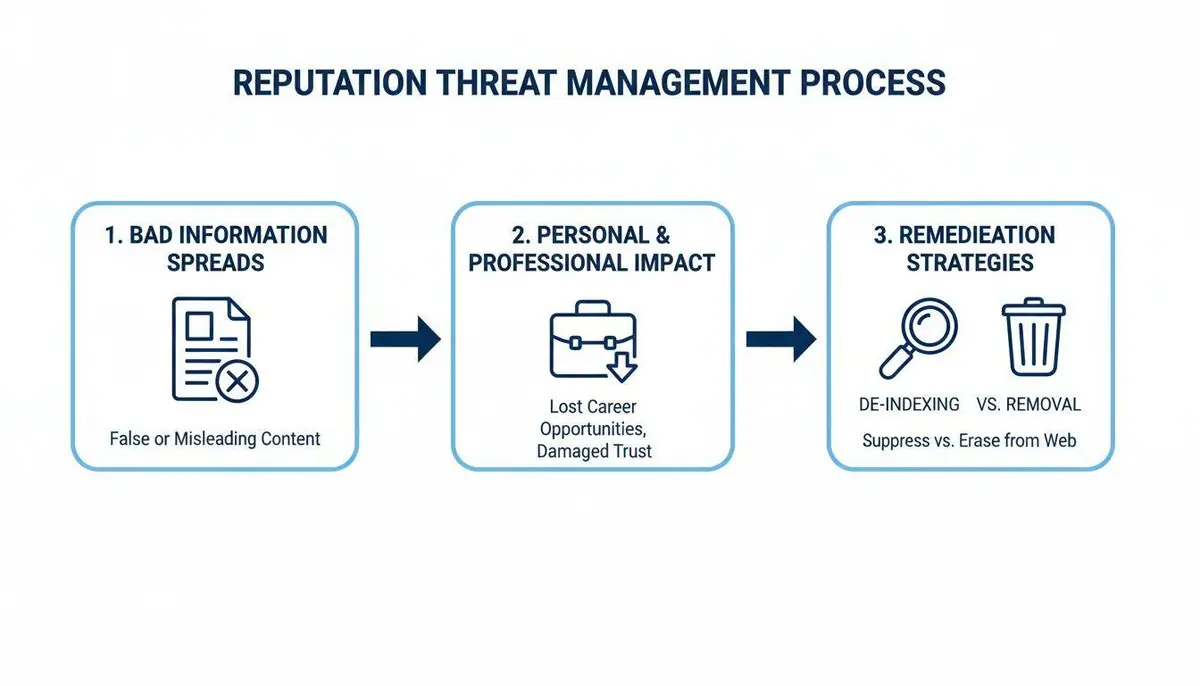
As the diagram illustrates, concealing a search result is a temporary measure. True resolution is achieved only by removing the content at its source.
A Tactical Comparison of DIY Removal Options
Before taking action, you must understand the immediate, self-service options available. Each method serves a specific function and has a different probability of success. Knowing which tool to deploy in which scenario is foundational to an effective response.
| Method | Primary Purpose | Likely Success Rate (DIY) | Best For |
|---|---|---|---|
| Google’s Removal Tools | To de-index content from search results based on policy violations. | Low to Moderate | Clear-cut violations like doxxing, non-consensual explicit images, or exposed financial/medical data. |
| Webmaster Outreach | To have content permanently deleted from the source website. | Low to Moderate | Situations where the publisher may be unaware of the harm or can be persuaded to remove the content. |
| “Remove Outdated Content” Tool | To clear Google’s cache after content has already been taken down. | High | A “cleanup” step when the source website has removed the page but it still appears in searches. |
The most effective strategy often involves a combination of these tactics. Initiate containment with Google’s tools while simultaneously pursuing source removal for a permanent resolution.
Using Google’s Own Removal Tools
Google provides several channels to request the removal of information from its search results. These are not guarantees but are your first line of defense, particularly if the content clearly violates Google’s policies. Success depends on selecting the correct tool and framing your request with precision.
The most common tool is the “Remove Outdated Content” tool. This is intended for use after content has been removed from the source website but a cached version persists in search results. By providing the URL, you prompt Google’s systems to verify the removal and update the search index.
For content that remains live, you must utilize the “Results about you” feature or other specific removal forms. These are designed for cases involving personally identifiable information (PII) and other highly sensitive data.
Google is most responsive to requests involving:
- Doxxing Content: The malicious publication of a home address, phone number, private email, or other personal contact information.
- Non-consensual Explicit Imagery: Any intimate photos or videos distributed without your consent.
- Financial or Medical Information: Leaked bank account numbers, credit card details, or confidential health records.
Pro Tip: Be precise. When submitting a request, provide both the exact URL of the webpage and the URL of the Google search result page. In your explanation, state directly why the content violates Google’s policies, referencing the specific type of PII or sensitive data exposed.
How to Contact a Webmaster Correctly
While awaiting Google’s response, you must pursue the source. Approaching the site owner or webmaster is a delicate but necessary action. The objective is not to plead, argue, or threaten, but to make a calm, professional, and legally informed request that frames removal as their most logical course of action.
Your communication should be firm and dispassionate. Introduce yourself, provide the exact URL of the content, and explain the basis for your removal request. Often, a site owner may be unaware that the content violates their own terms of service or local privacy statutes. Presenting your request as a notification of a policy violation on their part is more effective than a simple plea.
For a comprehensive playbook, review our strategic framework for removing personal information from the internet.
This approach has become increasingly critical. The rise of AI-driven search in 2026 has created a new urgency to erase negative name associations from Google. AI Overviews now summarize top search results in 30% of SERPs, which has reduced click-through rates by 35% and helps cement negative narratives at the top of the page.
Our own reputation audits reveal that 42% of executives discover negative content about themselves within the top 10 results. This is not merely an ego-driven concern; it correlates to a 19% average decline in revenue for the brands they lead.
When polite outreach fails, you have reached the point where legal pressure must commence. For executives, high-net-worth individuals, and their legal teams, understanding the available legal instruments is a core component of reputation defense. These frameworks provide the necessary leverage to compel action from search engines and hosting companies.
Pursuing legal action to remove your name from Google search results is an exercise in precision. It requires building an airtight case with substantiated evidence, proving that the continued online presence of the information is not only damaging but legally untenable.
The Right to Be Forgotten and Its Global Reach
The most prominent legal instrument is the “Right to be Forgotten” (RTBF), enshrined in the EU’s General Data Protection Regulation (GDPR). This empowers individuals within the European Union to request that search engines de-index search results that are outdated, irrelevant, or inaccurate. In such cases, Google must balance the individual’s right to privacy against the public’s interest in the information.
Based on our experience, the most compelling arguments under the RTBF center on key areas. These include the passage of time, demonstrating that the information relates to a resolved matter from years prior with no current public relevance. Another is factual inaccuracy, where you can prove the content is erroneous and damaging your reputation. Finally, there is irrelevance, where a search for your name surfaces content with no meaningful connection to you.
While the RTBF is an EU law, its principles are gaining global traction. California’s Delete Act, for example, represents a significant step toward similar rights in the U.S., granting individuals new powers to compel data brokers to delete their personal information. To understand these evolving legal standards, you can read our analysis on the Right to be Forgotten in the USA and its practical realities.
Deploying a DMCA Takedown Notice
If the problematic content is your own intellectual property (such as copyrighted photographs, stolen corporate documents, or your written work used without permission) the Digital Millennium Copyright Act (DMCA) is your most direct and potent weapon.
A DMCA takedown notice is not a request; it is a legal demand issued directly to the website’s hosting provider or the search engine.
For a DMCA notice to be effective, it must be drafted with legal precision. You must declare, under penalty of perjury, that you are the copyright owner (or an authorized agent) and that the material is being used without consent. Upon receipt of a valid notice, a hosting company is legally obligated to remove the content expeditiously to maintain its “safe harbor” status. This makes the DMCA an exceptionally fast and effective tool for clear-cut cases of copyright infringement.
A DMCA notice bypasses negotiation. It creates a legal obligation for the platform to act, shifting the burden to the infringing party to file a counter-notice if they believe they have a right to use the content.
Navigating Defamation and Libel Claims
Defamation is the most complex legal avenue for content removal. Here, the burden of proof is on you to demonstrate that a publisher has disseminated a false statement of fact that has caused material harm to your reputation.
This burden is particularly high for public figures, who must often prove “actual malice”, that the publisher knew the statement was false or acted with reckless disregard for the truth.
Mere offense or embarrassment is insufficient. To compel a removal based on defamation, you must construct an irrefutable case, typically requiring a court order that declares the content defamatory, clear evidence that the statements are false facts rather than protected opinion, and tangible proof of reputational or financial damages.
Without a court order, most U.S.-based search engines and hosting companies will refuse to adjudicate defamation claims, citing their immunity under Section 230 of the Communications Decency Act. As you weigh legal options, it is useful to consider how legal matters impact an online presence in other contexts, such as how criminal records impact your digital footprint and the process of record suspensions. Such cases highlight how one’s legal status can shape public perception online.
Advanced Tactics for Source Removal and De-Indexing

The effort to remove your name from Google search results involves two distinct strategic paths: de-indexing and source removal. While often used interchangeably, these are fundamentally different approaches. The choice between them is a critical decision.
De-indexing is the process of requesting that Google hide a webpage from its search results. The content itself is not removed; it remains on the original website, accessible via a direct link. Source removal is the definitive action, the permanent deletion of the damaging content from the website where it was first published.
Selecting the appropriate strategy is entirely dependent on the specific circumstances of your case.
De-Indexing: The Surgical Strike
De-indexing should be viewed as a rapid-response containment measure. It is the tactic employed when speed is paramount, such as during an unfolding public relations crisis or the recent leak of sensitive information where immediate action is required to stanch the damage.
The objective is not to erase the content permanently but to render it invisible to the 99% of individuals who rely on search engines for information. This is an act of containment, not of complete remediation.
De-indexing is our preferred strategy in scenarios such as a sudden negative press story, where de-indexing the article provides crucial time to formulate a defense without widespread public scrutiny. It is also used for leaked confidential information, where a swift de-indexing request can prevent viral dissemination among employees, investors, or the media. Finally, it is suitable for outdated but non-defamatory information you prefer to have fade into obscurity.
This process focuses on severing the link between your name and the harmful page within Google’s index. For a technical breakdown, we have prepared a strategic guide to understanding URL de-indexing.
Source Removal: The Permanent Solution
While de-indexing provides a tactical advantage, source removal delivers finality. It is the only method that guarantees damaging content is gone permanently. This strategy is reserved for situations where the information is so toxic that its continued existence online, in any form, presents an unacceptable risk.
Situations demanding source removal are invariably more severe and require a more assertive and comprehensive plan.
Source removal is not about hiding a problem. It is about eliminating it. This is the only path to true resolution and ensures the content cannot be re-indexed or resurface on a mirror site.
This is a non-negotiable approach for several key scenarios: defamatory blog posts attacking your character or business must be removed at the source to prevent lasting reputational harm; non-consensual intimate imagery (NCII) requires complete deletion from the hosting server without exception; and persistent copyright violations demand source removal to end a futile cycle of de-indexing.
Achieving source removal often requires direct negotiation with webmasters, publishers, or their legal counsel. It involves identifying clear violations of their terms of service, constructing a solid legal case, and applying pressure when necessary. This is where professional expertise becomes essential, as we not only secure the removal but also actively monitor for its reappearance.
When DIY Isn’t Enough: Knowing When to Call in the Pros
Attempting to resolve a serious online reputation threat with public-facing tools is a significant gamble. While DIY methods may suffice for minor, isolated issues, they have clear limitations. For high-profile individuals or businesses, there is a point where self-service becomes not just ineffective, but dangerous.
That line is crossed when you face complex, aggressive, or persistent attacks, not an outdated article, but coordinated smear campaigns or deeply embedded negative content that public removal forms were never designed to address. When the stakes are this high, there is no margin for error.

Scenarios That Demand an Expert
The key skill is recognizing when a manageable problem has become a crisis. Certain situations are beyond the scope of polite emails and standard Google forms. These signs indicate it is time to engage a professional firm.
You require expert intervention when facing coordinated smear campaigns involving multiple negative articles, fake reviews, or defamatory social media posts appearing simultaneously. Other indicators include anonymous or unresponsive sources hiding behind proxy servers, making contact impossible; persistent negative news from established media outlets protected by law; and content posted on the dark web, on platforms designed to be immune to takedown requests.
These problems do not resolve themselves. They demand a sophisticated strategy that combines legal knowledge, technical acumen, and established industry relationships.
What a Specialized Firm Brings to the Table
A dedicated content removal firm operates outside the constraints of public channels. Our function is to bypass slow, often futile processes and proceed directly to targeted action. This is not a matter of magic, but of proven methodologies and deep expertise.
This expert-led approach is crucial as search engines constantly evolve. Google’s March 2026 Spam Update, for example, rolled out in a record 19 hours and 21 minutes and fundamentally altered how the algorithm treats certain content. Google’s own reports for 2025-2026 show it actioned over 5.7 billion URLs for policy violations, with 28% of those cases involving personal defamation where names were linked to false news or mugshots.
Despite these enforcement actions, our internal data shows that DIY removal attempts fail in over 60% of these complex cases. In contrast, our team at ContentRemoval.com maintains a 92% success rate for removing leaked images and arrest records, often initiating the process within 24-48 hours. You can find further analysis on how Google’s updates impact search results on breaklineagency.com.
Professional intervention is an investment in a guaranteed outcome. It is the decision to resolve a problem discreetly and permanently, rather than risking public escalation and failure.
Our capabilities are founded on three pillars:
- Legal Expertise: We do not merely send requests; we construct legal arguments. We leverage precise violations of terms of service, copyright law (DMCA), and local privacy rights to compel action from hosts and registrars.
- Proprietary Technology: Our systems operate 24/7 to identify new threats as they emerge and prevent removed content from being republished on mirror sites or new domains, a common failure point in DIY efforts.
- Established Relationships: We maintain direct lines of communication with the compliance and legal departments at major hosting companies, search engines, and social media platforms. These relationships enable us to escalate issues and secure removals far more rapidly than a standard user can.
Engaging a professional firm is a business decision, a calculation of the return on investment when your reputation, career, or security is at stake. It provides a level of certainty and speed unattainable through individual effort.
Here are answers to the most critical questions clients face when seeking to remove their name from Google search results.
How Long Does This Actually Take?
The timeline varies significantly based on the nature and location of the content. A “Right to be Forgotten” request in Europe may take weeks or months for Google to adjudicate. Conversely, a properly executed DMCA takedown notice for copyright infringement can result in content removal within days.
The primary challenge arises with complex situations: entrenched defamatory posts, coordinated smear campaigns, or hostile websites. In these instances, standard channels are often inadequate.
Professional intervention fundamentally alters this timeline. By leveraging specialized legal and technical protocols, we frequently bypass standard queues and secure removals within 24-48 hours. When a reputation is under active assault, this speed is paramount.
Can You Really Delete Something “Permanently”?
Absolute, permanent deletion from every corner of the internet is a practical impossibility. Once online, information can be copied, cached, and archived. The viable objective is not digital extinction but complete and thorough removal from public view, rendering it effectively invisible.
This is a two-part mission. First, source removal requires getting the content deleted from its original website. This is the foundational step. Second, de-indexing ensures Google and other search engines erase the content from their results and cached memory.
A successful strategy must also include continuous monitoring to detect and neutralize any reposts or mirror sites. Without this final step, you risk engaging in a futile cycle of re-emerging negative content.
Should I Hire a Lawyer or a Content Removal Firm?
The choice depends entirely on your objective. A traditional lawyer is essential if your goal is to file a formal lawsuit, such as for defamation to obtain a court order. However, litigation is a public process, can be exceedingly slow, and often draws more attention to the very material you seek to suppress.
We employ a different methodology. At ContentRemoval.com, our exclusive focus is on fast, discreet takedowns. We do not operate through public court filings. Instead, we utilize a synthesis of legal expertise, technical strategies, and direct negotiation with web hosts, domain registrars, and platform administrators.
By focusing on levers such as terms of service violations, we can often resolve matters more quickly and with greater confidentiality than the conventional legal system permits. Our approach is engineered for individuals who require a problem to be solved with speed and discretion.
When your reputation is at stake, you require a team that acts decisively. ContentRemoval.com delivers the specialized capabilities needed to clear your digital footprint and protect your name. Schedule your confidential assessment today and let us begin.
Frequently asked questions
What is the difference between de-indexing and source removal?
De-indexing asks Google to hide a specific URL from its results while the content stays live on the original site. Source removal compels the publisher to delete the article, post or record entirely, so it cannot be re-indexed or shared. The article recommends de-indexing for rapid containment and source removal for anything defamatory, intimate or persistently republished.
How do I ask a website owner to remove content about me?
Write a calm, professional request that identifies yourself, gives the exact URL and states the basis for removal, ideally framed as a notification that the content breaches their own terms of service or applicable privacy law. Do not plead, argue or threaten. Many owners are unaware of the violation and will act when it is presented that way.
Should I hire a lawyer or a content removal firm to clear my name from Google?
A lawyer is essential if the goal is a lawsuit and court order, such as for defamation. Litigation is public and slow, and can draw more attention to the material. A removal firm focuses on discreet takedowns through terms of service violations, DMCA and direct negotiation with hosts and platforms. Many clients use both, depending on the objective.